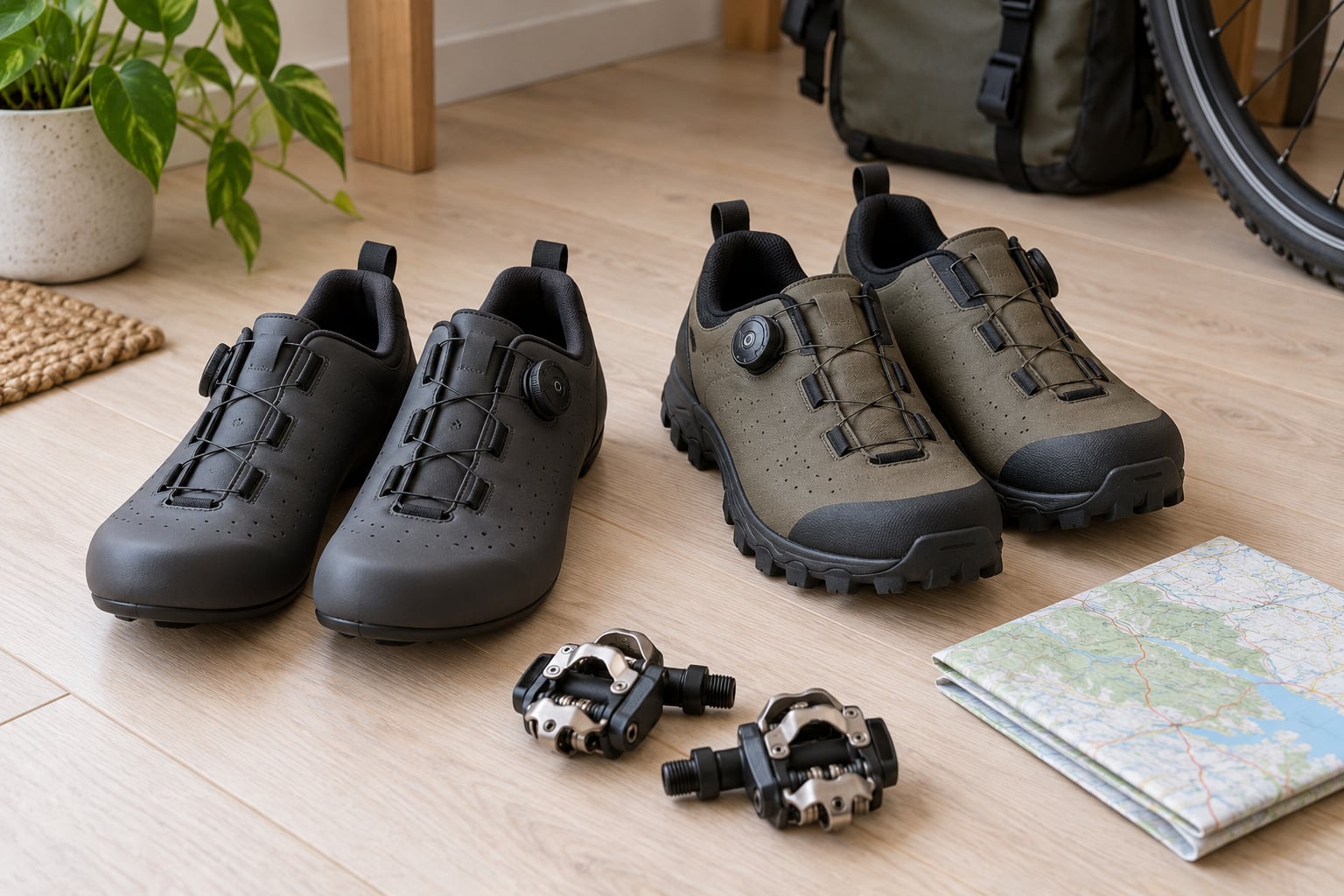
Road shoes vs mountain bike shoes for touring comes down to how much time your feet spend off the bike. Road shoes put more power into each stroke and handle poorly on foot; mountain bike shoes walk comfortably, shed debris and wear out slower, and give up very little pedalling efficiency once you are used to clipless.
If your tour is four straight days of tarmac between hotels with an espresso stop at the end of each one, road shoes are fine and you will notice the stiffness. If your route crosses gravel, involves pushing a loaded bike up a loose grade, or assumes you will walk two kilometres into a campsite, mountain bike shoes or a walkable touring shoe are the better tool.
Most of the argument online is fought over pedalling efficiency, which is the least important variable on a tour. Forums like CyclingUK and Road Bike Review keep landing on the same conclusion: a recessed two-bolt cleat is what makes a shoe tolerable to stand in, and once you are already riding clipless, the efficiency gap between a stiff road sole and a mountain bike sole is small enough that most tourers stop noticing it.
Table of Contents
- Road Shoes vs Mountain Bike Shoes for Touring at a Glance
- Pedaling Efficiency and Cleat Performance
- Road shoes vs mountain bike shoes for touring: efficiency on the bike
- Walking Comfort and Stop-Frequency Practicality
- Durability, Foot Protection, and Weather
- Ventilation, Bulk, and Bike-Packing Comfort
- Fit, Adjustability, and Pedal Compatibility
- Which Should You Choose?
- Frequently Asked Questions
- Are wider mountain-bike shoes better for long road tours?
- Can I use road cycling shoes on gravel touring routes?
- Should touring shoes have stiff or flexible soles?
- How much do I need comfortable shoes to be for bike touring?
- Should I choose touring shoes based on the type of bicycle pedal?
- Conclusion
Road Shoes vs Mountain Bike Shoes for Touring at a Glance
The table below is the version to screenshot. Road shoes favor paved efficiency; mountain bike shoes favor mixed-surface practicality.
| Criterion | Road shoes | Mountain bike shoes |
|---|---|---|
| Best use | Paved touring, fast group rides, races | Mixed road and gravel, bikepacking, loaded tours |
| Pedaling efficiency | Highest, stiffest sole | Slightly softer, negligible once accustomed |
| Walking comfort | Poor, protruding cleat catches on floors and steps | Good, recessed cleat keeps the foot flat |
| Durability | Upper wears through at the toe and heel grip | Rubber lugs and reinforced panels last longer |
| Ventilation | Good, minimal upper and tongue | Good, mesh panels common but bulkier |
| Bulk | Compact, easy to pack | Wider and taller, more volume per shoe |
| Cleat options | Three-bolt road cleat, wider cleat choice | Two-bolt SPD cleat, walkable cleats available |
| Foot protection | Minimal, thin toe and no side panels | Toe bumper and side panels against rocks |
| Likely touring fit | Snug, glove-like, less toe room | Firmer, roomier toe box, suits swelling feet |
One column is not simply better. A shoe that survives a season of loaded touring and walk-outs is worth more than one that saves a few watts.
Pedaling Efficiency and Cleat Performance
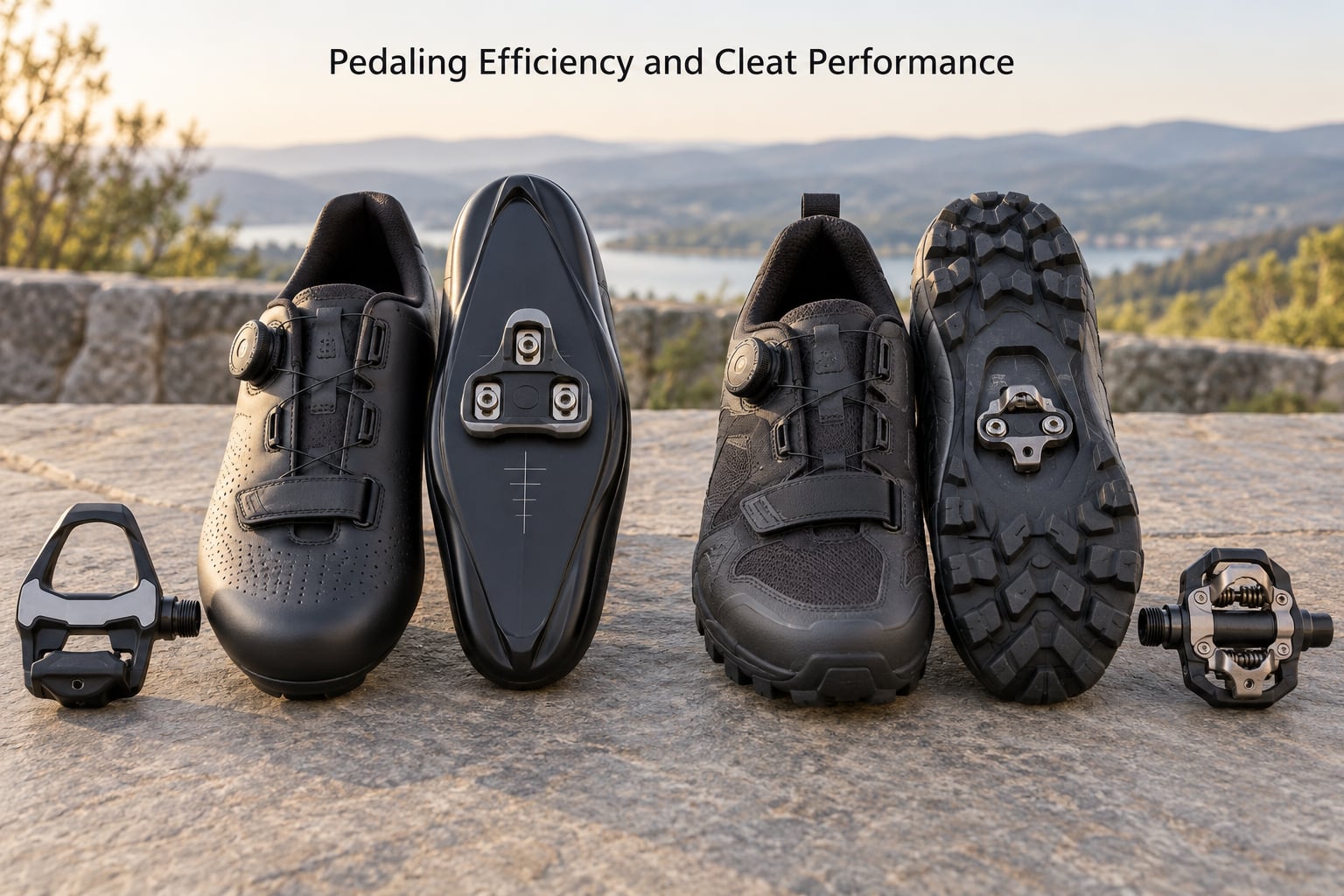
Road shoes get their efficiency from a stiff sole plate that resists foot flex, so more of your leg force goes forward instead of into bending the forefoot. Mountain bike shoes trade a small amount of that for a sole that flexes slightly, plus a recessed cleat area and a rubber lug pattern that holds on loose ground.
Engagement works the same way in both systems. Your cleat hooks into the pedal body in three positions, and pulling up hard before the stroke keeps the shoe locked through the top of the pedal rotation. One bikepacker put it plainly in a forum thread: with clipless you get the push forward and pull back part of the stroke, and much of that disappears on a flat pedal.
Cleat choice matters more than the shoe label on a tour. A wide three-bolt road cleat has a larger contact patch and spreads pedal pressure, but it hangs below the sole and picks up everything it touches. A two-bolt SPD cleat sits inside the shoe’s sole channel and can be mounted in a recessed position so the rubber around it stays flat against the ground.
Road shoes vs mountain bike shoes for touring: efficiency on the bike
On smooth pavement the gap between a stiff carbon-soled road shoe and a mountain bike shoe is measurable in a lab and mostly invisible from the saddle on a fully loaded bike. Riders who switch to mountain bike shoes for touring usually report one adjustment period and then no loss at all.
Either type can lose efficiency for the same reason: poor fit. A shoe that is too long lets the heel lift and the cleat sit behind the pedal spindle, which scrubs power on every stroke. Set cleat tension before the trip, tighten the closure so the heel stays down, and most of the theoretical difference disappears.
Walking Comfort and Stop-Frequency Practicality
Mountain bike shoes walk better mainly because of cleat position, not because the sole is softer. A recessed SPD cleat leaves the bottom of the shoe flat, so you can stand, walk and climb stairs normally. A protruding road cleat rocks your weight forward and catches on anything you step over.
Count the stops on a typical tour day and the arithmetic gets easy. Cafes, campsites, town centres, museums and roadside water points add up to a few kilometres of walking a day without anyone planning it. Add a mechanical failure and that figure can triple, because a taco’d wheel or a blown tyre on a rural road means walking until someone has a spare.
Watch out for the trap here. Plenty of mountain bike shoes have a rigid plate and a thin, slick plastic outsole that grips pedal bodies well and loose gravel badly. Wide is not the same as walkable. A shoe with actual rubber lugs and some forefoot flex is the one you want if the trip includes hike-a-bike sections.
Riders touring in road shoes often add rubber cleat covers, which slice over steps and clean floors rather than hooking them. That is a genuine improvement and it makes cobbles tolerable. It does nothing for a five-kilometre walk-out.
Durability, Foot Protection, and Weather
Mountain bike shoes are built for contact with the world. Rubber lugs shed mud, toe bumpers stop rocks, and side panels take the hits that come from a loaded pannier or a handlebar bag swinging into your foot. Road shoes put a smooth, nearly slick sole against the ground and offer almost no reinforcement where a stray rock would land.
Water is the other side of the argument. A touring shoe with a nylon plate and mesh upper will dry by the next morning if you stuff it loosely and let air move through it. A waterproof road shoe keeps rain out and traps the same damp inside, because water gets in over the cuff and stays there. On a multi-day trip in changeable weather, quick drying usually beats waterproofing.
Mud is where cleat systems separate cleanly. A three-bolt road cleat has no mud clearance and packs solid on the first wet descent. Two-bolt SPD cleats, including the small walkable ones, release grit far more easily, and steel versions survive debris that would destroy plastic cleats, at the cost of picking up grease on anything they touch.
For a long tour, the practical trade is simple: accept scuffed toes and keep the shoe dry, or keep the toes pristine and dry your feet every evening anyway.
Ventilation, Bulk, and Bike-Packing Comfort
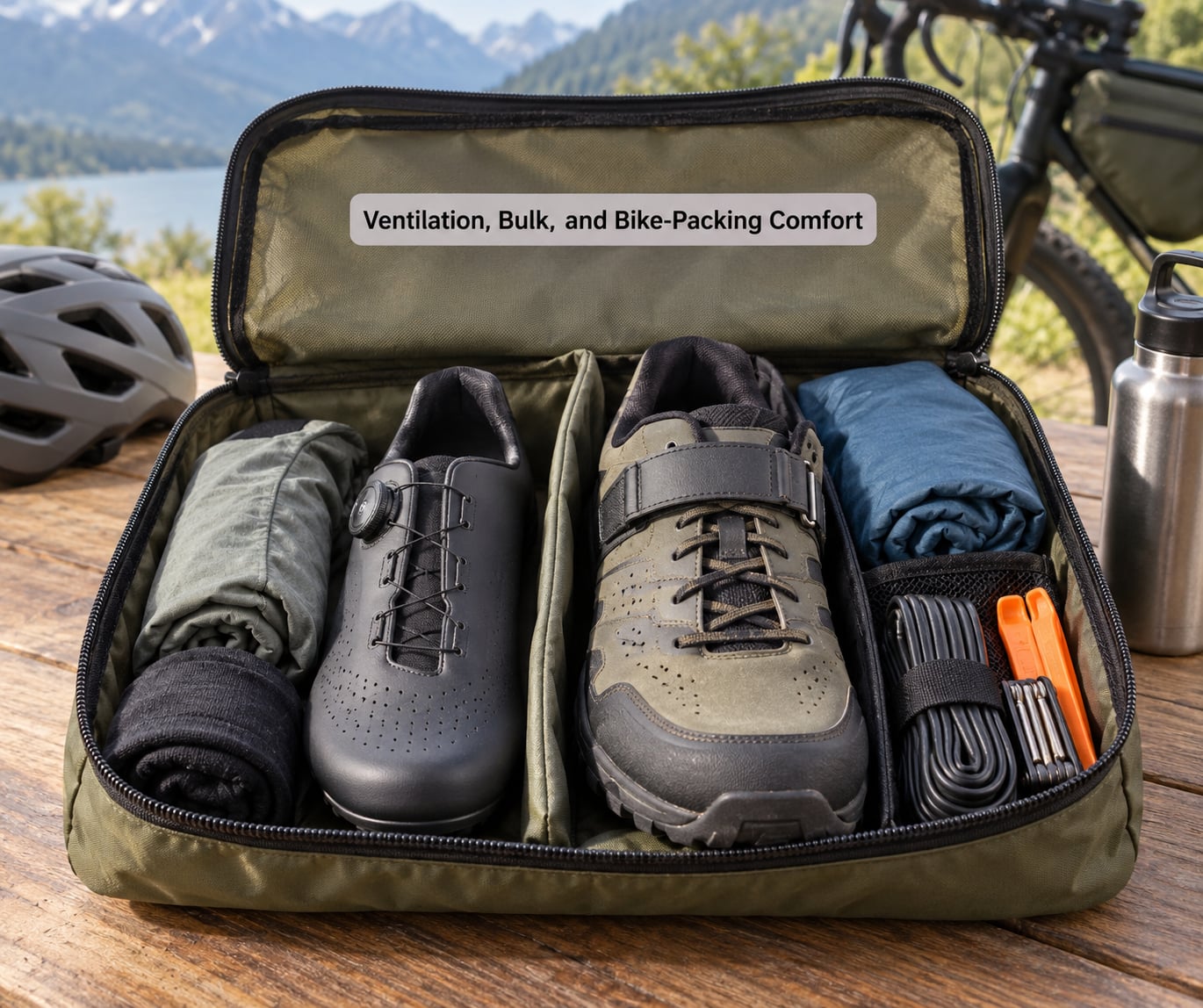
Road shoes are smaller in almost every dimension. Thin uppers, low tongues and slim soles mean a pair disappears into a pannier. Mountain bike shoes carry a lugged outsole, thicker padding and extra structure, and two pairs of them add real volume to a fast-packing kit.
On a bike with panniers and a seat bag, that bulk barely registers. It becomes obvious on a bikepacking setup where every litre counts, especially on a frame bag or a top tube bag that is already holding your rain gear and food.
Ventilation is a wash in hot weather. Road shoes breathe well because there is very little material to breathe through. Mountain bike shoes usually add mesh panels and vents over the toes, so they cool comparably while keeping sun glare and trail debris out. A nylon-plate touring shoe sits in the middle: stiffer than a mountain bike shoe, lighter and less ventilated than a race road shoe.
Fit, Adjustability, and Pedal Compatibility
Fit matters more than the road versus mountain bike label. Road lasts are shaped for a snug, glove-like feel with minimal toe room; mountain bike lasts are firmer through the midfoot with more space ahead of the toes, and that extra room suits feet that swell over several days of riding.
Check the areas that cause trips to fail. Heel lift makes your cleat sit off the spindle and costs power. A shallow instep plus a tight closure makes your foot slide forward into the toe box. Toe room that is too tight shows up on day three as a hot spot that turns into a blister by day four.
Adjustability covers the gap between the two categories well. Laces disappear when they swell, BOA dials give even micro-adjustment, ratchet buckles hold a precise setting all day, and hook-and-loop straps are easy to change on a stop. Any of them works, and all of them work better when you set them the same way every ride.
Compatibility is the hard constraint. Three-bolt road cleats do not fit two-bolt SPD shoes, and the reverse is also true. Check what your touring bike’s pedals take before you buy anything, and if you ride both a road bike and a mountain bike out of the same pannier, dual-sided pedals or a pair of shoes that suit both is the answer.
Wide feet are the most common unresolved complaint in cycling shoe threads. Riders on forums keep pointing each other to Lake and Bont for lasts that run wide and true, and to women’s low-volume lasts for narrower feet. Try shoes late in the day, wear the socks you will tour in, bring your own insoles if you use them, and expect to size down from your everyday shoe.
Which Should You Choose?
Pick road shoes when the surface is paved end to end, your days are long on the bike and short off it, and you already wear clipless comfortably. Pick mountain bike shoes when gravel, dirt, loose grades or frequent stops are part of the plan.
- Paved road touring with hotel stops: road shoes are acceptable, and a touring shoe with a nylon plate is the version I would actually pack.
- Mixed road and gravel: mountain bike shoes or a walkable touring shoe.
- Frequent cafe, campsite and sightseeing stops: mountain bike shoes, ideally with deeper rubber lugs.
- Lightweight bikepacking where pack volume is tight: the most compact shoe that still walks well, and travel light everywhere else.
- Entry-level riders moving to clipless: mountain bike shoes, because the cleat stays recessed and the fit is more forgiving.
- One rider switching between a touring bike and a mountain bike: two-bolt SPD shoes, or dual-sided pedals with two-bolt cleats on the clipless side.
A short checklist covers the rest. Estimate your daily off-bike distance and how many stops it involves, then match the cleat system to your pedals, then the pedals to your terrain, then the shoe class to the walking. Decide whether you are carrying one pair or two, try the fit late in the day with your own socks, set cleat tension at home, pack cleat covers and a spare cleat, and break in stiff soles on the first two days of the trip rather than the first two hours.
Frequently Asked Questions
Are wider mountain-bike shoes better for long road tours?
Usually, yes, because comfort on a tour depends on how you feel standing and walking rather than on pedalling power. Mountain bike shoes also have a roomier toe box, which suits feet that swell over several days. The exception is a rider whose only off-bike time is a short stop, where the stiff road sole feels better on long seated hours.
Can I use road cycling shoes on gravel touring routes?
You can ride them, and plenty of people do on well-maintained gravel. Protruding road cleats collect mud with no way to clear it, and a smooth sole offers no grip when you push a loaded bike on a loose grade. If gravel is more than a short diversion on your route, choose a mountain bike or touring shoe with a recessed two-bolt cleat and rubber tread.
Should touring shoes have stiff or flexible soles?
Stiffer soles transfer more power and hold the foot steady, while more flexible soles are easier to walk in and less likely to blister your heels. Most touring riders land in the middle with a nylon-plate touring shoe, which is firm enough to pedal efficiently and soft enough to hike a few kilometres. Very rigid carbon plates suit racing more than multi-day riding.
How much do I need comfortable shoes to be for bike touring?
Comfortable enough for all the walking your trip realistically involves, including the walk you have not planned yet. Cafes, campsites and roadside stops quietly add kilometres every day, and a mechanical failure can multiply that. Walk in your intended shoes around a store or a market before the trip and treat any rubbing or pressure as a problem to fix.
Should I choose touring shoes based on the type of bicycle pedal?
Yes, and this should be your first filter, because cleat systems do not cross over. Three-bolt road cleats and two-bolt SPD cleats fit different shoes and different pedal bodies. If you are still choosing pedals, pick the pedal type first, then find touring shoes in that cleat pattern, then choose the model that suits your surface and walking.
Conclusion
Road shoes suit paved, stop-light touring where speed and stiffness come first. Mountain bike shoes suit mixed terrain, frequent stops, loaded riding and any trip where you might have to walk a long way, at a cost in bulk that only matters on a minimal bikepacking kit.
Whatever you choose, work backwards from the trip: confirm the cleat pattern your pedals take, estimate your off-bike distance, then fit the intended pair late in the day with your touring socks. Ride a long local loop in them before you commit to a week of touring, because a shoe that is wrong will only get worse by day three.