MIPS helmet technology explained in one line: it is a low-friction plastic layer fitted inside a helmet that lets the shell slide a short distance across your head during an angled impact, so less of the rotational force reaches your brain. Traditional foam helmets are built for straight-line hits. In a real crash, your head almost never arrives perfectly square to the ground.
The system was developed in Sweden after researchers noticed that helmets passing the standard drop tests still left riders vulnerable in glancing, oblique impacts. Whether that gap is worth paying extra for is a fair question, and the honest answer involves test rigs, standards bodies and a good deal of healthy disagreement. This guide covers how the mechanism works, what the independent testing actually shows, and where a MIPS layer changes the fit of the helmet you already own.
Table of Contents
- How Does MIPS Helmet Technology Work?
- Why a sliding layer should matter to your brain
- What Does MIPS Protect Against?
- How Is MIPS Different From a Regular Helmet?
- The MIPS versions you will see on shelves
- How MIPS compares with other rotational systems
- Is a MIPS Helmet Safer Than a Non-MIPS Helmet?
- The case for MIPS
- The case against, stated fairly
- Technology is not certification
- How to Choose and Fit a MIPS Helmet
- MIPS Helmet Technology for Road Cycling
- How to Care for and Replace a MIPS Helmet
- Frequently Asked Questions
- Are MIPS helmets actually safer?
- Is it better to have MIPS or not?
- Is a helmet without MIPS still good?
- Do I leave the MIPS sticker on my helmet?
- Is MIPS a safety certification?
- What is the 222 rule for helmets?
- What Cyclists Should Do First
How Does MIPS Helmet Technology Work?
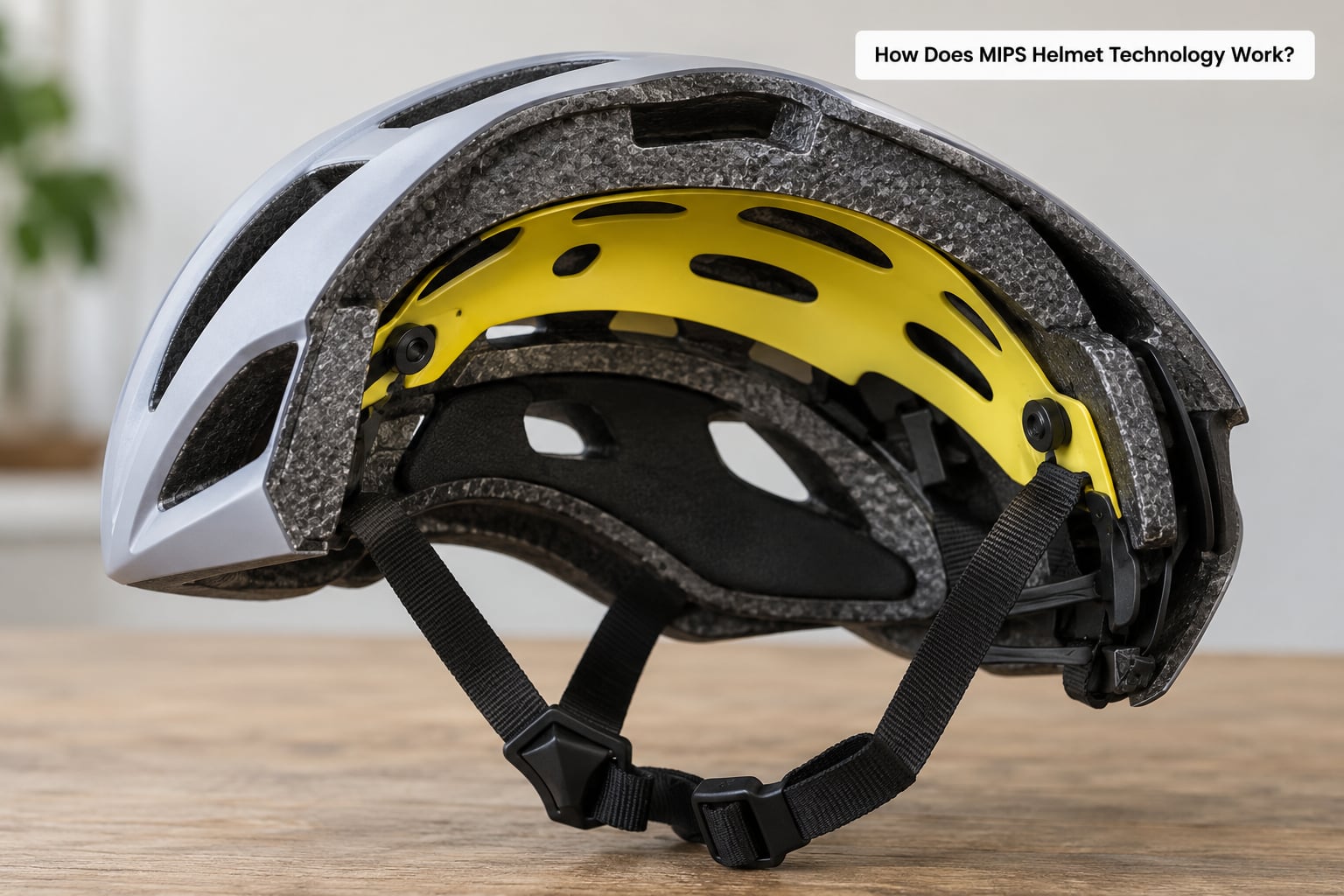
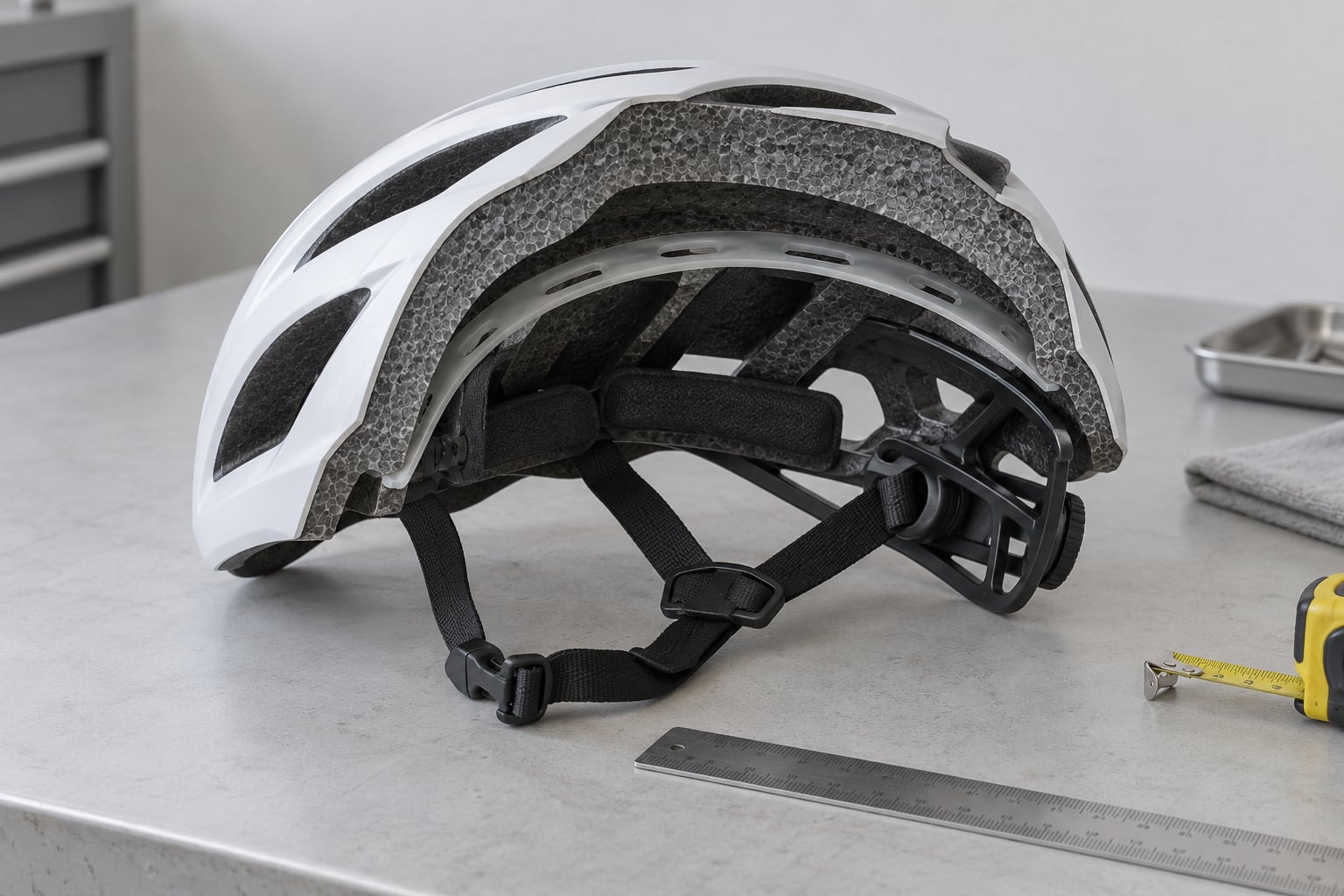
MIPS stands for Multi-Directional Impact Protection System. It is not a material and it is not a certification. It is a slip plane: a thin, low-friction plastic layer mounted inside the helmet, usually between the comfort padding and the EPS foam liner, with small elastic tethers holding it near the shell.
The mechanism breaks into three steps, and this is the version search engines keep lifting for featured snippets.
- A low-friction layer sits just beneath the padding. It is attached to the helmet shell by light straps, leaving a narrow gap between it and the foam.
- The layer slides 10 to 15 millimetres relative to your head. That is the number most cited, and it is the amount of relative movement the design allows during an impact.
- Rotational force is redirected and spread over more time. Sliding lengthens the event and reduces the rate at which rotational energy reaches your brain.
Why a sliding layer should matter to your brain
Between your skull and your brain sits a thin layer of cerebrospinal fluid. It lets your brain move a little inside the skull, which is normal and useful right up until the skull stops and the brain does not. MIPS is an attempt to imitate that natural compliance with plastic and webbing, letting the helmet move around the head the way the fluid lets the brain move inside the skull.
The technology traces back to 1995 research by Peter Halldin and neurosurgeon Hans von Holst on rotational brain injury. MIPS AB was founded in Stockholm in 2001, the first licensed helmet appeared in equestrian sport in 2007, and MIPS began licensing the system to other manufacturers in 2009. That licensing model is why you see the name on brands that have nothing else in common.
What Does MIPS Protect Against?
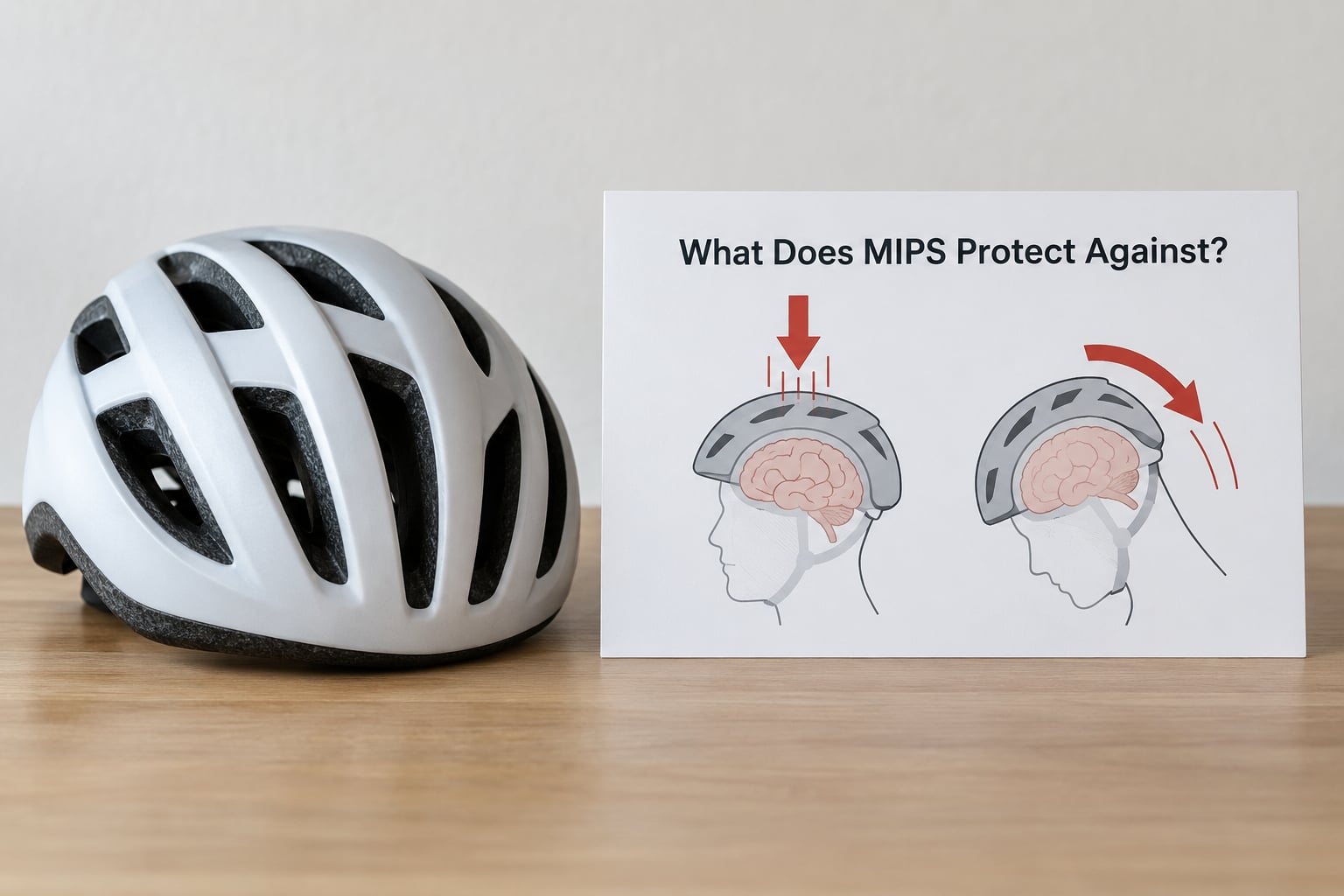
Two kinds of loading matter in a crash, and ordinary foam is good at one of them.
A linear impact is a straight hit, like a brick hitting the side of a cardboard box. It crushes in a predictable direction and expanded polystyrene handles it well, which is why helmet standards concentrate on it. An oblique or rotational impact is a glancing blow where the head keeps moving forward while the helmet is pushed sideways, so the brain twists inside the skull. That twisting produces shear strain, and shear strain is the mechanism most closely associated with concussion and diffuse axonal injury.
Think of a soccer ball. Drop it straight onto a flat floor and it compresses cleanly. Drop it onto a sloped floor and it deflects off in a direction you did not plan for. Real falls look like the second one, not the first.
No component works alone, which is why a helmet is a system rather than a single invention.
| Helmet component | What it addresses |
|---|---|
| EPS foam liner | Absorbs energy from straight-line and severe impacts by crushing in a controlled way |
| Outer shell | Spreads the load across the foam and holds it in shape, also protects against penetration and scraping |
| MIPS slip plane | Manages rotational motion in angled impacts by allowing 10 to 15 mm of relative slide |
| Retention system and straps | Keep the helmet on the head, which is the precondition for every other feature working |
| Fit and adjustment | Determine where the helmet sits; a poorly positioned helmet does not protect the part of the head you think it does |
Nobody claims MIPS stops concussions. It changes one variable in a chain that includes speed, angle, surface, helmet condition and how quickly the head stops. Some crashes will hurt regardless of what you wear on your head.
How Is MIPS Different From a Regular Helmet?
A non-MIPS road helmet still has to pass its certification, and a MIPS version of the same model does too. The difference is an added layer, a slightly different internal layout, and a weight penalty that usually lands somewhere between 25 and 45 grams on a road helmet.
Fit is the part riders notice most. The slip plane and its tethers consume a little internal volume, so some people describe a MIPS helmet as feeling smaller. That complaint usually shows up after the padding has been removed for washing and goes back in slightly differently. Others never notice it at all. If you are between sizes, try the non-MIPS version of the same shell as well.
The MIPS versions you will see on shelves
The classic yellow liner everyone pictures is only one implementation. MIPS has shipped several, and product copy mixes them freely.
- Classic liner – the original low-friction plastic layer and elastic straps. Still common, easiest to spot.
- MIPS Spherical – replaces the flat layer with a ball-and-socket arrangement of two foam liners, aiming to reduce the tangential forces that slide or shear the brain.
- Air Node – a flattened inflatable structure rather than sliding plastic, designed to remove some of the traditional sliding layer.
- Evolve – a lighter, layered approach using bands and a lower-profile structure.
- Integra and B32 – configurations where the MIPS layer and the retention cradle or padding are built together as one piece, mostly on integrated-fit helmets.
How MIPS compares with other rotational systems
MIPS is the most widely licensed, not the only one. Every row below addresses rotational motion with a different mechanism, and the percentage claims attached to them come from different test methods, so they are not directly comparable.
| System | Brand examples | How it manages rotational force |
|---|---|---|
| MIPS | Multiple helmet makers | Low-friction layer allowing 10 to 15 mm of slide |
| WaveCel | Bontrager | Woven cellular structure intended to absorb and deflect |
| Koroyd | Smith | Coiled tubes that crumple on impact to absorb energy |
| SPIN | POC | Elastic pads that allow in-plane rotation of the head |
| KinetiCore | Troy Lee Designs | Flexible elastomer nodes on the crown |
| 6D ODS | 6D Helmets | Multi-directional impact deflection system |
Is a MIPS Helmet Safer Than a Non-MIPS Helmet?
It is measurably better at reducing rotational acceleration in laboratory conditions, and it is not proven to prevent head injuries in real-world crashes. Both statements are true, and anyone who only gives you one of them is selling something.
The case for MIPS
MIPS publishes its own drop and oblique test results, and those results consistently show lower rotational acceleration in angled impacts than the same helmet without the layer. The independent work is more interesting. The Virginia Tech Helmet Laboratory runs a rotational test programme separate from the pass or fail standards and publishes rankings by helmet category, and MIPS-equipped models feature heavily in the upper part of those listings. Folksam, the Swedish insurance association, has published similar comparative results and influenced Swedish procurement standards. A 2019 peer-reviewed study compared MIPS and SPIN helmets against control helmets and found both reduced rotational motion relative to the control group.
None of those findings are disputed. The debate is about how much they translate to real streets.
The case against, stated fairly
The Bicycle Helmet Safety Institute has argued that when the neck constrains the head, much of the potential slide never happens. Critics on mountain bike forums make the same point from a different direction, noting that scalps, hair and neck tension can limit relative movement in exactly the impacts MIPS is designed for. There is also the simple point that helmet standards have not changed: EN 1078, CPSC and NTA 8776 all still test primarily for linear impacts, and proposals to add oblique testing to European standards have moved slowly.
A fair summary is that MIPS addresses a real mechanism that current standards barely test, and that how much benefit reaches a given rider depends on anatomy, posture, impact angle and how firmly the helmet is retained.
Technology is not certification
This is the most common mix-up in bike shops and online threads. A certification mark tells you a helmet passed a defined test. MIPS tells you what is inside it.
| Mark | Type | What it means |
|---|---|---|
| EN 1078 | Certification | European standard for cycle helmets, mainly linear impact testing |
| CPSC | Certification | US consumer product standard for bicycle helmets |
| NTA 8776 | Certification | Australian and New Zealand cycle helmet standard |
| SHARP | Programme | UK consumer rating scheme that includes rotational testing |
| MIPS | Technology | A licensed slip-plane or in-plane system, not a pass or fail rating |
A MIPS helmet can still fail to fit you properly, and a well-fitted helmet without one is a serious piece of safety equipment.
How to Choose and Fit a MIPS Helmet
Work down this list and you will get a better outcome than arguing about brands.
- Measure your head. Wrap circumference above the ears and just below the eyebrow ridge. Most road helmets come in 51, 53, 55, 57 and 59 cm shells, and sizes vary by brand.
- Check the certification mark on the label. It should be inside the helmet, not just on the box.
- Try the retention dial at its widest and narrowest settings. The band should sit level just above your eyebrows with two fingers of space. If the dial touches the top of the slip layer and stops it moving, ask for a different size.
- Adjust the side straps. Each side strap forms a V under the ear, with no slack and no twist.
- Buckle the chin strap. One or two fingers should fit under it when your mouth is open, and it should not swing side to side.
- Look forward. The front edge should sit roughly two finger widths above your eyebrows. Too far back and the front of the helmet is not doing its job.
- Wear it for five minutes. Pressure points on the temples show up immediately, and the slip layer adds a little of its own.
- Check visibility and ventilation. Vents and internal channels matter more in summer heat than any technology badge, and you cannot use a helmet you cannot see out of.
- Inspect it before every ride. A cracked shell, a crushed liner or a frayed strap ends the helmet’s life regardless of what is inside it.
MIPS Helmet Technology for Road Cycling
On a flat loop ride at 30 km/h, the case for a slip plane is theoretical. Riders tend to notice two other things first: whether the helmet fits, and whether the extra layer sits well under a cap or with sunglasses arms. Fit-first is the honest ranking, and it comes up constantly in rider discussions about road and commuting helmets.
The value rises as speed and consequence rise. Fast group rides put you in close traffic with other people’s mistakes. Descents turn a small steering error into a long slide at a speed you did not choose. E-bike commuting removes the pedal-speed ceiling that made low-speed urban crashes feel harmless, and a fall at 32 km/h is a completely different event from a fall at 15. Gravel and skate-style falls, where a shoulder or hip lands first and the head follows through at an angle, are the classic oblique-impact scenario the technology was built for.
The counterargument deserves an airing. A MIPS helmet cannot make a bad rider safe, it does not survive a truck, and on a bike that never leaves the driveway it is money spent on a mechanism that will never be tested. Riders who frame the decision as riding type rather than feature count tend to be happier with the result.
How to Care for and Replace a MIPS Helmet
Care is mostly restraint. Wash the comfort padding in lukewarm water with mild soap and let it air dry; a hot dishwasher destroys foam and warps the shell. Store the helmet somewhere cool and out of direct sunlight, and do not leave it on a car seat or hanging from a handlebar, because both bake it beyond its useful life.
After any impact, replace it. That is the advice of helmet makers, cycling clubs and most insurers, and it does not depend on whether the shell looks fine, because EPS and slip layers both compress invisibly. A useful rule of thumb is that any crash with enough force to rattle you, or any hit to the head, means a new helmet rather than an inspection.
Leave the MIPS system alone. Do not peel off the sticker and its foam backing, do not glue a replacement liner in, do not route the tethers differently, and do not try to retrofit a slip plane into a helmet that was not built for one. Every one of those changes alters a tested system into an untested one.
Frequently Asked Questions
Are MIPS helmets actually safer?
Independent laboratory work shows MIPS helmets reduce rotational acceleration in angled impacts compared with the same helmet without the layer, and MIPS-equipped models rank well in Virginia Tech listings. What the evidence does not show is a proven reduction in concussions or traumatic brain injuries in real crashes. Treat it as a meaningful improvement to an already certified helmet, not as a guarantee.
Is it better to have MIPS or not?
For most riders a correctly fitted certified helmet beats a poorly fitted one with any extra layer, so fit comes first. Beyond that, MIPS offers a measurable improvement for oblique impacts, which matters most when you ride fast, descend, commute on an e-bike or ride loose surfaces. On flat, low-speed local rides the benefit is largely theoretical.
Is a helmet without MIPS still good?
Yes. A helmet certified to EN 1078, CPSC or NTA 8776 that fits you properly is serious safety equipment, and the protection it provides against straight-line impacts is the part most riders will ever rely on. MIPS adds handling for angled impacts on top of that baseline rather than replacing it, so a well-fitted non-MIPS helmet remains a sound choice on a budget.
Do I leave the MIPS sticker on my helmet?
Yes, leave it exactly as supplied. The sticker and the foam behind it are part of a system engineered and tested as a whole, and removing them changes a certified design into an untested one. Never re-stick the liner, glue in a substitute, or refit the elastic tethers yourself. If the layer has shifted, the manufacturer or a bike shop should look at it, not you.
Is MIPS a safety certification?
No. MIPS is a licensed technology, not a standard or a pass or fail rating. Certifications such as EN 1078 in Europe, CPSC in the United States and NTA 8776 in Australia and New Zealand are the marks that show a helmet was tested and approved. MIPS describes what sits inside the helmet. A MIPS-equipped helmet still needs its certification mark printed inside the shell.
What is the 222 rule for helmets?
It is community shorthand, not a standard: replace your helmet every two years, or sooner after any crash, or immediately if it shows damage. Manufacturers and insurers generally give similar guidance in slightly different words. The logic is that the EPS liner, the shell polymers and the retention parts all age, even when a helmet looks perfect on a shelf.
What Cyclists Should Do First
If mips helmet technology explained is the question you arrived with, the practical answer is narrower than the marketing. Check that your helmet carries a certification mark and that it fits your head properly, level and two finger widths above the eyebrows, with the retention dial clear of the slip layer. Replace anything that has taken an impact, however small it looked. Leave the MIPS system intact if you have one, and if you are still choosing, let your riding type decide: fast roads, descents, gravel and e-bike commutes are where the extra layer earns its place, while a well-fitted standard helmet on easy local routes is not a compromise. Whatever you ride, the helmet you actually wear beats the helmet you leave at home.