A well-made carbon frame commonly lasts 10 to 20 years or more, and many ride for a working lifetime. The honest caveat is that carbon does not wear out on a schedule, so lifespan depends far more on materials, construction, use, impacts, storage and maintenance than on the calendar.
That reframe matters more than the number. Riders tend to ask how long does a carbon frame last because they assume a five-year warranty means a five-year replacement interval, and it does not. It means the maker covers manufacturing defects for five years.
I ride a carbon road bike that is well past that mark, and so do plenty of others in the forums I read for this guide. The frames that actually get thrown away are the ones that were hit, dropped or clamped badly, not the ones that simply aged on a shed wall.
Table of Contents
- How Long Does a Carbon Frame Last?
- What Is the Average Lifespan of a Carbon Bike Frame?
- What Changes the Life of a Carbon Frame?
- What shortens a carbon frame’s life
- Frame quality and rider weight
- How your use pattern changes the picture
- How Long Does a Carbon Frame Last Under Daily Training?
- What to check on a high-mileage frame
- Where damage usually shows up first
- Does a Carbon Frame Have a Set Expiration Date?
- What Can Damage a Carbon Frame?
- How Can You Check Whether a Carbon Frame Is Still Safe?
- Should You Repair or Replace an Old Carbon Frame?
- How to Extend the Life of a Carbon Road Bike
- Frequently Asked Questions
- Is a carbon frame more durable than an aluminum frame?
- Can a carbon bike frame last 20 years or more?
- How do I know if an old carbon frame is still safe to ride?
- What kind of impact can crack or compromise a carbon frame?
- Can a damaged carbon frame be repaired safely?
- Conclusion
How Long Does a Carbon Frame Last?
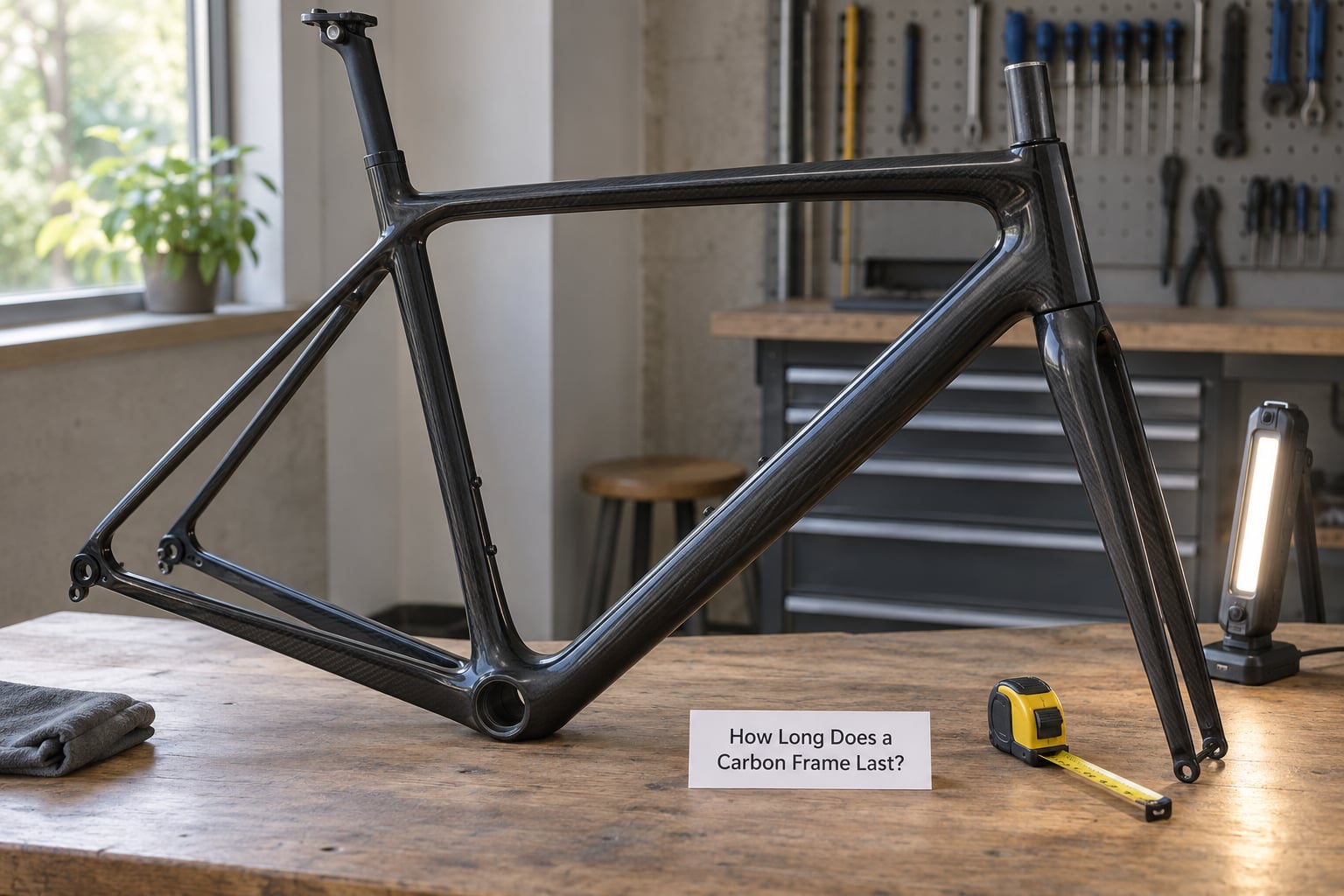
There is no universal carbon frame lifespan, but the honest range is 10 to 20 years of normal riding, with plenty of frames going 20-plus and some never being retired at all.
The reason carbon behaves differently from aluminium is in how the material carries load. A carbon fibre composite is thousands of individual filaments bonded in an epoxy matrix, and the fibres themselves do not weaken with repeated cycling the way a metal’s crystalline structure does. Richard Matthews, a composite engineer quoted by British Cycling, puts it as a basically infinite fatigue life when a frame is designed accordingly.
Read that with the right qualifier, though. Infinite fatigue life inside the design load envelope does not mean infinite tolerance for abuse. Load the frame in a direction it was never built to handle and it can fail suddenly, which is why crashes and handling errors end far more carbon frames than mileage does.
What Is the Average Lifespan of a Carbon Bike Frame?
Roughly 10 years minimum for regular riding, 20 years plus for careful owners, and indefinitely for a frame that never suffers an impact. Anything less usually points to damage rather than age.
The numbers floating around online disagree because they measure different things. CyclingTips, quoted by Haideli, puts typical carbon road frames at 6 to 10 years. Some manufacturers and their warranty terms get read as a 5-to-7-year service life. Cervélo’s engineering position is that carbon does not expire.
All three can be defended, and none of them is a shelf life. The 6-to-10-year figure describes when frames typically get replaced, which is usually because a rider wanted new geometry, new component standards or simply a newer bike, not because the old one stopped working.
| Material | Typical lifespan | Fatigue behaviour | After a crash |
|---|---|---|---|
| Carbon fibre composite | 10-20 years, often far longer | Near-infinite fatigue life within its design load envelope | Can hide impact damage; may need non-destructive testing |
| Aluminium | 5-10 years for a well-used frame | Fatigues predictably, bent and straightened metal weakens over time | Dents visibly, usually easier to assess |
| Titanium | 20 years and beyond | Strong fatigue resistance, springs back from dents | Very forgiving, rarely cracks |
| Steel | Decades, sometimes generations | Fatigues slowly but generously | Bends rather than breaks |
Canyon makes a similar point from the other direction, recommending carbon for riders who plan to keep a bike for a couple of decades because it does not fatigue the same way as metal.
What Changes the Life of a Carbon Frame?
Frame design and build quality set the ceiling, and everything after that is about how the bike is treated.
What shortens a carbon frame’s life
- Crash and kerb impacts, especially side loads
- Over-torquing clamps at seatpost, stem and brakes
- Hidden delamination under the paint after a hit
- Bottles, pumps and racks loading mounting bosses
- Frame clamps in a workstand closing on thin tubes
- Heat parked in a hot car boot or under UV-heavy sun
- Sweat and road salt eating away at metal fittings
- Loose dropouts and worn bearing seats at the ends
Frame quality and rider weight
Not every carbon frame is built the same. Weight, layup quality and manufacturing method decide how much load the frame tolerates before damage becomes structural, and cheaper frames have less margin for abuse. Heavier riders and heavier loads put more energy through the same joints every ride.
How your use pattern changes the picture
| Use pattern | What it puts on the frame | Likely outcome |
|---|---|---|
| Light | A few rides a week on smooth roads | Decades of service with routine care |
| Moderate | Regular road or gravel miles, occasional rough surfaces | 15-20 years, occasional cosmetic marks |
| Demanding | Daily training, gravel, potholes, frequent car transport | Shorter life expectancy, regular inspections needed |
| Severe | Downhill, enduro racing, jumps, repeated crashes | Inspection after every significant impact, retire sooner |
Storage counts more than most riders assume. A bike kept dry indoors and a bike left through two winters caked in road salt see completely different lives.
How Long Does a Carbon Frame Last Under Daily Training?
High-mileage training does not wear a carbon frame out. What it does is raise the odds of eventually hitting something hard enough to matter, and that is a completely different failure pattern from gradual wear.
Rough surfaces and potholes concentrate load into the same small areas every ride. The chainstays take kicks from stand-in and stand-out feet, the fork crown eats brake forces, and the head tube junction absorbs whatever comes down the road.
Frequent transport adds its own risk. Roof racks and boot interiors carry plenty of hard edges, and a frame that flexes under a strap in transit can be damaged without any impact at all.
What to check on a high-mileage frame
Log your mileage somewhere you will actually look at it again, and inspect the mounting points: seatpost collar, stem, brake calipers, bottle bosses and any accessory mounts. Then look at the bottom bracket area and both dropouts, where wear and small cracks tend to appear first.
Check the joints too, particularly where the chainstay meets the bottom bracket shell and where the head tube meets the down tube. Any movement, click or creak that appears with every pedal stroke is worth a look.
Where damage usually shows up first
Chainstay scuffs from shoe contact and stone chips look alarming and are usually cosmetic, as long as the clearcoat is intact and no fibres are exposed. The same goes for small paint marks around the head tube or fork.
Does a Carbon Frame Have a Set Expiration Date?
No. There is no date after which a carbon frame becomes unsafe to ride, and the resin in a well-made composite does not quietly dissolve with age.
Four different things get lumped together under the word damage. Manufacturing defects show up early and are the one category where the warranty applies. Cosmetic wear means paint, clearcoat and stone chips, which change nothing structural. Impact damage includes the hidden kind, where a hard knock separates laminate layers underneath intact paint.
Fatigue concerns are the fourth category, and they are the ones to reason about carefully. A properly built frame designed for the loads you put through it has essentially unlimited fatigue life, so repeated normal riding is not what ends it.
What does end it is a load the frame was not designed for, repeated or extreme. If you suspect that happened, stop guessing and get a frame specialist or the manufacturer to assess it. Manufacturers will also tell you whether a specific frame falls under a warranty claim or a recall.
What Can Damage a Carbon Frame?
Carbon is tough but not forgiving of the wrong load direction. Most damage falls into a handful of repeatable patterns.
- Side impacts, such as clipping a kerb with a pedal or a downtube
- Frontal collisions, where compression crushes the front triangle
- Falls, where the top tube takes a load it was never sized for
- Compression damage from clamping in a workstand or rack strap
- Drivetrain wear near the bottom bracket and dropouts
- Bottle cage or rack mounts loaded beyond their rating
- Heat exposure, such as a bike left in a hot vehicle
- Repeated flexing at joints from hard riding or carrying loads
Galvanic corrosion deserves a mention because almost no article covers it. Sweat and winter road salt attack the metal parts a carbon frame bolts into, so fittings can seize or corrode long before the composite itself is affected.
| What you can see | What it means | Verdict |
|---|---|---|
| Chipped paint or scuff, clearcoat intact | Cosmetic surface marking | Ride as normal |
| Surface resin cracks, no movement | Cosmetic, often from an impact | Ride, monitor |
| Dull sound when tapped, or frame creaks | Possible delamination or joint movement | Stop, get inspected |
| Soft spot, ripple, exposed fibres | Delamination or matrix damage | Do not ride, assess |
| Crack, split, bent or loose dropout | Structural failure | Retire the frame |
How Can You Check Whether a Carbon Frame Is Still Safe?
A careful visual check under good light catches most problems that matter, and it takes about ten minutes.
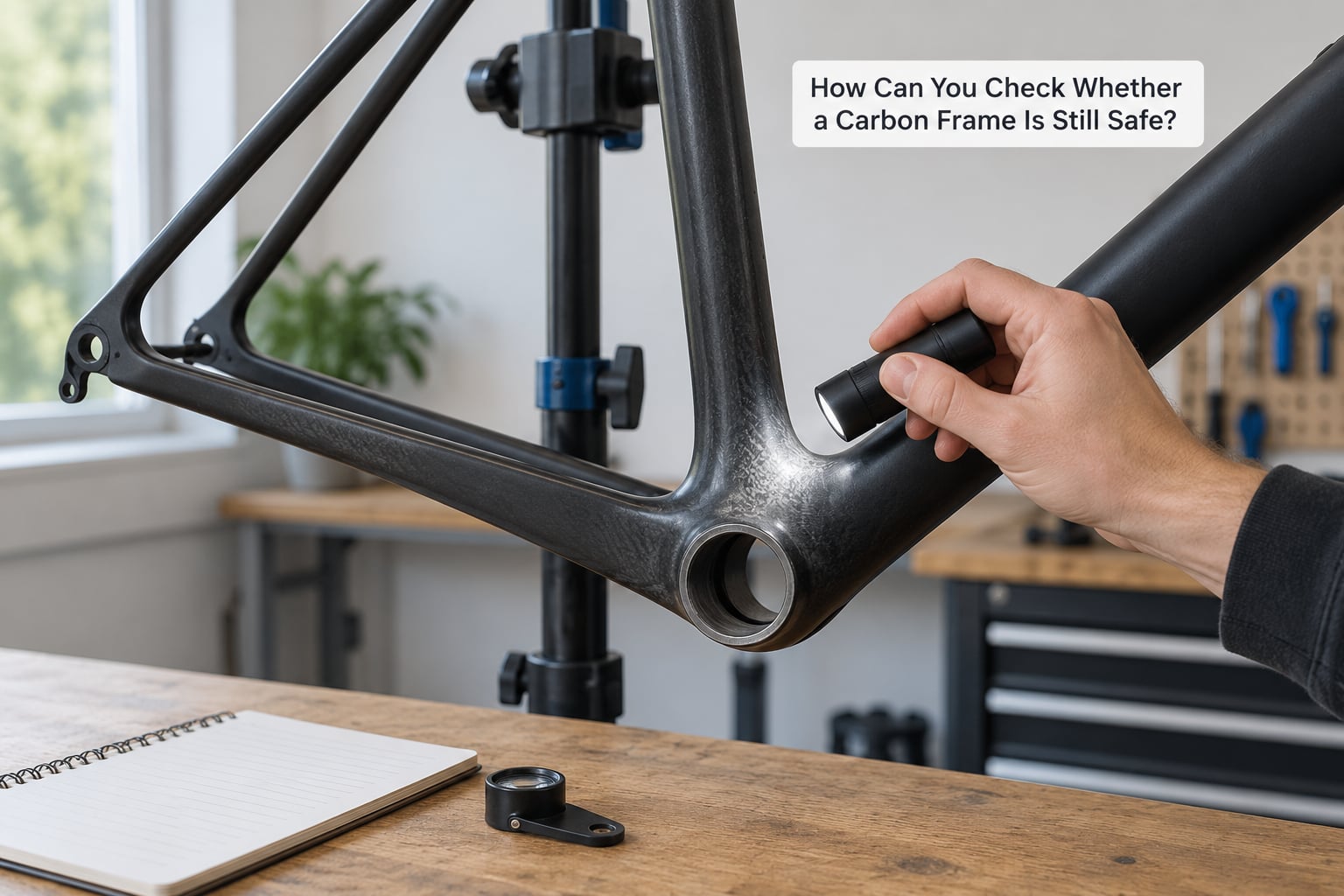
- Strip nothing off, but clean the frame first so dirt does not hide anything. Wipe it with mild soap and water, then dry it.
- Run your fingers along every tube and joint, feeling for ripples, dents or soft spots, particularly at the head tube, bottom bracket shell and dropouts.
- Check the inside of the chainstays and seatstays for exposed fibres or a dull white patch that means the laminate has separated under the paint.
- Tap along the tubes and joints with a coin or a bare knuckle. A clean tap is normal, a dull thud suggests delamination, and an unpleasantly loud resonance is what riders call a screaming frame.
- Ride and listen. Creaks on every pedal stroke, a frame that feels vague under power or a change in the way it takes a hit all deserve a mechanic’s attention.
After any real crash, skip straight to a professional. Ultrasound, X-ray or CT inspection is the only reliable way to see inside the laminate, and plenty of shops will do it as a standard post-crash check.
Should You Repair or Replace an Old Carbon Frame?
Repair is a serious option, not a last resort. Carbon composites have been repairable for decades, and a competent repair can return a frame to full service.
The deciding factors are the location, the type and the extent of the damage. Scuffs, chips and paint marks need a cosmetic refinish. Cracks or holes away from load-bearing areas can often be structurally repaired and re-veneered. Damage at the bottom bracket shell, head tube, chainstay or seatstay junction sits in exactly the places that carry the highest loads and needs a specialist opinion every time.
Replace the frame when the damage runs through a critical junction, when it follows a previous repair in the same area, when the frame has been repaired more than once, or when a non-destructive test shows delamination spreading through the structure. A crack that keeps coming back in the same spot is a sign of an underlying design or manufacturing issue.
The economics work out the way you would expect. Repairing a frame on a bike worth keeping is usually sensible. Paying for a structural repair on a frame you were about to replace anyway rarely is.
How to Extend the Life of a Carbon Road Bike
Most of what shortens a carbon frame’s life is avoidable, and the fixes are boring.
- Use a torque wrench every time. Over-tightened carbon components crush the material instead of clamping it.
- Use assembly paste, not grease, at carbon seatpost and stem clamps. Grease is slippery and is the opposite of what is needed there.
- Never clamp a workstand jaw directly on a thin tube, and pad anything that grips the frame.
- Protect the frame in a vehicle with proper frame padding rather than loose straps.
- Clean with mild soap and water. Skip pressure washers, which force water into joints and bearings.
- Keep bottles and cages torqued lightly, and do not hang heavy bags on bosses meant for a bottle.
- Rinse winter salt off after salty rides and dry the bike before storing it.
- Store indoors, dry, away from heat and direct sun.
- Have a qualified mechanic inspect the frame after any significant impact, even when it looks fine.
Gravel riders commonly run protective film on the frame because stone strikes are constant. It does nothing for crash damage, but it keeps a lot of cosmetic chipping off the paint.
Frequently Asked Questions
Is a carbon frame more durable than an aluminum frame?
For fatigue resistance, yes. Properly built carbon has what composite engineers call a near-infinite fatigue life inside its design load envelope, while aluminum weakens gradually with repeated loading and never fully recovers from being bent straight. The tradeoff is how each handles a crash. Aluminum dents and shows the damage, which makes it easier to assess. Carbon can look perfect on the surface while delamination hides underneath, so aluminum is the more forgiving material after an impact.
Can a carbon bike frame last 20 years or more?
Very possibly, and plenty of riders prove it every year. Riders in cycling forums regularly report 20-plus years of ownership on undamaged frames, and some ride 1990s carbon bikes that are still perfectly fine. The catch is that a frame only reaches that age if it never suffers a significant impact. Buy a quality frame, ride it sensibly, and getting to 20 years becomes a matter of routine rather than luck.
How do I know if an old carbon frame is still safe to ride?
Age alone tells you very little. Inspect the frame under good light, feel along every tube and joint for dents, ripples or soft spots, check for exposed fibres or dull patches of laminate, and tap the tubes to listen for a dull thud that hints at delamination. Pay attention to the bottom bracket area, dropouts and both head tube junctions. After a crash of any consequence, have a qualified mechanic or a frame specialist run a non-destructive test instead of guessing.
What kind of impact can crack or compromise a carbon frame?
Side loads and compression hits do the most damage. Clipping a kerb, dropping the bike onto a hard edge, a car door, a fall onto the top tube or a frame crushed in a workstand can all compromise the laminate. Compression-style collisions and any impact that leaves the paint intact but the structure damaged are the dangerous ones, because the frame can look fine and fail later. If you hit hard, get it inspected rather than riding it and hoping.
Can a damaged carbon frame be repaired safely?
Yes, and carbon has been repairable for decades. Scuffs and chips need only a refinish, while cracks and holes can often be structurally repaired and re-veneered by a specialist. The caution is location: damage at the bottom bracket shell, head tube, chainstay or seatstay junction sits where loads are highest and deserves an expert assessment. Repeated repairs in the same area, or delamination spreading through the structure, usually mean the frame should be retired.
Conclusion
A quality carbon frame can last 20 years or more when it is used carefully and never crashed, but impacts and rough handling matter far more than the calendar does. That is the whole argument against replacing a frame on a schedule.
Start with a full inspection under good light, note your mileage and any incidents in a log, and get a qualified mechanic or frame specialist to assess anything that feels, sounds or looks wrong. If the frame has been hit hard, do not ride it on the assumption that intact paint means intact structure.
That is how how long does a carbon frame last stops being an open question and becomes something you decide by looking after the bike rather than counting the years.