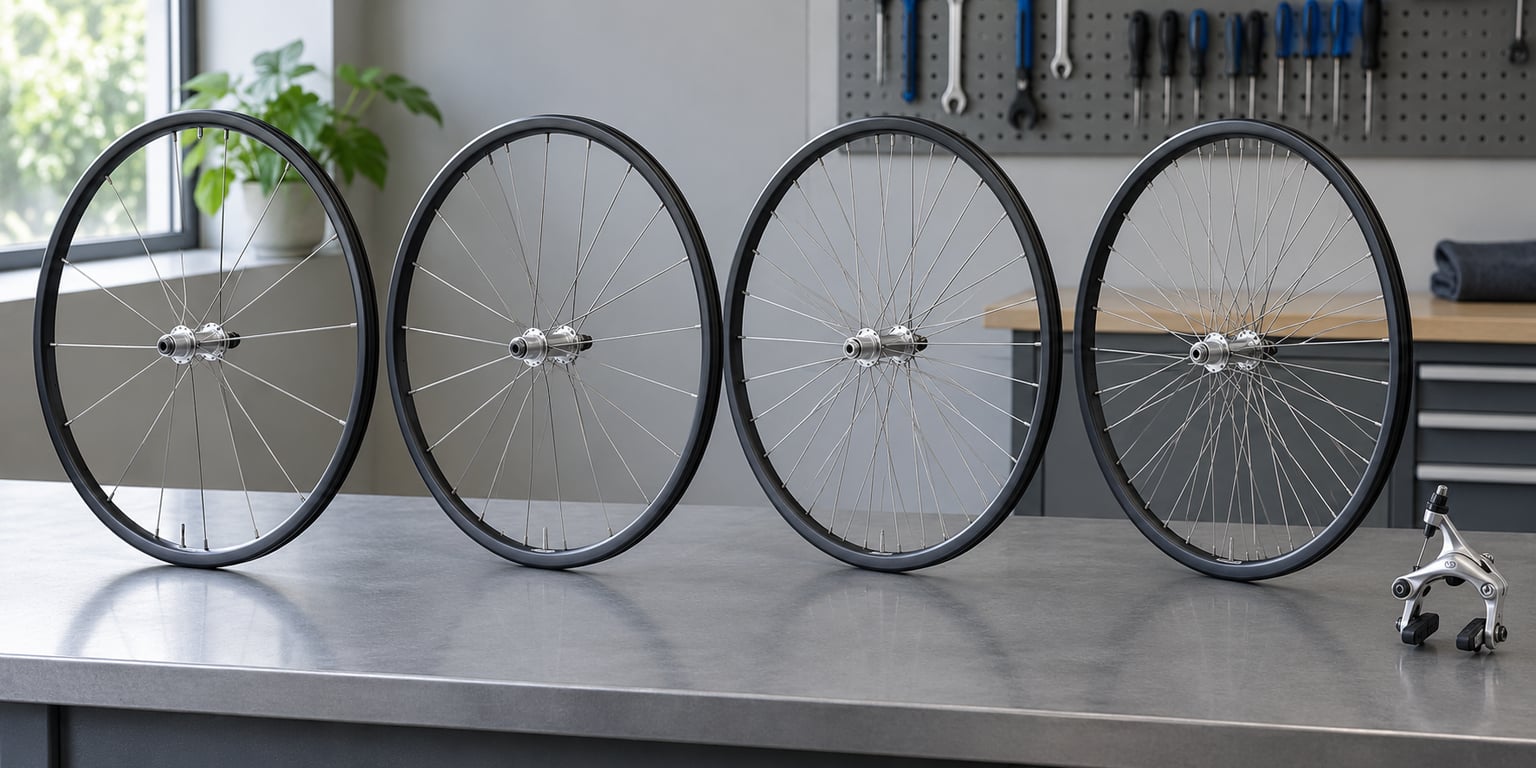
Spoke count is simply how many spokes a wheel has, and on a road wheelset you will nearly always see a pair listed as something like 24/28, meaning 24 in the front and 28 in the rear. That number decides how your weight, your pedalling torque and your braking force get spread between the hub and the rim, which is why two wheels with the same count can feel nothing alike. Here is spoke count explained for road wheels: what the common numbers actually change, and when a low count is a deliberate engineering choice rather than a shortcut.
Table of Contents
- What Does Spoke Count Mean on a Road Wheel?
- Why Does Spoke Count Matter?
- Spoke Count Explained for Road Wheels by Riding Need
- Which Road Spoke Counts Are Most Common?
- Are More Spokes Always Better?
- How Does Spoke Pattern Change Performance?
- What Spoke Count Is Compatible With My Rim?
- Should I Choose Fewer or More Spokes for Climbing?
- How Do Spoke Count and Rim Depth Work Together?
- How Do You Check a Wheel’s Spoke Count?
- Frequently Asked Questions
- Is a 24-spoke road wheel weaker than a 32-spoke wheel?
- Why are road wheels often sold with different front and rear spoke counts?
- Do more spokes make a road wheel faster?
- What spoke count is best for climbing and racing?
- Can I replace spokes or change the spoke count on my existing wheel?
- Conclusion: What to Choose First
What Does Spoke Count Mean on a Road Wheel?
Spoke count is the number of spokes in a bicycle wheel. On a road bike you will usually see 20, 24, 28, 32 or 36, and each spoke is a tensioned steel rod that pulls the rim toward the hub. Together those spokes spread the load instead of letting it concentrate at one point, and the count sets how many of them are sharing the work.
The count is written per wheel, not per pair. A wheelset listed as 24/28 has 24 spokes in the front and 28 in the rear, and that asymmetry is not an accounting error. The rear wheel has to resist pedalling torque and chain tension, so it gets the higher number, while the front mainly has to hold you up and, with disc brakes, absorb hard stopping force.
Front and rear counts can also differ between the two sides of the hub, which matters when you are ordering replacement spokes rather than buying a wheelset. Count them separately and write it down.
Why Does Spoke Count Matter?
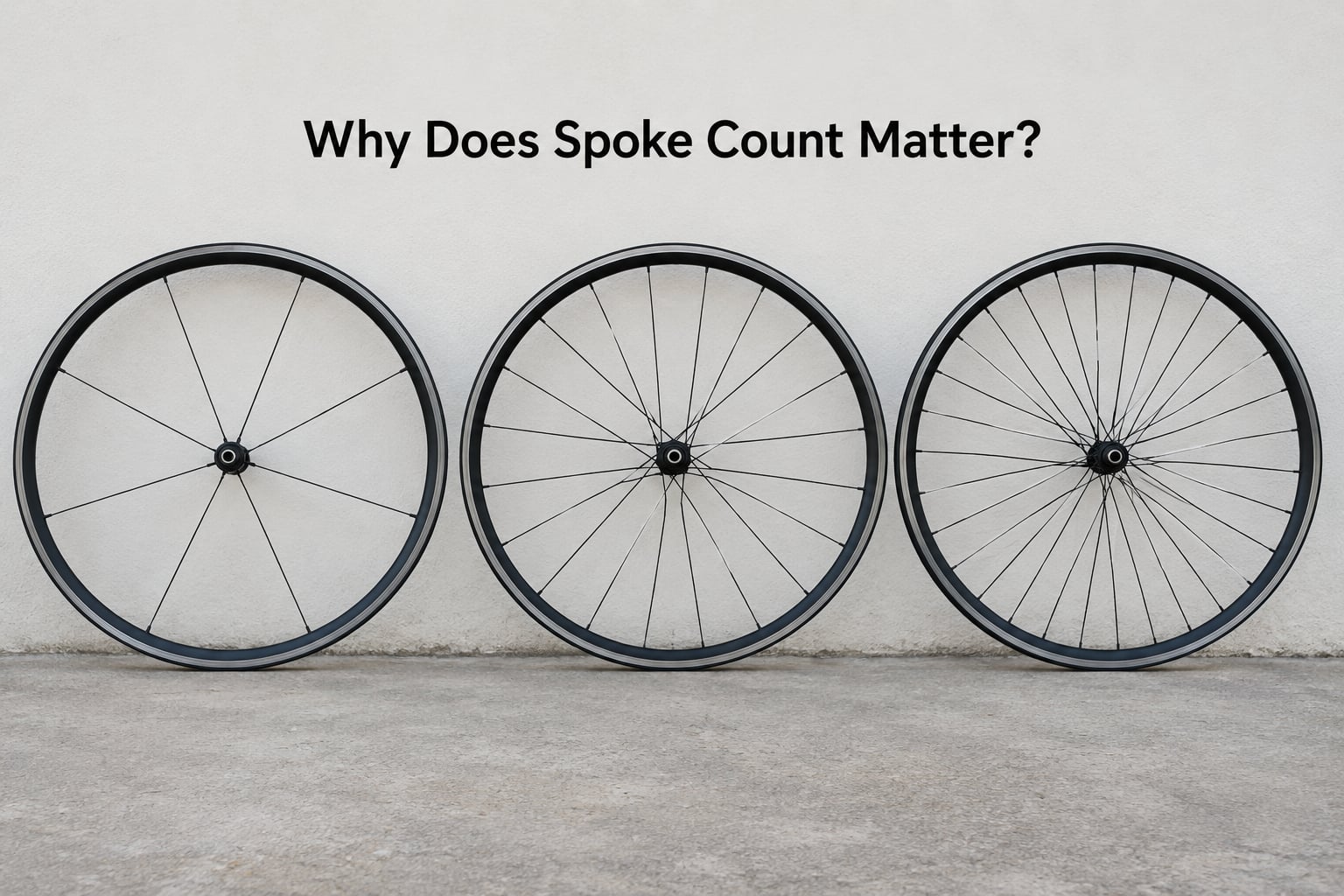
Weight is the most obvious effect. A straight-gauge stainless steel spoke with its nipple weighs roughly 5 grams, so dropping four spokes from a wheel saves about 20 grams before the rim, hub and tyre are considered. Across a wheelset that is somewhere around 60 to 90 grams, which on a climbing bike is real and on a training bike is mostly invisible.
Strength and durability come next, but the trade is subtler than most marketing implies. More spokes means more points of support, a shorter unsupported span of rim between them, and a smaller share of every load carried by each individual spoke. Fewer spokes means each one carries more, and the rim sections between holes flex further.
What that feels like depends on where the load is applied. Braking pushes sideways and twists the front wheel, while pedalling torque twists the rear, so lateral stiffness and radial stiffness matter in different places. A wheel can be laterally stiff and still feel vague under power, which is why rim shape and hub flange width often tell you more than the count.
Aerodynamics is the third factor, and the smallest one. Fewer spokes means slightly less frontal area, but at racing speeds the rim depth and tyre dominate drag. The saving from going 32 down to 28 is real yet modest, and it is often overstated by brands selling a lighter wheel.
| Spoke count | Typical build | Weight effect | Durability | Drag | Best for |
|---|---|---|---|---|---|
| 20 | Straight-pull, wide flange | Lightest, around 100g lighter than a 32 build per wheel | Fewest redundancies, unforgiving of rough surfaces | Lowest spoke-area drag | Race weight on smooth tarmac, lighter riders |
| 24 | 3-cross or straight-pull | Light, roughly 40g lighter than 28 per wheel | Good, thin margin if you are heavy or ride rough roads | Low | Climbing, crits, racing |
| 28 | 2-cross or 3-cross | Moderate, the all-round middle | Strong for most riders and most surfaces | Moderate | Endurance, sportive, light gravel, commuting |
| 32 | 3-cross, often disc-ready | Heavier, roughly 40g heavier than 28 per wheel | Very good, forgiving after a single breakage | Moderate | Gravel, all-road, touring, heavier riders |
| 36 | 3-cross, eyeleted rims | Heaviest of the road counts | Highest load capacity of the group | Highest spoke-area drag | Bikepacking, loaded touring, rough winter roads |
Spoke Count Explained for Road Wheels by Riding Need
Start from what the bike is for, then adjust. Racing and climbing on smooth tarmac point to 20 or 24 in the front and 24 or 28 in the rear. All-round training and sportive riding sit happily at 24/28 or 28/28. Commuting and winter road riding favour 28 or 32, because the surface decides more than your fitness does.
Touring with panniers, gravel and all-road pushes the same way. Riders who carry load, ride cobbles, or simply live on roads with potholes get a lot more out of a higher count, since the extra spokes take the edge off repeated impacts.
Four things override the basic rule, and every one of them can move you a step in either direction: rider and bike weight, rim depth, spoke gauge, and brake type. A 90kg rider on a shallow 21mm rim with discs is a different problem from a 68kg rider on a 40mm rim with rim brakes, even though both are called 28-spoke wheels.
Which Road Spoke Counts Are Most Common?
Most road wheelsets fall into five buckets. The pairing pattern tells you what the builder thought the wheel had to do, which is often more informative than the count alone.
| Count | Typical pairing | Likely tradeoff | Riders it suits |
|---|---|---|---|
| 20 | 20 front / 24 rear | Lightest option, least margin for damage | Weight-focused racers and climbers on clean roads |
| 24 | 24 front / 28 rear | Light, but thin if you are heavy or ride rough | Racing, criteriums, fast road rides |
| 26 | 26 front / 28 rear | Unusual, usually a weight compromise | Riders trimming grams without dropping to 24 |
| 28 | 28 front / 28 rear, or 24/28 | Slightly heavier, markedly tougher | Endurance riders, sportive riders, commuters |
| 32 | 28/32 or 32/32 | Heavier, needs a rim and hub built for it | Gravel, touring, all-road, heavier riders, discs |
| 36 | 32/36 or 36/36 | Noticeably heavy on smooth road | Bikepacking, loaded touring, rough surfaces |
Disc brake wheels usually sit one step higher than rim brake versions of the same rim, because the braking force arrives through the hub rather than at the rim wall. That is why a lot of modern disc wheelsets read 28/32 while older rim-brake ones read 24/28.
Are More Spokes Always Better?
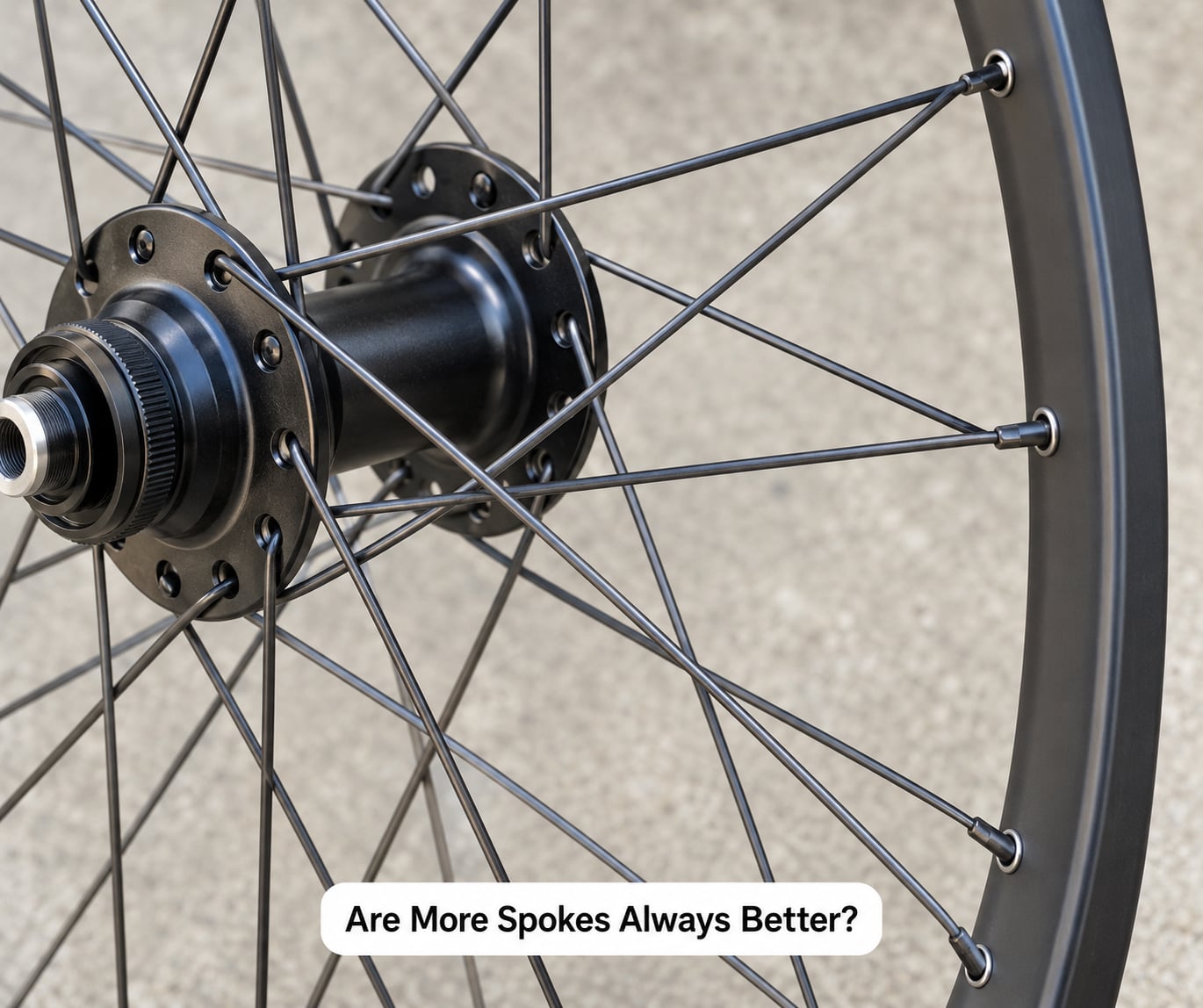
No. More spokes give you more redundancy and more load-sharing, but each added spoke also brings weight, drag and build cost, so a high count on a wheel that never sees a rough surface is just grams you carried for nothing.
The bigger correction is that count alone does not make a wheel stiff. Mechanics on bikeforums.net make this point repeatedly: stiffness is mostly a property of the rim, and durability matters more than the headline number. What count changes is the unsupported span, the length of rim sitting between two spoke holes with nothing behind it. A builder testing one rim found roughly 75mm of unsupported span on a 24-hole rim and noticeably less on the 28-hole version of the same rim.
The second lever is the hub. A wide flange spreads the spoke ends further apart, which resists twisting far more effectively than adding spokes would. That is how a builder gets a 20-spoke front wheel to behave like a stiffer 28, and it is why you should check the flange width on a spec sheet before you worry about the count.
Tension matters too, and it is the one thing that is entirely under the rider’s control. A wheel built with even tension stays true and holds shape; one with a slack spoke wanders, and the rim takes the load it was not designed for.
How Does Spoke Pattern Change Performance?
The lacing pattern is the angle at which spokes cross from the hub flange to the rim. More crosses means a shallower, more side-to-side angle, and a stiffer wheel under braking and torque.
- Radial: spokes go straight out with no crossing. Very light and low drag, but almost no lateral stiffness, so it is used on front wheels only and almost never with discs.
- 2-cross: common on light 24-hole builds where spoke angle is limited.
- 3-cross: the road standard. Good lateral stiffness, good tension behaviour, works with discs.
- 4-cross: steeper angle and more lateral stiffness, used when a wheel is built for high loads or heavier gauge spokes.
- Semi-tangential: a hybrid where leading and trailing spokes cross differently to balance braking and driving force.
Direction of load is why the front and rear want different patterns. The front sees braking force pushing hard sideways, so it wants crossing and radial stiffness. The rear sees torque from pedalling twisting the drive side against the brake side, which is why radial lacing there would be a mistake.
Pattern also sets spoke length, because every cross eats length. That is the reason a rim cannot simply be laced to any hub.
What Spoke Count Is Compatible With My Rim?
Compatibility is mostly arithmetic, but it is easy to check before you order anything. Work through it in this order.
- Count the hub holes. A 24-hole hub cannot be laced to 28 spokes, whatever the rim allows.
- Check the rim drill pattern. Rims specify whether they take a standard 24, 28, 32 or 36 pattern, and some are drilled for only one.
- Work out the spoke length. It comes from hub flange diameter, hub width, rim diameter and lacing pattern, and it must land in the rim’s recommended range rather than poking past the tyre bed.
- Match nipple type. A box-section rim takes standard nipples; an eyeleted rim takes reinforced ones. Mixing them is how rims crack around the spoke holes.
- Match the brake type. Disc builds need a disc-compatible hub with the right rotor mount and end-cap spacing; rim brake builds do not, and mixing them will not lace properly.
- Balance the pair. If you are changing one wheel, match the other unless you deliberately want a stiffer front or rear.
Should I Choose Fewer or More Spokes for Climbing?
For a lighter rider on good tarmac, fewer spokes is the usual climbing answer, and it is where the weight actually shows up in a long climb. Twenty-four front and rear is common at the light end, and the low counts are common in lightweight climbing wheels for exactly that reason.
Higher counts make more sense for heavier riders, cobbles, potholes or simply a lot of repeated training miles. Builders on r/bikewrench commonly recommend 32 or 36 around 85kg for durability, and riders on r/cycling pushing back against low counts argue much the same. A 24-spoke wheel can still be ridden over rough tarmac; it just has less in reserve when something goes wrong.
The honest version is a trade-off rather than an upgrade. If your weight sits in the middle of the range and your roads are decent, 28 is the count that keeps working when conditions change.
How Do Spoke Count and Rim Depth Work Together?
Rim depth and spoke count have to be matched as a pair. A shallow rim is narrow and light, and it can carry a low count; a deep section is a tall vertical surface that wants more support, both for its own shape under load and to spread braking and torque across more attachment points.
Deeper rims are aerodynamic because they move air smoothly before it reaches the tyre. The benefit grows with speed and disappears at low speed, and it comes with real trade-offs in crosswinds, braking feel and weight. Frame designers also cap how deep a rim a given fork can take, which is a compatibility limit worth checking before you chase a low count.
The useful conclusion is that spoke count alone cannot predict how fast a wheel is. Aero testing compares complete wheels, rims and tyres together, and the spoke count is one variable among several. Judge a wheelset on the pair, and on your local terrain.
How Do You Check a Wheel’s Spoke Count?
You do not need tools, and you do not need to take the wheel out of the frame.
- Find one hub flange hole. Put a finger on a spoke where it enters the flange, or count the holes around the flange itself.
- Follow that spoke to the rim. Note the rim hole it lands in.
- Move one hole around the flange and follow the next spoke to the rim. Repeat until you come back to your starting point. That total is your count.
- Count each side separately if the spokes do not obviously alternate, which is the norm on a built wheel.
- Write down front, rear, drive side and non-drive side before you touch a tool. That is the list you need for replacements and rebuilds.
If you are buying a used wheelset, do this before anything else. A bent or rusty spoke is far easier to spot in a still wheel, and the count tells you straight away whether the rim was built for the load you intend to put through it.
Frequently Asked Questions
Is a 24-spoke road wheel weaker than a 32-spoke wheel?
Not automatically. Each spoke on a 24-spoke wheel carries a larger share of every load, but stiffness comes mostly from the rim and hub shell, and consistent tension matters more than the raw number. A well-built 24 with wide flanges and a stiff rim can outlast a sloppy 32. Rider weight, terrain and brake type decide how much margin you actually want.
Why are road wheels often sold with different front and rear spoke counts?
Because the two wheels do different jobs. The rear takes pedalling torque and chain tension, so it usually gets the higher count. The front takes braking force, which matters most with discs where that force arrives through the hub. A 24/28 pairing gives the rear the spokes it needs while trimming grams off the front, where the drive side has no chain to fight against.
Do more spokes make a road wheel faster?
Only a little, and less than brands tend to suggest. Fewer spokes mean marginally less frontal area and slightly less rotating mass at low speed. At racing speeds the rim and tyre dominate drag, so moving from 32 to 28 buys very little. Spoke count explained for road wheels is really a weight and durability decision rather than a speed one.
What spoke count is best for climbing and racing?
For a lighter rider on smooth tarmac, 24 in the front and 28 in the rear is the usual race-day answer, with 20 or 24 all round at the very light end. Riders above roughly 200lb, or anyone riding cobbles, potholes or loaded panniers, should step up to 28 or 32. Forum riders consistently report the higher count matters most once the surface gets rough.
Can I replace spokes or change the spoke count on my existing wheel?
You can replace spokes as long as you match length, gauge and material. Changing the count is only possible if the hub has the required number of holes, so going from 24 to 28 means a 28-hole hub. Count the holes on the hub flange, check the rim drill pattern, then confirm the spoke length falls inside the rim’s recommended range.
Conclusion: What to Choose First
Start with riding purpose, then rider and bike weight, then terrain and brake type. Only after those four are settled does spoke count become a real decision rather than a number to copy off a spec sheet.
From there, compare the lacing pattern, rim depth and wheel weight together, because a 32-spoke wheel on a shallow rim and a 24-spoke wheel on a deep section are not competing on the same axis. If you can only change one thing, move up a count for rough surfaces and heavy loads, and stay low for weight on clean roads.