A steel road bike is a road bicycle whose frame and fork are built from steel tubing, usually a chromium-molybdenum alloy such as Reynolds 725, Reynolds 853 or Columbus, valued for its compliant ride quality, its sizing range and the fact that it can be repaired and ridden for decades rather than for the lowest possible weight. That short answer hides a lot, so here is the long one.
Steel was the default frame material for bicycles for roughly a century. Aluminium took over the mass market in the 1980s and 90s, carbon swept up the high end afterwards, and steel spent two decades as the cheap option. Then a generation of riders who had spent years on very stiff bikes started buying steel again, and small framebuilders went back to making it deliberately. This guide covers what steel actually does for you on the road, how the tubing choices work, where steel loses to the alternatives, and how to pick one that suits the riding you do.
Table of Contents
- What Is a Steel Road Bike?
- Why riders choose steel: the honest list
- Steel Road Bikes Explained: How the Frame Shapes the Ride
- What Are the Main Types of Steel Used in Frames?
- What butted tubing actually means
- Lugs, TIG and fillet brazing
- Steel vs. Aluminum vs. Carbon Road Bikes
- Why Do Steel Bikes Feel Different?
- What compliance feels like on the road
- How Do You Choose the Right Steel Road Bike?
- Buying a used steel road bike
- Do Steel Bikes Require More Maintenance?
- Are Steel Road Bikes Worth It in 2026?
- Frequently Asked Questions
- Are steel road bikes heavier than aluminium and carbon?
- Is a steel road bike comfortable for century rides?
- Will a steel frame rust if I ride in wet weather?
- How do I find the right size steel road bike?
- Are steel road bikes suitable for racing and fast group riding?
- Can a damaged steel frame be repaired?
- Conclusion
What Is a Steel Road Bike?
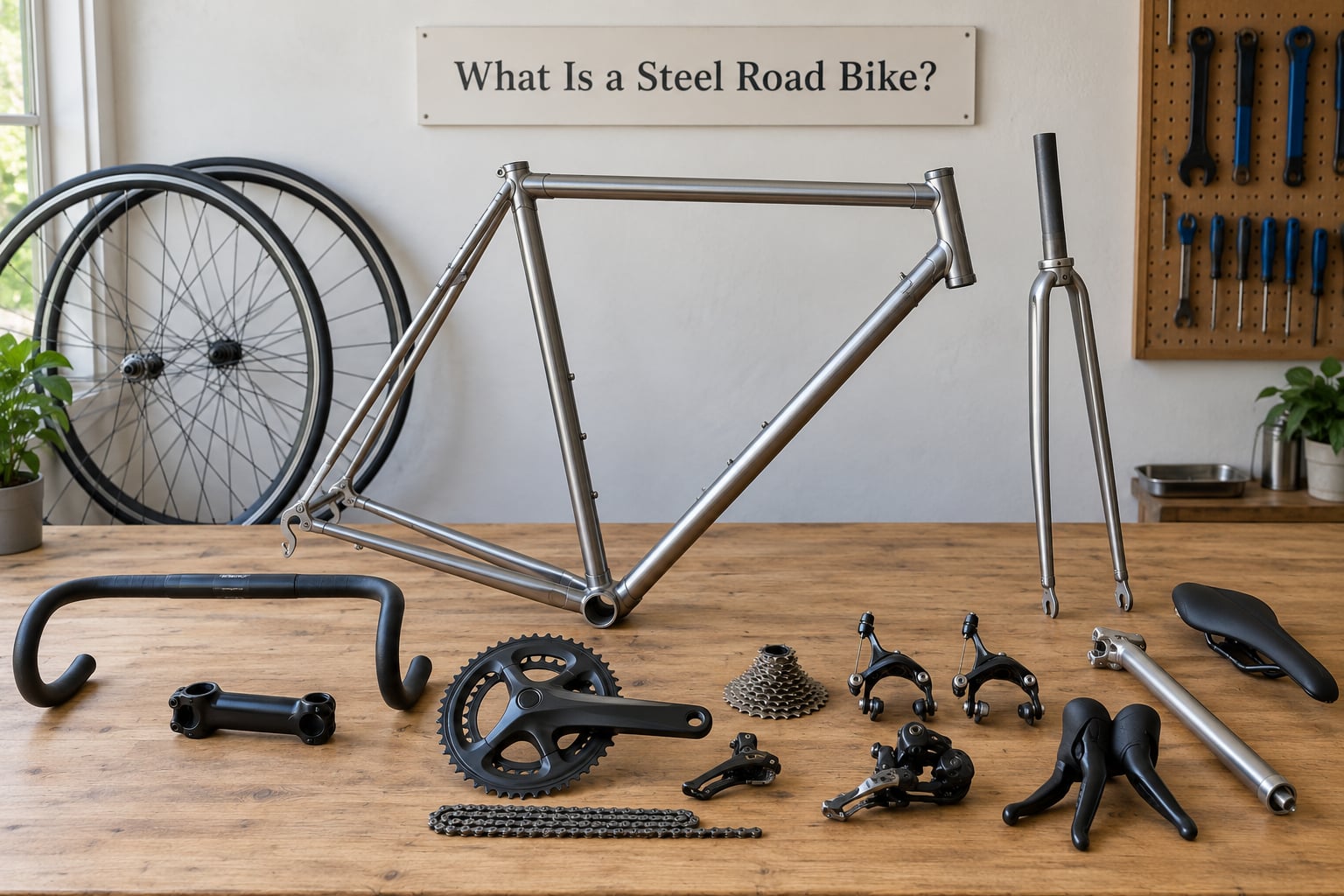
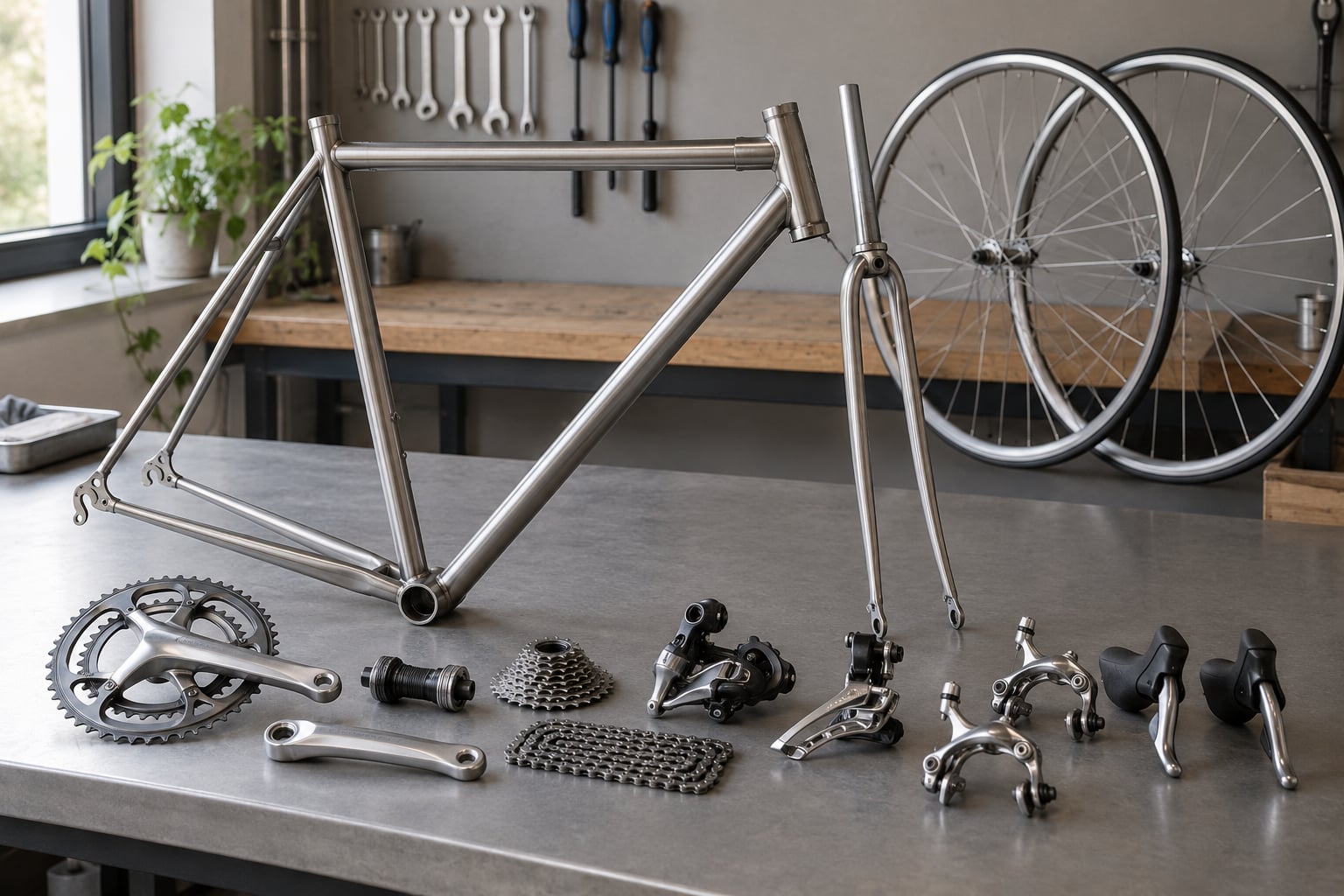
Put simply, a steel road bike is any road bike whose main structural tubes are steel. In practice that usually means the front triangle and rear triangle built from thin-walled steel tubes, plus a fork, often steel, sometimes carbon. Everything else on the bike — the drivetrain, the wheels, the saddle, the handlebar, the brakes — comes from other materials, because steel is only ever used for the frame and fork.
Steel frames divide into two broad families. Classic steel construction uses lugs: short pieces of steel sleeve the tube ends, and the tubes are either brazed or silver-soldered into them. It looks decorative and it is genuinely strong at the joints, where the tubes meet at angles. Modern steel construction uses TIG welding, sometimes fillet brazing, sometimes bonded joints in a few experimental frames, and CNC-machined dropouts and lugs cut from solid plate.
Some modern steel bikes also carry a carbon fork. Steel frame with carbon fork is now common on endurance and all-road models, and it is a genuine compromise: you gain about 300 grams and a stiff, precise fork, and you lose some of the supple, muted ride quality that drew people to steel in the first place.
Why riders choose steel: the honest list
- Ride comfort. Steel’s elastic modulus is low enough that the frame flexes slightly under load, which takes the edge off rough tarmac and repeated road buzz.
- Durability. A well-built steel frame tolerates decades of use, potholes and hard landings in a way carbon does not.
- Repairability. Steel can be welded, brazed or re-painted almost anywhere in the world by a general metalworker, not a carbon specialist.
- Sizing range. Custom and semi-custom builders fit almost any body, including riders with unusual proportions or injuries.
- Appearance. Thin tubes, lugs and fillet-brazed joints look the way a classic road bike is supposed to look.
- Weight. A steel road frame lands around 2 kg, roughly a kilogram more than a comparable carbon frame, and complete builds commonly weigh 8 to 9.5 kg.
- Stiffness-to-weight. For pure power delivery, carbon wins. Steel’s flex is comfort in one situation and lost watts in another.
- Rust. Bare steel corrodes if paint chips go unattended, particularly near the sea or on winter roads salted heavily.
- Lead times. Small steel builders sell out for weeks or months, so sizing an unusual frame can take patience.
Steel Road Bikes Explained: How the Frame Shapes the Ride
Steel combines a compliant, lively ride with predictable steering, a very wide range of available sizes and easy repairability. You pay for that in weight and in a small amount of sprint-time efficiency. That is the honest trade, and it is why most riders who switch to steel describe the bike as forgiving rather than fast.
Three things change when the frame is steel. First, compliance: the frame moves with you a little, so surface buzz arrives softened and long stretches feel less punishing. Second, steering: a steel tube set is light at the front, so the bike changes direction easily and carries momentum through a bend without feeling nervous. Third, longevity: the material has a very high fatigue limit compared with aluminium, and it deforms before it breaks, which is a useful property in a crash.
The weight difference is real but smaller in everyday use than the numbers suggest. A well-set-up steel bike at 9 kg is not noticeably slower than a 7.8 kg carbon bike at a steady pace on flat road. It is slower in a sprint, slower uphill when everything else is equal, and it needs slightly more effort to hold speed on a headwind, because you are pushing more mass.
One caveat worth stating plainly: material is not destiny. Geometry, tube shape, the fork, tyre choice and build quality decide most of what you feel between round one. A badly proportioned steel bike with an over-stiff fork will feel worse than a well-built aluminium one. Buy the bike, not the material label.
What Are the Main Types of Steel Used in Frames?
Nearly all modern road steel is a low-carbon alloy with small amounts of chromium and molybdenum added, which is why the shorthand “chromoly” caught on. The important practical differences are wall thickness, tube diameter and how the frame is joined.
| Steel type | What it is | Typical wall thickness | Where you meet it |
|---|---|---|---|
| Chromoly 4130 | Basic chromium-molybdenum alloy, the default budget steel | Straight gauge, roughly 0.6 to 0.9 mm | Entry-level and commuter steel frames |
| Reynolds 725 | Air-hardening alloy with high tensile strength and a smooth weld | Butted, roughly 0.5 to 0.6 mm at the thinnest points | Endurance and all-road frames, usually TIG welded |
| Reynolds 853 | Higher-strength alloy with finer tubing available in thinner gauges | Butted, roughly 0.4 to 0.5 mm | Race-oriented custom frames |
| Reynolds 953 | Alloy hardened in air, for outside diameter shapes that stay accurate over decades | Thin butted gauges, often ovalised | High-end custom and boutique frames |
| Columbus tubing | Italian drawn tubing family, including Spirit HSS and the ultra-thin 1.5 and Oversize lines | Butted, down near 0.4 mm on premium sets | Many boutique and Italian steel frames |
| True Temper | American alloy line, common in American framebuilding, including 531 and 003 | Butted or straight gauge depending on the set | US custom builders and touring frames |
| Stainless steel | Corrosion-resistant steel that is heavier and harder to work, and never needs paint | Thinner, typically straight gauge | A small number of commuter and city bikes |
What butted tubing actually means
Butted tubing is thick at the joints and thin in the middle of each tube, because that is where the bending forces are highest. A tube with 0.4 mm walls at the midpoint and 0.9 mm walls at the ends can carry the same load as a straight-gauge tube that is uniformly heavy, so you save weight exactly where you do not need it. Drawers and builders call the varying thickness pattern butting, and the practice is the reason a two-kilogram steel frame is possible.
Ovalised tubes take this further. Tube shapes that are flattened top and bottom resist torsional twist, which is where harshness comes from on rough roads, without needing extra material. A framebuilder who tells you the tubes are ovalised is telling you they were designed, not just assembled from a catalogue.
Lugs, TIG and fillet brazing
Lugged frames use short steel sleeves that the tubes fit into, then braze or solder the joint. Lug work is heavy and time-consuming, and it concentrates strength right at the tube ends. TIG welding fuses the tube ends directly with a weld bead, which is lighter and faster and lets a builder control the frame’s flex through tube profiles alone. Fillet brazing fills the joint with a silver alloy and is smooth enough to paint over; enthusiasts rate it as the best-looking and often the longest-lived option.
None of these choices is automatically better. A well-made TIG frame can outlast a badly made lugged one, and a hand-ovalised butted set from a skilled builder will feel better than anything from a production line.
Steel vs. Aluminum vs. Carbon Road Bikes
Steel against aluminium is mostly a question of feel and weight; steel against carbon is mostly a question of comfort and longevity; steel against titanium is a question of budget against repairability. Here is the short version.
| Attribute | Steel | Aluminium | Carbon | Titanium |
|---|---|---|---|---|
| Typical frame weight | About 2 kg | About 1.5 kg | About 1 kg | About 1.8 kg |
| Typical complete build | 8 to 9.5 kg | 7.5 to 8.5 kg | 6.8 to 8 kg | 8.5 to 9.5 kg |
| Ride feel | Compliant, springy, muted | Firm, sometimes harsh | Stiff, direct, quiet | Compliant, muted, heavier feeling |
| Stiffness-to-weight | Low | Moderate | Highest | Moderate |
| Sprint power | Acceptable, not the sharpest | Good | Best | Good |
| Fatigue life | Very high | Good, sensitive to dents | Excellent if undamaged, poor once cracked | Very high |
| Crash damage | Dents, sometimes bendable | Dents and cracks | Hard to assess, often written off | Bends rather than snaps |
| Repairability | Any competent metalworker | Specialist alloy welding | Specialist composite repair | Specialist TIG welding |
| Rust risk | Yes, if paint fails | Corrodes from the inside out if scratched | None | None |
| Custom sizing | Excellent | Limited | Excellent | Excellent |
| Best suited to | Long rides, rough roads, touring, commuting, riders who keep bikes for decades | Budget road riding, fast club rides | Racing, climbing, weight-sensitive riders | Premium touring and commuting |
Two generalisations are worth flagging. Aluminium frames can have internal corrosion that spreads invisibly from a small scratch, so a cheap aluminium frame that has been ridden hard is worth checking carefully on a used purchase. And the difference between a good steel frame and a bad one is far larger than the difference between a good and a bad aluminium one, because steel can be butted, ovalised and custom-shaped while mass-produced aluminium is usually hydroformed from one generic profile.
Why Do Steel Bikes Feel Different?
Steel’s stiffness comes from its elastic modulus, a fixed property of the material that no amount of clever shaping changes. Steel is roughly a third as stiff as aluminium in bending and far less stiff than carbon fibre along its grain direction. That number explains everything that follows.
When you ride, every road irregularity pushes up through the front wheel into the fork and head tube. The frame does not simply transmit that push; it absorbs a fraction of it and gives it back as the load passes. Riders describe the sensation as springy, alive, or as the bike moving with them. Engineers call it micro-strain: small, repeated elastic deformation that never becomes permanent and never accumulates as fatigue.
The catch is that the same elasticity is present when you put power down. Under a hard sprint effort the frame bends a little instead of transmitting every watt directly to the rear wheel. Outdoors, in a bunch, the difference is small. In a sprint final or a track race it is not, which is why almost no steel frame competes at the very top of professional road racing.
What compliance feels like on the road
On rough pavement, compliance shows up as less high-frequency harshness. The buzz that makes some riders clamp their hands on the bar and shift position simply arrives at lower amplitude. Over a long ride that difference compounds, and it is the single strongest argument steel riders make.
On climbs, a compliant frame is stable and calm but does not feel razor-sharp when you stand to sprint. On descents, low mass in the front end makes a steel bike feel settled and easy to place, and the frame’s small amount of flex takes the sting out of chatter over broken edges. On a full day in the saddle, the comfort difference is where the material pays for itself.
Useful flex and bad flex are easy to tell apart. Useful flex is a small, even give spread through the whole frame that returns fully to shape. Bad flex is a hitch or kick in the steering, a creak, a bottom-bracket shell that moves under power, or a chainstay gap that changes with load. Those are geometry and manufacturing faults, not material character, and they should never be accepted as part of the steel feel.
How Do You Choose the Right Steel Road Bike?
Choose in this order: what you will actually ride it on, what fits you, then what the frame is made of. Work through these seven checks.
- Decide the riding first. Long road days and rough surfaces favour steel. Racing, steep climbing and minimising grams favour carbon. Mixed use with heavy loads favours steel or titanium.
- Get real geometry numbers. Ask the builder or retailer for stack, reach, wheelbase and standover rather than a frame size letter. Compare them with the bike you ride now, not with a generic chart online.
- Check standover and tyre clearance. If you plan to fit 32 mm or wider tyres for rough roads, confirm the frame and fork both allow it before you commit.
- Look at the mounting options. Braze-on bosses for a top-tube bag, a rack, bottle cages or fenders decide whether the bike can do double duty on a commute and a weekend ride.
- Test ride it. Ride it for at least fifteen minutes if you can, and over a surface with cracks in it. Note whether the steering feels settled at speed and whether the ride stays quiet.
- Assess the components. On older steel bikes, check that the drivetrain and brake components are serviceable and worth keeping. A great frame with worn drivetrain money should be priced accordingly.
- Check serviceability where you live. Buy from a builder who is reachable afterwards. Some small builders quote waits measured in months, and a local repairer who understands steel is worth a lot over ten years.
Buying a used steel road bike
Used steel is where the value argument gets strong, and where the risk sits. Run a chain wear gauge on the drivetrain, look for rust bloom around the chainstays and seat cluster, and check the rear triangle for alignment by sighting along the chainstay from the dropout. Press gently on the fork blades and head tube area for hidden dents. Look under the chainstay guards and at the cable stops, where paint failure usually starts. Finally, check the brake mounts: a frame built for a specific disc standard may limit which calipers you can fit later.
Do Steel Bikes Require More Maintenance?
Steel frames are not inherently high-maintenance. They need the same routine servicing as any other bike, plus a little attention to paint, because that paint is the only thing standing between the steel and the air.
- Paint and chips. Touch chips promptly. A spot of touch-up paint on a chainstay takes minutes; a bloom that has spread under a decal takes a strip and refinish.
- Winter and salt. Wash the bike down after riding on salted roads, dry it fully, and do not leave it in a damp shed. Salt accelerates corrosion more than water does.
- Coastal air. Riders near the sea should keep paint in better condition year-round and consider wax or a protective coating on the frame.
- Chain and cables. Standard schedule: check chain wear every few hundred miles, replace cables and housing when they feel gritty rather than waiting for a failure.
- Bearings and headset. Service the headset and hubs on a normal annual schedule. Steel frames feel weightier through a worn headset, which gets blamed on the material.
- Tyre pressure. A slightly lower pressure on a steel bike costs almost nothing in handling and buys real comfort on rough roads.
Brake compatibility is one genuine modern wrinkle. Older rim-brake frames accept cable-pulled or centre-pull designs that many newer parts no longer fit. A full-steel, rim-brake frame may need a modern cantilever or V-brake conversion before you can fit contemporary components, so check that before buying parts.
Are Steel Road Bikes Worth It in 2026?
Steel is worth it when you ride a lot, ride far, or plan to keep the same bike for a decade or more. It is harder to justify as a second bike used for quick weekday blasts, where a lighter frame does more for you.
The value case is not really about the purchase price. It is about what happens afterwards. A comfortable bike gets ridden more often. A bike you keep longer amortises its cost over more rides. A frame that any metalworker can repair does not strand you when a fork or chainstay fails, and that option has real value for anyone who does not live near a composite repair shop. Frames that hold their geometry well also hold their value on the used market better than carbon, which buyers treat as fragile.
There is an emotional side too, and it is not silly. A brazed or lugged steel frame with a patina looks like a bike that will outlive you, and riders who keep bikes for decades tend to care more about their machines than the weight spreadsheet does.
The honest counterweight is weight. If your riding is competitive and mostly on smooth tarmac, the extra mass is a genuine cost. A well-fitting steel bike still beats a cheaper bike that does not fit you, so if you only have budget for one, put fit and geometry ahead of material.
Frequently Asked Questions
Are steel road bikes heavier than aluminium and carbon?
Yes, typically. A steel road frame usually weighs around 2 kg, against roughly 1.5 kg for aluminium and about 1 kg for carbon. Complete builds commonly land between 8 and 9.5 kg for steel, 7.5 to 8.5 kg for aluminium and 6.8 to 8 kg for carbon. At a steady pace on flat road the gap is hard to notice, but in a sprint or a steep climb the extra mass is real.
Is a steel road bike comfortable for century rides?
That is where steel road bikes make the most sense. The frame’s slight elasticity takes the edge off road buzz, and because it does not transmit every vibration straight into your hands and spine, a 100 mile day feels less tiring than the same ride on a very stiff frame. Weight is the trade-off, and on long days it matters far less than comfort.
Will a steel frame rust if I ride in wet weather?
Rain alone will not ruin a steel bike. Paint is what protects the frame, so the risk comes from chips, scratches and decal edges where bare metal is exposed, especially with road salt or sea air. Rinse the bike after salted or salty winter rides, dry it properly, touch chips in promptly, and a steel frame will outlive you. Bare or rusted steel needs far more care than painted steel.
How do I find the right size steel road bike?
Ignore the size letter and compare geometry. Ask for stack, reach, wheelbase and standover, then compare those numbers with a bike that already fits you well. Steel’s advantage is custom sizing, so many builders will fit unusual proportions if the standard sizes miss. A test ride matters most: check that you can reach the levers without straining and that your weight sits between the wheels.
Are steel road bikes suitable for racing and fast group riding?
For club rides, crits and amateur racing, yes, and many riders win events on steel. For professional road racing at the very top level, steel is effectively absent, because the small loss of power transfer under a sprint outweighs the comfort gain. What matters for fast group riding is that the bike steers precisely and feels settled at speed, and a well-built steel frame does both.
Can a damaged steel frame be repaired?
Usually, yes, and that is one of steel’s real strengths. Dents, bent dropouts and cracked chainstays or fork blades can often be welded, brazed or replaced by a competent metalworker, then refinished. That work is far more widely available than composite repair. Structural work still needs a framebuilder or experienced welder to assess it properly before you ride again.
Conclusion
Steel is a strong choice when you ride long and often, ride on rough roads, or want a bike you can keep and repair for decades. Start by getting the fit and geometry right, because those matter more than the material, then test a steel bike against an aluminium and a carbon one inside your budget and let the ride decide.