How bright should a bike light be? For most road riders, a steady front light of roughly 300 to 1,000 lumens covers everything from a lit city commute to an unlit country lane, while a rear light is judged by how visible it is, where it sits, and how long it runs rather than by its maximum output.
That is the short version. The useful version is that brightness is a dial you set for the darkest 200 meters of your route, not for the average conditions you ride in. NHTSA figures quoted in a bike lighting guide from BikeLegal put roughly half of all bicycle fatalities in darkness or low light, so the number you dial in before you leave the house is doing real work.
Table of Contents
- How Bright Should a Bike Light Be for Night Riding?
- What Do Bike Light Brightness Numbers Mean?
- How Much Light Do You Need for Different Rides?
- What Is the Best Brightness for a Commuting Bike Light?
- What Is the Best Brightness for Long Night Rides?
- How Bright Should a Bike Light Be on Unlit Roads?
- How Do You Choose a Bike Light That Is Bright Enough?
- How Bright Should a Bike Light Be for Safe Road Cycling?
- Frequently Asked Questions
- Is 200 lumens bright for a bike light?
- Is 500 lumens bright for a bike light?
- Is 1000 lumens bright for a bike light?
- Can a bike light be too bright?
- Why do front and rear bike lights need different brightness?
- Conclusion: Choose the Light for Your Route
How Bright Should a Bike Light Be for Night Riding?
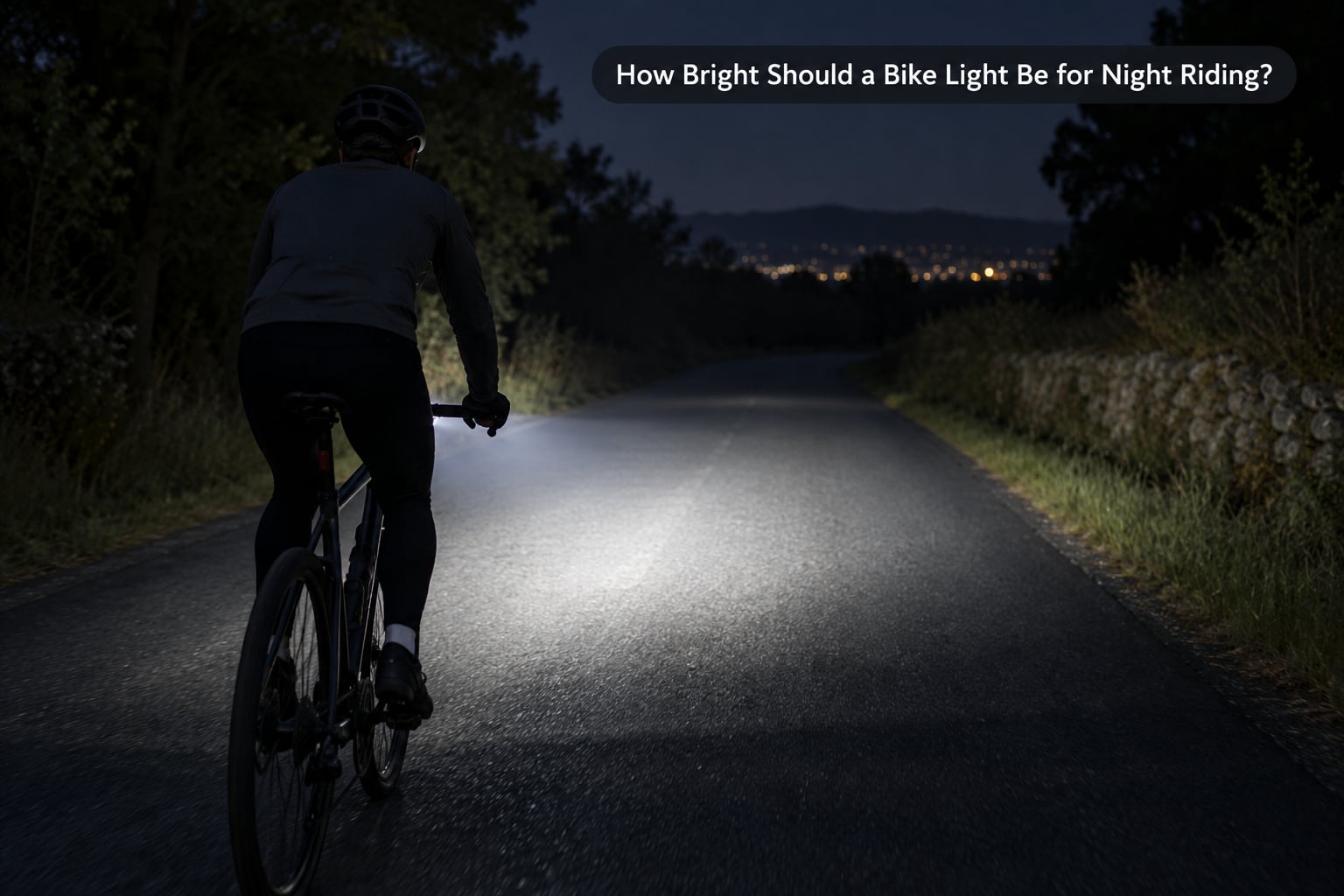
Here is the range most people land on. A steady front light of 300 to 1,000 lumens covers paved road riding, from well-lit streets through to country lanes with nothing but moonlight. The rear light needs far less, usually 20 to 100 lumens at night, because its job is to be noticed rather than to light anything.
Split by environment, published guidance lines up more closely than the marketing pages suggest. BikeRadar puts the minimum for unlit roads at 600 lumens and recommends 1,000 or more over tricky terrain. Bookman gives urban commuting 50 to 200 lumens on the front. BikeLegal settles in between at 200 to 500 lumens for city riding and 800 to 1,500 for rural roads and trails.
The disagreement between those ranges is mostly a difference in what they assume about the road. Nobody is arguing that 200 lumens on a pitch-black lane with no streetlights works well; they are describing streets where the streetlights do the work. Pick the number that matches the dark stretch, not the bright one.
Two habits come up constantly in rider discussions. The first is the see versus be seen split that circulates on r/cycling: a low-output light handles being seen, and you need roughly 300 lumens before you start seeing the road surface rather than just the rider in front of you. The second is the pothole test, which riders use far more than any spec sheet. If you can spot a raised drain cover or a broken glass in front of the bike rather than at your front wheel, the light is doing its job.
What Do Bike Light Brightness Numbers Mean?
Lumens are the total amount of visible light a lamp puts out in every direction. That is genuinely useful, and it is also the least informative number on the box, because a light aimed at a patch of tarmac twenty meters ahead and one aimed at the treetops score identically.
| Measurement | What it tells you | Why it matters on a bike |
|---|---|---|
| Lumens (lm) | Total visible light emitted in all directions | Sets the ceiling, but ignores where the light lands |
| Candela (cd) | Intensity in one direction; roughly 12 lumens | The unit used in UK lighting law, where a minimum of 4 candela is set |
| Lux | Light actually falling on a surface | The closest published number to how well you can read the road |
| Beam throw | How far down the road the light reaches | Decides how much reaction time you get at speed |
| Cutoff line | The upper edge of a shaped beam | Stops the beam blinding drivers coming the other way |
For an intuition anchor, 1,600 lumens is roughly a 100 watt incandescent bulb, which is a useful sanity check when a listing claims 5,000 lumens for a handlebar light. It may be true as raw output, but light scattered across a wide flood pattern does very little for the patch of road where you are actually going.
That is why a well-made 600 lumen light regularly outperforms a scattered 1,200 lumen one in rider reports. Beam pattern decides whether the output lands where your eyes are pointing, and optical focus does the rest. A tight spot beam 800 lumens wide with no hot spot is worse than a shaped flood that puts usable light on the tarmac from fifteen meters out.
Flash modes deserve their own mention because they change what the number means. A 200 lumen daytime flash pattern is far more visible in daylight than a 200 lumen steady beam, because motion and contrast do the work that raw output cannot in full sun. Most riders run flash by day and steady at night, which is exactly the convention.
How Much Light Do You Need for Different Rides?
This is the chart to bookmark. It is the one page on this topic that puts front and rear numbers side by side for every environment, because the two lights should never share a recommendation.
| Riding environment | Front light | Rear light |
|---|---|---|
| Daytime visibility | 200-600 lumens in day flash mode | 100-200 lumens flashing |
| Well-lit city streets | 200-400 lumens | 20-100 lumens |
| Suburban and mixed urban routes | 400-600 lumens | 50-100 lumens |
| Unlit country roads | 600-1,000 lumens | 50-100 lumens |
| Fast night road riding | 800-1,200 lumens | 100-200 lumens |
| Gravel and towpath night riding | 800-1,500 lumens | 100-200 lumens |
| Mountain trails | 1,200-3,000 lumens plus a helmet spot | 100-200 lumens |
| Kids’ bikes | 15-50 lumens with a flash mode | 15-50 lumens |
Daytime is the case riders most often get wrong by buying nothing. A cheap light on flash is what makes you visible to drivers who have already decided you are part of the scenery, and reflective clothing does more of that job than another 400 lumens ever will.
Trail riding is the opposite end. r/MTB consensus clusters around 1,200 to 1,500 lumens on the helmet, with 750 to 950 lumen lights described as pretty adequate for familiar routes. On a trail, speed stays low and the light has to reveal roots and edges at an angle, which is a different problem from lighting a flat road.
Group rides change the math again. Riders on r/bikecommuting commonly run a single 500 lumen helmet light for group night rides on familiar roads, because the ride usually stays together and the route is known. Solo unlit riding is where the high end of the chart starts paying for itself.
What Is the Best Brightness for a Commuting Bike Light?
For an urban commute, 200 to 400 lumens on the front is the working range, and 400 to 600 covers routes with underpasses, park paths, or a long stretch of street with the lights off. Predictable aim matters more than raw output here, because a commuter mostly needs to read kerbs, drains and doorways rather than see to the horizon.
Riders on well-lit routes report that a modest light is genuinely fine, since the city lighting does the work. Commuters also consistently report running flash during the week and the lowest steady setting at the weekend, which stretches the battery to several days between charges.
E-bike commuters should sit at the top of their route’s range rather than the middle. The same light that suits a 15 mph ride on the same street leaves you short at 20 mph, and the extra speed is exactly what turns a late hazard into a collision.
What Is the Best Brightness for Long Night Rides?
Long night riders should care more about runtime and beam control than about peak output. A 1,000 lumen light that dies at 90 minutes is worse for a four-hour ride than a 600 lumen light that runs for three hours, and on a remote road the second one is the only one you still have.
Advertised runtime rarely survives contact with maximum output. BikeRadar’s testing notes a light claiming 1 hour 30 minutes at high output that delivered closer to two hours, and a 2,600 lumen model that managed about 1 hour 15 minutes at max. Read the runtime figure for the mode you will actually use, not the headline number.
The sensible long-ride setup is a mid-range front light running in a moderate mode, a rear light you can leave on all night, and a small backup you do not think about until the main battery dips. Riders who switched from a less populated area describe the move to pitch-black commuting as the moment they upgraded, and most of them went up in output and up in runtime together.
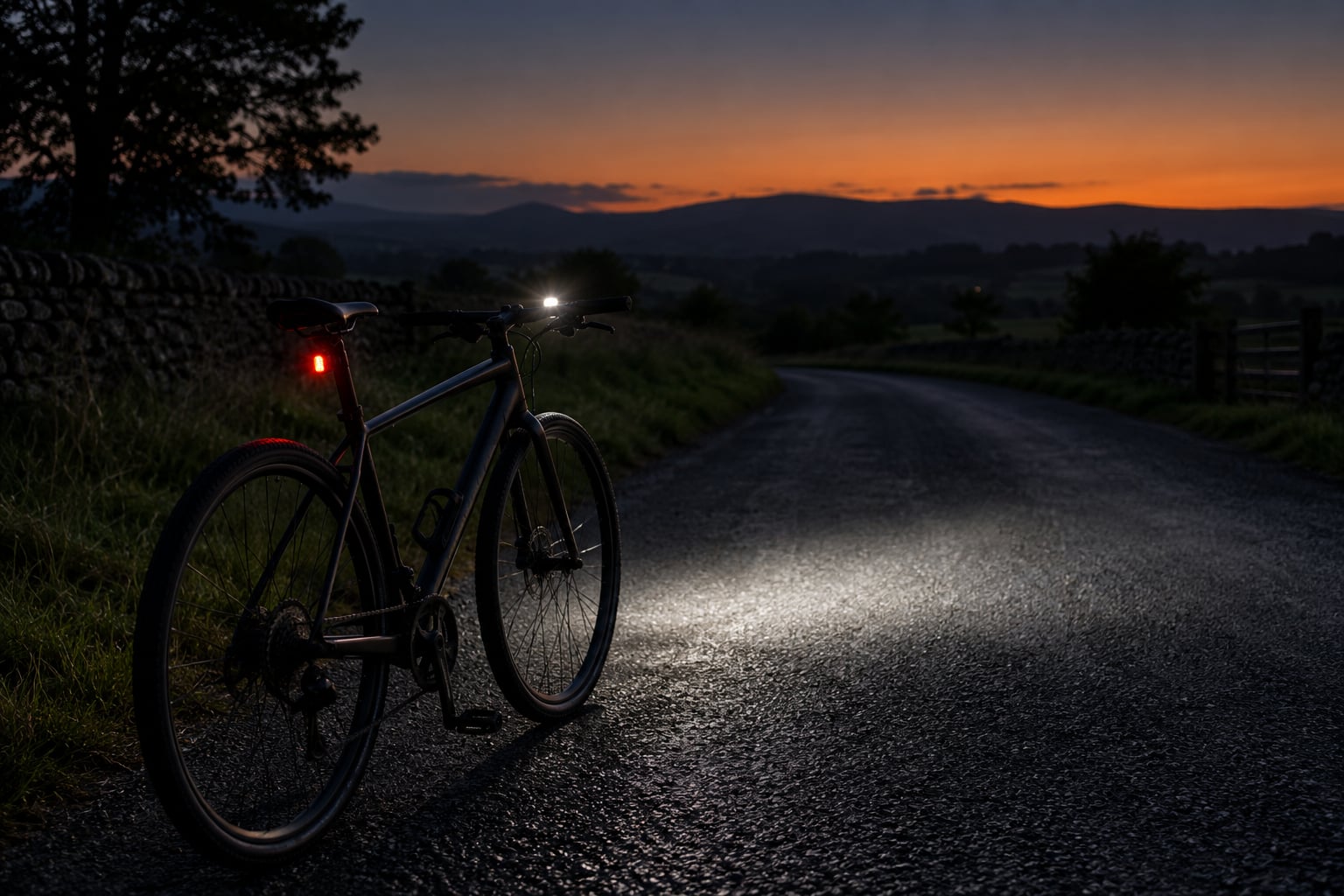
How Bright Should a Bike Light Be on Unlit Roads?
On unlit roads, the useful range moves up to 800 to 2,000 lumens, and 1,000 lumens is the number riders quote when they describe riding at speed past a pothole with no warning. That extra output buys beam throw, which buys reaction time.
Brightness also has a social cost here. A commenter in a r/bikecommuting thread on being too bright in traffic notes that 1,200 lumens is in the same range as many car headlights. Aim the beam 10 to 20 degrees downward, and if your light has a cutoff line or anti-glare optics, turn them on.
None of it changes the last rule of unlit road riding: go at a speed that suits what the light shows you. More lumens extend how far ahead you can see, they do not make a wet, unlit corner at 30 mph safe, and no lumen figure substitutes for picking a route you know.
How Do You Choose a Bike Light That Is Bright Enough?
Work down this checklist in order, and skip the brand. What you are choosing is whether the light will still do its job on your route in three months.
- Measured output, not the box number. A lot of the gap between an advertised figure and reality is thermal step-down, where the light dims itself when the housing heats up. Reviews that report sustained output at full power are worth more than the specification sheet.
- Beam pattern over brightness. A wide flood lights the near road and your own front wheel, a narrow spot reaches far and leaves a dark gap up close, and a combination beam handles both. Night commuting wants flood, fast road riding wants some spot.
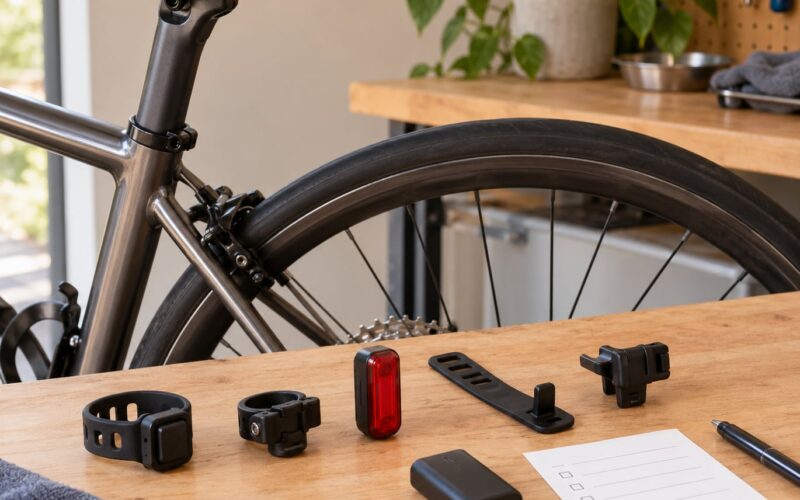
- Modes you will actually use. At minimum, a steady mode, a flash mode for daylight, and a low mode for runtime. A reactive brake sensor on the rear light is genuinely useful in stop-start traffic.
- A mount that survives. Broken handlebar mounts on budget lights are a recurring complaint in rider threads, and a light that droops changes the aim, which changes the effective brightness. Check for a metal strap or a mount rated for rough roads.
- Water resistance. IPX4 handles splash, IPX6 handles heavy rain, and IPX7 survives immersion. Year-round commuting deserves better than IPX4.
- Charging and battery visibility. USB-C removes a dedicated cable, and a battery indicator stops the mid-ride surprise that rider threads describe more than any other failure.
- Side visibility. Rear lights that pulse or flare outward catch a cyclist approaching from your flank at an intersection, which a plain steady block does not.
- Local rules. In the US, a common rule requires a white front light visible from 500 feet and a rear red light or reflector visible from 600 feet, though states vary. In the UK, the Road Vehicle Lighting Regulations of 1989 set a 4 candela minimum. German StVZO-approved lights are built around a certified cutoff line.
Dynamo and hub-powered systems are worth a look if you ride most nights and never want to remember a charger. They produce less light than a good USB light at any given moment, but they never run out.
How Bright Should a Bike Light Be for Safe Road Cycling?
A light bright enough and aimed well is only half of it. The habits around it decide how much good the lumens do.
Aim the front beam down 10 to 20 degrees so the brightest part of it lands on the road between you and the first hazard, not at the eye level of oncoming drivers. This is the single most useful five minutes of setup you will do, and it is why lights with a proper cutoff line exist.
Keep a rear light on every ride, day or night, including group rides where everyone assumes somebody else has one. Slow to the speed your light supports, especially on unlit roads and in rain, where the beam returns off the wet surface and the useful range shrinks.
Do not ride into bright lights looking straight at them. Aim and look slightly to the side of a car’s headlights so the glare stays at the edge of your vision and your eyes keep adapting to the dark. That single habit does more for your night vision than any lumen figure.
Weather changes the requirement in a way people rarely expect. Rain, fog and snow push you toward 500 lumens and above because visibility is reduced by everything in the air, but the same moisture scatters the beam back at you, so aim lower and keep the speed down rather than simply adding power.
And remember what brightness is not. It does not replace reflective clothing on your wheels and shoulders, a route with predictable lighting, or a bell. It buys you reaction time in the dark, which is the most valuable thing a rider can carry at night.
Frequently Asked Questions
Is 200 lumens bright for a bike light?
Yes, for lit streets. 200 lumens on the front is enough to be seen and to pick out kerbs and drains on a well-lit city route, and it is a sensible urban commuting figure. It is not enough to reveal the road surface on an unlit lane, where you want 600 lumens or more. Riders on well-lit commutes report that a modest light is genuinely fine.
Is 500 lumens bright for a bike light?
500 lumens is a good all-round number and probably the most useful single figure to remember. It lights suburban streets, mixed urban routes with underpasses, and park paths properly, and it sits in the middle of the range for battery runtime. It is not a bright-light answer for unlit country roads or trail riding, but for most commuting it is plenty.
Is 1000 lumens bright for a bike light?
Yes, 1,000 lumens is a genuinely bright bike light and the number most riders quote for unlit roads ridden at speed. The extra output buys beam throw, which buys reaction time. Riders often describe 1,200 lumens as being in the same range as many car headlights, so aim it 10 to 20 degrees downward and use any cutoff line the light has.
Can a bike light be too bright?
Yes, mostly in traffic. A very bright front light aimed at eye level blinds oncoming drivers and makes you harder to notice, and the glare costs you your own night vision as you ride through it. The fix is aim rather than output: point the beam 10 to 20 degrees down, use anti-glare optics or a cutoff line, and drop to a lower mode on lit streets instead of running maximum output everywhere.
Why do front and rear bike lights need different brightness?
They do different jobs. A front light illuminates the road ahead so you can see hazards, which is why it carries hundreds of lumens. A rear light only has to make you noticeable to traffic behind you, so 20 to 100 lumens at night and 100 to 200 in daylight flash is enough. Reviews and rider forums both insist these two numbers should never be given as a single figure.
Conclusion: Choose the Light for Your Route
Start here: for ordinary paved-road riding, pick a front light of roughly 300 to 1,000 lumens and a rear light in the 20 to 100 lumen range, then adjust the beam aim and the runtime for the darkest part of your route rather than choosing by maximum output alone.
If your commute is mostly lit streets, 300 lumens and a good mount will do more for you than 1,200 lumens of scattered flood. If it crosses unlit lanes at speed, step up and check the runtime on the mode you will actually use.