Electronic shifting vs mechanical shifting comes down to one trade: a drivetrain that never needs adjusting and needs charging, against one that costs less, repairs anywhere, and never leaves you stranded by a flat battery. Electronic shifting shifts faster and stays precise for thousands of kilometres; mechanical shifting is cheaper, serviceable by anyone with a multitool, and fits almost every frame ever built. Neither one is better for everyone — the honest answer depends on how far you ride from a bike shop, how often you crash, and whether you enjoy a Sunday morning with cables.
This is the comparison I wish someone had handed me before my second bike, so it covers the practical stuff rather than the marketing: how each system works, what actually feels different out on the road, what breaks, what it weighs, and what either choice costs you across five years of ownership.
Three questions settle most of it. How far is the nearest decent bike shop? How many kilometres a year do you actually ride? And do you like servicing a bike, or would you rather never touch a hex key? If you cannot answer those, read on — the sections below answer them one at a time.
Table of Contents
- Electronic Shifting vs Mechanical Shifting at a Glance
- How Each Shifting System Works
- Mechanical: cable tension and indexing
- Electronic: signals, motors and self-indexing
- The same gear change, electronic vs mechanical
- Shifting Feel and Precision
- Electronic Shifting vs Mechanical Shifting: Reliability and Maintenance
- Weight and Performance Differences
- Compatibility and Installation
- Cost to Buy, Maintain, and Upgrade
- Which Should You Choose?
- Frequently Asked Questions
- Are electronic shifters better than mechanical shifters for road cycling?
- How often do electronic bike shifters need charging?
- Can I convert my road bike to electronic shifting?
- Do electronic gears shift more consistently than mechanical gears?
- Are mechanical shifters easier and cheaper to maintain?
- What happens if an electronic derailleur or battery fails?
- Conclusion: Make the First Choice by Your Riding Priorities
Electronic Shifting vs Mechanical Shifting at a Glance
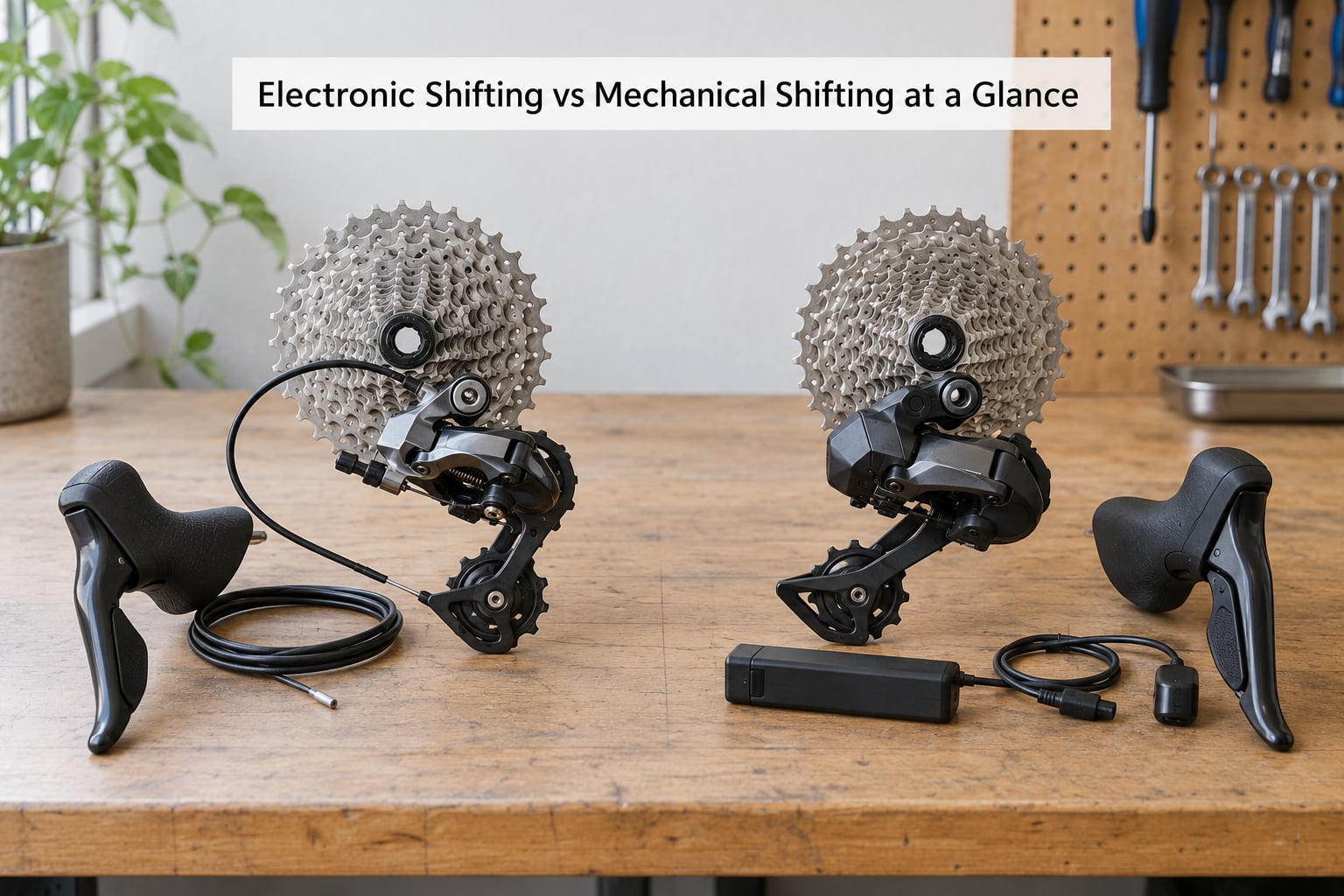
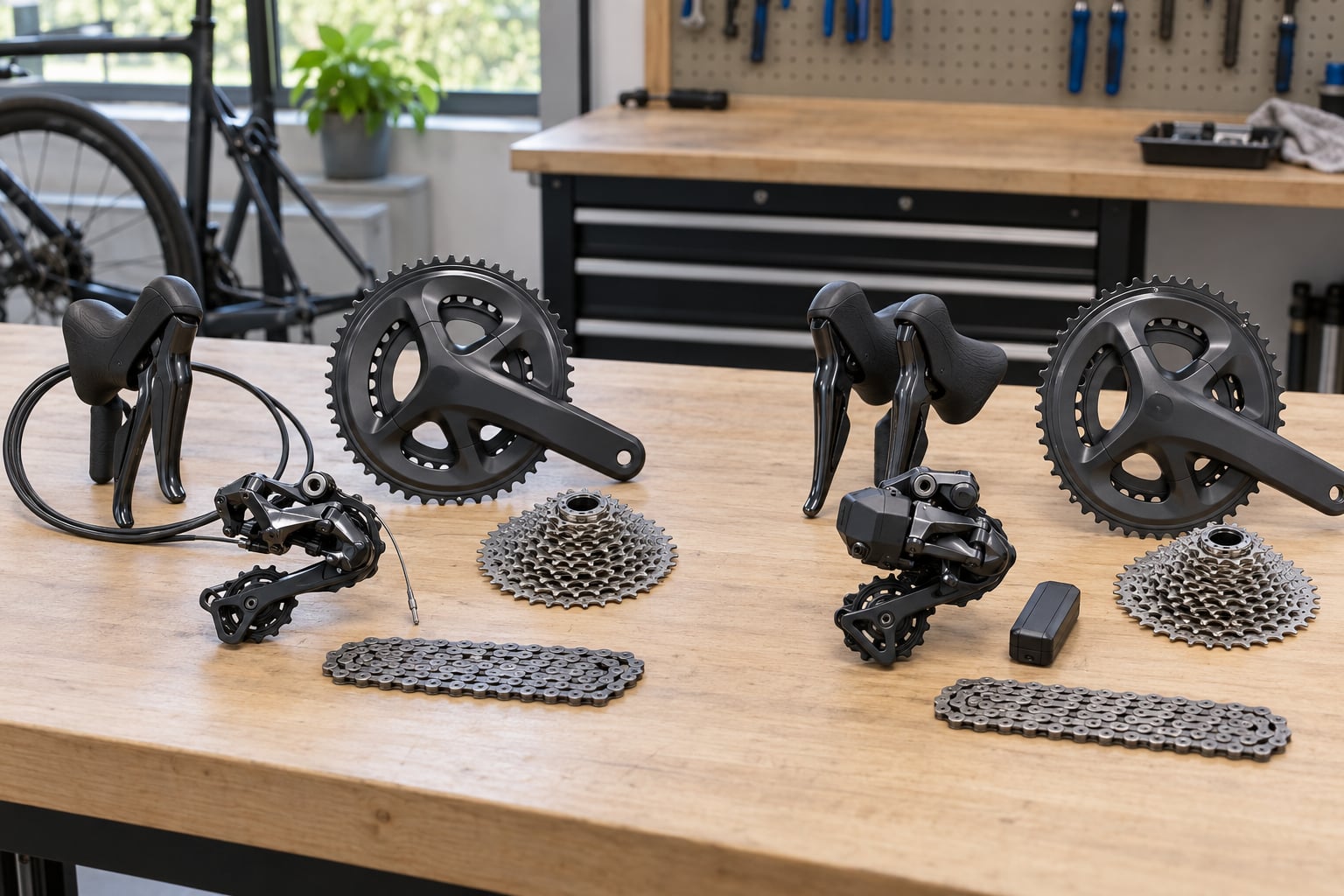
Here is the short version, criterion by criterion. Mechanical shifting uses cables and housing whose tension moves the derailleur; electronic shifting uses a battery-powered motor in the derailleur, triggered by a button and either a wire or a radio signal.
| Criterion | Mechanical shifting | Electronic shifting |
|---|---|---|
| Shifting precision | Good, and depends on correct cable tension | Very good, and identical every time |
| Consistency over time | Drifts as cables stretch and fray | Holds until the battery runs flat |
| Shift speed | Quick, but the chain moves only as fast as the cable | Very fast; published figures put a Di2 shift under 200 ms |
| Routine maintenance | Indexing tweaks, cable and housing replacement | Charging, firmware updates, nothing else |
| Battery and charging | None | Required; charges every few hundred kilometres to every few rides |
| Compatibility with older frames | Fits almost anything | Needs ports, routing space and sometimes a different freehub |
| Repairability | Any shop on earth can fix it | Fewer shops, and parts may age out of availability |
| Weight | Lighter overall | Heavier overall, though much of the extra weight is removable |
| Cost | Cheaper to buy, cheaper to run, cheaper to crash | Higher upfront, pricier consumables and crash repairs |
| Best fit | Budgets, touring, home mechanics, remote riding | Everyday road and gravel riders, racers, bad-weather commuters |
One row deserves a note. Battery life looks like a weakness in that table and behaves like a non-event in practice — SRAM’s AXS system is quoted at roughly 20 to 25 hours of ride time, and Shimano’s Di2 is typically measured in kilometres covered rather than hours parked.
How Each Shifting System Works
Both systems do the same physical job: move a chain from one sprocket to another. The difference is what carries the instruction from your left hand to the rear derailleur.
Mechanical: cable tension and indexing
On a mechanical bike, each click of the shifter pulls a fixed amount of cable through a Bowden cable — an inner steel wire running inside a housing that acts as the sheath. That tension rotates the derailleur’s mechanism just enough to guide the chain one cog up or down.
Indexing is the part most riders never think about. The shifter is calibrated so each click equals one gear, and a barrel adjuster at the lever lets you fine-tune tension by fractions of a turn. Get it slightly wrong and the chain hesitates, rubs, or overshoots.
Electronic: signals, motors and self-indexing
An electronic shifter has no cable at all. A button press sends a signal — down a wire on Shimano Di2 and Campagnolo EPS, over a radio on SRAM AXS — to a small motor inside the derailleur that positions the cage electronically and stops when it reaches the programmed gear.
Because the derailleur knows where it is supposed to be, it corrects for wear on its own. There is no stretch to compensate for, which is why an electronic drivetrain can go a full season without a single adjustment.
The same gear change, electronic vs mechanical
Picture yourself at the bottom of a climb in the 34-tooth ring and want the 30. Mechanically, you click once, the cable pulls, the derailleur guides the chain sideways, and the chain climbs one cog under its own load — usually, if the cable tension is right.
Electronically, you press the same lever once, a signal goes to the rear derailleur, a motor swings the cage, and the chain steps across in a fraction of a second, with no dependence on how the cable feels that morning.
Shifting Feel and Precision
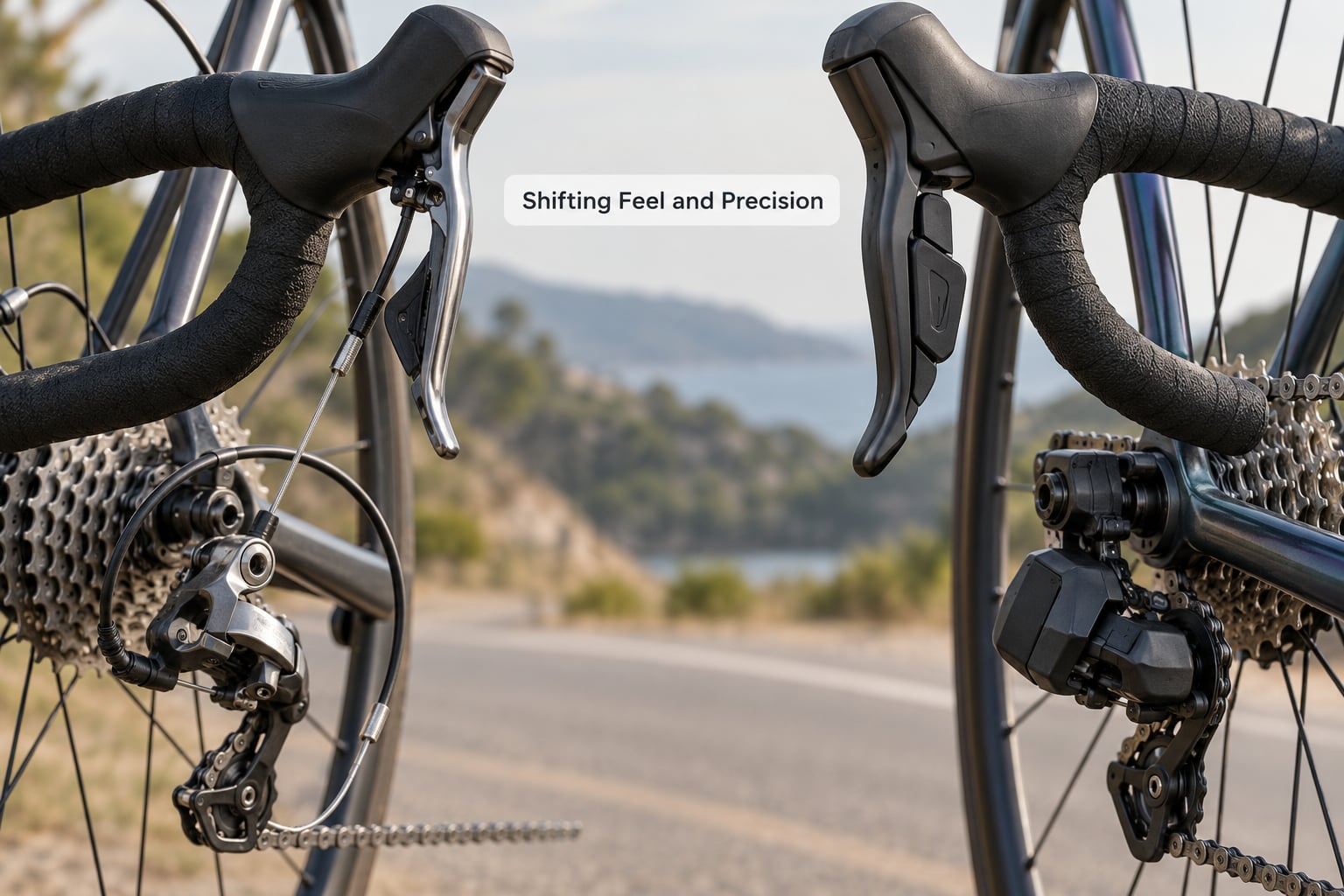
Electronic shifting is measurably faster and more repeatable. Mechanical shifting is more communicative. Those are different qualities, and which one matters more depends on how you ride.
Manufacturer and independent test figures put a Di2 shift under 200 milliseconds, with mechanical systems landing nearer 600 milliseconds once you include chain movement. In a sprint or a tight corner, that gap is the difference between a clean gear change and a chain that is briefly on two sprockets.
The more interesting advantage shows up over months. Mechanical indexing drifts with cable stretch, grit in the housing and dried-out grease, so a drivetrain that was crisp in April needs a barrel adjuster turn by August. Electronic indexing is positional, so it stays put — which is a large part of why riders describe an electronic bike as feeling the same on ride 50 as on ride one.
Electronic-only features add up in daily use. Multi-shift lets a long press skip several gears. Synchronized or auto-trim shifting moves the front derailleur automatically to stop chain rub, which is the single most common complaint from people who have just moved to electronic and are still used to picking their own gear line.
Where mechanical wins is feedback. A mechanical lever gives you a small positive click and a sense of how far the cable has travelled, and some riders genuinely prefer knowing what the mechanism is doing by feel. Electronic paddles are quieter and, to some hands, vaguer.
Accessibility cuts the other way, and this is where electronic gets recommended by riders you would not expect. Small buttons take far less hand strength than a long lever pull, and they work through thick winter gloves. Riders with reduced hand strength, numb hands or an injured thumb often find electronic the easier system, not the harder one.
Under load the difference shrinks. Shifting a mechanical drivetrain on a steep climb works perfectly well, and a well-set-up cable does not care how hard you are pushing. On a steady-load recovery ride, the two feel almost identical unless you are shifting constantly.
Electronic Shifting vs Mechanical Shifting: Reliability and Maintenance
This is the core distinction: mechanical systems need routine tuning and cable replacement; electronic systems need charging, firmware and physical protection of the components. Neither is maintenance-free — they just need different things.
A mechanical drivetrain’s maintenance is small and predictable. Cables stretch, housings fatigue, and shift quality fades with them. Velo’s tech editor reported riding a full year on Shimano GRX mechanical and never adjusting the shifting, while also reporting roughly three cable changes a year on a heavily ridden bike — both are ordinary mechanical realities, and how often you touch yours depends on your weather and your storage.
What actually goes wrong on a mechanical bike is mechanical: a frayed cable at the head tube, a sharp internal bend pinching the housing, grit washed into the mechanism, or a bent derailleur hanger from a knock. Every one of those is diagnosable by touch and fixable with tools most people own.
Electronic fault lists look different. Common complaints reported by riders include a battery that empties faster than expected, a derailleur that hesitates after a firmware update, a charger lost in a bag, and a connector or port that took water after a wash. The electronic shifting problems that reach forums are rarely dramatic — they are small, annoying and usually solved at home.
The honest risk with electronics is not failure but dependency. A dead battery means your gears stop changing until it is charged or swapped, and SRAM riders carry a spare battery in a saddle bag for exactly this reason. Some will move the front-derailleur battery into the rear unit to get home on whatever charge remains.
Crash damage is where the two split sharply. A bent hanger and a bent cable are an afternoon with hex keys. A bent hanger plus a motorised derailleur, a severed wire and a cracked battery mount is a much larger bill, and beginners crash often enough for that difference to decide the question.
Weight and Performance Differences
Comparing drivetrains by derailleur weight alone is the most common mistake here. What matters is the weight of the whole system, and it is not as one-sided as the numbers suggest.
An electronic groupset adds weight at the cockpit and at both derailleurs, and most of that comes from batteries, motors and housings that a mechanical group does not carry. On top of that, a wired system adds cable and junction boxes, while a wireless one trades them for radio transmitters and receivers.
The offsetting factor is what a mechanical bike does not have to carry. Electronic frames usually need mount points, ports and reinforced internal routing, and many mechanical builds carry a battery-shaped weight in the downtube to imitate that shape for frame compatibility. The gap between the two, measured as complete systems, is real but modest.
Performance differences are harder to measure than weight. Sustained power output over an hour is effectively identical, because your legs do that work. The electronic advantage shows up in the seconds around a change: faster shifts, less chain rub, less noise, and a drivetrain that stays where you put it.
Compatibility and Installation
Mechanical shifting drops into almost any frame. Cable stops, a hanger and a chainring bolts on, and a functioning drivetrain falls out. That is a genuine advantage on older steel bikes, modern aluminium frames with awkward routing, and anything built before ports became standard.
Electronic systems ask more of the frame. A wired group needs internal wiring channels, port access at the chainstay and shifters compatible with the frame’s cockpit. A wireless group removes the wire routing problem but keeps the shifter and derailleur compatibility requirement, and many frames need the manufacturer’s electronic-specific parts to be shaped correctly.
The awkward case is a frame designed for electronic, fitted with mechanical. Framebuilders report that retrofitted mechanical routing on such frames produces poor cable paths and kinks, which shows up as shifting that never quite settles. If you are assembling an electronic-ready frame, build it electronic.
Half-electronic builds exist and are worth knowing about. SRAM’s AXS shifters can be paired with mechanical brakes, giving you wireless shifting with a conventional lever feel, and you can run mechanical levers with an electronic rear derailleur. Brand mixing is real but constrained — within one brand, component compatibility is straightforward; across brands it is often not.
Can you convert? Technically yes, practically it is close to a full drivetrain swap. Shifters, derailleurs, wiring and often the chainset and cassette all have to match, so conversion rarely costs much less than buying a new group.
Cost to Buy, Maintain, and Upgrade
Mechanical shifting is cheaper at every stage, and the gap opens rather than closes over time. Cables, housing and a derailleur are inexpensive parts available in every shop and every online store, and a competent mechanic can service the whole system in under an hour.
Electronic shifting carries a higher purchase price, pricier replacement parts, and a battery that will need replacing eventually. Manufacturers quote batteries in hours of use, which is a moving target because cold weather, frequent shifting and a permanently lit head unit all draw more than idle riding does.
Set against that, an electronic drivetrain can cut the routine servicing that would otherwise eat into your budget. Over five years the maths depend almost entirely on how much you ride. Riders logging several thousand kilometres a year, or racing, get a much better return from paying the premium once than casual weekend riders do.
The upgrade path deserves its own warning. Moving from a mechanical group to electronic is rarely a shifter swap — it means new derailleurs, wiring, and usually a new chainset and cassette to match the mount standard. Do the whole thing at once or not at all, and check that your wheels and frame take the electronic drivetrain before you buy anything.
Long-term availability is worth thinking about. Velo has documented 2009 Dura-Ace Di2 groupsets still in service decades later, which is real evidence that electronic hardware can outlive expectations. Against that, buying a used electronic bike means asking about battery health and whether the brand still issues firmware support for that generation.
Prices move around between brands, retailers and seasons, so treat every figure you read as a snapshot and check current listings before deciding.
Which Should You Choose?
Choose mechanical shifting if any of these describe you.
- You want the cheapest way into a good drivetrain. The saving at purchase is large, and parts stay affordable for the life of the bike.
- You ride far from a shop. Cables can be fixed by the side of a road with a multitool; a motor or a dead battery cannot.
- You enjoy maintaining your own bike. Indexing and cable work is learnable, and the satisfaction is real.
- You ride classics, steel or touring bikes. Mechanical fits older frames and rim-brake builds with no compromise.
- You are a beginner who crashes. Crash repair costs far less on a mechanical drivetrain.
Choose electronic shifting if any of these apply instead.
- You ride most days in mixed weather. Sealed, self-indexing parts shrug off mud and grit that ruin cable tension.
- You want shifting that never needs adjusting. The shift quality stays identical for years without service.
- You race or ride at tempo. Faster shifts and auto-trim remove hesitation under pressure.
- You shift constantly on gravel. Long climbs and technical descents reward a drivetrain that lands where you put it.
- Gloves, cold hands or reduced grip strength are part of your picture. Buttons need less effort than a long lever pull.
- You barely touch the bike. No cables, no tuning, no annual service booking for shifting.
And if your bike already has a good mechanical group that shifts cleanly, replacing it with electronic is one of the least satisfying upgrades available. Fix the cables instead.
Frequently Asked Questions
Are electronic shifters better than mechanical shifters for road cycling?
For most road riders, yes. Electronic shifting is faster, self-indexing and needs almost no routine adjustment, so the drivetrain feels identical after a wet winter as it did in spring. Mechanical shifting is still the better pick for tight budgets, remote riding and anyone who wants cheap, in-the-field repairs. The real question is not which is more advanced, but how far you ride from a shop.
How often do electronic bike shifters need charging?
Usually once every few long rides. SRAM quotes roughly 20 to 25 hours of ride time for its AXS system, while Shimano frames the same thing in distance covered, typically around 1,000 km per charge. Cold weather, frequent shifting and a head unit left switched on all shorten that. Riders who cover long distances alone keep a spare battery in a saddle bag, which takes seconds to swap.
Can I convert my road bike to electronic shifting?
It is possible, but it is rarely cheap. Converting means new shifters, both derailleurs, wiring or receivers, and usually a chainset and cassette to match the mount standard, so the bill approaches the cost of a complete groupset. Your frame also needs electronic-compatible routing or port access. On a frame built for mechanical parts only, the conversion rarely works well.
Do electronic gears shift more consistently than mechanical gears?
Yes, and consistency is the real advantage. A mechanical derailleur depends on cable tension, which drifts as cables stretch, housings fatigue and grit gets into the mechanism, so shifting quality fades between services. An electronic derailleur positions itself to a programmed setting and corrects automatically, so indexing stays identical until the battery runs down.
Are mechanical shifters easier and cheaper to maintain?
Both, by a wide margin. Servicing a mechanical drivetrain means indexing tweaks and replacing cables and housing, usually under an hour with basic tools, and the parts are inexpensive and sold everywhere. Electronic systems need charging, occasional firmware updates and more expensive replacement components, and fewer shops are set up to work on them.
What happens if an electronic derailleur or battery fails?
Your gears stop changing until the problem is sorted. A flat battery is the easy case: charge it or swap in a spare, and shifting returns. A failed motor, water in a connector or a derailleur damaged in a crash is harder, usually needs a replacement part, and may mean no shifting until a shop can fit it. Mechanical failure is slower but almost always fixable roadside.
Conclusion: Make the First Choice by Your Riding Priorities
Electronic shifting gives you faster, repeatable shifts and almost no upkeep. Mechanical shifting gives you cheaper parts, roadside repairability and a drivetrain any shop in the world can service. That trade-off is the whole argument.
So start with your riding rather than with the gear count. Decide how far you are from help, how many kilometres you cover, how often you crash and whether you want a bike that never needs adjusting or one you can service yourself. Set your budget around that answer, and check that your frame and wheels take the drivetrain you have chosen before you spend anything.
Whichever way you go, buy the bike you will actually want to ride at 7am on a wet Tuesday. That matters more than either system.