If you have ever wondered what is cross chaining and why avoid it, the short answer is simple: cross-chaining is running your chain at an extreme diagonal across the drivetrain, either the big chainring with the largest rear cog or the small chainring with the smallest one. Riders avoid it because that angle makes the chain articulate harder, rub, wear faster and, on a narrow-wide ring, occasionally drop off.
Most of the strong warnings you will read online exaggerate it. A few seconds in an extreme gear will not wreck a drivetrain, but a habit of riding big/big or small/small the whole way up a climb will quietly shorten the life of the parts you paid the most for.
Last reviewed for 2026 by the Diablocyclists tech desk. Everything below reflects what mechanics and riders actually report, not what the manuals warn about.
Table of Contents
- What Is Cross-Chaining and Why Avoid It?
- How Cross-Chaining Creates an Extreme Chain Line
- Why Avoid Cross-Chaining on a Road Bike?
- What Is Cross-Chaining and Why Avoid It in Practice?
- How to Shift Smoothly Without Cross-Chaining
- What to Do If You Have Already Cross-Chained
- Frequently Asked Questions
- Is occasional cross-chaining bad for a road bike?
- Can cross-chaining damage the derailleur or cassette?
- Is cross-chaining okay during a race or long climb?
- What is the difference between cross-chaining and a cross-chained drivetrain?
- What gear should I use instead of cross-chaining on a climb?
- Conclusion
What Is Cross-Chaining and Why Avoid It?
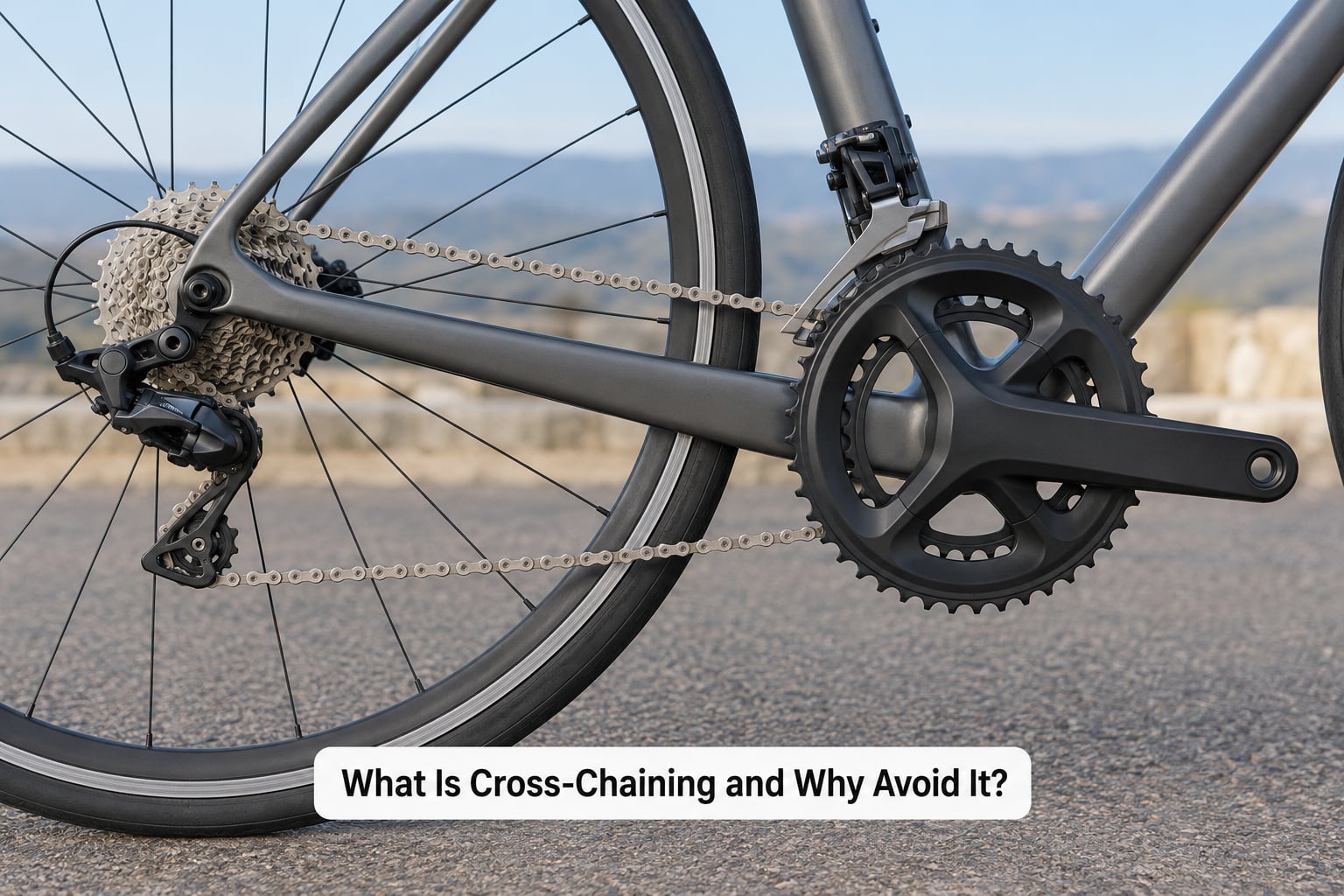
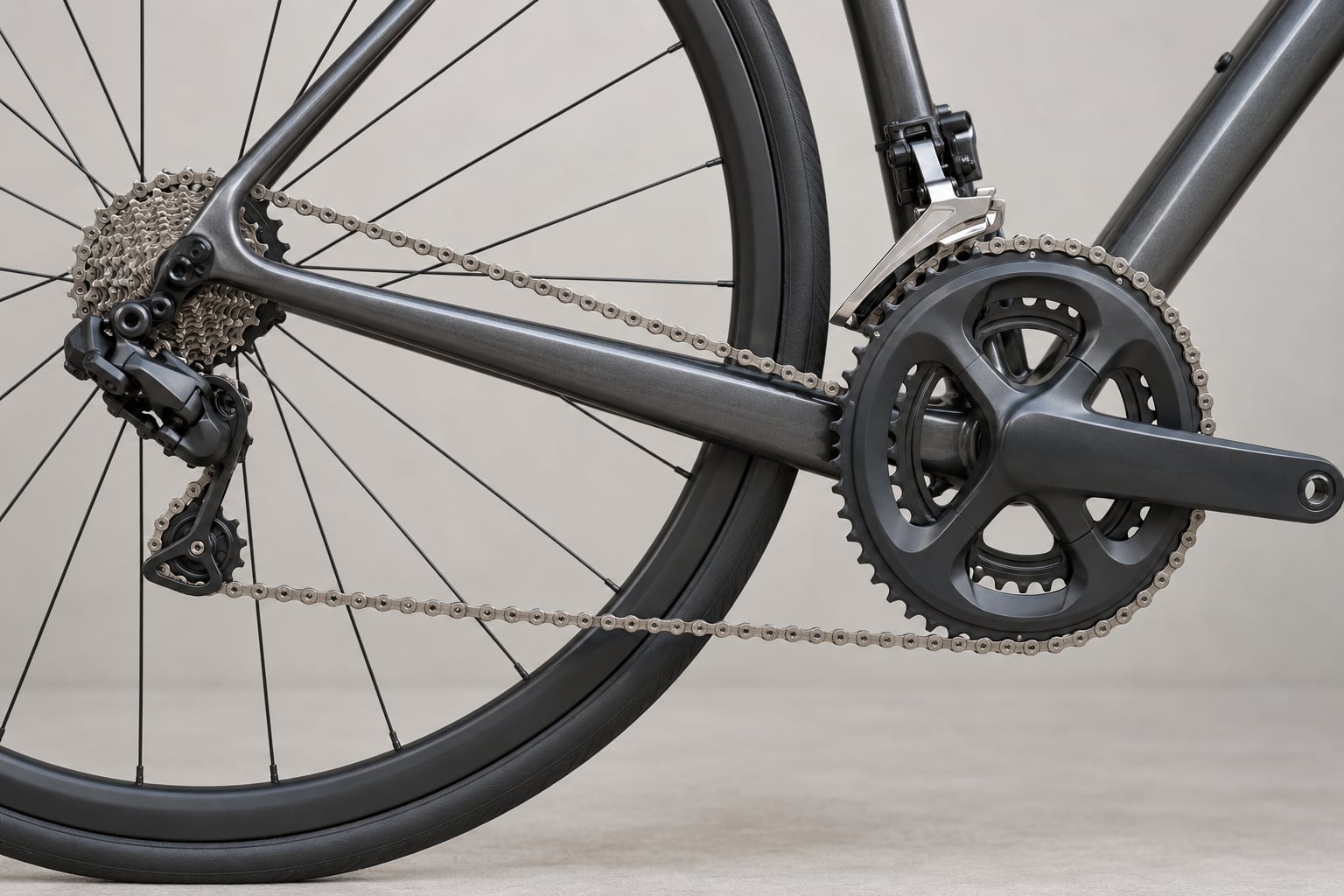
Cross-chaining means combining the chainring and cog that sit at opposite ends of the same axis, which forces the chain to run as diagonally as the frame allows. There are exactly two combinations that count as cross-chained:
- Big/big – the largest chainring driving the largest rear cog. This is the easiest gear and the flattest chain angle.
- Small/small – the smallest chainring driving the smallest rear cog. This is the hardest gear and the steepest chain angle.
The reason to avoid them is geometry, not superstition. Bicycle drivetrains are built around a straight chain line, and the further you stray from it, the more sideways force the chain has to absorb on every pedal stroke.
Road forums tend to repeat a useful phrase: cross-chaining is bad, but it is not disastrous. BikeForums and r/BikeMechanics threads agree on the direction of the effect and disagree loudly about the size of it.
How Cross-Chaining Creates an Extreme Chain Line
Chainline is the straight line between the centre of the chainring and the centre of the cog you are running on. On a double crankset that line is only perfectly straight on the middle cogs, and the design of the frame decides how much of the cassette sits off that line.
On a standard double such as 53/39, the big ring lines up reasonably well with the middle of the cassette, so the outer cogs are the only awkward ones. A compact double such as 50/34 pulls that window forward, which means the small ring is straight in the middle of the cassette rather than the big ring. Triples make it worse because there are three front positions and only one straight line to find.
| Drivetrain | Ride it here | Minimize this | Never |
|---|---|---|---|
| Compact double 50/34 | Small ring with the middle cogs | Small ring on the two smallest cogs | Big ring on the largest cog |
| Standard double 53/39 | Big ring with the middle cogs | Big ring on the two largest cogs | Small ring on the smallest cog |
| Triple 52/39/30 | Each ring with its middle cogs | Outer ring on the outermost cogs | Small ring on the largest cog, big ring on the smallest |
| 1x | Every gear, no exception needed | Nothing to avoid | There is no front chainline to misalign |
The familiar rule of thumb from a roadbikereview thread works well in practice: avoid the two smallest cogs in the small ring and the two largest cogs in the big ring. Everything between those is a working compromise, not a mistake.
Why Avoid Cross-Chaining on a Road Bike?
Four things get worse when the chain runs at a steep angle: articulation wear on the chain, noise and rub, drivetrain efficiency, and the risk of a chain coming off on a gated ring. The first is real but gradual; the last one is rare but sudden.
Mechanics on r/BikeMechanics describe the mechanism more precisely than most vendor pages do. A chain only articulates where it changes direction, so an angled chainline forces the side plates to bend further around the pins and rollers on every joint that engages. That extra flexing is what accelerates pitch elongation, and a stretched chain is the single biggest reason a cassette wears out.
The other three effects are easier to feel from the saddle. Rubbing against the front derailleur cage makes a distinctive noise, and it is usually the first symptom that tells a rider something is off. Efficiency loss is small but real, since a chain deflected sideways does not transfer power as cleanly as one running straight. And on a narrow-wide or gated chainring, where the teeth are shaped to trap the chain, a badly angled chain can climb off under load.
Chain wear is cumulative, not catastrophic. A dropped chain is a single bad moment, and it is the one that can take out a derailleur hanger.
What Is Cross-Chaining and Why Avoid It in Practice?
In practice, avoiding cross-chaining is less about purity and more about not letting the chain sit at its limit. On rolling terrain with a compact double, staying in the straight window means shifting the front ring often, and riders find that tiring.
Most experienced riders settle for a compromise: stay off the two outermost cogs in whichever ring you are on, and change front rings when the road tilts rather than when the gears run out. On a long climb, staying on the small ring through the middle cogs usually gives you a workable range without touching the extremes.
Brief cross-chaining is acceptable in the situations where there is no better option. Standing starts on a wall, a sudden surge when someone attacks, wet gravel, or the moment after you have shifted and are waiting for the chain to settle are all normal riding, not drivetrain abuse.
How to Shift Smoothly Without Cross-Chaining
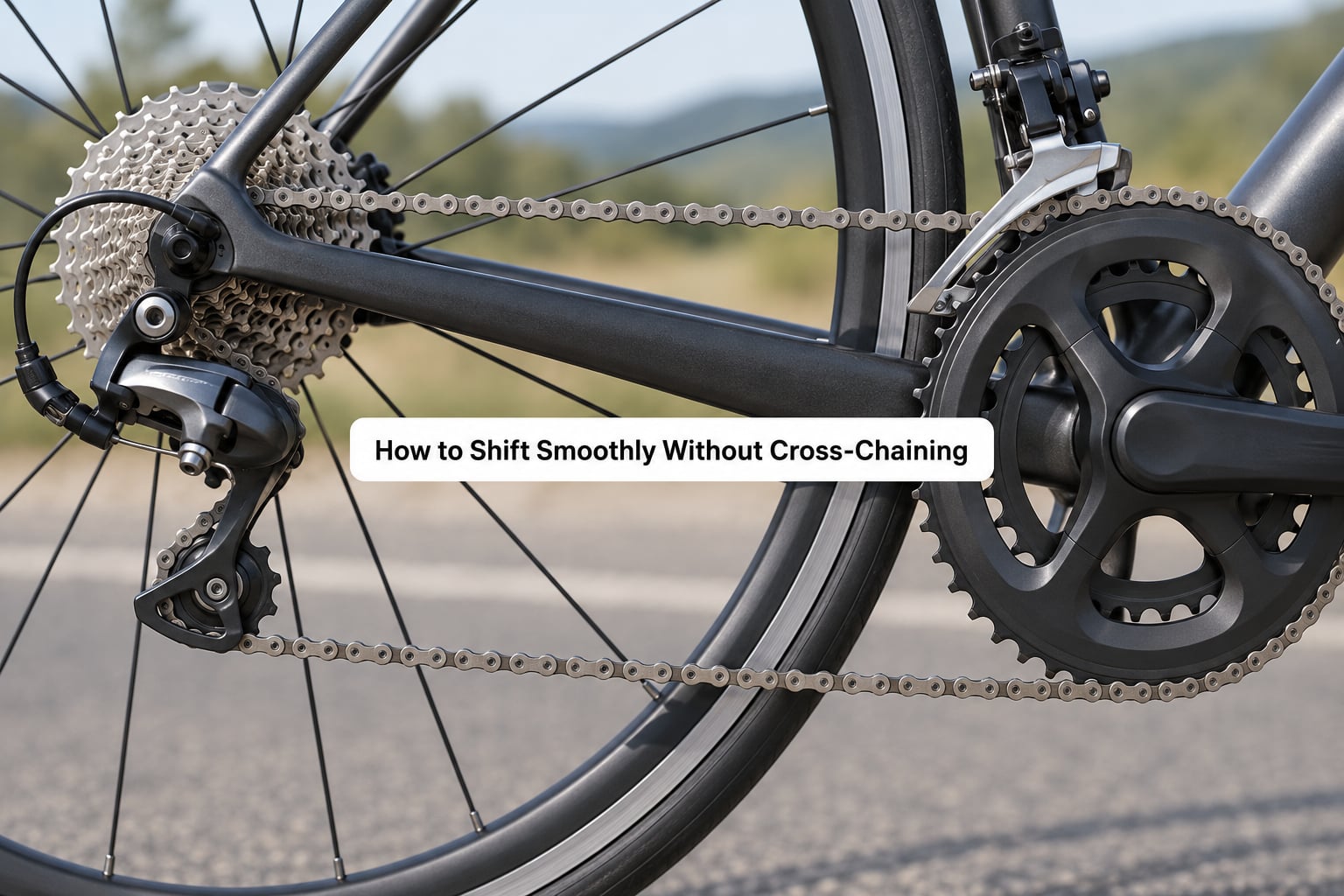
The fix is planning the shift before you need it rather than reacting to a gear that has run out. Most cross-chaining happens because a rider is out of gears on a surprise gradient and grabs the nearest combination.
Work through these habits and the angled combinations largely disappear:
- Shift the front ring early. Move to the small ring as the road starts to steepen, while you are still pedalling easily, not when the chain is grinding.
- Unload before shifting under load. Ease off the pedals for a moment through the front change and the chain moves far more cleanly.
- Avoid pairing a front shift with an extreme rear shift. Do one at a time and give each change a second to settle.
- Hold a steady cadence. Most riders find 80 to 100 RPM covers nearly all road terrain with a compact double, which removes most of the pressure to reach the extremes.
- Trim the front derailleur. Shimano 2×11 and 2×12 derailleurs have a second trim setting on the big ring that moves the cage inboard, reducing the angle at the top of the cassette.
None of this needs to be perfect. A front trim setting that has never been adjusted is a common reason riders cannot hold a straight line even when they are trying to.
What to Do If You Have Already Cross-Chained
Nothing, in most cases. A ride that included some cross-chaining leaves no visible damage and needs no replacement parts, because the wear it adds is measured in thousands of kilometres rather than minutes.
Inspect the chain if the shifting felt rough after the ride, or if you were in an extreme gear when something went wrong:
| Symptom | Likely cause | What to do |
|---|---|---|
| Chain rub on the front derailleur cage | Cage too close or too far for the gear combination | Set cable tension and barrel adjuster so the gap is even; add trim on the big ring |
| Rough or slow shifting under load | Chain stretched, or indexing off after a cable or housing change | Measure chain wear, re-index, replace the chain if it is past 0.5% |
| Chain dropped into the spokes or off the ring | Angled chain on a narrow-wide ring, or a damaged cage | Inspect chain and hanger, check hanger alignment, avoid the outermost cog on that ring |
| Pointy chainring teeth and uneven cassette wear | Long-term cross-chained riding combined with a worn chain | Replace the chain first, then judge whether the cassette still holds up |
A chain wear gauge is the only measurement that matters here. Replace the chain at around 0.5% stretch and immediately at 0.75%, and a lot of the worry about past cross-chaining simply stops mattering, because you are measuring the chain instead of guessing.
If the shifting is clean, the noise is gone and nothing bent, ride the bike. If the hanger is visibly out of alignment, that is a shop job, not a roadside adjustment.
Frequently Asked Questions
Is occasional cross-chaining bad for a road bike?
No. A few seconds in big/big or small/small will not damage anything you can measure. The wear from cross-chaining accumulates with distance, so a rider who crosses chains for a few seconds on a climb is fine. It becomes a problem as a habit across hundreds of kilometres, which is why riders are advised to avoid it.
Can cross-chaining damage the derailleur or cassette?
The derailleur is at risk only in the dropped-chain scenario: an angled chain on a narrow-wide ring can come off, and a fall from that can bend the hanger. The cassette suffers gradually, because a chain forced sideways articulates more sharply and stretches faster, shortening cassette life. Nothing here happens in a single ride.
Is cross-chaining okay during a race or long climb?
Yes, when there is no sensible alternative. Racing on a compact double often means holding the small ring through the middle of the cassette and occasionally reaching for an extreme gear when the gradient spikes. What is not okay is sitting in the outermost cog for most of the race because the front ring was never shifted.
What is the difference between cross-chaining and a cross-chained drivetrain?
Cross-chaining is a gear choice at a moment in time, and you can change it with one shift. A cross-chained drivetrain describes a bike that is set up so the chain runs badly in most gears, usually because of a bent hanger, a mis-set front derailleur or a frame with poor clearance. The second needs a shop, the first needs a shift.
What gear should I use instead of cross-chaining on a climb?
On a compact double, stay on the small ring and use the middle cogs of the cassette, then move to the big ring only on the flatter sections. If you still cannot hold a comfortable cadence on the small ring, the cassette range is the limit, not the chain angle. Rule of thumb: stay off the two smallest cogs in the small ring.
Conclusion
Cross-chaining is the extreme diagonal the drivetrain was never designed to run, and avoiding it is about keeping the chain near its straight line. The wear is real but gradual, so treat it as a habit to correct rather than a mistake to panic about.
Start with three things. On climbs, drop to the smaller chainring early and stay in the middle cogs of the cassette. Shift the front ring when the road changes rather than when the gears run out, and keep a steady cadence so you never need the extremes. Then take a chain wear gauge to the bike, because a measured chain tells you more than any argument about a few seconds of angled riding.
A shop check only makes sense if something actually went wrong: a dropped chain, a bent hanger, or shifting that stays rough after the cable tension and front trim have been set.