VO2 max intervals for cyclists are short, hard efforts of about two to five minutes with equal or near-equal recovery, run at roughly 106-121% of FTP for 15 to 30 total minutes of work per session. Ride them once or twice a week at most, after a proper warm-up, and treat the session as a dose you finish rather than a race you win.
Plenty of riders take this workout for granted and then spend months wondering why their watch says they are barely improving. This guide covers what the session actually trains, how hard each effort should feel, which interval length to pick, and how to run one properly on the bike.
Table of Contents
- What Are VO2 Max Intervals for Cyclists?
- How Do VO2 Max Intervals Improve Aerobic Performance?
- How Hard Should a VO2 Max Interval Feel?
- How Long Should Each VO2 Max Effort Last?
- How Often Should Cyclists Do VO2 Max Intervals?
- Which VO2 Max Interval Format Should Cyclists Use?
- How Do You Do VO2 Max Intervals on the Bike?
- What Do You Need to Perform VO2 Max Intervals for Cyclists?
- How Do You Progress VO2 Max Training Without Overtraining?
- What Common Mistakes Make VO2 Max Intervals Less Effective?
- Frequently Asked Questions
- Are VO2 max intervals the same as threshold intervals?
- How hard is a proper VO2 max interval for a recreational cyclist?
- Can I do VO2 max workouts without a power meter?
- How long should I recover between VO2 max intervals?
- How long does it take to see fitness gains from VO2 max training?
- What is the 75% rule in cycling?
- Conclusion: Start With One Controlled Session
What Are VO2 Max Intervals for Cyclists?
VO2 max is the maximum rate at which your body can take in and use oxygen during exercise, measured in millilitres per kilogram per minute. VO2 max intervals are the workouts that repeatedly push oxygen uptake up to that ceiling and hold it there for a few minutes at a time.
They are not the same as threshold work. Threshold training sits at the power you can hold for about an hour, and it raises the ceiling on sustainable speed. VO2 max work sits above that, at a power you could only sustain for minutes, and it pushes the aerobic ceiling itself upward. Sprint training is shorter still, under roughly 30 seconds, and builds anaerobic power rather than aerobic capacity.
The confusion is understandable, because both threshold and VO2 sessions feel hard and both land in zone 4 or zone 5 on most watches. The practical difference is intent. Threshold work is paced and controlled. VO2 work is uncomfortable by design, and the discomfort arrives around the two to three minute mark of each effort.
Who should be doing them? Recreational and club riders with several months of consistent riding, a sensible aerobic base, and a reasonably fresh FTP number. If your longest ride is still an hour and a half, spend eight to twelve weeks on steady zone 2 and threshold work first. There is no point trying to raise a ceiling you have not built yet.
How Do VO2 Max Intervals Improve Aerobic Performance?
Each hard effort spends oxygen faster than the body can resupply it, and the adaptation is to raise the ceiling rather than the sustainable pace. Repeat that regularly and several things change in your favour.
Stroke volume and cardiac output improve, so the heart moves more blood per beat at the same effort rate. Capillary density in the working muscles grows, which shortens the distance oxygen travels. Mitochondrial density rises, giving the legs more machinery to hold a high rate inside the aerobic range, and blood volume increases so oxygen is carried rather than diluted.
The dose that tracks the adaptation is time spent near the ceiling, usually expressed as time above 90% of VO2max. A twenty-minute session with lots of easy recovery between efforts and fifteen minutes at genuinely hard effort beats forty minutes of drift, because the hard minutes are where the signal lives.
VO2 max is also not the only number that matters. Threshold power, economy, skill, positioning and tactics decide races as much as aerobic capacity does, and raising the ceiling by a few millilitres will not rescue a rider who cannot hold a wheel on a climb. Treat VO2 work as one part of a plan that includes endurance miles, threshold work and recovery.
How Hard Should a VO2 Max Interval Feel?
Expect an RPE of 8 at the start of a rep and 9 to 10 by the last one. In power terms that is about 106 to 121% of FTP, in heart rate terms roughly 88 to 95% of maximum, and in cadence terms 85 to 100 rpm. Anything you can hold a full conversation through is too easy; anything that makes your vision narrow in the first minute is too hard.
| Measure | Target range | What it feels like | Typical use |
|---|---|---|---|
| Power | 106-121% of FTP | Comfortably above threshold pace | Opening and holding each rep |
| Heart rate | 88-95% of max HR | Rising through the first 60-90 seconds | Confirming you reached the zone |
| RPE (1-10) | 8 first rep, 9-10 last rep | Three or four words between breaths | Works with or without a power meter |
| Cadence | 85-100 rpm | Quick, tall, slightly breathless | Keeps the heart rate climbing |
| Work-to-rest ratio | 1:1 or longer | Enough recovery to repeat the effort | Determines quality of every rep |
For a rider sitting at 300 watts FTP, 106% is about 318 watts and 121% is about 363 watts. A set of six three-minute efforts at the lower end of that band gives 18 minutes of quality work without the early fade that comes from starting at the top.
Use power to open the interval and let heart rate catch up. Heart rate is a lagging indicator, and riders who chase it blow the first half of the effort and never reach the zone at all. Power holds the intensity steady while heart rate ramps into it over the first minute or so.
How Long Should Each VO2 Max Effort Last?
Two to five minutes is the useful range, with three to four minutes the most reliable starting point. Shorter efforts build repeatability and let you fit more volume into a session, while efforts of six minutes or more drift toward threshold intensity and stop training the aerobic ceiling. What matters most is total hard time, roughly 15 to 30 minutes, not one universal interval length.
| Effort length | Structure | Main purpose | Who it suits |
|---|---|---|---|
| 30 seconds | Many reps, short active recovery | Repeatability and neuromuscular freshness | Riders building work capacity or recovering from illness |
| 1-2 minutes | 8-12 reps, equal recovery | Time in zone with less mental cost | Masters riders and anyone returning to hard training |
| 3-4 minutes | 4-6 reps, equal recovery | The classic adaptation dose | Most riders most of the time |
| 5 minutes | 4-5 reps, 5 minutes recovery | Deeper stimulus, higher cost | Trained riders in a build phase |
| Decreasing | Long reps that get shorter as power rises | Volume plus top-end intensity | Late block and race-specific preparation |
The research here is genuinely mixed, and anyone who tells you otherwise is selling something. Rønnestad and colleagues compared short 30-second efforts with 15 seconds recovery against longer efforts in trained cyclists and reported substantially more time above 90% of VO2max for the short protocol, around six minutes fifty seconds versus four minutes forty-six. Vaccari’s group found a similar pattern with decreasing intervals, five minutes twelve seconds versus three minutes two. On the other hand, Seiler’s work found that longer efforts at a slightly lower intensity outperformed shorter, harder efforts in endurance-trained athletes.
Rather than pick a side, periodise. Longer efforts of four to eight minutes early in a block, shorter or decreasing efforts as the racing season approaches, and one to two sessions a week throughout. For most riders that also keeps the sessions sustainable, which matters more than any protocol’s theoretical ranking.
How Often Should Cyclists Do VO2 Max Intervals?
Once a week for recreational riders, twice a week maximum, with at least 48 hours between hard sessions. Trainers and coaches usually keep a single weekly session, because the second one is easy to make into a threshold effort by accident and then you have stacked hard days with no recovery between them.
Placement in the week matters more than the exact day. Two hard efforts back to back will do more harm than the fitness gained from the second one. Keep the days either side genuinely easy, and put the session after a rest day or after a long, slow ride so the legs are rested but not flat.
In a three-week loading cycle, a common pattern is two VO2 sessions in week one, two in week two, then a week with one or none before the next load. If you are riding a masters’ race, a gravel event and a club time trial in the same fortnight, drop the second session. Hard racing counts as training load, and it counts heavily.
Which VO2 Max Interval Format Should Cyclists Use?
Pick a format you can finish and repeat in six weeks, then adjust the length and volume as the block progresses. Standard sets, short on and offs, long hill repeats, over and unders and mixed power sessions each train something slightly different.
| Format | Example session | Strength | Trade-off |
|---|---|---|---|
| Standard sets | 4×4 min at 115% FTP, 4 min recovery | Simple, repeatable, easy to pace | Can become boring and predictable |
| Short on and offs | Two sets of 13 x 30s hard, 15s recovery | Most time in zone, low perceived cost per rep | Hard to hold real power on the short efforts |
| Long hill repeats | 4×8 min at 95-100% FTP on a climb | Lower power, steady effort, race feel | Eight minutes risks slipping into threshold |
| Over and unders | 4×5 min alternating 5s at 120% and 55s at 100% | Builds tolerance of surges inside a steady effort | Too complex when fatigued |
| Mixed power | 3×3 min at 106%, then 2×3 min at 118% | Two intensities in one session | Needs an honest sense of current fitness |
How Do You Do VO2 Max Intervals on the Bike?
Run the session in the same order every time so that warm-up, set and cool-down become automatic.
- Warm up for 15-20 minutes. Steady riding below threshold, then two or three 20-second openers at around 105% FTP with full recovery between them. Openers wake up the fast-twitch fibres so the first rep is not the one where your legs remember how to sprint.
- Check your targets before you start. Confirm the FTP number you are using is current. A stale FTP is the most common reason a session feels flat or breaks riders early.
- Complete a 30-second power check. Sit in the saddle, hold the target watts for half a minute, and note your cadence and heart rate. This is the baseline you compare against at the end of each rep.
- Hold the target, not the maximum. Aim for the middle of your power band, not the top of it. Cadence in the 85-100 rpm range keeps the heart rate rising instead of settling.
- Regroup fully in recovery. Pedal easily or stand out of the saddle. If heart rate is still above roughly 80% of maximum when the next rep starts, shorten the set rather than pushing on.
- Cool down for 10-15 minutes. Easy spinning, then refuel. A session that ends with a hard effort gives you a much worse night than the workout deserved.
If your power drifts up while your heart rate lags, you went out too hard. If heart rate never comes up despite hitting the numbers, check cadence, heat, hydration and how rested you are. None of those adjustments require new equipment.
What Do You Need to Perform VO2 Max Intervals for Cyclists?
A reliable bike, a safe place to ride, and honest knowledge of how hard the session should feel. Everything else is optional.
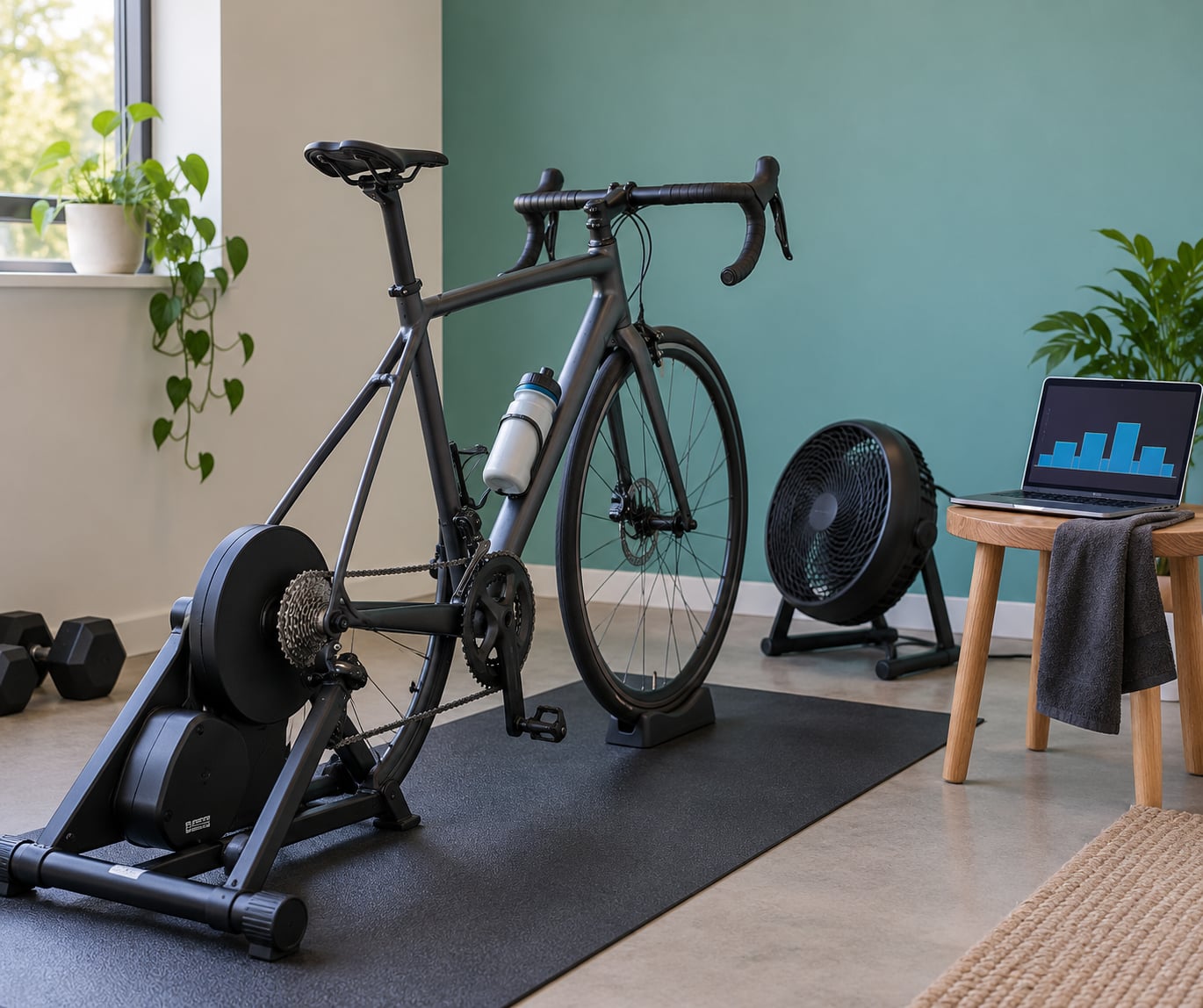
A power meter makes this training far easier, because the targets stop being guesses. A heart-rate monitor is worth adding but should confirm the session rather than drive it, since heart rate lags badly at this intensity. A trainer with controllable resistance, or ERG mode on a smart trainer in Zwift, removes headwind and gradient as variables and is useful in bad weather.
A fan matters more than most riders expect. On a trainer, a strong fan keeps heart rate lower and closer to what you would hit outdoors. Drink before you are thirsty, and have recovery food within the hour after the set.
A training log is the last piece and the one most riders skip. Write down the format, the target power, the RPE at the end of each rep and how you felt. That record is how you catch a bad FTP number or an overreaching week early.
You do not need a lab test, a VO2 max smart ring or any supplement to benefit from this training. Tenors and other mid-workout capsules marketed at VO2 sessions are not required for the adaptation.
How Do You Progress VO2 Max Training Without Overtraining?
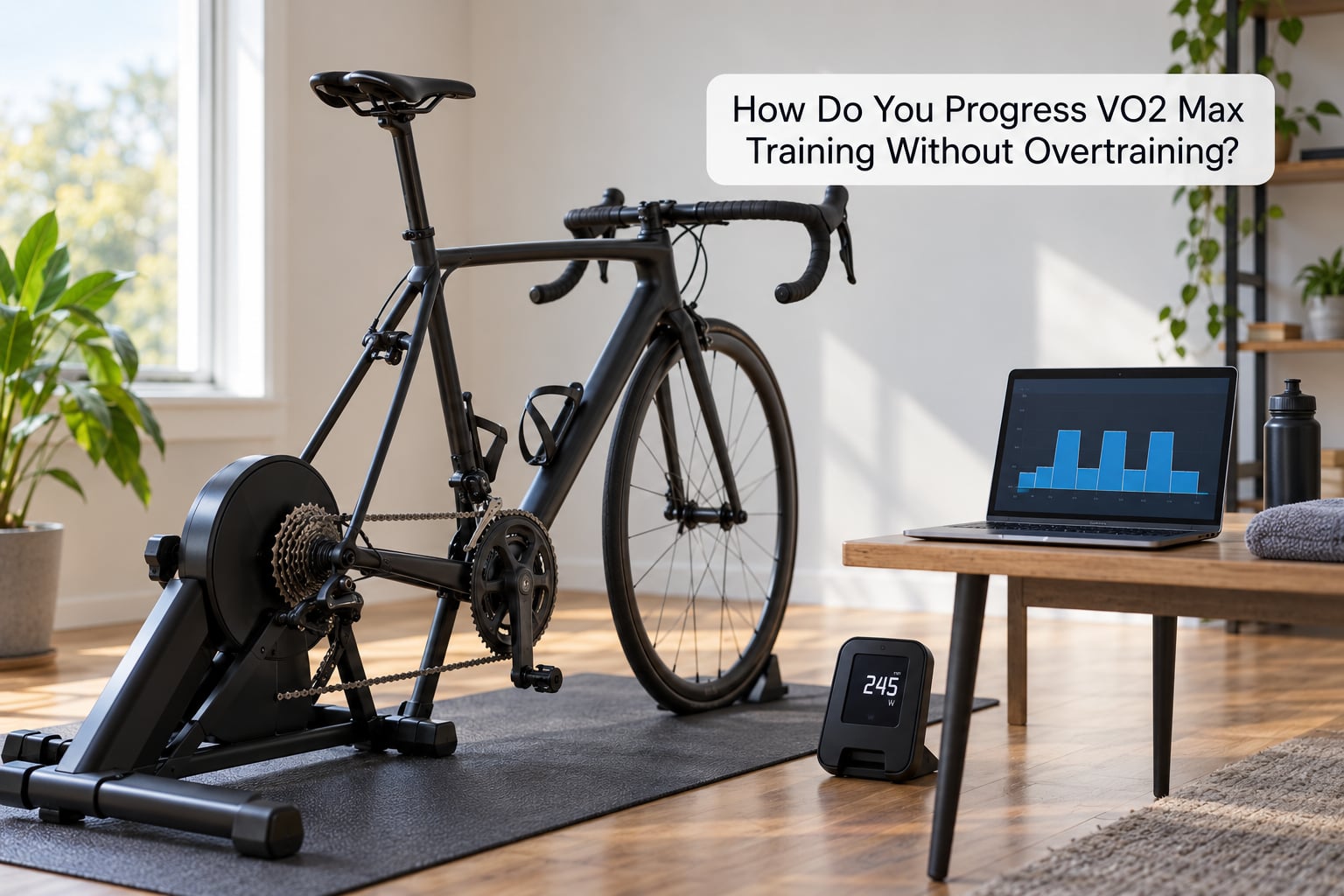
Progress one variable at a time and keep the total time in zone steady or rising slowly. A four-week block looks like this: week one establishes the format at the lower end of your power band, week two adds reps or lengthens each rep, week three increases power slightly, week four reduces volume before a retest.
Keep the work-to-rest ratio at 1:1 or longer throughout. Shortening recovery to squeeze in more reps is the most common way riders turn a productive session into a grinding one that takes four days to recover from.
Hold or reduce load when resting heart rate is elevated for several days, when the same session that felt like RPE 8 last month feels like RPE 9, when sleep degrades, or when you miss a session twice in a row. Two consecutive poor sessions is a clear signal, not a mild one.
For riders over 50, shorter efforts of one to two minutes with generous recovery let you reach and hold the target heart rate without the recovery cost that wrecks a five by five. Expect a slower return to form after hard blocks, and protect the days after.
Mountain bikers face a different constraint. Short on and offs of 15 to 60 seconds match how technical terrain actually demands power, and they keep heart rate in the target zone better than long efforts do. Pair them with one longer set per week rather than choosing one format only.
What Common Mistakes Make VO2 Max Intervals Less Effective?
Starting the first rep too hard. The first effort decides how many you finish. Open at the lower end of the band and let heart rate climb into it.
Chasing a stale FTP number. If FTP is six months old, every percentage based on it is off. Re-test or use RPE as your primary guide until you have a current number.
Riding every workout hard. VO2 work is a top-tier effort once or twice a week. Everything around it should be easy, or the session stops being a stimulus and becomes accumulated fatigue.
Shortening recovery to finish more reps. Quality per rep matters more than rep count. A 4×4 set with full recovery beats eight reps of the same length with half the recovery.
Skipping the warm-up. Without openers, power output drops through the set and the session becomes an endurance effort with hard moments.
Fearing the work so much that you underdo it. A session that felt merely unpleasant usually was not hard enough. The forum consensus is blunt about this: if it never became genuinely awful, nothing was trained.
Ignoring recovery signs. Persistent fatigue, poor sleep and rising resting heart rate are information. Cut the second session of the week and take the easy week you were already considering.
Frequently Asked Questions
Are VO2 max intervals the same as threshold intervals?
No. Threshold intervals sit at the power you can hold for about an hour, usually around 88-95% of FTP, and they improve your sustainable pace. VO2 max intervals sit above that at roughly 106-121% of FTP for two to five minutes, pushing the aerobic ceiling itself upward. Many watches label both as zone 4 or zone 5, which is why riders mix them up.
How hard is a proper VO2 max interval for a recreational cyclist?
It should feel like an 8 out of 10 at the end of the first rep and a 9 or 10 by the last one. In numbers that is about 106-121% of FTP, with heart rate rising through the first minute or two. If you can speak a full sentence during the effort, it is too easy. Most recreational riders finish a hard session having ridden well past what they planned.
Can I do VO2 max workouts without a power meter?
Yes, and the session still works. Use an RPE target of 8 to 10, ride on flat quiet terrain or a trainer, and keep heart rate between roughly 88 and 95% of your maximum. Cadence in the 85-100 rpm range helps heart rate climb properly. Power makes the targets repeatable rather than guesswork, so adding a meter later makes progression easier.
How long should I recover between VO2 max intervals?
Use equal time to the effort or longer, so a 1:1 work-to-rest ratio at minimum. Four-minute efforts usually pair with four minutes of easy recovery, three-minute efforts with three minutes or more. The test is simple: your heart rate should have come down before the next rep starts. If it is still high, cut the set rather than shortening the recovery further.
How long does it take to see fitness gains from VO2 max training?
Most riders notice something in four to eight weeks of consistent work, and stronger time trial or climbing results in a season or two when the sessions sit alongside steady endurance riding. The gains show up as holding a higher power for longer rather than as a single dramatic day. Progressing the FTP estimate on your watch is usually the earliest sign that it worked.
What is the 75% rule in cycling?
It is a coaching guideline suggesting that if your FTP estimate has risen by more than about 5% over a recent training block, the number is probably too high. Many riders find a 10% rise and pull the estimate back down to somewhere closer to a 5% increase. It is a rough sanity check on a watch estimate rather than a laboratory measurement, so treat it as a prompt to re-test properly.
Conclusion: Start With One Controlled Session
The safest first step is a single four-by-four-minute session at about 110-115% of a current FTP, four minutes easy between reps, with 15 to 20 minutes of warm-up including a couple of openers. Note the RPE after each rep so you know whether that was genuinely hard work or a comfortable ride.
VO2 max training works best as an addition to a week built around steady endurance riding, not as a replacement for it. Start with one session, keep 15 to 30 minutes of hard work as the dose, and protect the days around it. Done consistently for a block, it raises the ceiling that every other part of your riding depends on.