Interval training workouts for cyclists are structured sessions that alternate hard efforts with controlled recovery, and the numbers matter more than the theory. Below you will find ten sessions with the exact sets, reps, work interval, rest interval, target zone and total time, plus how to scale each one down when you are tired.
Each workout runs about 45 to 75 minutes including warm-up and cool-down. If you have a power meter, target the zone listed in the table. If you do not, every workout here still works using rate of perceived exertion on a 1 to 10 scale, and I have spelled out what that feels like.
Treat every interval as a short time trial. Start each repetition evenly, hold the effort, and resist the urge to go out harder than the first one.
Table of Contents
- Interval Training Workouts for Cyclists at a Glance
- How these interval training workouts for cyclists fit a training week
- 1. 4 x 4-Minute VO2 Max Intervals
- 2. 8 x 30-Second Sprint Intervals
- 3. 3 x 10-Minute Threshold Intervals
- 4. 5 x 5-Minute Tempo Intervals
- 5. 2 x 20-Minute Race-Power Intervals
- 6. 6 x 90-Second Climbing Repeats
- 7. 12 x 1-Minute High-Cadence Intervals
- 8. 4 x 8-Minute Over-Under Intervals
- 9. 10 x 1-Minute Aerobic Surge Intervals
- 10. 1 x 30-Minute Progressive Time Trial
- Frequently Asked Questions
- How long should bike intervals be?
- How often should a cyclist do interval training?
- What is a good work-to-rest ratio for cycling intervals?
- Do I need a power meter to do interval training?
- Should I do cycling intervals on an indoor trainer?
- Can cycling help lower cholesterol?
Interval Training Workouts for Cyclists at a Glance
This table is the whole guide in one screen. Pick the session that matches the goal you are actually training for this month, not the one that sounds hardest.
| Workout | Sets x Reps | Work | Rest | Target zone | Primary purpose | Total time |
|---|---|---|---|---|---|---|
| 4 x 4-minute VO2 max | 4 x 4 min | 4 min | 2 min easy | Zone 5, about 115 to 120% FTP | Raise VO2 max | 60 min |
| 8 x 30-second sprints | 8 x 30 sec | 30 sec | 2.5 min easy | Zone 5+, full effort | Anaerobic capacity, top speed | 40 min |
| 3 x 10-minute threshold | 3 x 10 min | 10 min | 5 min easy | Zone 4, about 95 to 100% FTP | Raise FTP, lactate clearance | 75 min |
| 5 x 5-minute tempo | 5 x 5 min | 5 min | 3 min easy | Zone 3, about 85 to 92% FTP | Aerobic rhythm, durability | 65 min |
| 2 x 20-minute race power | 2 x 20 min | 20 min | 10 min easy | Zone 3 to low 4 | Century and gran fondo pacing | 90 min |
| 6 x 90-second climbs | 6 x 90 sec | 90 sec | 3 min easy | Zone 4 to 5 climbing | Climbing-specific strength | 55 min |
| 12 x 1-minute high cadence | 12 x 1 min | 1 min | 1 min easy | Zone 2 to 3, 100 to 110 rpm | Pedaling efficiency, acceleration | 50 min |
| 4 x 8-minute over-under | 4 x 8 min | 4 min hard, 4 min easy, repeated | 8 min between sets | Zone 5 and Zone 1 | Holding power when tired | 70 min |
| 10 x 1-minute surges | 10 x 1 min | 1 min | 2 min easy | Zone 4, controlled | Bridging easy riding and VO2 work | 55 min |
| 1 x 30-minute progressive time trial | 1 x 30 min | 30 min, effort rises every 5 min | None | Zone 3 to Zone 5 | Test and pacing feedback | 60 min |
How these interval training workouts for cyclists fit a training week
Roughly three quarters of your riding should be easy. If you follow the 75% rule, hard sessions are the exception that makes the easy riding work, and two interval sessions a week with easy days around them is the pattern most riders can hold for a full season.
Never stack two hard sessions back to back. A common mistake is Friday intervals followed by a Saturday race, and the second effort is always the weaker of the pair.
One thing comes up every time someone asks whether intervals actually help. The answer is yes, with one condition: the effort has to land in a specific zone. Riding kind of hard for arbitrary lengths does not produce the same adaptation, which is exactly why the zone column above is not optional.
1. 4 x 4-Minute VO2 Max Intervals
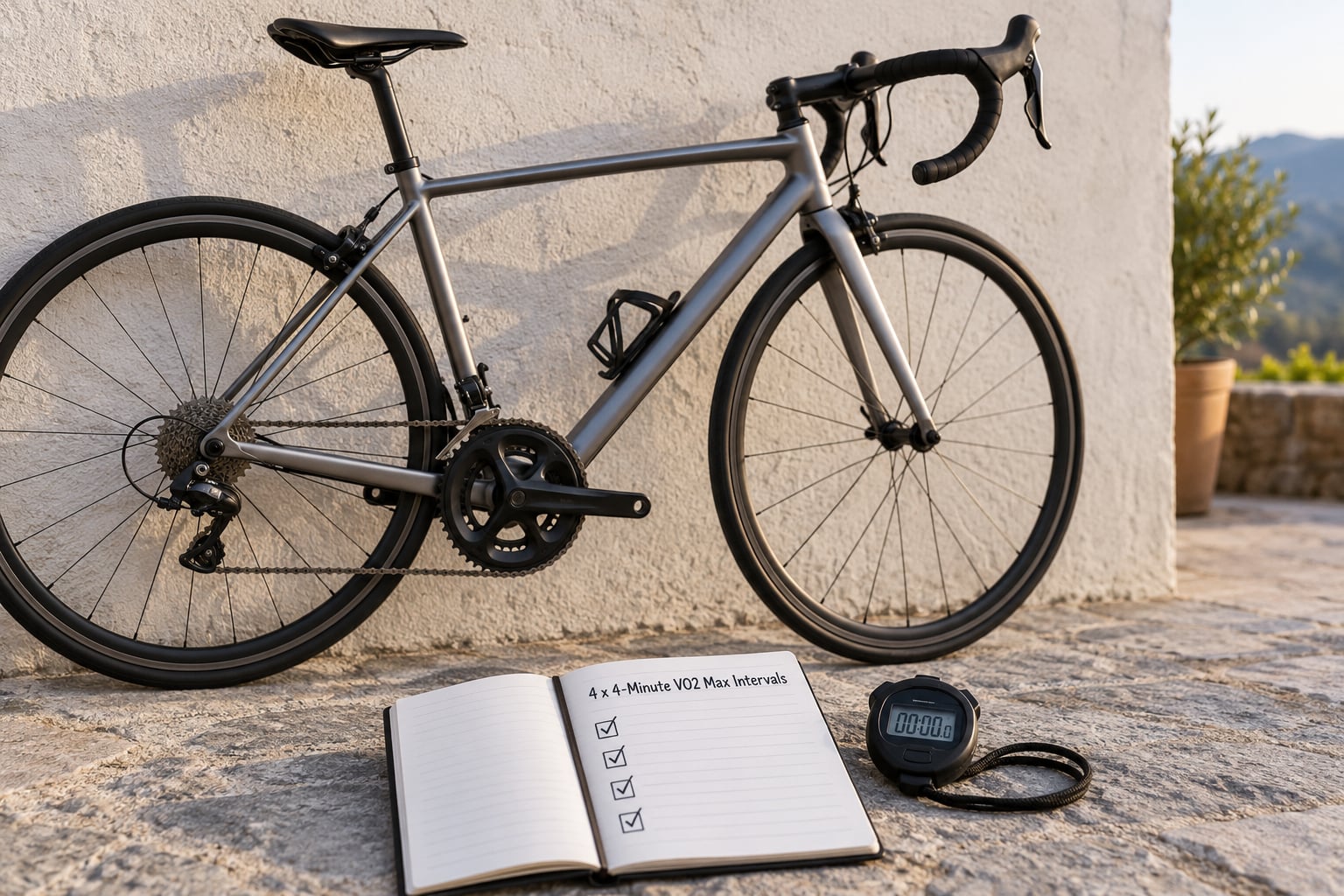
This is the classic VO2 max session and the most reliable place to start if your goal is raw riding speed. Four minutes hard is long enough to stress oxygen uptake, short enough that you can finish all four with real quality.
Prescription: 10 to 15 minutes easy warm-up with three short 20-second accelerations, then 4 minutes at zone 5, 2 minutes easy, four times through. Cool down 10 to 15 minutes easy.
Target roughly 115 to 120% of FTP, which for most riders lands between RPE 8 and 9 out of 10. Your breathing should be hard and rhythmic, and you should be able to say a short sentence but not a paragraph.
Beginners should start with 3 x 4 minutes and one full week between sessions. Riders with limited recovery time can drop the set count to three and keep the effort identical, and the lost stimulus is small.
On the bike, stay seated for the first two minutes, then stand if you want to relieve the saddle. Smooth the pedal stroke through the whole repetition because a surge at the start burns the effort you want at the end.
2. 8 x 30-Second Sprint Intervals
Short sprints train the parts of you that long efforts never touch: explosive acceleration, leg tolerance and the ability to produce high power briefly. They also sharpen how fast you change gear after a corner or a restart.
Prescription: 10 to 15 minutes easy warm-up with three 5-second builds, then 30 seconds at maximum effort, 2.5 minutes very easy, eight times through. Cool down 10 minutes easy.
The rest is long on purpose. A 30-second effort with 2.5 minutes of recovery is a neuromuscular and anaerobic session, and if you cut the rest to 30 seconds you are doing a completely different workout that will leave you flat for the rest of the day.
Go truly maximal here. Riders often hold back and wonder why the session feels pointless, and a genuine all-out effort with full recovery is the point.
Do this no more than once a week. Maximum-effort work carries a high cost per minute, and stacking it into a second hard session is how riders end a season feeling flat rather than fast.
Outdoors, pick a flat straight with a clear run-out and check the road before you start. On a trainer, stand if your setup is stable enough, because standing sprints are the most realistic version of a race finish.
3. 3 x 10-Minute Threshold Intervals
Threshold work is the session that moves your functional threshold power, and it is the best return on time for riders who want to raise their cruising speed rather than their sprint speed. Ten minutes sits right at the edge of what you can hold cleanly.
Prescription: 15 minutes easy warm-up with two 3-minute builds, then 10 minutes at zone 4, 5 minutes easy, three times through. Cool down 10 to 15 minutes easy.
Target 95 to 100% of FTP, or RPE 8 to 9 but a controlled kind of hard. You should be breathing through your nose for part of it, and if you can comfortably chat for the entire ten minutes, you are too easy.
Pacing is the whole exercise. Start the first minute about 2% below target, settle in, and hold. The last two minutes of each interval are where most riders blow up, and finishing strong is worth more than starting fast.
Stay seated, drop your upper body, and keep the pedals turning smoothly at a moderate cadence. A grinding low cadence for ten minutes generates a lot of noise and a lot of fatigue for very little speed.
Riders over 50 often do well with 2 x 10 minutes and a 6-minute recovery. The adaptation is the same and the session stops feeling like punishment on the third repetition.
4. 5 x 5-Minute Tempo Intervals
Tempo work is the middle of the range and it builds the sustained rhythm that long rides depend on. It is less about going fast than about holding a clean, repeatable effort without drifting.
Prescription: 12 to 15 minutes easy warm-up, then 5 minutes at zone 3, 3 minutes easy, five times through. Cool down 10 minutes easy.
Target 85 to 92% of FTP, which is RPE 6 to 7. You can talk in short sentences, and your heart rate should sit a beat or two below where it would be at threshold.
When to use a flat route matters more here than in the other workouts. A rolling road turns a tempo interval into an uncontrolled surge, so pick a flat stretch, a long steady climb or a stationary bike where the effort stays the same for the full five minutes.
This is the session to add when you want more structure but your legs are tired from the weekend. Riders who are not racing often get more from five tempo minutes a week than from chasing another VO2 max block.
Use it as a dress rehearsal. If the effort feels sustainable in week one, add 30 seconds to each interval the following week rather than adding a sixth repetition.
5. 2 x 20-Minute Race-Power Intervals
This is the long-interval session for century riders, gran fondo riders and anyone whose event is decided by holding a pace for hours. It is less about raw fitness and more about practicing the pace you intend to hold on event day.
Prescription: 15 to 20 minutes easy warm-up, then 20 minutes at zone 3 to low zone 4, 10 minutes easy, then 20 minutes again. Cool down 10 to 15 minutes easy.
Target 88 to 95% of FTP, or RPE 6 to 7 that you could hold for another 20 minutes if the road were flat and the day were easy.
Fueling is not optional in a 90-minute session. Eat 30 to 60 grams of carbohydrate beforehand and take fluid regularly, and practice the same thing on your long weekend ride so your gut knows what to expect.
Do not extend these past 20 minutes each unless you are training for something very specific, and do not attempt this workout after a hard climb session earlier in the week. The recovery cost is large and the quality drops in the second repetition.
Outdoors, run it on a road with a long flat or gentle false-flat section. If you hit a climb halfway through a repetition, hold the effort and let the power drop rather than grinding.
6. 6 x 90-Second Climbing Repeats
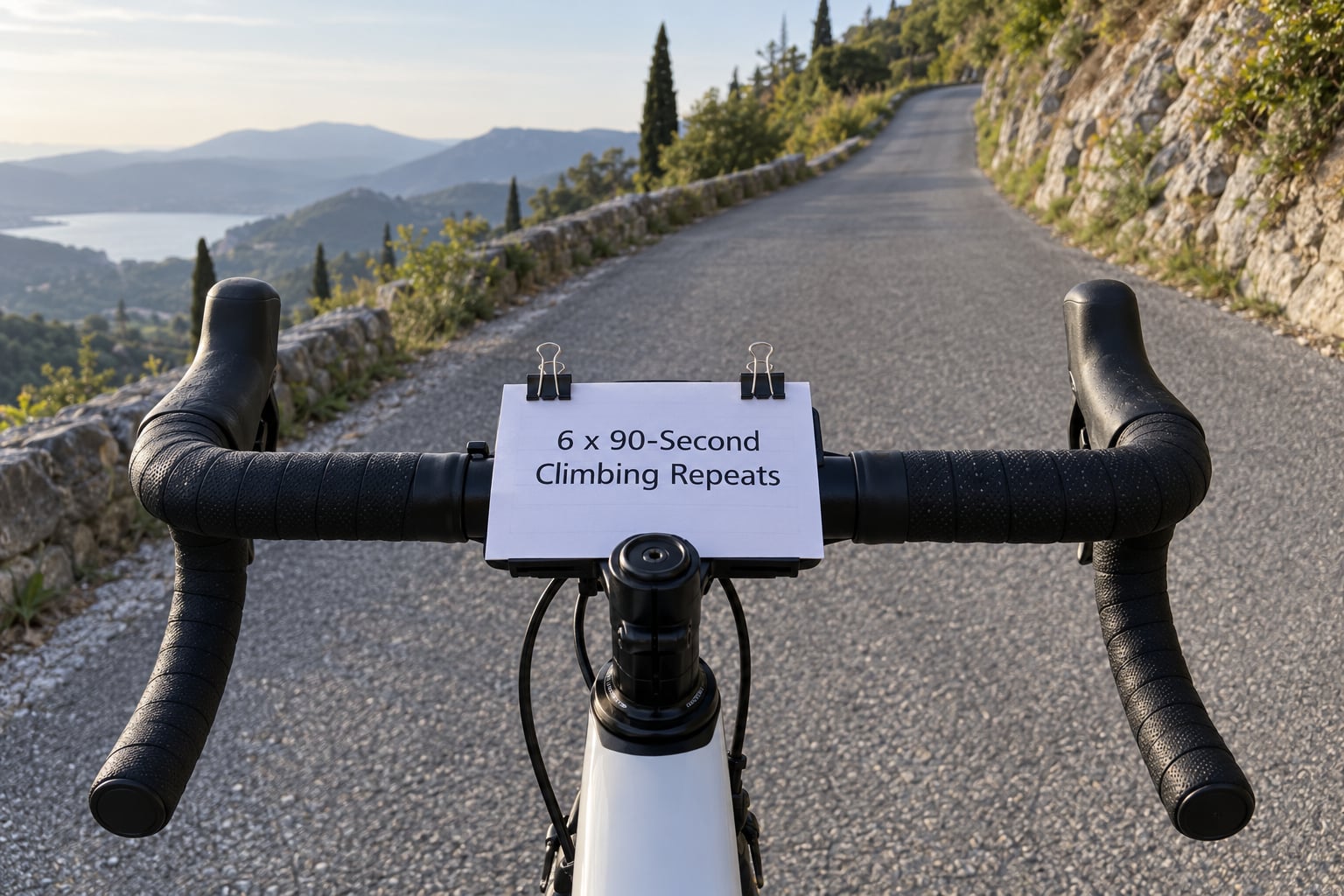
Short steep repeats build the climbing strength that long marathon efforts cannot. Ninety seconds is the sweet spot because it is long enough to demand real power and short enough that you can repeat it well.
Prescription: 15 minutes easy warm-up with three short accelerations, then 90 seconds hard uphill, 3 minutes easy spinning, six times through. Cool down 10 minutes easy.
Hill selection is the whole workout here. Pick a climb steep enough that you are near or above your threshold, long enough to hold 90 seconds at that effort, and free of traffic. A hill that is too shallow turns this into a poor man’s tempo session.
Gearing matters more than people expect. Stay seated for the first three repetitions if that keeps you smooth, then switch to standing for the last three. Standing uses a different muscle mix and lets you attack the same gradient differently, and training both is the point.
No hill nearby? Do the same thing on the trainer at a high gear and a high resistance setting, or find a long set of stairs you can ride up and down without traffic. The indoor version is less specific but it develops the same leg tolerance.
Stop this session at four repetitions if the pace is dropping more than a few seconds per climb. Consistency across all six matters more than any single number.
7. 12 x 1-Minute High-Cadence Intervals
Cadence work is a different animal from sprinting. Here you are asking your legs to spin faster and more smoothly, which improves efficiency and reduces the force needed for a given speed.
Prescription: 10 to 15 minutes easy warm-up with three 30-second cadence builds, then 1 minute at 100 to 110 rpm in zone 2 to 3, 1 minute easy at 85 to 90 rpm, twelve times through. Cool down 10 minutes easy.
Resistance is the part riders get wrong. Go light enough that you can hold the top cadence with a smooth stroke, because grinding at a high cadence is the opposite of the intent and usually produces knee discomfort.
Think of it as a leg speed ladder rather than a hard effort. You should be able to ride the entire session at a conversation pace, and if you are gasping, you have turned it into something else.
The payoff shows up in your normal riding. Higher comfortable cadence usually means lower power at the same speed, and on long events that compounds across five or six hours.
Cadence work is also the safest session in this guide. Riders returning from an injury, riding after a long race, or simply not fresh can do this and still get a structured session done.
8. 4 x 8-Minute Over-Under Intervals
Over-under work alternates a hard effort with an easy one inside the same block, and the pattern is deliberately unpleasant. It trains the specific skill of holding power when you are already suffering, which is the defining condition of racing and of the last hour of a century.
Prescription: 15 minutes easy warm-up, then 8 minutes made of 4 minutes hard at zone 5 and 4 minutes very easy at zone 1, repeated. Rest 8 minutes between the four sets. Cool down 10 minutes easy.
The hard and easy halves should feel like a clear on-off switch, not a moderate blur. If the easy four minutes feel hard, you started the hard four minutes too fast.
Know where this session belongs. It fits in the four to six weeks before an event, and it does not fit in the week of a race, after a long illness, or in a week when you have already done a VO2 max session.
For most riders, workout 3 or 4 is a better choice on a week when sleep has been poor. Over-under sessions amplify fatigue rather than absorb it, and choosing the gentler option is a skill in itself.
Outdoors, a rolling road works well for this format because the alternation is built into the terrain. Just make sure the climbs and descents are long enough to hold each four-minute block.
9. 10 x 1-Minute Aerobic Surge Intervals
Ten one-minute surges is the most accessible session on this list and the best bridge for club riders who find a full VO2 max workout intimidating. The surges are hard but controlled, and the generous recovery keeps the session aerobic rather than anaerobic.
Prescription: 10 to 15 minutes easy warm-up, then 1 minute at zone 4, 2 minutes easy, ten times through. Cool down 10 minutes easy.
Target 100 to 110% of FTP, or RPE 8, but never an all-out effort. You should be able to start the next repetition with the same feeling you started the first, and if the second one feels much worse, you went too hard on the first.
Progress over several weeks instead of going harder. Weeks one and two at 95 to 100% of FTP, weeks three and four at 100 to 105%, then add a second set of ten if you are recovering well between sessions.
This is the workout I suggest to riders who have been training without structure for a few years. It gives them a session with a clear target and an honest finish line, which is usually all the motivation a person needs to keep showing up.
It also travels well. A treadmill bike, a stationary bike with a resistance knob and a smart trainer can all deliver it, because the work-to-rest ratio is forgiving and the effort is judged by feel.
10. 1 x 30-Minute Progressive Time Trial
A single progressive effort is the safest hard session in the guide and a genuinely useful test. Instead of repeated intervals, you ride one 30-minute block where the effort rises every five minutes, which shows you what you can actually sustain.
Prescription: 15 minutes easy warm-up with two progressive builds, then 30 minutes starting at zone 3 and finishing the final 5 minutes at zone 5, then 10 to 15 minutes cool-down.
Structure the 30 minutes in six five-minute blocks: 85%, 90%, 92%, 100%, 105% and then all out. If you blow up at 92%, that is information, and it is the most useful information a single session can give you.
Write down your average power and your heart rate at the end. Compare the two sessions eight weeks apart and you have a real answer about whether your training is working, instead of a vague feeling that the bike is going slightly faster.
This is also the workout to choose when you are not sure how hard you can currently go. One effort has a much lower recovery cost than four, and you still get a real number at the end of it.
On the road, use a route with a shallow gradient or run it on a trainer where the resistance changes are repeatable. Trying to change speed by shifting gears on a busy road is a good way to end the test early.
Frequently Asked Questions
How long should bike intervals be?
It depends on the adaptation you want. Reps of 15 to 30 seconds with 2 to 4 minutes of recovery train top speed and anaerobic capacity. Reps of 3 to 5 minutes with 2 to 3 minutes rest raise VO2 max. Reps of 8 to 20 minutes at a slightly easier effort build sustainable power for long events. The workout is the time, not the total session, that determines what your body adapts to.
How often should a cyclist do interval training?
Two hard sessions per week is the pattern most riders can sustain, with at least one easy day between them and nothing else hard in the same 48 hours. One quality session a week is plenty if you are riding a lot of easy miles. Riders racing on weekends often keep one hard midweek session and treat the weekend ride as the second effort.
What is a good work-to-rest ratio for cycling intervals?
For VO2 max work of 3 to 5 minutes, rest of about half the work length is standard, so 4 minutes hard with 2 minutes easy. For threshold and tempo efforts of 5 to 20 minutes, rest longer, usually 40 to 60 percent of the work time. For sprints of 30 seconds or less, rest should be at least 4 to 5 times the effort. Longer efforts need more recovery, not less.
Do I need a power meter to do interval training?
No. A power meter makes the target repeatable, but every workout on this page can be run on rate of perceived exertion. Use a 1 to 10 scale, hold the same number on every repetition, and aim for one rep in reserve rather than a maximum effort. If you only have a resistance knob, set it so the effort feels like the number you want and change nothing between reps.
Should I do cycling intervals on an indoor trainer?
Indoor sessions are better for consistency, for exact interval timing and for winter training, and outdoors is better for practicing real terrain, cornering and pacing. Most riders use both. On a basic trainer, expect the resistance knob to need adjusting every few minutes on a warm day, and check the calibration with a brake test before you start a structured workout.
Can cycling help lower cholesterol?
Regular cycling raises cardiovascular fitness and is associated with healthier cholesterol levels, especially when combined with changes in diet and other exercise. It is not a substitute for medical care, and anyone with a diagnosed cholesterol problem should discuss their activity plan with their doctor rather than treating a training plan as treatment. Ride for consistency, not as a medical intervention.
Start with workout 4 or 9 this week if you have been riding without structure. Do the full warm-up, keep the effort honest rather than heroic, and write down the numbers when you finish.
Next week, move up one workout. Give the aerobic days between sessions a real chance to do their job, because that is where most of the improvement actually happens.