The signs of overtraining in cyclists are stubborn: power that drifts down at the same effort, a resting heart rate that will not settle, sleep that never feels restorative, and a rider who cannot face the bike. None of those alone proves anything, which is exactly why overtraining gets missed for weeks.
This guide is general information about training and recovery, not a diagnosis. If symptoms persist despite reduced training, or if they include chest pain, fainting or severe breathlessness, get medical advice rather than another training plan.
Table of Contents
- Signs of Overtraining in Cyclists: Physical and Mental Clues
- Performance and recovery signs of overtraining in cyclists
- Less obvious emotional and cognitive warning signs
- How Is Overtraining in Cycling Different From Normal Fatigue?
- What Causes Overtraining in Cyclists?
- How Do You Track Changes Without Guessing?
- What Warning Signs Should You Record in a Training Log?
- What Should You Do If You Think You Are Overtraining?
- How Can a Cyclist Return to Training After Symptoms Improve?
- How Long Does Recovery Take After Overtraining?
- When Should a Cyclist See a Doctor?
- Frequently Asked Questions
- Can a cyclist be overtrained without competing in races?
- Is muscle soreness proof that a cyclist is overtraining?
- How many consecutive bad rides mean a cyclist should rest?
- Can poor sleep alone cause the symptoms associated with overtraining?
- Should a cyclist train when illness is causing persistent fatigue?
- What to Do First
Signs of Overtraining in Cyclists: Physical and Mental Clues
Overtraining syndrome is what happens when your training stress stays higher than your body can rebuild from for long enough that training stops making you faster. A hard week, a poor race or three days of bad sleep is not the same thing, and treating it as if it were usually makes things worse.
The reason it slips through is that the early version does not arrive as one big symptom. It shows up as several small drifts at once, in performance, in recovery markers, and in how the bike feels in your head. Riders on r/cycling describe the same pattern repeatedly: everything looked fine on paper until nothing did.
Performance and recovery signs of overtraining in cyclists
These are the clues that show up on the bike or in the data, and they tend to arrive in roughly this order.
- Power drifts at the same effort. A familiar threshold session that used to sit at 280 watts now sits at 255 at the same heart rate and the same perceived effort.
- Heart rate creeps upward at the same power. Riders call this decoupling, and forum users on the Weight Weenies board treat a low heart rate at your usual power as a classic early fatigue signal rather than a fitness gain.
- The warm-up takes longer. Legs feel heavy through the first 20 minutes and spins on the trainer take extra coaxing to get moving.
- Recovery between rides stops working. Tuesday still feels like Monday, and the sessions you would normally recover from in a day now linger for three.
- Fatigue that sleep does not fix. A full night changes nothing, which is the detail that separates this from a rough week.
- Resting heart rate sits above your baseline. A few beats per minute higher on most mornings, without a reason, is worth paying attention to.
- Soreness lasts longer than it should. Legs stay heavy after a hard week, or soreness shows up after an easy ride rather than a hard one.
- You get sick more often. Persistent colds, sore throats or a bug that will not shift are common reports, because heavy training suppresses some immune function.
- Sleep gets worse. Trouble falling asleep, waking unrefreshed, or waking in the night after a hard evening session. TrainerRoad forum users ask about this specific pattern more than any other.
- Appetite changes. Losing interest in food, or craving sugar constantly, often shows up alongside the training changes rather than instead of them.
No single item on that list means overtraining. Three or more, held together for more than a week while you keep training hard, is a different conversation.
Less obvious emotional and cognitive warning signs
The mental signs get dismissed as a bad mood or a busy month at work, which is how a lot of riders end up riding through stage two of the syndrome. Irritability is common: small things land hard, and the usual post-ride satisfaction turns into nothing at all.
Concentration suffers in ways riders notice at work rather than on the bike, with poorer focus and slower decisions that have nothing to do with fitness. Riders on the Weight Weenies forum described recognising they were under-recovering only once everything fell flat, numbers down and food cravings out of nowhere, which is how long this tends to sit unnoticed.
Motivation is the biggest tell. r/cycling riders repeatedly say the clearest signal was dreading sessions they normally enjoy, rather than any physical metric. That flat feeling after a ride you should have loved is worth more than a single bad workout.
How Is Overtraining in Cycling Different From Normal Fatigue?
Normal training fatigue has a beginning and an end. You ride hard on Saturday, you are tired on Sunday, and by Monday or Tuesday you are fine again. Overtraining has no clear end point, and that is the difference the table below is really about.
| Marker | Normal training fatigue | Overtraining |
|---|---|---|
| How long it lasts | A day or two | Weeks, with no clear recovery point |
| Effect of a rest day or two | You bounce back | Little or no change |
| Performance at the same effort | Comes back quickly | Power and speed keep dropping |
| Sleep | A night or two of disruption | Unrefreshing sleep for an extended period |
| Mood | Passable, settles | Irritability or low mood that does not lift |
| Motivation | Low on hard days only | Dreading rides you normally enjoy |
| Resting heart rate | Normal, brief shifts | Slightly elevated across most mornings |
| Illness and soreness | Occasional, brief | Frequent minor illness, persistent soreness |
| Appetite | Unchanged | Reduced appetite or constant sugar cravings |
Symptoms also cannot be read one at a time. A raised resting heart rate could be illness, heat, caffeine, a stressful night or simply a bad measurement. Riders who chase a single number end up more confused than when they started, so look for the same drift across several markers before deciding anything.
What Causes Overtraining in Cyclists?
The core cause is a mismatch between stress in and recovery out, sustained for weeks. Training breaks tissue and taxes systems so they can rebuild slightly stronger during recovery, known as supercompensation. Stack more stress than you deposit in sleep, food and easy days, and the rebuild stops happening.
Riders usually move through a progression rather than landing there at once. Functional overreaching means a short, planned block where you get fitter and slightly more tired, then come back stronger. Non-functional overreaching is when that fatigue does not resolve and performance stalls or drops. Prolonged non-functional overreaching can develop into overtraining syndrome, which is a diagnosis a clinician makes after excluding other causes, not something you can confirm from a training log.
Volume jumps are the most common trigger. A beginner on r/Velo described going from four to six hours a week to more than ten and hitting the symptoms in the second week of the increase. The same thing happens when riders add a hard gym block on top of riding, pile up long weekend days through a race build, or double up sessions during a busy period at work.
Other contributors stack quietly underneath. Under-fuelling is one of the most common and least discussed, and it overlaps with low energy availability and RED-S, where there is not enough energy left for recovery after training. Poor sleep, illness, personal stress, travel and altitude changes all raise the cost of the same training load, which is why a plan that worked last season can break without the plan changing.
How Do You Track Changes Without Guessing?
The riders who catch this early all do the same thing: they compare trends over weeks rather than reacting to a single session. Two kinds of data help, and neither is very useful alone.
Subjective measures are how the ride actually felt, including perceived effort, motivation before the session and how you slept. Objective measures are what the body reported independently, such as resting heart rate, heart rate variability, power at a fixed heart rate and how quickly you recovered between rides. When both drift in the same direction for a fortnight, that is a real signal.
| What to track | How to read it | Warning pattern |
|---|---|---|
| Morning resting heart rate | Compare with your own rolling baseline | A few beats per minute above baseline across most mornings |
| Heart rate variability | Read the trend, not one morning | Sliding downward over two to three weeks |
| Power at a set heart rate | Compare identical test efforts | Gradual decline with no change in training |
| Perceived effort | Rate the same familiar sessions | Effort ratings climbing while output falls |
| Sleep and recovery time | Note hours and how you felt on waking | Unrefreshing sleep for a sustained stretch |
| Motivation and mood | Score mornings before riding | Dreading sessions you normally enjoy |
| Illness and soreness | Log dates and duration | Repeated minor illness, soreness that lingers |
Riders who distrust their own data run into a real problem. Forum users report resting heart rate and recovery scores looking perfectly normal while power and mood were clearly falling. That happens, and it is why the mental and performance signals in the table above count even when the wearable says everything is fine.
What Warning Signs Should You Record in a Training Log?
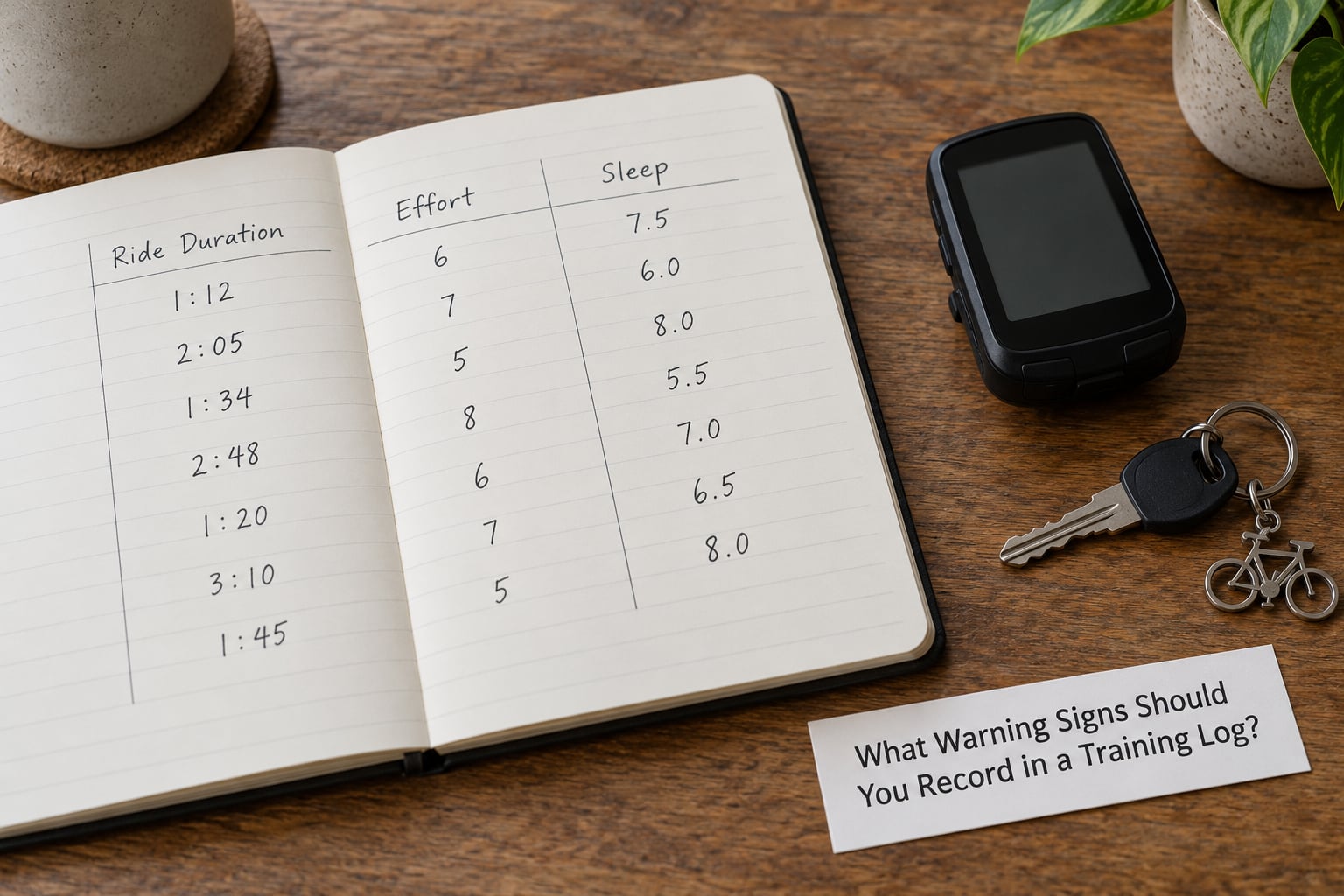
Keep the log small enough that you will still fill it in. Six fields is enough: ride duration, perceived effort out of ten, recovery time in hours, hours slept, a one-word mood score, and any symptom worth remembering.
Add resting heart rate and weekly hours if you track them anyway. Write the log the same way each time, because the value is in the consistency of the comparison rather than in the precision of any entry.
Then read it monthly rather than daily. A weekly glance catches a bad patch; a monthly read catches the two-month slide that actually ends careers, and it is much harder to argue with a month of notes than with one strange Tuesday.
What Should You Do If You Think You Are Overtraining?
Cut the load first. Drop the hard sessions, reduce weekly volume, and stop adding intensity for at least a couple of weeks. Not every symptom needs a total stop, but the instinct to push through is what turns a recoverable overreach into months of trouble.
Prioritise sleep and ordinary meals. Consistent sleep in a dark room and regular meals with enough protein and carbohydrate do more for recovery than any supplement riders tend to reach for. Eating becomes harder to ignore when your legs feel heavy and your mood is flat.
Watch whether symptoms improve on reduced training. That is the single most useful piece of information you can take to a doctor, so keep logging while you find out.
Do not train through illness. Training on top of an infection does not speed things up and commonly extends them, and fever or chest symptoms mean stop and get advice.
Get a qualified health professional involved if symptoms persist beyond a few weeks of easy riding, keep worsening, or show up at rest. Chronic fatigue has causes beyond training, and a clinician can check the ones worth checking.
How Can a Cyclist Return to Training After Symptoms Improve?
Return gradually and let symptoms set the pace. Start with easy, conversational riding for a week or two, and only add one new thing at a time. If a normal ride leaves you flat again, drop back rather than repeating the session.
Most riders rebuild faster than they expect once the load drops. A month off the bike costs far less fitness than riders fear, and the fitness you keep after a few weeks of easy spinning is enough to start from.
After significant illness, repeated injury or a long stretch of impaired recovery, a doctor or sports-health professional should guide the return. That matters most for anyone whose symptoms included fever, chest symptoms or exhaustion that lasted well past a normal bad week.
How Long Does Recovery Take After Overtraining?
It depends entirely on how far the process went and how honestly it was managed. Ranges are wide because people carry different loads, sleep patterns and lives, and because early detection changes everything.
| Situation | Typical range | What it usually looks like |
|---|---|---|
| Hard training block, caught early | A few days to 1 week | Easy riding and sleep restore the feeling of freshness |
| Functional overreaching at a camp or block | 1 to 2 weeks | Planned reduction, then a clear bounce back |
| Prolonged fatigue with performance drop | Several weeks to a few months | Reduced training, symptoms improve gradually |
| Diagnosed overtraining syndrome | 6 months to 2 years | Extended guided return, sometimes with medical oversight |
Anyone quoting a fast timeline is usually describing early detection. Symptoms that drag on for months deserve an assessment by a doctor rather than another attempt to train through them, because repeatedly restarting while impaired is what stretches the recovery out.
When Should a Cyclist See a Doctor?
Get medical advice urgently for chest pain, fainting, severe or worsening shortness of breath, confusion, extreme weakness, or symptoms that appear even at rest. These are not training signals, and no amount of load adjustment explains them.
Book a non-urgent appointment if symptoms persist despite two to three weeks of reduced training, if fatigue is there in the morning before you have done anything, or if you are losing weight or unable to keep food down.
Overtraining and illness overlap, and the distinction is worth spelling out. Overtraining symptoms tend to track with training changes and improve when the load drops. Illness tends to arrive with a fever, sore throat, swollen glands, body aches or symptoms that are present when you are completely rested, and it does not improve by cutting sessions.
A clinician may also want to rule out other explanations for persistent fatigue, including under-fuelling and low energy availability, thyroid problems, anaemia or sleep disorders. Naming those possibilities is not a diagnosis; it is a reminder that unexplained fatigue deserves a proper look.
Frequently Asked Questions
Can a cyclist be overtrained without competing in races?
Yes. Racing is not a requirement, and plenty of riders meet the problem without a calendar. Club riders who add hours, gravel riders stacking long weekend days, and commuters layering hard indoor sessions on top of a full-time job all have the same load-to-recovery mismatch. Training load comes from every hard hour, not just from results.
Is muscle soreness proof that a cyclist is overtraining?
No. Ordinary soreness after a hard climb or a cold, windy ride is normal and usually clears in a day or two. The overtraining version is soreness that lingers for several days after easy rides, arrives without a hard session, and comes with heavy legs rather than tired ones. Soreness on its own is one data point, not a diagnosis.
How many consecutive bad rides mean a cyclist should rest?
There is no magic number, which is part of why riders argue about it. What matters is the pattern behind the rides. Three or four poor sessions in a row after a training block, with a rising resting heart rate and unsettled sleep, is reason enough to cut the load now rather than wait. A single bad ride after a hard week is just a bad day.
Can poor sleep alone cause the symptoms associated with overtraining?
It can produce most of them. Short or fragmented sleep raises resting heart rate, blunts mood, slows reaction time and makes everything feel harder, so sleep loss mimics overtraining closely. Forum riders ask about this pattern after hard evening sessions more than any other. Fix sleep first, cut training second, and reassess after a couple of weeks.
Should a cyclist train when illness is causing persistent fatigue?
No. Training on top of an infection does not speed recovery and frequently drags it out. If there is a fever, chest symptoms, or fatigue that persists at rest, stop training and seek medical advice. Gentle movement during a mild cold is a personal call, but lingering illness with genuine fatigue is not a training day.
What to Do First
Stop adding load today, before deciding anything else. If several of the signs above have been with you for more than a week, drop the hard sessions for two weeks and go back to easy riding.
Then look at the last two months of training against recovery. Volume jumps, a hard gym block, a race build and a stretch of poor sleep usually explain it once you can see them together.
Keep logging while you test whether things improve. Symptoms that ease with reduced training were a training problem, and that answer is worth having. Symptoms that do not ease, or that include chest pain, fainting, severe breathlessness or exhaustion at rest, need a doctor, not another training week.
Riding is supposed to make the rest of your life better. When it quietly stops doing that, the honest read is that it is time to back off, not time to try harder. Reviewed for 2026.