Gym exercises for road cyclists are heavy, low-rep strength and stability movements — squats, deadlifts, split squats, rows, presses and anti-rotation core work — that build the muscles, tendons and trunk control cycling loads unevenly. Two short sessions a week make you a stronger climber and a steadier rider, and you will feel the difference on the third long ride, not the third workout.
Road riding is a high-repetition, low-force movement. You turn the pedals thousands of times a week but almost never ask a muscle for a genuinely hard effort, and you spend hours folded over the bars with your upper back and hamstrings doing nothing. What that produces is predictable: a weak glute, a knee that complains on long descents, a lower back that aches after three hours in the drops, and a sprint that feels like it runs out after five seconds.
This list is for club riders and racers who want more of that, and for masters riders coming back to the bike after years off. Every movement comes with the cue that matters, a realistic set-and-rep prescription, and a machine swap if your gym has no rack. Nothing here needs a coach to be safe, but if you have an existing knee, back or Achilles injury, get clearance from a physiotherapist before you load a barbell.
Table of Contents
- Gym Exercises for Road Cyclists at a Glance
- 1. Back Squats
- 2. Romanian Deadlifts
- 3. Bulgarian Split Squats
- 4. Step-Ups
- 5. Standing Calf Raises
- 6. Planks
- 7. Dead Bugs
- 8. Side Planks
- 9. Kettlebell Swings
- 10. Cycling-Specific Hip Thrusts
- Frequently Asked Questions
- How often should a cyclist strength train?
- Can I lift weights and ride on the same day?
- Will lifting weights make me bulky?
- What rep range should cyclists lift in?
- What muscles does road bike riding work?
- How long should a cyclist’s gym session be?
- Where to Start This Week
Gym Exercises for Road Cyclists at a Glance
| Exercise | Main cycling benefit | Muscles emphasized | Equipment or stability needed |
|---|---|---|---|
| Back squats | Climbing and out-of-the-saddle power | Quads, glutes, trunk | Squat rack or leg press |
| Romanian deadlifts | Pedal stroke power and hamstring strength | Hamstrings, glutes, spinal erectors | Barbell or dumbbells |
| Bulgarian split squats | Corrects side-to-side leg imbalance | Quads, glutes, stabilisers | Bench or wall for balance |
| Step-ups | Knee control and climbing-specific strength | Quads, glutes, hip flexors | One stable step or box |
| Standing calf raises | Ankle stiffness and foot support | Gastrocnemius, soleus | Wall or rail for balance |
| Planks | Stable hands and posture over long rides | Abdominals, obliques, glutes | Floor only |
| Dead bugs | Trunk control that resists motion while pedalling | Deep core, hip flexors | Floor only |
| Side planks | Cornering balance on uneven roads | Obliques, lateral glutes | Floor only |
| Kettlebell swings | Short, sharp hill attacks | Glutes, hamstrings, lats | Kettlebell or dumbbell |
| Hip thrusts | Top-of-stroke glute strength for climbing | Glutes, hip extensors | Bench or chair |
The table is a map, not a programme. Pick four movements to start with, get those right for a month, then add more.
1. Back Squats
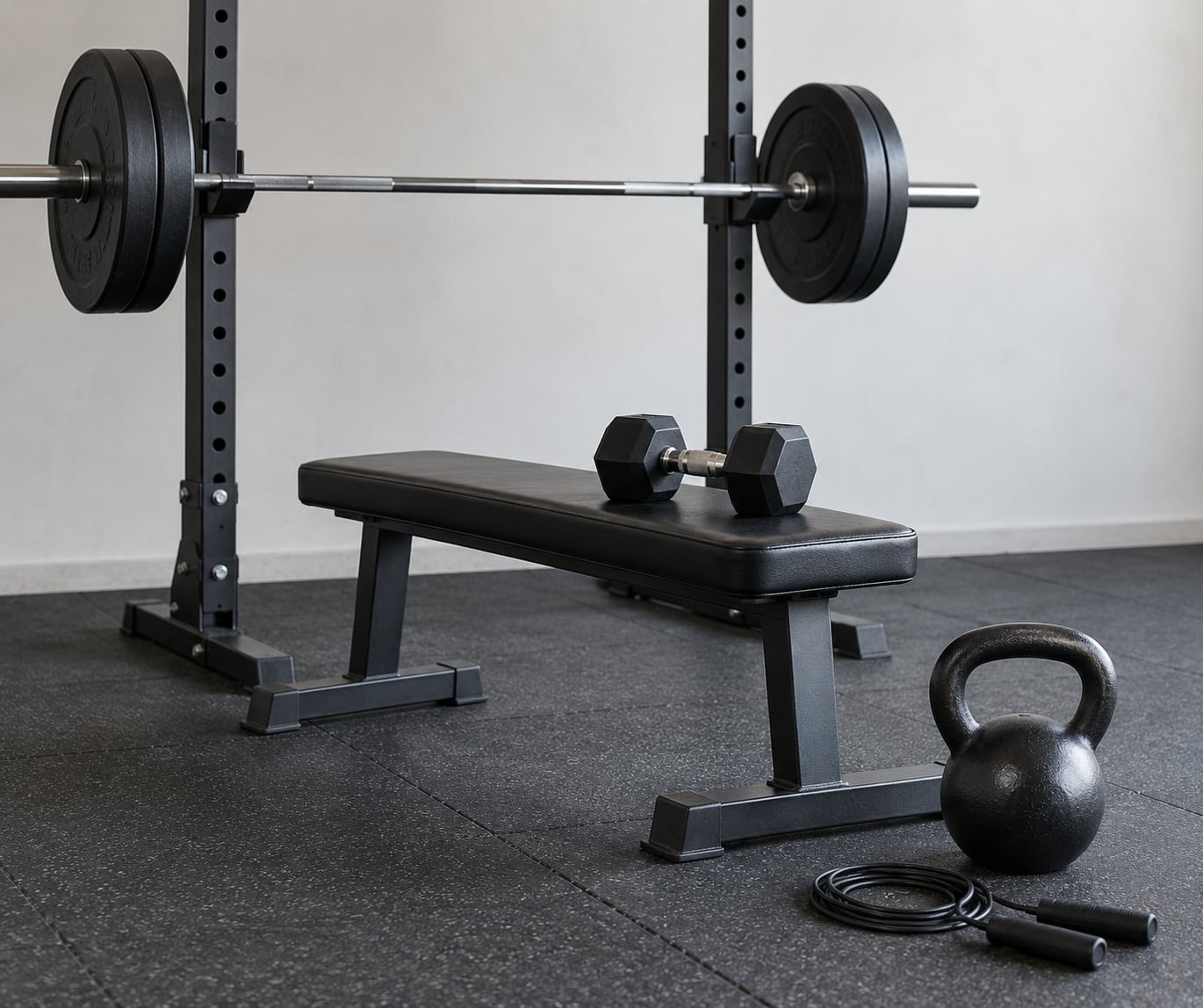
Squats are the single most useful lift for road riders because they train exactly what pedalling demands: quads and glutes producing force through a range of motion that changes every time the road tilts. Riders who cannot hold a low-cadence, high-torque effort on a steep gradient are usually short of quad and glute strength, and a squat is the fastest way to build it.
Set your feet about shoulder width with the toes turned out 15 to 30 degrees. Brace, push your knees out over your toes, and sit between your hips rather than back. Go as deep as you can with a flat back — depth matters less than control, so stop where your heels want to lift.
Example set: four sets of four reps at about RPE 8, three to four minutes rest between sets. That is heavy enough to build maximal force and light enough to recover from before a weekend ride.
No rack? Do the same rep count on the leg press, feet mid-platform and lower as low as your hips allow, or on a hack squat, which keeps the load on your feet where it belongs. Riders over 60 should start with three sets of six and a box squat to the seat rather than chasing depth.
2. Romanian Deadlifts
Romanian deadlifts load the posterior chain — hamstrings, glutes and spinal erectors — which cycling uses constantly but never develops, because the saddle takes most of the hamstring’s work. That neglect is why many riders end a long ride with a stiff, achy lower back.
Stand tall holding a bar at your hips, knees soft, then push your hips straight back and let the bar slide down your thighs. Keep your back flat and stop when you feel a strong stretch in the hamstrings, usually around mid-shin. Drive your hips forward to stand up.
Example set: three sets of six reps, controlled for three seconds on the way down. Pause and reset between each rep rather than bouncing at the bottom.
If a barbell version wrecks your back, do it single-leg with a dumbbell and one hand on a bench. It is harder, half the loading, and it does the imbalance work for you at the same time.
3. Bulgarian Split Squats
Everyone pedals more strongly with one leg than the other, usually by a small margin that repeats on every ride. Unilateral loading fixes it, and Bulgarian split squats are the most direct way to do that: one leg works while the other stabilises.
Stand about two feet in front of a bench, set your rear foot on the bench behind you, and lower straight down. Most riders need to start with bodyweight only and let their arms hang or hold the bars for balance. Watch the front knee track over the middle toes and the heel stay down.
Example set: three sets of eight reps per leg, two to three seconds on the lowering phase. Rest 90 seconds between legs, not between reps.
Over 60 or knee-sensitive? Use a lower bench so the drop is shorter, or hold a wall rail for support and shorten the range. Both preserve the exercise.
4. Step-Ups
Step-ups look trivial and are quietly one of the most cycling-specific movements on this list. They build single-leg hip and quad strength in a pattern that resembles a pedal stroke, and they demand knee control under load, which is exactly where road riders feel niggles.
Place a step at knee height or just below. Drive through the whole front foot to stand on top, then lower for a slow count of three. The slow lowering is the exercise; bouncing off the box turns it into a stepper and teaches you nothing.
Example set: three sets of ten reps per leg, holding dumbbells at your sides once bodyweight feels easy. Total session time on this one: about four minutes.
No step? Any low stable box, the bottom stair of a staircase, or a low curb will do. Hold the rail with one hand for balance if you need to.
5. Standing Calf Raises
Your calves and the small muscles of your foot take thousands of impacts and hold your weight through every pedal stroke, but cycling sits or stands too still to challenge them. Stiff ankles also make the pedal stroke smaller. Standing calf raises fix both in about three minutes a week of work.
Stand with the ball of your foot on a step and your heels hanging free. Rise as high as you can, pause for a second at the top, then lower slowly past a comfortable stretch. Keep your knees straight for the gastrocnemius and slightly bent for the soleus, doing a second set that way.
Example set: three sets of 15 reps straight-legged and two sets of 15 with bent knees. Light bodyweight or a dumbbell in each hand is plenty.
Use a wall or a rack for balance. A rider who wobbles is wasting the set on isometric balance work instead of ankle work.
6. Planks
How much trunk strength a cyclist actually needs? Enough to hold the torso still while the legs do very different things, and not so much that the upper body gets tight. A plank builds that middle setting, and it is the cheapest way to make your position look composed from the side.
Forearms on the floor, elbows under your shoulders, legs straight, body in one line from ear to heel. Squeeze your glutes and quads so your hips do not sag, and breathe normally — holding your breath for 30 seconds is how beginners end up with a wobbly, over-tightened version that helps nothing.
Example set: three holds of 30 to 45 seconds, resting a minute between. If you are past 60 seconds, add difficulty rather than duration: shoulder taps or a wider stance.
7. Dead Bugs
Dead bugs teach your core to resist movement while you pedal, which sounds like a small thing and is not. Road riding is continuous low-level trunk motion — the bike leans, the road shifts, the bars twitch — and a trunk that reacts to every wobble wastes energy and shakes your saddle.
Lie on your back with your arms pointing at the ceiling and your knees bent over your hips. Press your lower back gently into the floor and keep it there. Extend one arm overhead and the opposite leg out until your lower back starts to lift, then stop and swap sides.
Example set: three sets of ten reps per side, moving slowly. Exhale as the arm and leg reach out. Range matters more than load here — a small, controlled range beats a big one that ruins your back position.
8. Side Planks
Cornering, camber, tram lines, a pothole you did not see — lateral hip and trunk strength is what keeps you composed when the road tilts. Side planks train that side-to-side stability, and they also hit the oblique and hip muscles that hold you in the drops without you noticing how hard they are working.
Lie on your side with your elbow under your shoulder, legs stacked or staggered, and lift your hips so your body forms a straight line. Knees bent to about 90 degrees is easier and just as useful for a rider who finds the full version too wobbly.
Example set: three holds of 20 to 30 seconds per side, with a hand on the floor only if you need it. Raise the top hip higher than you think you need to; that is the whole exercise.
9. Kettlebell Swings
Swinging a kettlebell teaches explosive hip extension, which is the fastest way to develop the kind of power a rider needs for a short, steep attack out of the saddle. It also gives glute engagement that pedalling alone rarely delivers.
Start with the kettlebell between your feet, hinge down and grab it with two hands, then stand up hard and let it swing to roughly chest height using the momentum of the hips, not the arms. The arms are rope. Let it swing back down and repeat, hinging again each time.
Example set: four sets of 10 to 15 reps. Rest a minute between sets. Most mistakes are an arm lift or a squat, so watch for those: the hips go back and forward, the shoulders stay square.
New to this? Do the same movement with one dumbbell held with both hands, or start with 12 swings on light weight and spend a week on the hinge before adding load. A bad swing with a heavy bell hurts your back; a good swing with a light one will not.
10. Cycling-Specific Hip Thrusts
Hip thrusts put heavy load on the glute at the exact moment in the movement where the top of the pedal stroke needs it. Riders who struggle with out-of-saddle climbing and short pitches, and who feel their hamstrings rather than their glutes, usually find this one changes their climbing fastest.
Sit with your upper back against a bench or chair, knees bent, feet flat and close to your hips. Drive through your heels and lift your hips until your body is level, squeezing your glutes hard at the top. Lower halfway and go again.
Example set: three sets of ten reps. Keep the ribcage down; arching the lower back to get the weight higher means the glutes stop working.
Where to place it in a week? One time per week is plenty. Two or three sets once you have six weeks of consistent lifting behind you. Barbelled, then with a dumbbell on the hips, then bodyweight — and add resistance bands around the knees for lateral hip work if your glutes are firing unevenly.
Frequently Asked Questions
How often should a cyclist strength train?
Two sessions a week is the most useful number for most riders: enough to build strength, not enough to compete with your riding for recovery. One session works for riders already consistent, three is for off-season base blocks only. Keep roughly 48 hours between a hard lifting session and an important ride, and cut to one maintenance session during racing.
Can I lift weights and ride on the same day?
Yes, and plenty of riders have no other option. Put the gym work first, before the ride, and keep it short. Doing it after a long ride leaves you already fatigued, which hurts both sessions. If you train after riding, skip the heaviest leg work and do core work, rows and mobility instead.
Will lifting weights make me bulky?
No, not with low rep ranges. Three to five reps per set, stopping two or three reps before failure, trains force without the sustained volume that grows muscle size. Mass gain needs high-volume hypertrophy work plus a calorie surplus, and that is simply not what this programme contains. Body mass almost never moves on a cycling-focused diet.
What rep range should cyclists lift in?
Most of your work belongs between three and eight reps. Heavy sets of three to five build the maximal force and neural strength you need for climbing and sprinting; sets of six to eight give you more practice and less fatigue per set. Sets of ten or more are worth adding only for trunk work, where the load is light and the goal is endurance and control.
What muscles does road bike riding work?
Quadriceps, hamstrings, glutes and calves, in that order of demand, plus the hip flexors that lift your knee to the top of every stroke. Riding also loads your lower back and shoulders, though far less than the legs. What riding does not do is load your upper body hard or ask either side of your body to work on its own, and those are the gaps gym work fills.
How long should a cyclist’s gym session be?
Twenty to thirty minutes, which sounds wrong and works better than an hour. A cyclist’s gym session is a supplement to a large training week, not a second workout. Two or three compound lifts plus core work fills that time easily, and you finish it fresh enough to ride well later in the week.
Where to Start This Week
Pick four movements from this list — back squats, Romanian deadlifts, Bulgarian split squats and planks are a solid starting set — and do two sessions of twenty-five minutes, three to four days apart. Ride easy the day after your second lifting session, and judge the results over the next month rather than the next ride.
Add the rest only once those four feel routine. These gym exercises for road cyclists pay off through consistency and a few good cues, not through how much you can cram into a session on a Wednesday.