To train for a 200K ride you need 12 weeks if your weekend ride is already around three hours, or closer to 16 if it is not. Build your longest ride to 70-80% of the event distance, keep roughly 80% of your riding conversational, and rehearse your fuelling on every long ride so the second half is boring.
Most first-timers don’t get hurt by being unfit. They get hurt by sitting still for nine hours when they’ve only ever sat for two. A 200K is a durability event, not a power event, so the plan below is organised around hours in the saddle and what you eat during them.
Rider histories from randonneuring and cycling forums make the same point repeatedly: the urge to quit peaks around the 150km mark, and riders who finished comfortably had already decided in week one how they’d handle it. Treat the plan as a set of decisions made calmly in advance.
General information only here. If you’re managing a heart condition, an injury, diabetes or a history of disordered eating, talk to a doctor or a registered dietitian before you commit to a block like this.
Table of Contents
- What You Need
- Weekly time commitment
- Step-by-Step: How to Train for a 200K Ride
- Weeks 1-3: Build Your Aerobic Base
- Weeks 4-6: Add Long Rides and Race-Specific Work
- Weeks 7-9: Test Your 200K Readiness
- Weeks 10-12: Sharpen and Taper
- How to adjust the plan if you have under six hours a week
- Your week at a glance
- Common Mistakes
- Making every ride hard
- Raising distance too fast
- Neglecting fuelling and hydration
- Training through pain
- Skipping recovery
- Having no contingency plan
- Frequently Asked Questions
- How long should I train for a 200K ride?
- How many miles should I ride each week to prepare for a 200K?
- Should I do intervals when training for a double century?
- What should I eat and drink during 200K training rides?
- How do I taper before a 200K ride?
- Can I train for a 200K if I am a beginner cyclist?
What You Need
You need a bike that fits and has been serviced, a route file for the event, and enough food and drink for eight to ten hours of riding. Everything else is nice to have.
- A road bike with a recent service. New chain, new brake pads, and both tyres checked for cuts and pressure. A mechanical at 140km ends the day, so budget an afternoon in the workshop before week one.
- A saddle position that survives hours. If you’re shifting position constantly on a four-hour ride, your saddle is wrong, not your fitness. Sit on the bike for ninety minutes wearing your normal kit before the block starts.
- Lights that last. A front light that runs five hours is useless if the sunset is at 20:30. Charge or carry a backup, and know where the switches are in the dark.
- The event route. Distance, cut-off time, elevation gain, resupply points, and whether it’s self-supported. Audax rules mean no support and no drops; a sportive means feeds and mechanics. The plan changes.
- Food you actually like. You’ll be eating the same four or five things for eight hours. Test them on a training ride, never for the first time on event day.
- A training log. A phone note works. Record duration, distance, how it felt, and what you ate. Two minutes after each ride is enough to spot a bad week before it becomes a bad month.
Weekly time commitment
Plan on 5, 7, or 10 hours a week depending on your base. Three to five rides a week, with the weekend ride doing most of the work, is the pattern that fits around a job.
Adjust the block for your starting point. An experienced rider cruising 100km most weekends can compress this to 10 weeks. A rider who hasn’t put a bike down since spring needs 20 weeks, and no plan on this page will fix that in three months.
Step-by-Step: How to Train for a 200K Ride
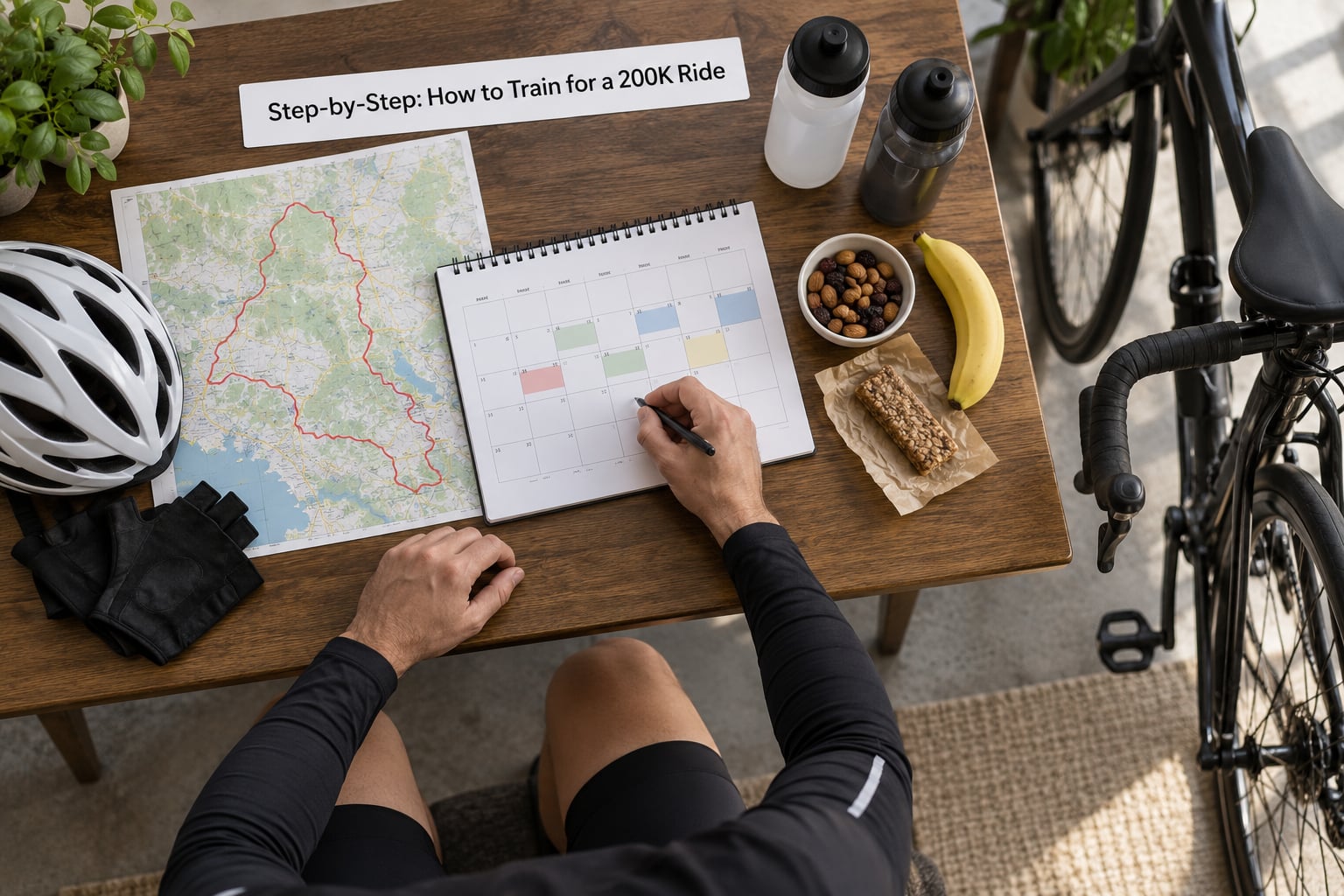
The block runs in four phases: base, build, peak, and taper. Each phase has a job, and each phase tells you when to move on.
Weeks 1-3: Build Your Aerobic Base
Three weeks of easy, frequent riding. Four to five rides a week, all conversational, with the weekend ride growing from about 90 minutes to 2.5 hours.
Conversational means you can hold a full sentence while riding, roughly Zone 2, somewhere around 60-70% of your FTP. If you have no power meter, use the talk test and a steady heart rate. Don’t chase numbers in these weeks. You’re building the tissue that will hold up at hour six, and that only happens slowly.
Add easy hills, ten minutes of climbing work at a civil pace, three or four times. This trains the muscular endurance you can’t pedal your way to later. Most riders skip it and then wonder why their hands and lower back fail at 130km.
Add two 30-minute strength sessions a week: squats or split squats, hinges, rows, and some core work. Nothing fancy. This is tendon and posture insurance for a day spent folded over handlebars.
Increase weekly volume by no more than 10% at a time, and follow three hard weeks with one easy week. Your phase worked if your resting heart rate is unchanged, your weekend ride felt controlled rather than heroic, and you can still ride on Tuesday after a hard Sunday.
Weeks 4-6: Add Long Rides and Race-Specific Work
Now the long ride becomes the centre of the week, growing from three hours to 4.5 hours by week six.
Keep those long rides steady and unstructured. Riders on forums describe the split clearly: do your intervals on the short midweek rides, and let the big weekend day be quiet. Chasing pace on a five-hour ride buys nothing.
- One tempo session a week. Two blocks of 20 minutes at 75-85% of FTP, five minutes easy between them. This raises your sustained speed without eating your recovery.
- Repeated climbs. Find a route near home with a climb you can do 5-8 times in a session. Ride it at threshold-ish effort with easy spin-back recoveries. That is the closest thing to the 3rd and 4th category climbs you will hit on the day.
- Paceline practice. Once a week, get four or six riders together and learn to sit in a line, hold a wheel, and take your turn. Most groups have one person who cannot do this, and it is usually the person who gets dropped at 150km.
- Fuelling practice. Work up from 30g of carbohydrate an hour to 60-90g. Practise pit stops two or three times in the weeks before the event: pull over, eat something, drink, get back on. Doing this cold on event day wastes ten minutes and your rhythm.
Your phase worked if you can ride four hours and still feel like you have something left, and if you can open up after three hours of steady riding without your heart rate spiking.
Weeks 7-9: Test Your 200K Readiness
This is where you find out whether the plan matches your event. One long ride reaches five to six hours, and you rehearse the day rather than just riding it.
Time your long ride against the expected event time, not just the distance. If your route suggests an eight-hour finish and you have only ever done four, you have a gap to close in these three weeks.
- The main rehearsal ride. Five to six hours on a route you know, with your event kit, your food, and your bottles. Try one out-and-back with a turnaround and a loop home afterwards if your legs allow it.
- Sustained climbing. Long climbs at tempo rather than sprint efforts. If your event climbs repeat every hour, practise the rhythm of hard-then-easy rather than emptying yourself on the first.
- Controlled intervals. Keep them. Two or three sessions a week, short and sharp, and never on top of a long ride.
- Back-to-back riding. If your event weekend has two days of riding, or your event lands the day after a club ride, do that deliberately. Saturday five hours, Sunday two easy hours. It teaches you to start tired.
Write your bail-out criteria now, while you are calm. What is the actual signal that you cannot finish? Time cut-off, a mechanical you cannot fix, a crash, blood sugar crashing repeatedly with no fix. Decide in advance, tell someone the plan, and it stops being a decision you make at 150km with a blank mind.
Weeks 10-12: Sharpen and Taper
Three weeks to hold what you built and then arrive fresh. Most riders lose fitness here by adding rides out of nerves, so cut volume instead.
- Week 10. Full intensity, full volume. Your last big long ride happens here, five to six hours, ideally with the hill profile of the course.
- Week 11. Cut total hours by 40%. Keep one tempo ride and a couple of openers: 10 minutes at race pace with easy spinning between. Race rhythm, not race load.
- Week 12. Two or three short rides of 60-90 minutes, all easy. Re-read the route, check the bike, lay out your kit, and get your sleep right. Two easy openers three and two days out keeps the legs awake.
You want to finish week 12 feeling slightly under-trained and slightly restless. That’s the correct feeling. Cut carbs in the last two days? No. Carb load three days out at around 10g per kg of bodyweight for two days, then eat normally, and stay topped up overnight.
This is the step most riders skip and it’s the one that decides how you feel at hour five. Week 12 worked if you feel keen rather than flat.
How to adjust the plan if you have under six hours a week
Three rides a week, one of them long, and the structure stays the same. Here’s roughly how to adjust how to train for a 200K ride when time is the constraint.
Drop the mileage targets and keep the long ride. If six hours a week is all you have, the Sunday ride becomes 3.5 to 4.5 hours and the other two rides stay short and mostly easy. Build that ride by minutes, not miles: add 15 to 30 minutes a week and stop when you hit five hours.
Keep one tempo session. Short and sweet beats nothing, and it costs 75 minutes including warm-up.
Stretch the block rather than compressing it. Riders with limited hours do better over 16 to 20 weeks than over 10. The rule against adding volume more than 10% a week applies harder when you have fewer sessions, because there’s less time to recover.
Skip the group paceline ride if it doesn’t fit. Trade it for a solo steady ride and use a podcast. A missed social ride costs you nothing; a missed long ride costs you everything.
Your week at a glance
| Phase | Weeks | Weekly hours | Longest ride | Focus |
|---|---|---|---|---|
| Base | 1-3 | 5-7 | 90 min to 2.5 h | Consistency, Zone 2, strength |
| Build | 4-6 | 7-9 | 3 h to 4.5 h | Long ride, tempo, climbing reps |
| Peak | 7-9 | 9-11 | 5-6 h | Rehearsal, pacing, pit stops |
| Taper | 10-12 | 4 down to 3 | 60-90 min | Freshness, carb load, openers |
Common Mistakes
Almost every DNF or slow finish traces back to one of these six.
Making every ride hard
The fix is about 80/20: roughly 80% of your riding easy, 20% hard. Ultra fitness comes from volume you can recover from, and riders who race every session arrive at 200K already cooked.
Raising distance too fast
Add no more than 10% to weekly volume, and take a lighter week every third or fourth week. A 10% rule isn’t a law of physiology, but it’s a decent guard against the tendon and overuse problems that end a block in week six.
Neglecting fuelling and hydration
Eat 60-90g of carbohydrate an hour from the first hour, not when you feel hungry. Drink 500-750ml an hour, with 20-30g of carbohydrate and 200-400mg of sodium per bottle. Practice it on long rides, and plan the packing: for a nine-hour ride that’s roughly nine bottles plus food, so plan resupply or a route with shops.
Training through pain
Fatigue is fine. Pain that changes your gait, a hot spot that won’t settle, a knee that aches at the top of every climb: stop and get it looked at. For numbness in your hands, drop your position and move your grip regularly. See a doctor if it continues.
Skipping recovery
Sleep, food off the bike, and easy days. If your resting heart rate is five or more beats above normal for three days, or you feel flat and heavy, drop the next long ride. Missing one long ride costs you almost nothing. Compounding over two bad weeks costs you the event.
Having no contingency plan
Weather, a mechanical, a feed station with nothing left, darkness arriving early. Decide in advance what you’ll do: the loop route with a bail-out point, the backup bar if the first falls, the spare tube and multi-tool in your jersey pocket, a spare light battery, and the cut-off time you will respect even if you’re only 20km short.
Coming back after a layoff? Assume you’re starting from scratch and add a month. Training indoors in bad weather? A trainer reproduces intensity and cadence work well, but it cannot teach you to sit still for six hours, so keep one long outdoor ride a week whatever the forecast. If the ride has to be shortened, shorten the training, don’t skip it.
Frequently Asked Questions
How long should I train for a 200K ride?
Twelve weeks is the minimum if your weekend ride is already three hours or more. Riders starting from a two-hour weekend, or returning from months off, need 16 to 20 weeks. The length of the block matters less than whether you reach five to six consecutive hours in the saddle before the event, because that is the habit that decides the outcome.
How many miles should I ride each week to prepare for a 200K?
For an experienced rider with a solid base, 150 to 200 miles a week in the middle of the block is realistic. Beginners should focus on hours instead: 6 to 8 hours weekly, building to around 10 by week nine. Distance matters less than time for this event, so do not chase mileage at the cost of recovery.
Should I do intervals when training for a double century?
Yes, but sparingly. One tempo or sweet-spot session a week, plus short over-geared accelerations, keeps your speed without touching your endurance. Keep hard sessions away from your long ride, because combining the two is the fastest route to fatigue, injury and a disappointing finish.
What should I eat and drink during 200K training rides?
Aim for 60 to 90g of carbohydrate an hour, taken from the first hour rather than when hunger hits. Drink 500 to 750ml an hour with 20 to 30g of carbohydrate and 200 to 400mg of sodium per bottle. Practise this on long training rides, since your stomach adapts far more slowly than your legs.
How do I taper before a 200K ride?
Cut weekly volume by about 40% in week eleven and keep intensity high with short openers. Week twelve is two or three easy rides of 60 to 90 minutes. Carb load three days out at roughly 10g per kg of bodyweight, protect your sleep, and let the fitness you already built show up on the day.
Can I train for a 200K if I am a beginner cyclist?
You can, with a longer runway. Expect 18 to 24 weeks, keep the total plan at four or five hours a week initially, and pick an event with a generous cut-off time and plenty of daylight. Finishing is the goal for a first attempt, so choose a route that avoids big mountains and remote sections.
Start with week one: three easy rides and a longer Sunday ride, no heroics. Build the long ride by minutes until you reach five hours, keep fuelling at 60-90g an hour from the first hour, and cut volume in the final fortnight. Adjust the block to your own hours and route rather than forcing someone else’s numbers.