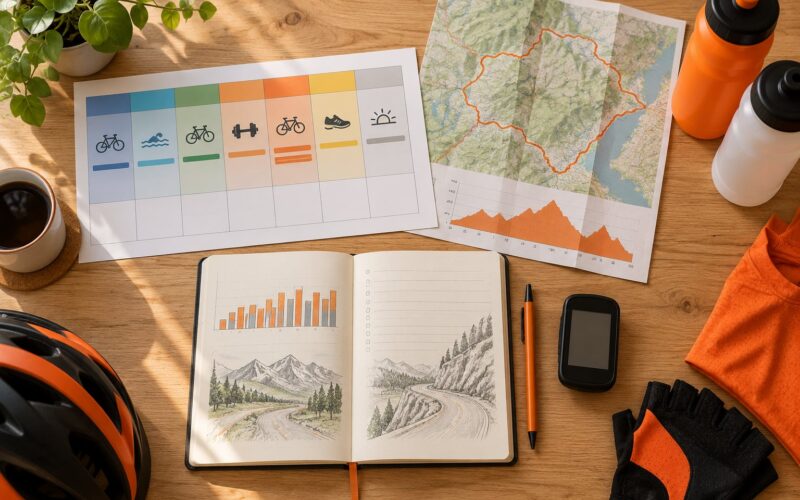
Strength training for cyclists works best as a small weekly habit: two 30 to 45 minute sessions of squats, hinges, lunges, pushes, rows and core work, done with heavy loads and low rep counts so the hard rides stay hard. Strength work builds peak power, muscular endurance and bone density without turning you into a bodybuilder.
Most riders I talk to already know they should be lifting. What they do not have is a plan that survives a real week of 12 to 15 hours in the saddle. That is the gap this guide closes.
Table of Contents
- Why Strength Training Helps Cyclists
- What Should Cyclists Train: Legs, Core, Upper Body, or Everything?
- Legs first, because legs are the engine
- The posterior chain is the quiet fix
- Core work for control, not for six-pack bragging
- Upper body and grip as support work
- The Best Strength Exercises for Cyclists
- How Often Should Cyclists Strength Train?
- A Simple Strength Training Plan for Road Cycling
- Session template
- Week-by-week progression
- Strength Training Without Interfering With Cycling
- How to Choose Equipment and a Coach
- Frequently Asked Questions
- What is a good strength workout routine for cyclists?
- Will lifting weights make my legs bulky?
- How often should I strength train for cycling?
- What is the ideal rep range for cyclists?
- Is squatting good for cycling?
- How long until I see power gains from lifting?
- Conclusion: Start With Two Sessions a Week
Why Strength Training Helps Cyclists
Riding is a concentric, low-impact sport. You push the pedals through a limited range, you never have to brake a load, and the impact that would normally build bone simply is not there.
That leaves several gaps strength work fills neatly:
- Peak and sprint power. Heavy lifting recruits more motor units and trains you to recruit the fast-twitch fibres you save for a 10-second attack.
- Muscular endurance. Holding power for 20 minutes on a climb punishes legs that cannot sustain output once the fresh feeling is gone.
- Climbing power per kilo. A stronger rider wins the same gradient carrying less body weight, because the watts come from muscle rather than from survival instinct.
- Cycling economy. Research on trained cyclists has found economy gains of roughly 5 percent over about eight weeks of strength work, which is a real reduction in the oxygen cost of a given watt.
- Time to exhaustion. Riders in the same studies held a fixed output longer, which matters most when the pace is uncomfortable rather than hard.
- Posture and lower back resilience. Trunk and hip strength holds the torso steady in an aggressive position, which is where a lot of road-riding backache originates.
- Bone density. This matters most from your fifties onward, and also for younger riders who log heavy sweat and long hours outdoors.
What strength training does not do is raise VO2 max or functional threshold power by itself. Those come from riding. Lifting makes the power you already have cheaper to produce and harder to exhaust, and it lowers the injury rate that quietly cuts seasons short.
Think of the 2026 training year this way: the bike builds the engine, the weights build the chassis.
What Should Cyclists Train: Legs, Core, Upper Body, or Everything?
Train everything, but spend your limited minutes in this order: legs, posterior chain, core, then upper body and grip.
Legs first, because legs are the engine
Quadriceps and glutes produce most of the force at the top of the pedal stroke. Squats, step-ups and lunges develop exactly that push, and a deeper range of motion usually translates into more usable force in a low, aerodynamic position.
The posterior chain is the quiet fix
Hamstrings, glutes and spinal erectors absorb and return energy through the bottom of the stroke. Riders who skip hinges almost always end up with tight hips and grumpy lower backs, and the Romanian deadlift is the cheapest insurance available.
Core work for control, not for six-pack bragging
The job of the trunk in cycling is resisting rotation and holding position under fatigue. Planks, side planks, dead bugs and carries do that. Long sets of high-rep abdominal work mostly trains endurance nobody needs here.
Upper body and grip as support work
Rows, presses and carries build the postural strength that lets you hold an aggressive position, and grip strength matters for out-of-the-saddle sprinting and for simply carrying your bike when you have to.
Two more worth fitting in: unilateral movements, because cyclists always pedal one leg harder than the other and one-sided work exposes the difference, and hip and ankle mobility, because a stiff ankle quietly limits your usable saddle height and saddle position.
The Best Strength Exercises for Cyclists
Here is the menu. Each entry names the movement, what it trains and how it transfers to the bike.
- Back squat or goblet squat. Quad and glute force in the range where you ride hardest. Keep the depth you can control and pause at the bottom.
- Bulgarian split squat. Unilateral leg strength plus a hip range-of-motion drill. Excellent for riders who feel one knee take over on climbs.
- Romanian deadlift. Hamstring and glute strength with a light hinge. The single best lift for a rider with a stiff or complaining lower back.
- Conventional or trap bar deadlift. Total-body pulling strength and grip. Progress it slowly, and treat it as the most fatiguing lift in the session.
- Push-ups or bench press. Upper-body pressing for posture and, honestly, for pushing a headwind at 20 km/h.
- Overhead press or dumbbell press. Shoulder strength and overhead control, which most riders have quietly lost.
- Bent-over row or single-arm cable row. Upper back, which is where a rounded road-rider posture comes from.
- Farmer’s carry. Grip, trunk and posture under load, and it needs no equipment beyond something heavy in each hand.
- Plank and side plank. Trunk stability in two planes, 30 to 45 seconds a side, not a two-minute hold.
- Dead bug. The best lower back insurance in this list, because it teaches the trunk to stay still while the limbs move.
- Glute bridge. Hip extension and glute activation, useful after long rides and on rest days.
- Couch stretch or deep squat hold. Hip flexor and ankle range of motion. Two minutes here saves a lot of fidgeting on the bike.
If you only have time for four, take the split squat, the Romanian deadlift, the row and the dead bug.
How Often Should Cyclists Strength Train?
Twice a week is the answer for most road riders, with one session for riders in a heavy racing block and three in the winter base.
| Phase | Sessions per week | What changes |
|---|---|---|
| Winter base and pre-season | 2 to 3 | Heaviest loads, lowest reps, longest range of motion |
| Build phase | 2 | Same movements, roughly 10 percent less volume |
| Racing season | 1 to 2 | Two hard sets per movement, never a session to failure |
| Recovery week or illness | 0 to 1 | Mobility and easy core work only |
Beginners do well with two sessions on non-consecutive days, full body each time, 35 to 45 minutes. Add a third only when two is genuinely easy and the riding load is light.
If you already ride 12 to 15 hours a week, do not add sessions. Cut sets instead. One set of three to five reps on four movements beats three sets on a week you are already absorbing.
A Simple Strength Training Plan for Road Cycling
Here is a twelve-week structure you can follow without a coach, built as two full-body sessions a week with a clear progression.
Session template
- Warm-up, 8 to 10 minutes. Band lateral walks, 10 bodyweight squats, 10 hip hinges, 10 push-ups, then two light ramp sets of your first lift.
- Main lifts, 5 to 6 movements. Squat variation, hinge, push, pull, unilateral leg, core. Three to five working reps per set, three to four sets.
- Rest three to five minutes between sets. Long enough to keep the sets honest. Two minutes for accessory work.
- Effort cue. Stop each set with about two reps left in reserve. No grinding, no failure.
- Cooldown, 5 minutes. Easy walking plus a hip or chest stretch.
Week-by-week progression
Weeks 1 to 3 are the pattern phase: find your working loads on all six movements and learn the positions. Weeks 4 to 6 add load, aiming for two reps per kilo more than week 3 on the squat, hinge and press. Week 7 is a lighter week, roughly 60 percent of the usual sets, to arrive recovered. Weeks 8 to 11 are the heaviest stretch, where load climbs while sets stay at three. Week 12 cuts to two sets per movement and finishes the block.
Add weight only when every rep in every set is controlled at the same load. When that stops being true, drop the weight, fix the reps and rebuild.
Strength Training Without Interfering With Cycling
Fatigue is the only thing you actually have to manage, and a weekly structure handles it better than willpower.
Put your two lifting sessions on your easiest riding days, or on days you are not riding at all. If your hard sessions are Monday, Wednesday and Saturday, lifting lands best on Tuesday or Thursday and on Sunday. Riders on the cycling forums who train 12 to 15 hours a week converge on the same idea: the lifting has to go somewhere specific, not wherever a gap appears.
Two ordering rules cover nearly every case. Lifting before an easy ride is fine, and sometimes ideal, because the ride keeps you loose afterwards. Lifting straight after a hard interval session is a bad idea, because you will be training on depleted legs. If a day holds both, do the ride first, eat, and lift later in the week.
Keep the distance from your key sessions. The commonly repeated rule of thumb is to avoid heavy lifting within about two days of a long ride, a race or a big climbing day.
Soreness is the other issue. Delayed onset soreness mostly shows up in unfamiliar movements, not in the loads themselves, so it fades after two or three weeks of consistent work. Riders who report feeling strong immediately after a session and then flat for days are usually looking at a program with too many movements and too much volume.
How to Choose Equipment and a Coach
Buy the least equipment that lets you do the movements above well, and progress it one tier at a time.
- Bodyweight only. Squats, split squats, push-ups, single-leg glute bridges and a backpack carry cover most of the program. It costs nothing and it works.
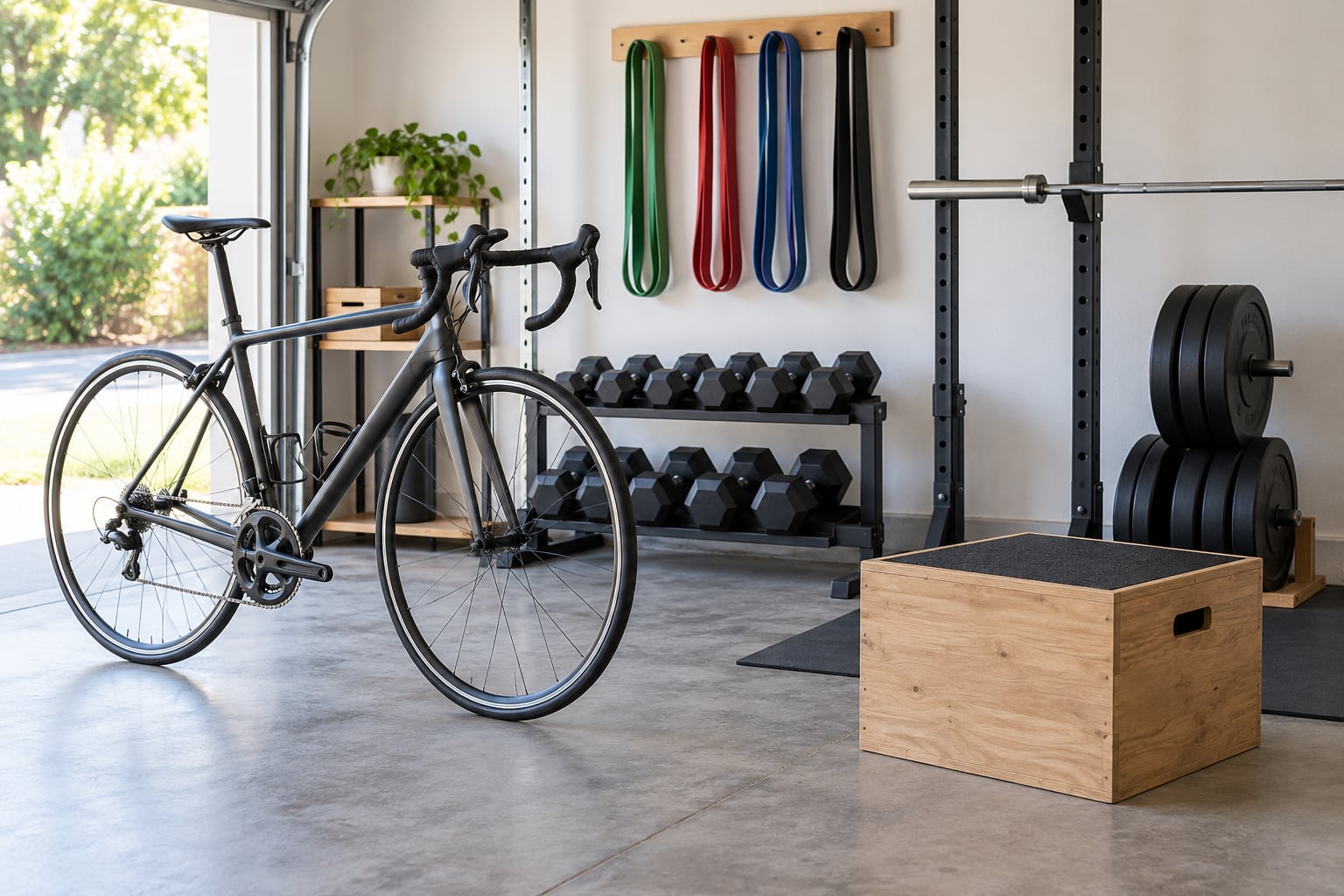
- Bands and dumbbells. Handles nearly everything above and stays portable for hotel rooms and campsites. A pair of adjustable dumbbells is the single most useful purchase.
- A rack, barbell and plates. Needed for true heavy squats, deadlifts and bench. Worth it once you are riding 10 or more hours a week and want to keep progressing for years.
- Machines. Useful for push and pull work when you cannot squat a barbell, and for riders coming back from injury under a physio’s guidance.
Coaching is worth considering if you have never trained with a barbell, if you are returning after a crash, or if you already ride 15-plus hours and cannot see how to fit more in. A one-off session with a qualified strength coach, usually enough to learn the squat, hinge and press patterns properly, solves most intimidation. For anything involving ongoing pain, see a doctor or a physical therapist first.
Whatever tier you pick, the progression rule is the same: more load, not more exercises.
Frequently Asked Questions
What is a good strength workout routine for cyclists?
Two full-body sessions a week, 35 to 45 minutes each, is the standard answer. Each session covers a squat variation, a hinge, a push, a pull, one unilateral leg movement and two core exercises. Work three to five reps per set for three or four sets, resting three to five minutes between sets and stopping with about two reps in reserve. Keep the hardest riding days separate from the gym work.
Will lifting weights make my legs bulky?
Not if you program it the way cyclists need. Muscle growth comes mostly from high volume, frequent sets and enough food to support it, and that is not what a cyclist lifting three to five heavy reps twice a week is doing. Riders routinely add strength while staying the same weight, because a stronger rider wins the same gradient carrying the same kilos. If your weight does climb, the usual cause is eating more, not lifting.
How often should I strength train for cycling?
Twice a week for most riders, two or three in the winter base, and one to two short maintenance sessions during the racing season. What matters more than the number is placement: keep lifting on your easy days or your rest days so it never lands next to intervals, a long ride or a race. If your riding load is already high, cut sets before you cut sessions.
What is the ideal rep range for cyclists?
Three to six reps per set, with three to five minutes of rest. Low reps and heavy loads produce the neural and tendon adaptations that raise peak power, while the fatigue cost stays small. Fifteen to twenty rep bodybuilding work adds a lot of fatigue for very little transfer, and riders often drift into it because pedalling also feels repetitive. Accessories can sit at eight to twelve reps if you enjoy them.
Is squatting good for cycling?
Yes, and it is the first exercise most riders should master. Squats build quad and glute force for the top of the pedal stroke, and the deeper you go within a controlled range, the more of that force you can use in an aerodynamic position. Start with a goblet squat or a light barbell and add load gradually. Unilateral work such as split squats is a good companion for riders who feel one knee dominate.
How long until I see power gains from lifting?
Technique usually improves within two to three weeks, and short efforts such as five-second and one-minute power tend to respond first because they depend on force production. Longer efforts move more slowly, with economy changes often showing over six to eight weeks. Keep a simple test, such as a fixed five-second or five-minute effort, and repeat it at week zero, week six and week twelve so you are comparing numbers rather than memories.
Conclusion: Start With Two Sessions a Week
Book two 40-minute sessions this week, pick four movements from the list, and use loads you can control for four clean reps. Progress the weight, not the exercise count, and keep your hardest riding in its own space on the calendar.
Strength training for cyclists is a support system, not a replacement for the bike. Two sessions done consistently will make you stronger on the same gradient, tougher over the same distance, and less likely to end a season with a knee or a back that needs rest.