How to train for a gran fondo takes 12 weeks for most riders, and 8 is enough if you already ride four or more hours a week. The plan is not complicated: build an aerobic base on easy rides, add climbing and threshold work once the base exists, rehearse the fuelling and pacing you will use on the day, then drop your volume for the final ten days so your legs are fresh rather than heavy.
A fondo punishes one thing above all else, and it is not fitness. It is going too hard in the first hour and arriving at the signature climb with nothing left. Riders who train patiently through the base phase almost always finish comfortably; riders who race their training rides blow up by kilometre 60.
Before the week-by-week breakdown, six numbers cover most of it:
- 12 weeks of structure, starting with four to eight weeks of easy aerobic riding before anything hard.
- About 80% of your riding at easy intensity, conversational pace or below roughly 75% of your FTP.
- Long ride growing about 10% a week until it reaches 2.5 to 3.5 hours, which is where most riders get the mental benefit.
- 60 to 90g of carbohydrate per hour while riding, and 80 to 90g on the day itself.
- Opening at 65 to 75% of FTP, which feels too easy for the first 30km.
- A 7 to 10 day taper that cuts volume by half but keeps a few short sharp efforts.
A note on who this is written for: recreational and club road riders aiming to finish their first or second 100 to 200km fondo, plus experienced riders moving up to something hillier. It is a template. Your life, your work week and your current fitness will need editing, and if you have a heart condition, a breathing condition, a recent injury or any medical concern, get cleared by a doctor before starting a block like this.
Table of Contents
- What You Need
- Route information
- Essential kit
- Optional, and honestly optional
- Nutrition planning
- How to Train for a Gran Fondo: The 12-Week Step-by-Step Plan
- Weeks 1-4: Build an Aerobic Base
- Weeks 5-8: Add Climbing and Faster Riding
- Weeks 9-10: Simulate Gran Fondo Demands
- Weeks 11-12: Sharpen and Taper
- How to Pace the Full Gran Fondo
- How to Fuel and Hydrate During the Ride
- Common Mistakes
- Frequently Asked Questions
- How long should I train for a gran fondo?
- Can I prepare for a gran fondo in less than 12 weeks?
- How long should my longest training ride be?
- Do I need to be able to climb before doing a gran fondo?
- Should I train indoors or outdoors for a gran fondo?
- What should I eat before and during a gran fondo?
- Conclusion
What You Need
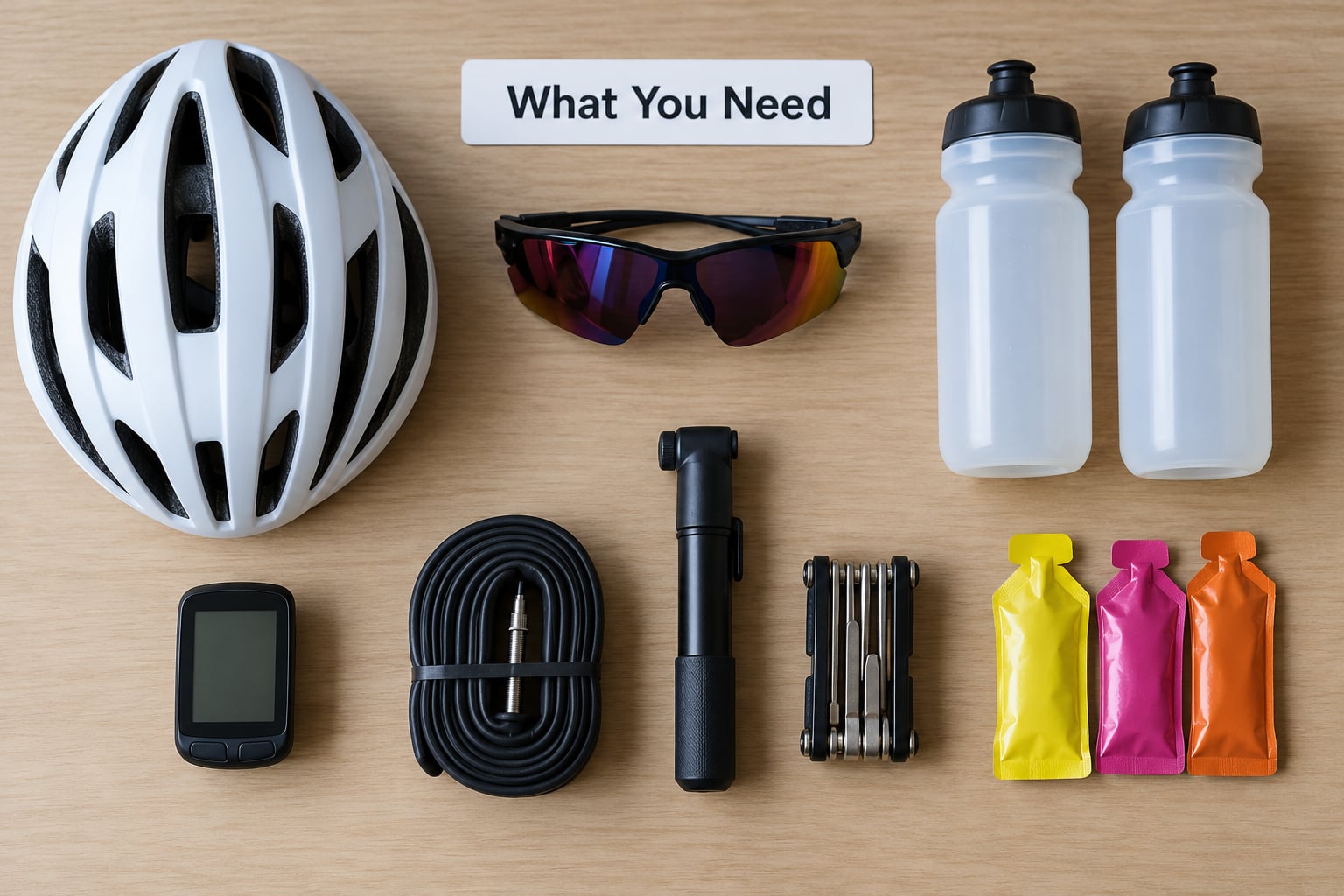
Start with the essentials, then decide what you can live without. Buying everything at once is how people quit a training plan in March.
Route information
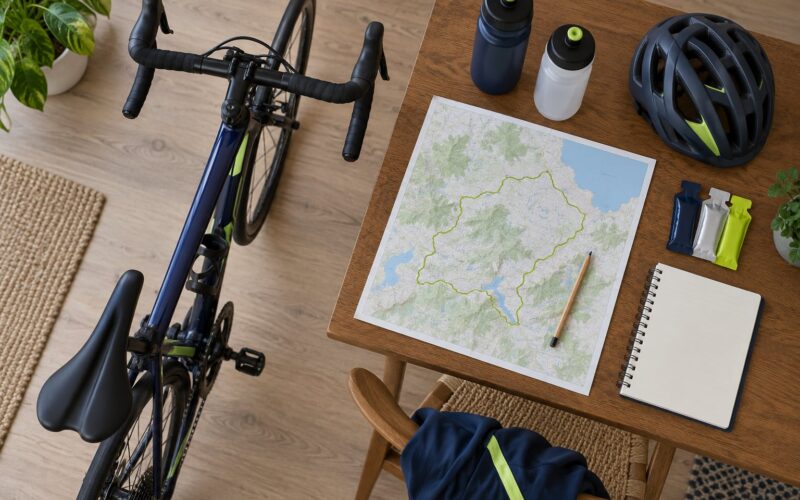
You cannot train for a course you have not looked at. Find the event profile before week one: total distance, total elevation in metres, and the length and gradient of the biggest two or three climbs. A 160km fondo with 1,000m of climbing and a 160km fondo with 3,000m are different events with the same start time.
Write down the climb that scares you and plan specific sessions for it. If it is a 20-minute climb at 7%, a rider whose only hard work is flat-out sprints will not enjoy the day.
Essential kit
- A road bike that has been serviced, with a chain that is not stretched and brakes that bite predictably.
- Tyres at the pressure you have actually run before, not a number you read somewhere.
- Two spare tubes, a CO2 inflator or mini pump, tyre levers and a multitool with a chain breaker.
- Two bottles plus a cage, and a third bottle or a feed pouch for rides over three hours.
- A base layer, arm and knee warmers if it starts cold, and a packable wind jacket for descents and rain.
- Food you have already eaten on training rides, plus one backup item you have never had to open in a panic.
Optional, and honestly optional
A power meter is useful but not required. Riders without one can train perfectly well on perceived effort, talking pace and heart rate, and many older riders with decades of good pacing do not need one at all. If you do ride with one, ride with it for eight weeks before you trust a single number, because the first two weeks are always inaccurate.
Aero equipment matters far less than most product pages suggest. On a course with repeated climbing, you are upright for a large share of the distance, and saving 15 watts in a position you cannot hold is worth nothing.
Nutrition planning
Work out roughly how many hours your longest race will take, then multiply by 60g of carbohydrate an hour for a first estimate. That gives you a number to build a food plan around and, more importantly, a number to test on training rides rather than discover at kilometre 90.
How to Train for a Gran Fondo: The 12-Week Step-by-Step Plan
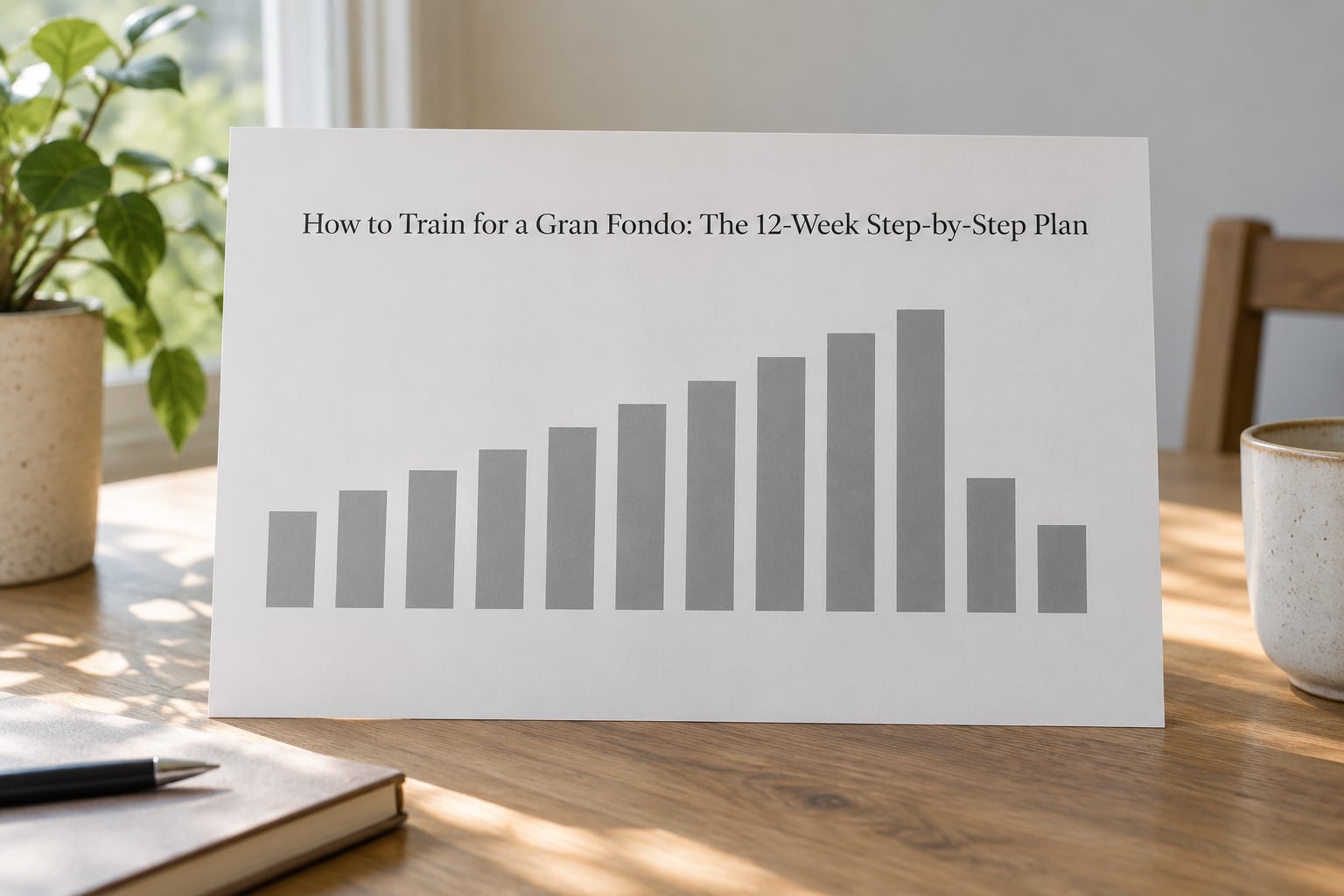
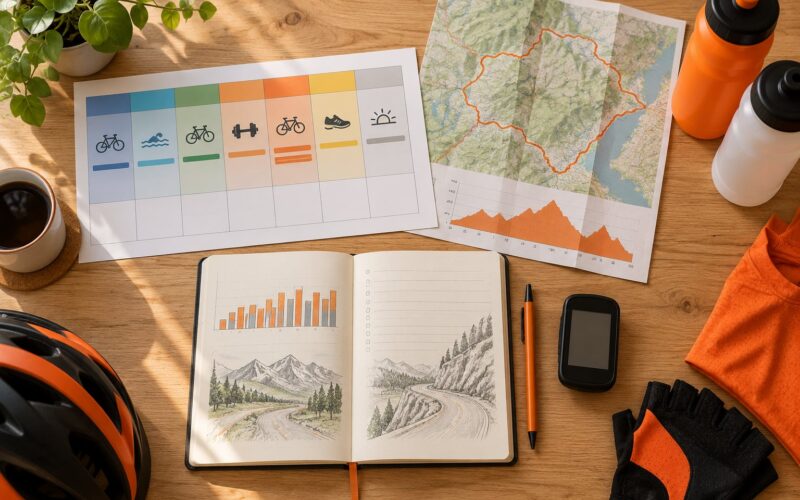
The plan runs in four blocks: four weeks of aerobic base, four weeks adding climbing and faster riding, two weeks of full event rehearsal, and two weeks of sharpening and taper. Weekly duration should rise gradually, the long ride should grow by roughly 10% every week until the peak, and every fourth week should drop back by 20 to 30% so you absorb what you have done rather than carrying fatigue into the next block.
Fit it around your actual week. Riders with office hours and small children routinely do four sessions: one short weekday effort, two easy rides that can be squeezed into a lunch break or a commute, and the long ride on the weekend. That is enough. One r/trainerroad user described almost exactly this shape, with a shop ride, two trainer workouts, a Saturday long ride and a Sunday strength session, and it is a good template for anyone whose weekend is the only reliable block.
| Week | Focus | Ride hours | Key sessions | Long ride |
|---|---|---|---|---|
| 1 | Base | 5-6 | Easy spin, endurance ride, strength | 1h30 |
| 2 | Base | 6-6.5 | Cadence work, endurance ride, strength | 1h45 |
| 3 | Base | 6.5-7 | Steady endurance, hill repeats at easy pace, strength | 2h |
| 4 | Recovery | 5-5.5 | Easy riding only, no efforts | 1h30 |
| 5 | Build | 7-8 | 2x20min at threshold, endurance ride, strength | 2h15 |
| 6 | Build | 8 | 3×12-15min climbing reps, rolling terrain, strength | 2h30 |
| 7 | Build | 8-9 | Threshold 3x15min, first fuelling rehearsal, strength | 2h45 |
| 8 | Recovery | 6-6.5 | Easy riding, mobility | 2h |
| 9 | Peak | 9-10 | Race rehearsal: long climb, full fuelling, group pace | 3h |
| 10 | Peak | 9-10 | Back-to-back long rides, climbing specificity | 3h30 |
| 11 | Taper | 5-6 | Short openers, 2x10min sweet spot, short ride | 1h30 |
| 12 | Race week | 3-4 | Two easy rides, race | Race |
Adjust the hours column to your life, not the other way round. If you can only find six hours a week, keep all six and cut the least important session. If you have ten hours, do not add them all to the long ride; put the extra time into easy weekday riding and one extra quality session.
Weeks 1-4: Build an Aerobic Base
The base phase is four weeks of riding that should feel almost too easy. Aim for heart rate you could hold through a conversation, or power below roughly 75% of FTP, and stay there for 90 minutes to 2 hours at a time.
What matters in these weeks is time in the saddle, not intensity. Add one or two short cadence efforts per week, holding a comfortable cadence for 3 x 5 minutes in a middle gear, to build pedal smoothness without loading your legs. If you ride with power, run a 20-minute test in week one so every later prescription has something to hang on.
Add one or two 30-minute strength sessions a week: squats or split squats, hip hinges, rows and some core work. Most riders find this harder than the riding for the first fortnight. Keep the loads modest, and stop if your riding degrades noticeably, which usually means the gym has taken more out of you than it put back.
The long ride grows by about 10% a week through these four weeks, ending near two hours. That is short for a fondo, deliberately so. You are building a habit, not simulating a race.
You will know the base is working when easy rides feel easier at the same heart rate, when your average speed on a familiar flat loop creeps up without extra effort, and when you can ride three hours and still want to go out on Monday. If those have not happened by week four, add more easy time and postpone the intensity work for a week. There is no penalty for starting the build late.
Weeks 5-8: Add Climbing and Faster Riding
Now you add one or two genuinely hard sessions a week, while every other ride stays genuinely easy. The easiest way to wreck this plan is to treat every ride as a workout and arrive at week eight exhausted.
The two sessions worth doing:
- 2 x 20 minutes at threshold, with 10 minutes easy between. If you ride with power, 88 to 95% of FTP. If you do not, it is hard but controlled, roughly the pace of a fast group ride you can just about hold for 20 minutes.
- 3 x 12 to 15 minute climbing repetitions on a gradient of 6 to 8%, with 10 to 15 minutes of easy spinning between reps. Keep the effort smooth rather than surging. Long climbs are a different animal from short punchy ones, and r/Velo consensus is that efforts over 30 minutes belong at about 0.8 to 0.9 of FTP rather than above it.
Every other ride in weeks 5 to 8 stays easy, and one of them should be long. Grow the long ride to 2 hours 30 by week 7, and start practising fuelling on it. Eat something every 25 to 30 minutes without waiting for hunger, drink on a timer, and write down what you took in. That log is more useful than any app.
Week 8 is a recovery week. Drop the hours, ride everything easy, and do some mobility work. Coming out of it fresh matters more than squeezing one extra hard session in.
Weeks 9-10: Simulate Gran Fondo Demands
These two weeks are the closest thing to race day you will get, and the goal is rehearsal rather than fitness. Fitness is already built; what you are training now is the specific set of skills that decide whether the day is enjoyable.
Plan the week 9 long ride around your biggest climb of the course. If the event climb is 20 minutes at 7%, ride that climb, and then ride it again after 45 minutes of easy riding. Consecutive climbs are where most riders discover they cannot repeat an effort, and that is exactly the gap you want to close before the event rather than at kilometre 120.
On that ride, rehearse the whole day. Start conservatively and stay there for 30 to 40km. Sit in a group for a stretch and notice how much easier it feels when you stop leading the wind. Take your full fuelling plan in, with real numbers, so you know what 60 to 90g an hour actually feels like in your stomach at hour three.
One r/cycling rider described exactly this gap: he rode a 65km mini fondo with 1,100m of climbing in 3 hours at a 205W average and could still hold 200W at the end, yet his legs felt tired. His fix was more low-intensity hours plus two gym sessions a week, not more hard riding. If your legs feel cooked while your power holds up, the answer is almost always more easy riding and better recovery, not more intensity.
Week 10 should include a long weekend with two rides in a row, ideally with the second one three to four hours. Finishing a long ride tired and then getting out again teaches your legs the thing no interval can: that day two of a fondo still works.
Rehearse the bike and the kit too. Ride the exact bike, in the exact shoes, with the pack or bottles you plan to carry. A saddle sore or a chafing shoulder that only shows up at hour five is a training-day discovery, not a race-day one.
Weeks 11-12: Sharpen and Taper
Cut your hours roughly in half for these two weeks but keep the intensity. This is the detail most riders get wrong: dropping the hard efforts as well as the volume leaves you heavy and slow for three weeks, because your body loses its sharpness well before it loses its fitness.
Week 11 looks like this: one easy hour-long ride, one ride with three or four short openers of 8 to 10 minutes at a hard-but-not-maximal effort, a short threshold block of 2 x 10 minutes, and one 1 hour 30 minute ride with a few surges to practise holding pace in a bunch. That is the week.
Race week is two short easy rides, ideally 45 to 60 minutes, and then the event. Nothing more. No heroics, no testing, no trying to prove anything to yourself in the last three days.
While you are riding easy, take care of the logistics. Check registration details and start times, lay out the kit the night before, get the bike checked, sort out food for the morning, and set two or three alarms. Fondos lose more riders to a flat tyre at kilometre 5 in a panic than to any fitness failure.
Sleep is worth as much as anything you do this week. Go to bed earlier for the three nights before the event, and resist the urge to reorganise your packing list at midnight.
How to Pace the Full Gran Fondo
Pacing is the single biggest factor you control on the day, and the biggest reason riders who trained well still finish miserable. The first 30km is a trap: the pace feels easy, the group is fast, the feed zone was good, and the climb at 60km looks harmless from a distance.
Open at 65 to 75% of FTP. If you ride without power, that is a pace where your breathing is controlled and you could talk in short sentences. Most riders go out at 90% because everyone around them is going out at 90%.
A practical rule: for the first 30 to 40km, deliberately ride at the back of the group or slightly off it. Drafting behind other riders saves a real amount of energy, and r/Velo riders commonly put it at 25 to 30% on a fast section, which is the difference between arriving at the first climb fresh and arriving already working.
From there, adjust effort to terrain rather than to the riders around you. Uphill sections sit at 75 to 85% of FTP. Flat sections let you hold 90 to 95% if you are in a group and being sheltered, and less if you are on your own in the wind. Descents are free speed, but ride them at a pace where you would still be able to steer if someone swerved.
Save something for the end. Whether you are chasing a time or simply finishing, the last 20km decide how you remember the day, and riders who spent everything at kilometre 70 have nothing there. Strong in the last 20km beats showing off in the first 20km, every single time.
One last practical piece. Find a local hilly loop and ride it often in training, and never stop pedalling on the climbs. A wobble at the bottom of a long gradient costs far more than a 20-second gap.
How to Fuel and Hydrate During the Ride
Plan the food before you plan the pace. Ride time, not distance, determines intake: multiply your expected hours by 60 to 90g of carbohydrate an hour, and work out how that divides across two bottles, a feed pouch and any aid stations on the route.
A practical example for a five-hour ride: around 80g an hour, so 400g for the day. That might be one bottle mixed to 80 to 100 calories an hour, one 60g gel every 45 to 60 minutes, and a real-food option at the halfway point, such as a banana or a homemade oat bar. Real food works; plenty of riders finish well on sandwiches.
Drink 500 to 750ml of fluid an hour as a starting point and go higher in heat. Add sodium, typically 300 to 600mg an hour, especially if you are a heavy sweater or the forecast is hot. Your bottles are the mechanism; set a timer if you have to, because thirst arrives late.
Eat on a schedule, not on hunger. Hunger on a long ride is a lagging indicator, and by the time you notice it you are already behind. Set an interval for every 25 to 30 minutes and eat whether or not you want to.
Treat your gut like anything else in training. Test every product on a long ride, in training, over several weeks. A gel you have never swallowed before, a drink you have never mixed at concentration, or a supplement someone handed you at registration is a genuine risk on a 6-hour day. Ignore the sample table, or treat anything from it as untested.
And do not build the plan around aid stations. They exist, they vary, and the good ones are crowded. Carry what you need, and treat the feed zone as a bonus rather than a strategy.
Before the event, keep carb loading light. For anything under about three hours, a normal high-carbohydrate dinner the night before is plenty, plus your usual breakfast. Heavy multi-day loading is disproportionate for a single-day fondo and often shows up as a bloated, uncomfortable start.
Common Mistakes
Almost every abandoned fondo plan fails for one of the same reasons. Here are the eight I see most often, with the correction for each.
- Adding volume too fast. Jumping from four to nine hours a week is how people get injured in week three. Increase weekly hours by no more than 10%, and take a recovery week every fourth week.
- Riding every session hard. If every session has an effort, nothing is easy and the aerobic base never builds. Keep the split near 80% easy, including in the build phase.
- Training only on flat terrain. Climbing has its own demands, and a fondo route rarely flattens out. Build one climbing session a week from week five onward.
- Having no fuelling plan at all. Arriving at hour four with gels in your jersey pockets and no routine to follow is a recipe for running out of energy. Decide the number and test it.
- Skipping the long ride until the last two weeks. Long rides cannot be compressed into a fortnight. The mental endurance of hours in the saddle has to be built early, when it is boring and easy.
- Tapering by cutting intensity too. Dropping the hard efforts along with the volume leaves you heavy. Cut hours, keep short sharp openers.
- Training to the start, not the finish. If your plan’s peak is the week before the event, you will arrive carrying fatigue instead of freshness.
- Riding the whole event at the group’s pace. Joining a group faster than your training supports is a common way to blow up by the first feed zone. Ride the pace your training built, not the pace the group sets.
Two smaller tips. Ride the event bike, with the event kit, on your longest training ride rather than a different setup. And check in with how you feel during the week, not only at the weekend: a week of poor sleep and heavy legs is a reason to cut volume, not to add a workout.
Frequently Asked Questions
How long should I train for a gran fondo?
Plan on 12 weeks for most riders, and you can compress it to 8 if you already ride four or more hours a week consistently. Returning riders with a low base, or anyone coming back from a winter break, need closer to 20. Three things set the length: your current weekly hours, the length of the longest climb on the course, and whether you want a comfortable finish or a fast one. A first 100km fondo needs less preparation than a climbing-heavy 180km route.
Can I prepare for a gran fondo in less than 12 weeks?
Yes, and for experienced riders 8 weeks works well because most of the fitness is already there. The way to compress is to cut base-phase volume, not the intensity work. Keep your two weekly threshold and climbing sessions, shorten the early long rides, and start the build sooner. If you currently ride under three hours a week, 8 weeks is optimistic. Be honest about your starting point before you commit to a date.
How long should my longest training ride be?
Three to three and a half hours is the practical target for most riders, and it should sit one to two weeks before your peak week. Most riders reach the mental and fuelling benefit well before they reach the full event distance, and training five-hour rides on top of everything else creates more risk than reward. If your event is much longer, add one back-to-back weekend of two long rides rather than a single very long day.
Do I need to be able to climb before doing a gran fondo?
You do not need to be a good climber, but you need enough threshold fitness to sit at 75 to 85% of FTP for 20 to 30 minutes without being dropped, and to repeat that effort later in the day. Riders who cannot climb usually suffer on the second and third climbs, not the first. Two climbing sessions a week from week five, plus a long ride that repeats a climb, closes most of that gap for a recreational rider.
Should I train indoors or outdoors for a gran fondo?
Indoor work covers your aerobic base, threshold sessions and long steady efforts perfectly well, and in winter it is often the only realistic option. A turbo trainer or Zwift can also replicate long climbs by holding a steep gradient. What indoor riding cannot teach you is cornering, descending, pack skills and fuelling logistics, so get outside at least weekly if you can, and always for the longest ride of the block.
What should I eat before and during a gran fondo?
Before: your normal breakfast, eaten three hours before the start, built around carbohydrate you already digest well. No new foods. During: 60 to 90g of carbohydrate an hour, and 80 to 90g on the day itself, split between bottles, gels or chews, and one piece of real food if your stomach tolerates it. Drink 500 to 750ml an hour with added sodium, and eat on a timer every 25 to 30 minutes rather than waiting for hunger.
Conclusion
The plan comes down to four things: mostly easy aerobic riding to build a base, one or two hard sessions a week to raise your ceiling, repeated rehearsal of the fuelling and pacing you will use on the day, and a taper that cuts volume without cutting sharpness. Riders who do those four things consistently finish most of their first and second fondos comfortably, which is the whole point.
Your first action is small. Pick the event date, read the elevation profile, put the next three weekend long rides in your calendar with a reminder, and start week one this week. Twelve weeks from that ride, you will be ready.
Updated for 2026. This is a template rather than a prescription: adjust it to your life, and talk to a qualified coach or a medical professional before starting if you have any health concerns, an injury history or a heart or breathing condition.