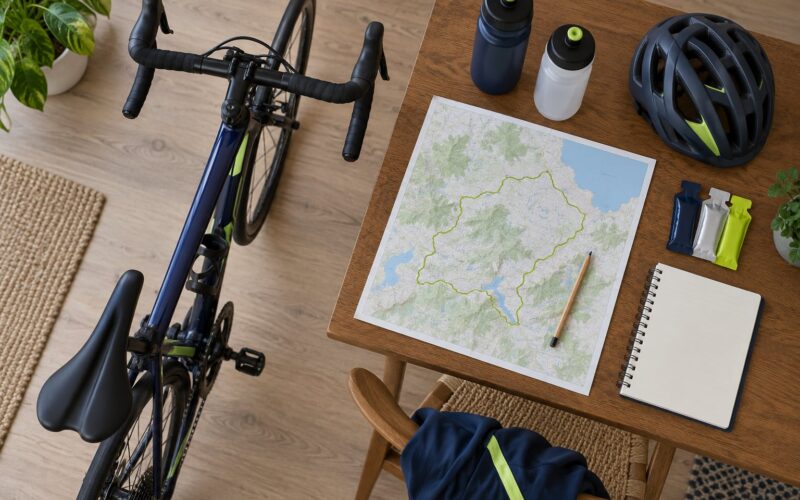
To structure a cycling training week, alternate hard and easy days: one or two quality sessions, one long endurance ride, several conversational rides, and at least one full rest day, with no more than two genuinely hard efforts in seven days.
Most riders don’t fail because they ride too little. They fail because every ride feels medium-hard, or because the hard day lands on the day before the long ride. The framework below fixes both problems and takes about fifteen minutes to lay out for any week, including one built around a century.
Table of Contents
- What You Need Before You Structure a Cycling Training Week
- Step-by-Step: How to Structure a Cycling Training Week
- Start With Your Weekly Time Budget
- Place Your Key Sessions on Concrete Days
- Build the Easy-Ride Core of Your Cycling Training Week
- Choose a Key Session That Matches Your Goal
- Progress the Long Ride Gradually
- Add Short Recovery or Technique Work
- Plan the Next Week With a Simple Check
- Common Mistakes
- Frequently Asked Questions
- Should I plan my cycling week by miles or by hours?
- How many rest days should I take when training for a century?
- What if my schedule changes and I have to miss a ride?
- Should the hardest interval session come before the long ride?
- How do I know if my training week is too hard?
- How should I fuel during a long training ride?
- Conclusion
What You Need Before You Structure a Cycling Training Week
Six inputs, and you can find all of them in about ten minutes:
- Your current weekly riding time. Add up the last four weeks and divide by four. That average is your baseline, not your target.
- Your real availability. Write the actual windows you can ride in — Tuesday 6:15 to 7:30 am, Sunday morning — not the windows you wish you had.
- One primary goal. Finishing a century, climbing better in a club ride, or rebuilding fitness after a layoff. Each one changes the key session.
- Your long-ride date. Count back from it. That’s your real deadline, and it decides everything else.
- Recovery constraints. A demanding job, a young child, an injury, or a partner who trains alongside you. All of these cap your volume.
- A tracking method. Duration, distance, and perceived effort on a 1-10 scale is enough. A power meter or heart rate monitor adds precision, but it’s optional and it is not the plan.
If you can only fill in the first two, plan the week anyway and refine it later. Momentum beats perfection.
Step-by-Step: How to Structure a Cycling Training Week
Start With Your Weekly Time Budget
Start from what you actually rode, then plan roughly the same amount. Jumping from four hours to ten in a single week buys nothing but soreness.
| Weekly time | Typical shape | Key sessions |
|---|---|---|
| 4-5 hours | 3 rides | 1 quality session, 1 long ride, 1 easy ride |
| 6-8 hours | 4-5 rides | 2 quality sessions, 1 long ride, 2 easy rides |
| 10-12 hours | 6 rides or more | 3 quality sessions, 1 long ride, 2 short recovery or skills sessions |
Reserve about a quarter of your available time for recovery before you plan anything else. If Sunday afternoon is the only long window you have, protect it and fit the rest around it.
Place Your Key Sessions on Concrete Days
Write the key sessions on named days before you fill in anything else. Two rules keep the week safe: leave at least 48 hours between hard efforts, and never stack a hard day directly before the long ride.
Here is a complete six-hour week for a rider about six weeks out from a century:
| Day | Session | Time |
|---|---|---|
| Monday | Rest day | 0:00 |
| Tuesday | Sweet spot intervals, 3 x 12 minutes hard with 8 minutes easy | 1:15 |
| Wednesday | Easy endurance ride with cadence drills | 1:00 |
| Thursday | Easy endurance ride or 40-minute technique session | 1:00 |
| Friday | Rest day | 0:00 |
| Saturday | Long ride, conversational pace with two planned stops | 3:00 |
| Sunday | Recovery spin, 45-60 minutes, genuinely easy | 0:45 |
Put the second quality session on Thursday only if you feel strong on Wednesday. Otherwise move it to Monday of the following week and ride easy all week.
Build the Easy-Ride Core of Your Cycling Training Week

Easy riding means you could hold a conversation the whole way. On a power meter that usually lands around zone 2; by feel, it’s nasal breathing and a heart rate you could sustain for two hours.
Easy volume is what lets you repeat the hard work. Big sessions only pay off if you can do them again next week, and the aerobic base that makes a century feel manageable comes from these unremarkable hours, not from Saturday’s suffering.
Fill your shorter weekday slots with two hours or less of easy riding. Longer than that on a weekday often eats into sleep, and a rider who sleeps badly has no easy days left to give.
Choose a Key Session That Matches Your Goal
Pick the one session that matches your goal and let the rest of the week support it:
- Intervals — short hard efforts with full recovery, typically three to five minutes on, equal or more off. Best for short efforts and climbing repeats.
- Sweet spot or tempo — longer efforts at a hard-but-controllable pace, typically three to twelve repetitions of ten to twenty minutes. Best for a century pace and for sustained climbing.
- Hill repeats — the same climb several times with a long spin back down. Good on roads where you can’t ride flat intervals safely.
- Long endurance block — ninety minutes of steady riding with the last twenty minutes moderately hard. A good choice when you are new to structured training.
For a century rider, tempo work usually wins. The ride lasts five to six hours, and the fitness that decides the outcome is the ability to hold a steady, slightly uncomfortable pace for a long time rather than to sprint at the end of a set.
Progress the Long Ride Gradually
Start around 60 to 70 miles if your current weekly volume is 4 to 6 hours. Add roughly 10 miles every one to two weeks, and stop at about 85 to 90 percent of your target distance two to three weeks before the event.
Keep the pace conversational even when the route turns flat and fast. A long ride that starts at race pace ends at a crawl, and you get no fitness benefit from the middle section you rode at half effort.
Plan two stops before you leave, not one. Drink on the first, eat a carb source on the second, and treat any long ride over two hours as a fueling rehearsal. When the distance grows, cut back-to-back volume — a four-hour Saturday usually means an easy or skipped Sunday.
Add Short Recovery or Technique Work
A 30 to 45 minute spin at genuine recovery pace helps when your legs feel heavy but you’re not sore and not tired. If you slept badly, your resting heart rate is up, or yesterday’s session wrecked you, take the full rest day instead. A rest day is training; an easy ride on top of genuine fatigue is just extra fatigue.
Use technique work when a quality session falls through. Cornering, braking before a wet corner, descending with control, holding a steady cadence, riding out-of-the-saddle briefly on climbs, and practicing eating and drinking while riding all transfer straight to a century.
Riders on an indoor trainer get one real advantage here: a hard session can slot into any weekday without weather or daylight getting a vote.
Plan the Next Week With a Simple Check
At the end of the week, answer five questions:
- Did I have decent energy on the key session, or did it feel flat?
- Am I sore in a way that suits training, or does it linger?
- Did I hit the planned numbers, even loosely?
- Which sessions did I miss, and was the reason controllable?
- How did sleep and mood look across the week?
If two answers are poor, cut the second quality session next week and add easy time instead. Don’t chase mileage. Ride the same hours with better sleep and better food, and you’ll get more out of them.
Common Mistakes
Stacking intensity. Two hard days in a row usually ends with a mediocre third one. The fix is simple: 48 hours minimum between hard efforts.
Making every ride moderately hard. Nothing gets hard enough to improve and nothing gets easy enough to recover. Give each ride one clear label — hard, long, or easy — and don’t blur them.
Raising distance and speed together. Add one variable at a time. A new rider who doubles their long ride and drops 20 mph on Saturday has built a sore, not a fitness.
Skipping fueling practice. You cannot save this for race day. Eat and drink on every long ride and your stomach will recognise it on the day.
Planning no recovery. Two or three hard weeks followed by an easy week is standard practice in every serious club. Drop your volume by a third, keep the easy spins, and drop the second quality session.
Finishing tip: write the week on paper and put it somewhere you’ll see it — fridge, desk, phone note. A plan that lives in a training app you have to open is a plan that gets skipped.
Frequently Asked Questions
Should I plan my cycling week by miles or by hours?
Plan by hours or minutes in the saddle. Distance changes with terrain, wind, and how fast you happen to be riding, so a 40-mile flat ride and a 40-mile hilly ride are not the same workout. Hours also match your work calendar better, since the question is really whether you can give Tuesday evening and Sunday morning to the bike.
How many rest days should I take when training for a century?
At least one, and two is usually better in a six-hour week. If you are riding five to six days a week, take the rest day early in the week after your hard session, then ride easy. Rest days are not lost fitness — they are when the training you already did gets absorbed.
What if my schedule changes and I have to miss a ride?
Drop the missed session rather than moving it. If you miss the key quality session, leave the week as it is with easy riding and a normal long ride. If you miss the long ride, keep the quality session where it is and ride easy the rest of the week. Never stack two missed sessions into one.
Should the hardest interval session come before the long ride?
Usually yes, with at least 48 hours between them. That gives the hard session fresh legs and the long ride genuinely fresh legs too. Putting the hardest effort the day after a long ride leaves you riding the long ride at the hardest point of your week, which is exactly backwards.
How do I know if my training week is too hard?
Watch your resting heart rate, sleep, mood, and how the key session felt. A resting heart rate several beats above your normal for several days, poor sleep, or a session that felt flat when it should have felt hard are all signs the week is too big. Cut the second quality session before you cut the easy riding.
How should I fuel during a long training ride?
Practice on every long ride over about ninety minutes. Aim for roughly 60 to 90 grams of carbohydrate per hour, starting early rather than waiting until you feel hungry, and drink to thirst plus a little more in hot weather. The goal of a training ride is to prove to your gut that this works before race day.
Conclusion
Start with the time you honestly have, not the time you wish you had. Put one quality session and one long ride on named days with 48 hours between them, fill everything else with conversational endurance riding, and schedule your recovery before you schedule the hard work. Do that consistently for six weeks and the century stops being a question.