Zone 2 training for cyclists explained in one line: it is the low-to-moderate aerobic range, roughly 55 to 75 percent of your FTP, where you can hold a full conversation but you are working. That range is where the aerobic base gets built, and it is the least glamorous part of any training plan. Here is how to find it, hold it on a real ride, and dose it so it actually moves your fitness forward in 2026.
Table of Contents
- What Is Zone 2 Training for Cyclists?
- How Do You Know You Are in Zone 2?
- Why no single measure works for everyone
- What Heart Rate, Power, and Pace Should You Use?
- What Does Zone 2 Feel Like on a Bike?
- How Much Zone 2 Training Should You Do Each Week?
- How Do You Use Zone 2 in a Weekly Cycling Plan?
- Beginner week
- Club rider week
- Century preparation week
- How Do You Progress Zone 2 Training?
- What Are the Common Zone 2 Mistakes?
- Where zone 2 training for cyclists breaks down
- Who Should Ask a Coach or Medical Professional for Help?
- Frequently Asked Questions
- Is Zone 2 the same as an easy recovery ride?
- Can I do Zone 2 training on an indoor trainer?
- Should I feel tired after a Zone 2 cycling session?
- How do I calculate Zone 2 without a power meter?
- Can I do Zone 2 on a long ride with a faster group?
- How long should a Zone 2 cycling workout last?
- Conclusion: Start With One Easy, Steady Ride
What Is Zone 2 Training for Cyclists?
Zone 2 is the second of the six training zones in the Coggan model, roughly 55 to 75 percent of FTP. You are riding at a conversational pace: your breathing is noticeably faster than at rest but steady, and you can speak in short sentences without gasping. Sustained work here builds mitochondrial density and capillarisation in Type I slow-twitch fibres, improves fat oxidation and stroke volume, and creates the aerobic base that every harder session and race sits on top of.
It is worth separating that from two things riders often mix it up with. Easy spinning is usually below Zone 2 and does very little beyond moving blood. Moderate tempo or sweet spot riding sits above it and builds aerobic fitness too, but with far more fatigue per hour.
Everyone benefits from some aerobic work. The dose differs sharply though: a beginner can adapt with 30 to 45 minutes, while an advanced rider often needs two to four hours in one go, or several concentrated easy blocks, to keep the same stimulus productive.
How Do You Know You Are in Zone 2?
The talk test is the most reliable check most riders will ever use: if you can say a full sentence without pausing for breath, you are not in Zone 2. If you can only manage two or three words at a time, you have moved up a zone. Breathing is the second signal — deep, rhythmic, nasal or mouth breathing through the nose at a comfortable rate rather than the harsh top-of-chest panting of a hard effort.
Power is the cleanest measurement if you have a meter, because it does not care about heat, caffeine or how you slept. Heart rate is the easiest, but it lags by 20 to 30 seconds and it climbs on its own as a ride goes on. Perceived exertion on a 1 to 10 scale should sit at 3 or 4.
Cadence is a useful backstop. Spinning around 85 to 95 rpm at an easy gear usually keeps you in range even on terrain that tries to drag you upward.
Why no single measure works for everyone
Zone 2 is a physiological state, not a number on a watch. A rider with a low FTP and a high threshold heart rate will overlap the same bpm as someone much fitter, and both can be correct. Data plus the talk test together is the only combination I would trust.
What Heart Rate, Power, and Pace Should You Use?
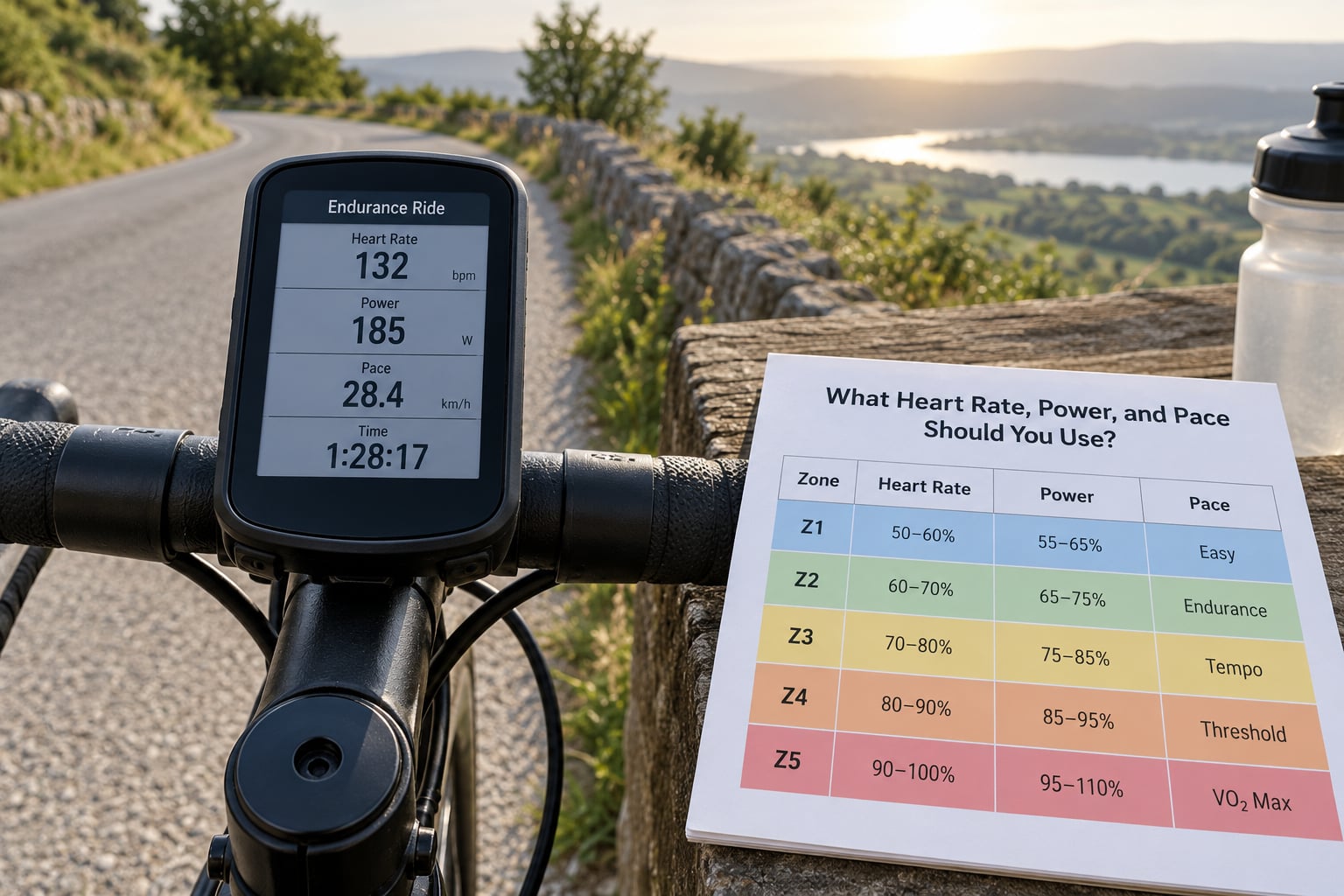
Use four anchors together rather than chasing one of them. Power gives you 55 to 75 percent of FTP, heart rate gives you roughly 68 to 85 percent of threshold heart rate, and about 60 to 70 percent of maximum heart rate. Perceived exertion should sit at RPE 3 to 4 out of 10. Here is what that power range looks like for common FTP levels.
| Your FTP | Zone 2 power (55-75%) | Typical Zone 2 heart rate |
|---|---|---|
| 150 W | 83-113 W | Around 125-145 bpm |
| 200 W | 110-150 W | Around 135-155 bpm |
| 250 W | 138-188 W | Around 145-165 bpm |
| 300 W | 165-225 W | Around 155-175 bpm |
| 350 W | 193-263 W | Around 160-180 bpm |
The heart rate column is a starting point, not a target. The common shortcut of subtracting your age from 220 can be 10 bpm or more off your real maximum, and that error moves the whole heart rate band. If your heart rate zones disagree with your power, trust power and fix the heart rate setting later with a field test.
One nuance that almost no guide mentions: below roughly 2.5 W/kg, the line between Zone 1 and Zone 2 stops mattering much. Riders above that number should also stop assuming Zone 2 has to feel slow — at 210 W on a 64 kg rider it is a perfectly respectable 3.3 W/kg.
What Does Zone 2 Feel Like on a Bike?
Early in a steady ride, Zone 2 can feel uncomfortably easy. Your legs are warm but quiet, cadence settles, and the effort is closer to a brisk walk up a hill than anything you’d call training. That sensation is the point: if you are suffering, you are not in the right zone.
Later in a long ride the same effort starts to feel heavier as heart rate drifts upward. If you then push harder to keep the numbers where they were, you slide into Zone 3 without meaning to. Notice when the drift starts and ease the pace rather than fighting it.
Good pedalling in Zone 2 is smooth and quiet. If you are rocking in the saddle or grinding through the pedals, the gear is too hard for the intensity.
How Much Zone 2 Training Should You Do Each Week?
For most club riders, 60 to 80 percent of total riding time in Zone 1 and Zone 2 is the working guideline, with the harder sessions making up the rest. That sounds like a lot until you see it as time: eight hours a week might mean six easy hours spread across four rides.
The minimum effective dose depends on how much aerobic “hardware” you already have built.
| Rider level | Minimum useful Zone 2 session | Sessions per week |
|---|---|---|
| Beginner (under 2 years) | 30-45 minutes | 2-3 |
| Intermediate (2-5 years, 8-12 hrs/week) | 60-90 minutes | 2-3 |
| Advanced (5+ years, 15+ hrs/week) | 2-4 hours, or concentrated easy blocks | 1-2 plus recovery rides |
One warning for high-volume riders: long easy days can be more fatiguing than they look, because there is no clear signal telling you to back off. If a four-hour Zone 2 ride leaves you flat for three days, the dose is wrong, not the zone.
How Do You Use Zone 2 in a Weekly Cycling Plan?
Place the easy work first and the hard work second. Riders who front-load intervals and then try to recover by riding slowly the next day usually get neither adaptation.
Beginner week
Two Zone 2 rides of 40 and 50 minutes, one short ride with four or five efforts of 20 seconds at hard pace with long recoveries, and two days off. Keep the easy rides genuinely easy for the first month.
Club rider week
One 90-minute Zone 2 ride, one long ride of two to three hours that starts in Zone 2 and allows a few minutes of tempo, one interval session with three to five hard efforts of three to five minutes, and one short recovery spin. Two full rest days.
Century preparation week
Long weekend ride of four to five hours in Zone 2 with controlled rolling terrain, a mid-week threshold session, one shorter Zone 2 ride to absorb the volume, and one rest day. Every third week, cut the volume by around a third rather than adding intensity.
How Do You Progress Zone 2 Training?
Progress by adding time, not intensity. Once an easy session feels unremarkable for two or three weeks, extend it by ten or fifteen minutes rather than raising the watts. Raising the intensity while the duration is already long is how riders end up exhausted and no fitter.
Progress in steps. A common jump is from three hours to five, and that is where the fatigue arrives without any fitness gain. Adding fifteen minutes a week gets you the same place with less damage.
When easy riding alone stops producing progress, the middle ground is structured Zone 2 work: long steady blocks interrupted by brief surges of 30 to 60 seconds at a moderately hard effort, then straight back down. You keep the aerobic load but add a little neuromuscular tension and a bit of time at the top of the aerobic range, without turning the ride into an interval session. This has become a common approach in 2026, and it works well on a trainer where the terrain will not interfere.
What Are the Common Zone 2 Mistakes?
Most riders who struggle with aerobic work fail in one of a handful of predictable ways.
Where zone 2 training for cyclists breaks down
Riding too hard. The most common error by far. If the first hour is comfortable and the last hour is a grind, the effort was wrong from the start.
Going so easy the ride means nothing. The opposite failure is real too. Drifting at a genuine recovery pace for three hours delivers almost no training stimulus.
Trusting heart rate blindly. Heart rate lags, drifts and is distorted by heat and dehydration. Use it to confirm what power tells you, not to replace it.
Matching another rider’s pace. A faster club rider sitting at 3.5 W/kg is not doing your Zone 2. Compare watts per kilogram, not absolute watts or speed on the road.
Skipping recovery. Zone 2 is supposed to be the thing that lets you handle your hard days. Without rest days, it becomes the hard day.
Raising volume too fast. Fitness responds over months, not weekends. Adding hours faster than you can absorb them is how riders get a chronic injury instead of a faster time.
Who Should Ask a Coach or Medical Professional for Help?
This article is general training information, not an individual prescription. Fitness, age, medication and medical history all change what is appropriate, and only a qualified clinician can advise on your specifics.
Stop riding and get medical advice if an easy ride leaves you unusually breathless, if you notice chest pain, palpitations, dizziness or fainting, or if unusual fatigue or a persistent drop in performance continues for more than a week despite reducing intensity.
A certified cycling coach is worth the time when you are working toward a specific target, rebuilding after time off, or stuck despite doing the easy work consistently. They can set your zones properly and adjust the plan as your numbers move.
Frequently Asked Questions
Is Zone 2 the same as an easy recovery ride?
No. Zone 2 sits at roughly 55-75 percent of FTP and still produces a meaningful aerobic stimulus. A true recovery ride is below that, usually under 55 percent, and its purpose is to help you absorb harder training rather than to build fitness. If your easy days feel genuinely relaxed and your weekly progress stalls, they are probably recovery rides wearing a Zone 2 label.
Can I do Zone 2 training on an indoor trainer?
Yes, and trainers are often easier. There is no wind, no traffic and no climbs to drag your intensity upward, so the only thing you have to manage is your own effort. Set a target power rather than following the resistance the software suggests, and aim for 45 to 90 minutes. Long indoor sessions do get monotonous, so breaking them into two shorter blocks across the week works better for most riders.
Should I feel tired after a Zone 2 cycling session?
A little tired is normal and expected after a long easy ride. Feeling properly cooked, or needing a day off to recover from something you were supposed to find easy, is a sign the session was too long or too hard. Most riders should finish a Zone 2 ride feeling like they had more left, which is exactly why leaving that feeling unused is the habit to build.
How do I calculate Zone 2 without a power meter?
Use heart rate as a percentage of threshold heart rate: aim for roughly 68 to 85 percent of it. If you do not know your threshold, use 60 to 70 percent of maximum heart rate as a rough starting point, then adjust. Combine the number with the talk test, ride at RPE 3 to 4 out of 10, and stay in a comfortable cadence. Expect the heart rate bands to be less accurate than a power meter would be.
Can I do Zone 2 on a long ride with a faster group?
You can, but you control the pace rather than the group setting it. Sit near the front, stay in the drops only when it is safe, and choose a gear that keeps your cadence smooth so you stay at conversational effort rather than chasing. If the group is riding above your Zone 2 power per kilogram, drop a few seconds off the back on the safe sections rather than grinding to stay in the bunch all day.
How long should a Zone 2 cycling workout last?
It depends on how much base you have already built. Beginners get most of the benefit from 30 to 45 minutes, intermediate riders need 60 to 90 minutes, and advanced riders often need two to four hours or several concentrated easy blocks. Progress duration in small steps, and treat the talk test and how you feel afterwards as the real measure of whether the session was long enough.
Conclusion: Start With One Easy, Steady Ride
Do one ride this week at a pace where you can talk the whole way. Check it against your FTP percentage, your heart rate and how you feel at the end, and let the numbers be approximate. Zone 2 training for cyclists works because it is boring and repeatable, and the riders who gain from it are the ones who do it consistently rather than perfectly. Add time slowly, keep one or two harder days in the week, and let the easy miles do the building.