Riding in a group is the fastest way to cover a road you have never seen, and the fastest way to crash if nobody is paying attention. The good news: most group crashes come from a short list of fixable habits, not from a lack of skill. Knowing how to ride safely in a group is mostly a handful of repeatable routines, and you can learn them on your first club ride.
This guide covers the eight habits that matter on the road, from joining your first club ride through handling a mechanical in the middle of a paceline. It takes about 20 minutes to read and a few rides to make second nature.
Table of Contents
- What You Need Before You Join a Group Ride
- Check the bike, not just the tyres
- Know the signals before the roll
- Step-by-Step: How to Ride Safely in a Group
- 1. Join a ride with a clear briefing
- 2. Choose a safe position in the line
- 3. Hold a steady line and predictable speed
- 4. Communicate clearly and early
- 5. Draft without causing a surge
- 6. Handle climbs, descents, and tight turns safely
- 7. Respond correctly to hazards and dropped riders
- 8. Regroup without creating another hazard
- Common Mistakes That Cause Group Crashes
- Overlapping wheels
- Sitting on the front of the wheel
- Unannounced movement
- Sudden braking
- Half-wheeling at the front
- Drifting between lines
- Forgetting to call hazards
- Dropping off without telling anyone
- Riding in the blind spot of the vehicle in front
- Riding straight to a regroup point
- Frequently Asked Questions
- Where should a beginner position themselves in a group?
- How much space should cyclists leave between riders?
- How do I safely move back to the rear of the group?
- What hand signals should road cyclists know?
- Should a group stay together when riders begin dropping?
- What should I do if I crash or see a rider go down?
- Conclusion
What You Need Before You Join a Group Ride
A reliable bike, a helmet you have actually worn for an hour, and enough knowledge to stop without being asked. Beyond that, a group needs a working rhythm: agreed signals, a leader, and a plan for stragglers.
Check the bike, not just the tyres
Run through brakes, both lights, tyre pressure and a quick check that the wheels spin freely. Carry a spare tube, tyre levers, a mini pump, a multi-tool, a tube of sealant or patches, and a tube of chain oil if your chain is dry.
Two water bottles, food for the planned duration, and a phone or a small cash float for an unplanned stop. Club rides usually average 18 to 22 km/h on the flat, so a route that looks short on a map is genuinely long at that speed.
Know the signals before the roll
Hand signals and calls vary a little by region and club, so ask the leader what the group uses rather than assuming. The set below covers nearly every situation you will meet, and it is the same across most road clubs:
- Palm down, moving up and down — slowing down
- Hand flat and held level, then waved — ride faster
- Elbow flicked to the side behind you — someone is passing on that side
- Finger pointed down at the road — hazard, in the direction of the point
- Hand sweeping to the shoulder — pull over and stop
- Hand raised, palm forward — stop the whole group
- Index finger up — turn on the left
- Hand held behind the back, tapping the seat — a car is behind, move up
Step-by-Step: How to Ride Safely in a Group
1. Join a ride with a clear briefing
Arrive ten minutes early and stand near the leader. Ask who the ride leader and the sweep are, what the pace will be, where the regroup points are, and what the group does when somebody falls behind.
A no-drop ride groups at every junction, at the top of every climb and after any mechanical. A drop ride does not, and that is a completely different contract. Knowing which one you signed up for is the single most useful thing you can learn in the parking lot.
Say who you are. A quick “first club ride, about 26 km/h” sets expectations and gives the leader a reason to watch for you. Riders on beginner and charity rides will usually give you a spot in the middle third of the group, where the pace is steadier and there is time to react.
2. Choose a safe position in the line
New riders belong in the middle of the group, not at the front. The front sets a pace you must hold, the back has no one watching behind you, and the middle is where the speed is most consistent.
Ask permission before you settle onto a stranger’s wheel. Riders who are still working out how to ride safely in a group usually say so on their first few rides, and the answer is always yes. Sit about a wheel to one side of the wheel you are following rather than directly in line, so your handlebars never intersect the rear wheel ahead.
On descents, wide turns or gravel, move back half a wheel and widen the gap. On a calm flat road in a small group, tighten up instead. The group reads the conditions, and so should you.
3. Hold a steady line and predictable speed
A steady line is what lets a group ride close together without tension. Look two to four riders ahead rather than at the tyre in front of you, keep your elbows soft, and pedal smoothly through any change in effort.
Sudden braking in a paceline is the single most common cause of a chain-reaction crash. If you need to slow, feather the brake and call it out loud. Never slam both levers because someone in front touched theirs.
Braking in a tight line needs a hand on the brake and a wide, open finger. A sharp squeeze mid-corner with a hand buried in the drops is how people wash out.
4. Communicate clearly and early
Call what you see, not what you feel. “Car up”, “glass”, “hole on the right” travel further up the line than a raised hand alone, and the rider who matters is usually two riders ahead of you.
Point and speak. A pointed finger with the matching verbal call is the standard: point at the pothole, say “hole”, and hold it until the rider behind you has also seen it. A call nobody repeats is a call that stopped at you.
Say where you are moving. Announce “moving up” before you leave the wheel, and check over your shoulder before moving to a line nobody is expecting you to take. Most collisions on group rides happen because someone moved without a word, so the habit of announcing every small change of line is what separates riders who learn how to ride safely in a group quickly from those who learn it the hard way.
5. Draft without causing a surge
Drafting is the main reason a group is faster and easier than riding alone; a well-positioned rider can save roughly 20 to 30 percent of their effort. The rule that keeps it safe is that the front rider stays smooth and the group behind stays calm.
Enter the line by pulling out to the side, moving forward alongside two or three riders, then settling in behind your chosen wheel. Leave the line the same way, in reverse. The mistake that causes most crashes here is accelerating after joining the group, which pushes a surge down the line that nobody behind can absorb.
If you ride on the front, hold a steady, slightly slower-than-max pace and move off with a clear call. Half-wheeling, where a rider pulls alongside and surges past, forces the whole group to accelerate and sets up a domino effect behind. In a club ride, stay in the line and take your turn when asked.
6. Handle climbs, descents, and tight turns safely
On a climb, the group stretches. Do not attack the moment the road tilts. Settle into a rhythm, stay seated or stand smoothly, and expect the pace to rise and fall as strong riders surge. The accordion effect means small variations at the front grow as they travel back, so stay loose on the bars and let the group breathe.
Before a descent, spread out. One bike length for every 10 to 15 km/h is a reasonable starting point, and on a technical or wet road use much more. Riders who know the road go first, then novices, then anyone comfortable with speed. Keep both hands light on the levers and follow the rider ahead’s line rather than your own instinct for the corner.
On switchbacks or wet pavement, ride side by side in twos where visibility allows, call the corner, and slow enough that the group stays in sight. Half the cornering injuries in group rides happen on the exit, when everyone is standing up and nobody is looking two turns ahead.
7. Respond correctly to hazards and dropped riders
For a pothole, gravel, glass or a stopped vehicle, call and point, then move out of the line in a straight, predictable path. Never swerve late and never cut across a wheel to avoid something. Passing behind a hazard and passing in front of it are both fine; a sudden lateral move is not.
For a mechanical, the rider moves to the edge of the road and the group either stops safely off the travel lane or continues at a steady pace. Tell the leader before the group rides away, and be explicit about it. Quietly dropping off is how groups lose track of people.
For a crash, the priority order is fixed. Call “crash” loudly and immediately. The rider who is hit by a wheel usually has time to react to the call alone, so shout early. Riders ahead of the problem slow and move to the side; riders behind pass on one side, not between the two wrecks. Then someone stays with the rider, someone calls for help, and the leader decides whether the group continues.
Never pick a bike up quickly. Riders run into the debris field because they do not know what is still moving. Check the rider first, then the bikes. If someone is unconscious or has lost feeling, do not move them; call emergency services and keep the group on the same side of the road, away from traffic.
8. Regroup without creating another hazard
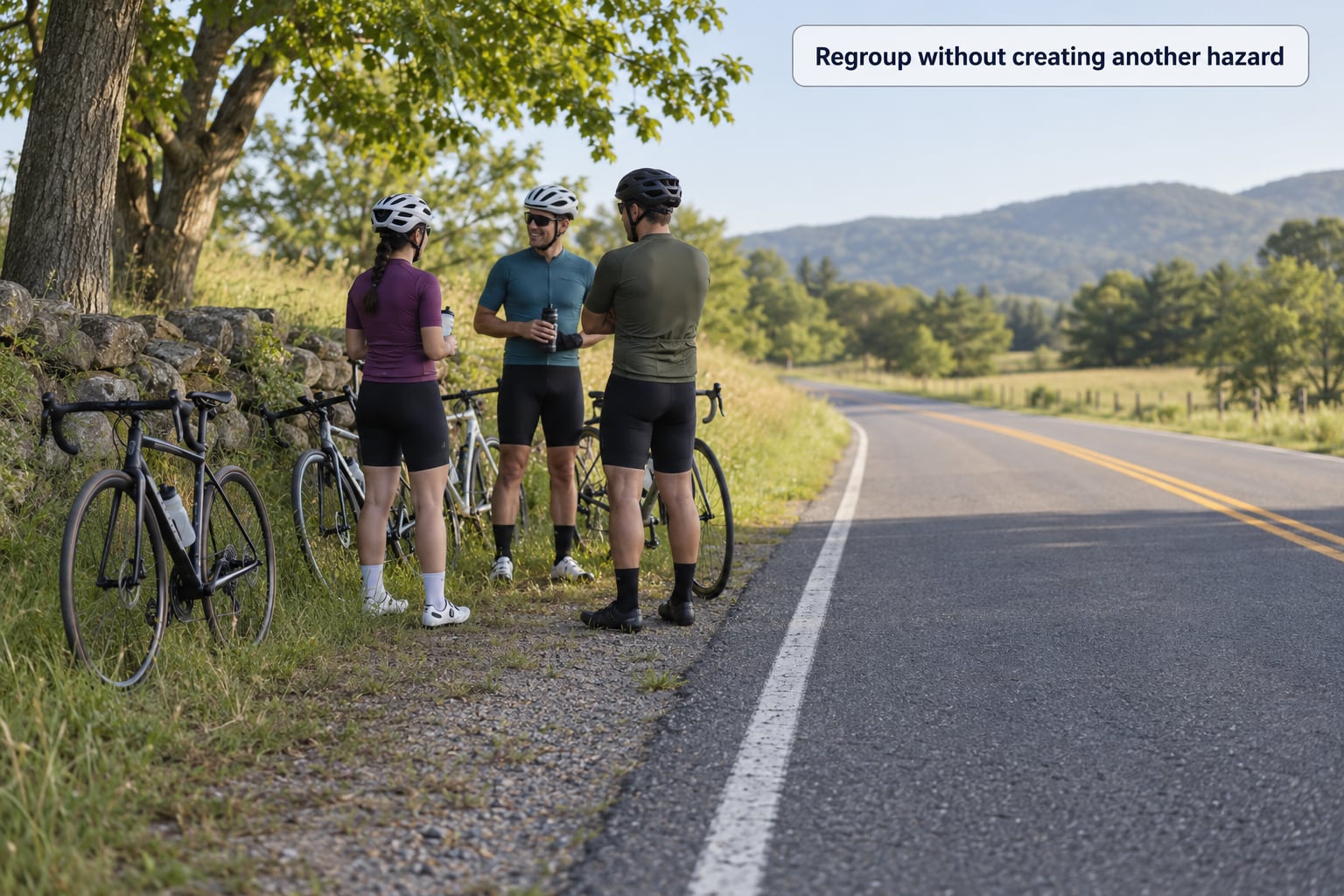
Stop where riders can see the group coming and where nobody has to stand in a live lane. Wide junctions, car park entrances, gateposts and lay-bys work. Blind bends, narrow bridges and the middle of a road do not.
Reform in the same order you rode, not in whatever order people arrive. That means the fastest riders get a couple of minutes to sort themselves, and the slowest riders are not pushed into the front of the paceline. Rolling out of a regroup in reverse order is how the first corner of the next section becomes a pile-up.
Move off together at a single agreed pace, not at whatever the leader feels like. The re-formed group is briefly the most dangerous part of the ride.
Common Mistakes That Cause Group Crashes
Almost every multi-bike pile-up traces back to one of the following. Each has a specific correction, and the fix takes a ride or two to stick.
Overlapping wheels
Half-wheeling means your front wheel crosses the path of the rider ahead’s rear wheel, so a small wobble becomes a collision. Sit a wheel to one side instead, and if you are directly behind, let yourself fall back a little.
Sitting on the front of the wheel
Tailgating feels fast and leaves nothing for the rider behind you. Leave at least a full wheel of space, and more on rough surfaces and in wind.
Unannounced movement
Moving out, back or across without a call is the most reported irritation on group ride forums and the most common cause of a wheel hitting a bar. Say “moving up” or “dropping back” every single time, and check behind you first.
Sudden braking
Braking hard in a tight line is the mechanism behind most rear-end crashes. Feather the lever, call it out, and let the group settle before you speed up again.
Half-wheeling at the front
Pulling alongside and surging past forces an acceleration wave down the paceline. Take your turn at a steady pace in the line instead, and let the group choose its own speed afterwards.
Drifting between lines
A rider who wanders across two lanes is usually relaxed and unaware. Hold a straight line, look well ahead, and keep your bike tracking straight rather than correcting constantly.
Forgetting to call hazards
You might see a pothole, but only the rider positioned to avoid it is riding towards it. Point, call it, and repeat it until it has been acknowledged.
Dropping off without telling anyone
Turning home alone leaves the leader counting riders. Tell the leader or the sweep, and let the group set the pace if the ride is a no-drop one.
Riding in the blind spot of the vehicle in front
Call “car up” when a vehicle gets close, and move up. Riders in the group who do not move are the ones cars pull alongside.
Riding straight to a regroup point
Standing on a road, in a blind corner, or in a bike lane blocks the traffic that the rest of the group is riding into. Pick a safe spot before the group is in trouble.
Frequently Asked Questions
Where should a beginner position themselves in a group?
Start in the middle of the group, behind a steady rider rather than in the front third. The middle rides at the most consistent speed, the front sets a pace you must hold, and the back has nobody watching behind you. Ask the ride leader before you settle in, and tell them you are new so they can place you well.
How much space should cyclists leave between riders?
Leave at least one full bike length on a smooth road at moderate speed, and increase it on descents, rough surfaces, wet pavement and in a crosswind. Many experienced riders use roughly one bike length per 10 to 15 km/h on a descent. Sitting a wheel to one side of the rider ahead, rather than directly behind, makes overlapping much less likely.
How do I safely move back to the rear of the group?
Check over your shoulder, say out loud that you are dropping back, and move to the side of the line first. Ride alongside the paceline for a moment rather than passing through a narrow gap, then settle in behind the last rider. Doing it in daylight, out loud and gradually is what keeps it safe and keeps other riders relaxed.
What hand signals should road cyclists know?
Learn palm-down for slowing, a flat waved hand for speeding up, an elbow flick for a rider passing, a finger pointed at the road for a hazard, a sweep to the shoulder for pulling over, a raised palm for stop, and a raised index finger for a left turn. Pair every signal with a spoken call, because the rider who matters is usually two places ahead of you.
Should a group stay together when riders begin dropping?
On a no-drop ride, yes: regroup at every junction, at the top of each climb and after any stop, and never leave a rider without a plan. On a drop ride, no, the group keeps its agreed pace and the sweep stays with the last rider. Ask the leader which kind of ride you are on before you roll out, because the two have completely different rules.
What should I do if I crash or see a rider go down?
Call it out loudly and early, because a rider about to be hit by a wheel can usually save themselves from the shout alone. The rider ahead slows and moves to the side, riders behind pass on one side only, and someone stays with the casualty while the leader handles the rest of the group. Check the rider before any bike, and do not move anyone with a possible head, neck or back injury.
Conclusion
Knowing how to ride safely in a group comes down to five habits, in order. Attend the briefing and find out whether it is a no-drop or a drop ride. Choose a spot in the middle where the pace is steady. Call hazards early and loudly, and announce every change of line. Leave more space than feels necessary. Then follow the leader’s speed instead of trying to prove something on the first climb.
Those five habits carry you through hundreds of rides, and they are the same ones the riders in the front half of the pack are still working on.