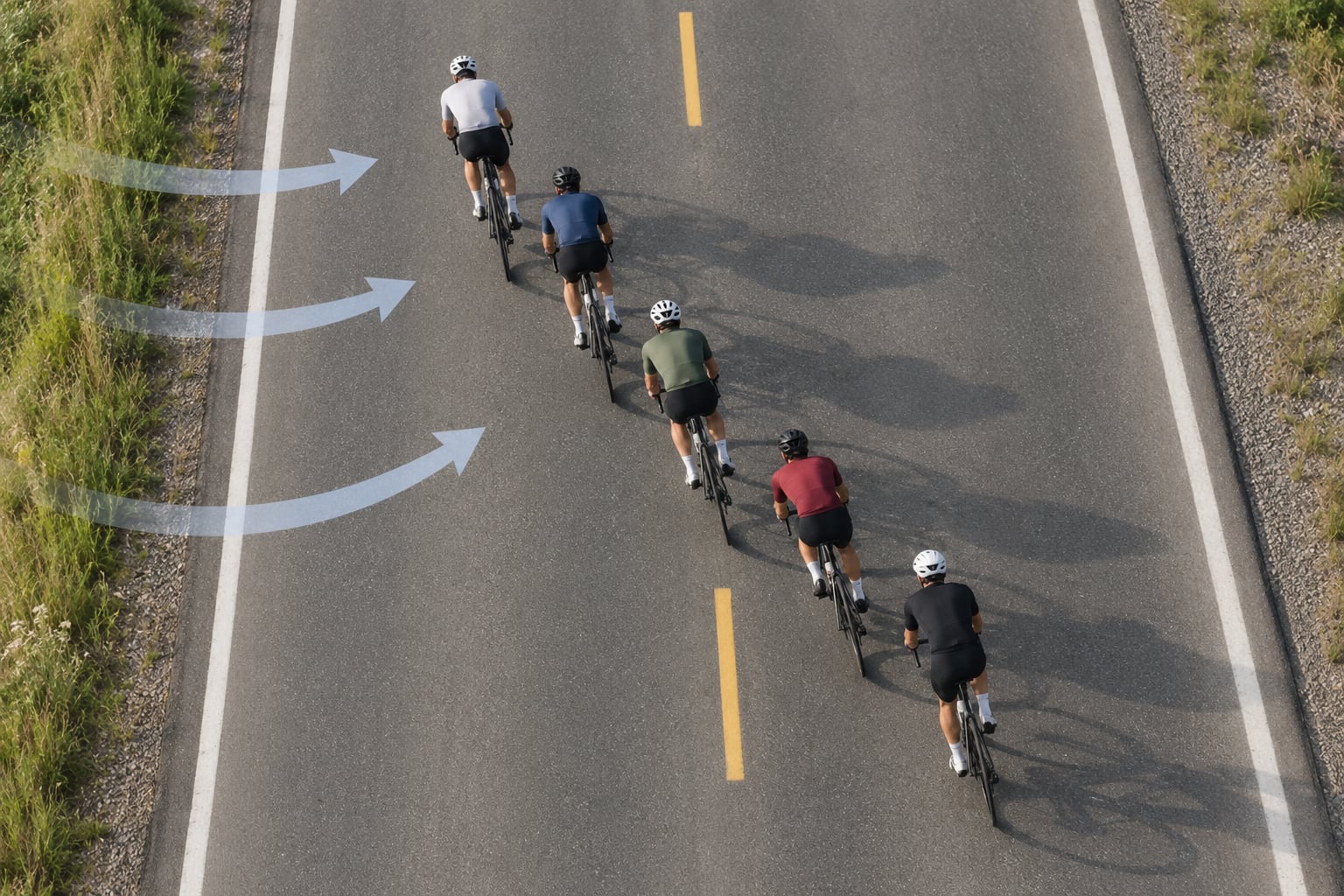
Echelon riding in crosswinds explained, in one line: a group abandons the single-file paceline and fans into a diagonal line across the road, so each rider sits in the sheltered air just off the shoulder of the rider ahead and shares the work of breaking the side wind. In strong gusts the diagonal gets steeper, the gaps tighten, and every change has to be called out loud. Most of the difficulty is not the line itself; it is the lateral movement needed to hold it at speed.
I have watched enough club rides fall apart in a crosswind to know the usual pattern. The first gust rolls through, everyone drifts at once, front wheels overlap, and about a third of the group ends up on the exposed edge with nobody to help them back in. The riders who handle it well are not stronger or braver. They just set the formation before the gust lands and then hold it with boring consistency.
Table of Contents
- What Is Echelon Riding?
- What Does Echelon Riding in Crosswinds Look Like?
- Why Crosswinds Make Echelon Riding Difficult
- How to Hold a Safe Echelon in Wind
- How much front-to-rear gap should you keep?
- How much lateral offset should you use?
- What should the group do, in order?
- How Riders Should Rotate Through the Echelon
- When Echelon Riding Is Not Worth the Risk
- How to Handle Gusts, Cracks, and Sudden Moves
- Echelon Riding in Crosswinds: Common Mistakes
- Frequently Asked Questions
- Should cyclists ride echelon or single file in a crosswind?
- How far apart should riders stay in an echelon?
- Why do riders at the back of a group still get pushed sideways?
- How often should a group rotate through the echelon?
- Can beginners safely join an echelon in strong wind?
- Conclusion
What Is Echelon Riding?
An echelon is a group of cyclists riding in a staggered, diagonal line across the width of the road rather than nose-to-tail. Instead of sitting directly behind the rider in front, each rider offsets to one side and slightly back, tucking into the clean-air pocket that trails off that rider’s shoulder. In a crosswind that pocket moves away from directly behind, so the whole line leans sideways.
One piece of housekeeping first, because it catches out new riders constantly: searching for this topic turns up a lot of exercise bike brand and aviation content. When cyclists say echelon, they mean the road formation. Nothing to do with a spin bike or with landing a plane in a crosswind.
What Does Echelon Riding in Crosswinds Look Like?
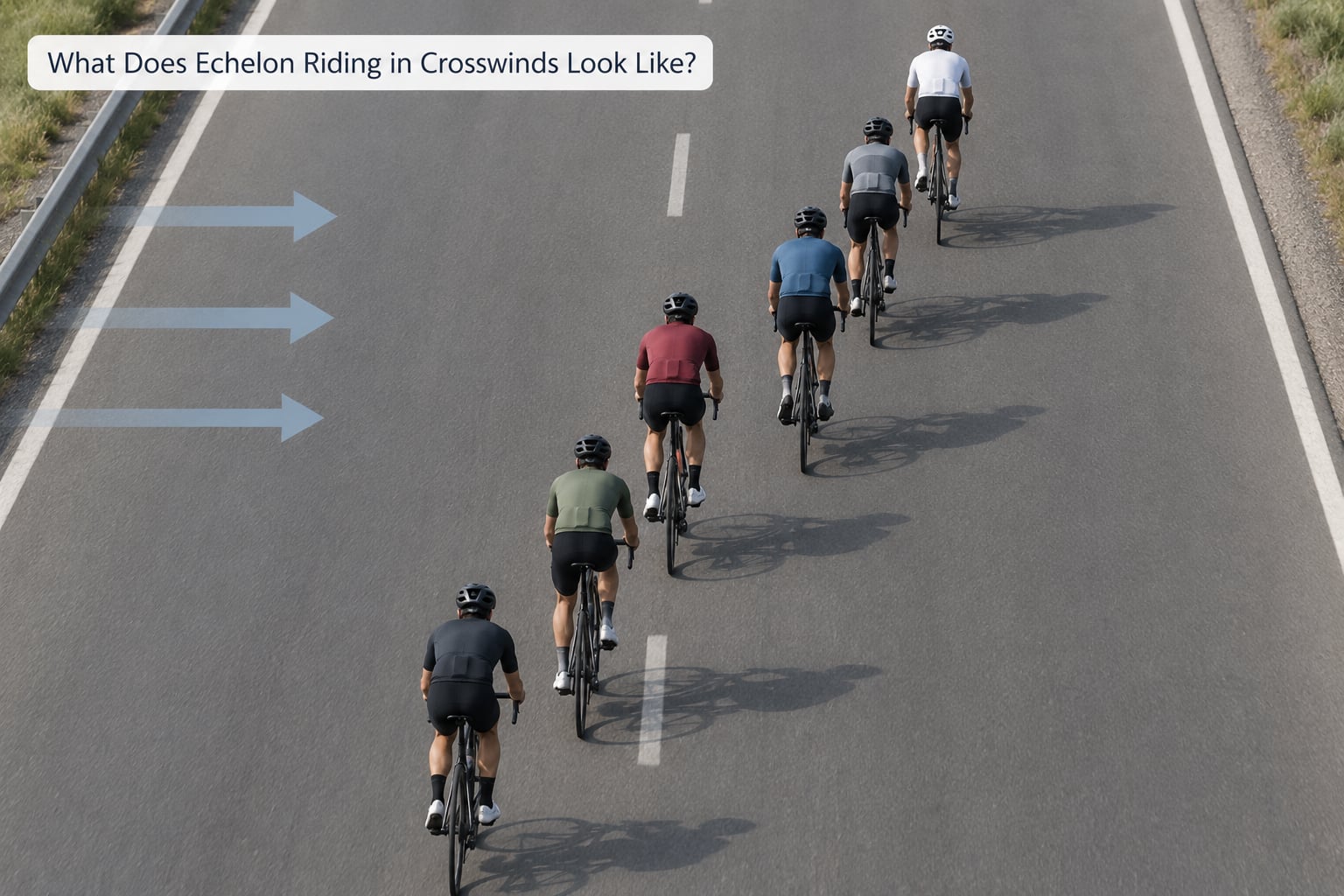
Picture a wide, empty road and five or six riders spread across it, each one a bike-length back from the last but offset sideways by roughly a shoulder width. The line runs diagonally from the windward edge of the road toward the leeward side, and the lead rider sits furthest into the weather. That is the finished shape.
What the shape looks like at any given moment depends on four things: how hard the wind is blowing, which way it is coming from, how much road there is, and how fast the group is moving. Harder wind means a steeper diagonal, because each rider has to sit further out of the wind to find the same pocket. A road with more width lets the line run longer without anybody getting pushed onto the verge.
Riders further back in the diagonal do not just copy the rider in front; they sit in that rider’s wake as well, which is why position two and three are the most efficient places in the formation. The rider on the extreme windward edge of the line has no one sheltering anything for them, and that edge position is where riders end up when they are late reacting.
If you watch a televised Grand Tour stage and the riders suddenly fan out, look at the angle of the diagonal. It is a decent read on how hard the wind is pushing. A shallow, almost straight line means it is breezy. A hard diagonal with riders strung across the full width of the road means the wind is strong and the group is about to split.
Why Crosswinds Make Echelon Riding Difficult
The core problem is that equally spaced riders in a crosswind do not experience equally spaced problems. Two riders one bike-length apart in a straight paceline feel nearly the same wind in a headwind, because the clean air sits straight behind. Turn that wind sideways and the pocket swings off to one side, so the rider directly behind is suddenly in disturbed air and the rider off the shoulder is the one coasting.
Gusts are the other half. A lull lets a group ride a comfortable diagonal; the gust that follows arrives as a visible wall of moving air, hits the exposed edge riders first, and pushes them toward the verge. Anyone caught between the gust and the group ahead has to make a lateral move at speed, and lateral moves are where echelon crashes come from.
- Wind shadow and wake geometry. A rider tucked behind a diagonal line is sheltered; a rider tucked directly behind is not, because the wake has moved out from under them.
- Road-edge turbulence. The windiest air on an open road is often the ditch or hedge line. Chasing shelter by dropping to the edge of the road can be the worst available choice.
- Large vehicle wakes. A lorry passing the other way throws a gust across the road that lasts far longer than the lorry takes to pass.
- Exposed sections. Coastal, causeway and open farmland stretches give the wind nowhere to slow down, and the gusts arrive with no warning at all.
- Front wheel exposure. The rider at the point of the diagonal is the one actually breaking the wind for everyone behind, and that is where the biggest effort jump lives.
Veteran riders in r/peloton threads describe a cross-tailwind as unusually conducive to holding an echelon, because the tailwind component offsets some of the lateral push. Same wind with a headwind component baked in and the diagonal fights itself the whole way to the finish.
How to Hold a Safe Echelon in Wind
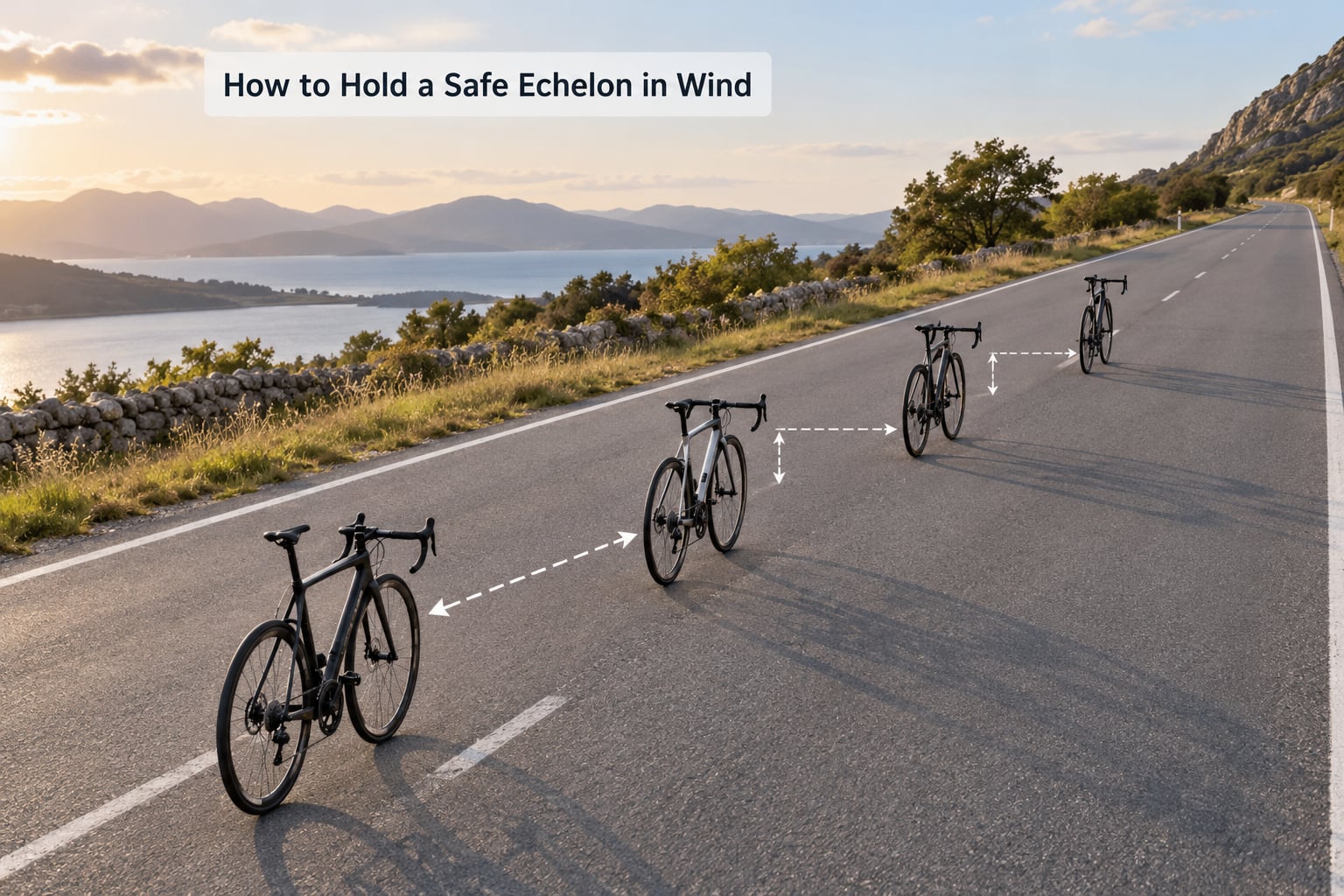
Hold an echelon by choosing the width first, matching cadence second, and only then worrying about speed. The order matters, because a group that sets speed before it sets position spends the whole gust correcting itself.
How much front-to-rear gap should you keep?
Keep at least a full bike length of clear road between the rider ahead and your front wheel. Overlapping wheels are the single most common complaint from club riders fanning out diagonally, and a line that was safe in a paceline becomes a wheel-length problem the moment it goes diagonal. More gap, not less, is the fix: a short gap looks tidier and it is the reason riders touch bars when a gust arrives.
How much lateral offset should you use?
Start with about a shoulder width of offset from the rider ahead and build from there. Too shallow and you sit in disturbed air with none of the benefit; too steep and you are on the road edge in one move, with nowhere to go when the next gust arrives. Lean on the graduated offset rather than a fixed number, because bikes, speeds and rider sizes vary and the pocket moves with them.
What should the group do, in order?
- Pick a side and commit to it. The group should fan away from the wind, toward the sheltered leeward edge, and everybody should be on the same diagonal. Two half-echelons facing opposite ways protects nobody.
- Set the speed before the gust. Ease the pace slightly as the wind builds rather than holding a hard effort and then dying as it arrives. A group that slows together keeps its shape.
- Leave a braking margin. Leave roughly two bike lengths to whatever is directly in front, and never follow a rider who is about to brake. Call the hazard before it becomes urgent.
- Match cadence, not gears. Pedal at the same rhythm instead of surging, rolling coast, then hauling back up. Cadence changes are visible and cost more than a gear change.
- Call every change out loud. One voice, short instructions: “moving up”, “coming through”, “gust”. Unannounced lateral movement at speed is how echelon groups crash.
There is no single correct speed for crosswind conditions. The useful test is whether the group can hold the diagonal with everyone pedalling smoothly and nobody chasing gaps. If the front riders are ragged and the back riders are sprinting, you are too fast for the wind, whatever your speedometer says.
How Riders Should Rotate Through the Echelon
Groups rotate so the same two or three riders are not breaking the wind for the whole stage. The rider at the point of the diagonal does the hardest work, so that position should be shared, and the fairest way to share it is a short turn rather than a long one.
A turn of roughly 30 to 60 seconds at group pace works well on a club ride. Longer than that and the rider ahead is cooked before the next pull; shorter and the group spends all its time moving up and down instead of riding. Whatever the interval, the pull should be steady. The single worst thing a front rider can do is accelerate, because the surge immediately stretches the diagonal and the gap behind grows faster than anyone can close it.
Move through the line the same way you would change lanes: check the gap, signal, then move on a smooth arc. Avoid accelerating into a gap that is only just big enough; a half-bike-length opening is an invitation to hold a sprint you cannot sustain. Riders on the windward edge should hold their line firmly and take their turn, and everyone should accept that someone new will need a few hundred metres before they settle into the pocket.
The person setting the pace watches the road and the gusts. The sweeper at the back watches for dropped riders, calls anyone who drifts out, and is the one voice that matters when the group splits.
When Echelon Riding Is Not Worth the Risk
Some roads cannot hold a diagonal safely, and no amount of skill fixes that. Break into smaller groups or a single-file line whenever any of these are true, and say it out loud so nobody mistakes the change for a split:
- The road is too narrow to give each rider a full bike length plus a shoulder offset, especially with traffic or an oncoming line to consider.
- The surface is poor, wet, gravelly, cambered or patched, so holding a straight line takes more bar input than a rider can spare.
- The crosswind is strong enough that riders are being pushed continuously toward the verge rather than buffeted.
- Visibility is poor around bends, over crests or in spray, so nobody can see a car door or a vehicle about to turn out.
- There is construction, a junction, a bridge pinch or a bus stop where vehicles cross the line.
- Large vehicles are passing in the opposite direction, or the group has just come through a lorry’s wake.
- The group includes riders who are new to handling a bike one-handed, or who are nervous about lateral movement at speed.
Group size matters more than wind strength here. Four riders can share the load comfortably. Add more bodies to a road that cannot widen the line and something has to give, and it is usually the rider at the back who ends up riding alone in the wind.
How to Handle Gusts, Cracks, and Sudden Moves
Most echelon incidents are a gust meeting a rider who was not ready for it. Handling them is less about technique than about staying loose and staying spread out.
Soften your grip on the bars through a gust rather than clamping down. A locked front wheel in a side push is the fastest way to go down, and the small amount of pressure you take out of your hands before the gust arrives is what keeps the front wheel tracking. Keep pedalling, even if it is a low, steady gear, because a rolling bike resists a lateral shove far better than one coasting.
When a gust hits, let the formation open. Riders should add a metre of front-to-rear gap and hold their lane rather than everybody bunching toward the sheltered side, because a bunched cluster is where bars and wheels meet. A gust that arrives while a rider is making a lane change is the worst combination, so call it, then move.
For cracks, potholes and debris, the rider who sees it points and calls it rather than swerving around it silently. Two verbal warnings beat one silent dodge every time. And if a rider does go down in front of you, the group’s job is to soften the bunch behind rather than funnel into the gap at full speed.
Echelon Riding in Crosswinds: Common Mistakes
Overlapping wheels. The most common and most avoidable crash cause. Fix it by adding front-to-rear gap every time the line goes diagonal, and by checking your gap visually rather than by feel.
Drafting straight behind in a side wind. That position protects you in a headwind and does very little in a crosswind. Offset until you can feel the pressure on your shoulder drop.
Inconsistent cadence. Stop-and-go pedalling and surging on the front both stretch the line. Work at a rhythm you can hold for a couple of minutes.
Moving out of sequence. Riding up before the pull is finished, or passing two riders in one move, is how a diagonal becomes a mess. Take your turn in order and move back when you have had yours.
Hiding at the road edge. The gutter position is usually the windiest place on the road, not the calmest. Shelter comes from the rider in front, not from the verge.
Building the echelon after the gust. The formation has to exist before the wind peaks. Groups that react late have already lost the front riders by the time they look like an echelon.
Forcing a formation the road cannot hold. A long line on a narrow road is more dangerous than a single file. Splitting into pairs is not failure; it is a sensible read of the road.
Riding on the outside to avoid a role change. Staying wide is a fine decision for a few seconds and a bad plan for an entire sector. The riders who take a turn early tend to be the ones still riding comfortably at the end.
Frequently Asked Questions
Should cyclists ride echelon or single file in a crosswind?
Ride an echelon when the road is wide, the surface is clean and the wind is strong enough that single file leaves the back riders working far harder than the front. Drop to single file, or split into pairs, when the road is narrow, the surface is broken, visibility is poor or vehicles are passing. A group of four or fewer is often better off in a simple line than in a badly spaced diagonal.
How far apart should riders stay in an echelon?
At least a full bike length of clear road between your front wheel and the rider ahead, and more than that when the line is diagonal or a gust is building. Lateral spacing should be roughly a shoulder width, adjusted until the pressure on your leading shoulder drops. If you can see the tyre of the rider in front at the same moment you feel the wind on your shoulder, the gap is wrong.
Why do riders at the back of a group still get pushed sideways?
Because the shelter is not directly behind. In a crosswind the clean-air pocket trails off the rider’s shoulder, so a rider sitting nose-to-tail is in disturbed air, and the riders most exposed are the ones who cannot reach a sheltered position at all. Wind gradient near hedges and ditches makes the gusts uneven across the road too, so two riders one bike-length apart can feel very different winds.
How often should a group rotate through the echelon?
On a club ride, turns of roughly 30 to 60 seconds at group pace are usually enough to share the work fairly. The point of rotation is not fairness alone; it is that nobody at the point of the diagonal should be exhausted before the sector ends. Rotate in order, take your turn, and move back afterwards without a surge to close the gap.
Can beginners safely join an echelon in strong wind?
Yes, provided the group keeps the formation small and the calls are constant. Sit in the sheltered half of the diagonal, not at the exposed edge, and copy the rider directly ahead rather than chasing gaps. Ask a ride leader to run a slow drill first, on a wide and quiet road. Riding quietly behind someone who already knows the formation is the fastest way to learn the position.
Conclusion
If you have never tried this, the first move is small: a short, wide, lightly loaded formation on a quiet road, with one person calling every change. Get the spacing and the road conditions right before you worry about wind protection, because a diagonal held at a safe distance beats a tight one every time.
Once that feels boringly normal, add one element at a time. Try a wider lateral offset, then a short turn at the front, then a gust ridden out without bunching. Echelon riding in crosswinds is a positioning skill above all else, and positioning is learned by repetition rather than by talent. Updated for 2026, since group ride etiquette and road guidance move on.