Fueling a 5 hour bike ride means hitting a fixed carbohydrate target every hour from the first 30 minutes to the finish, roughly 60-90g of carbs, 500-1000ml of fluid and 500-1000mg of sodium per hour, or 300-450g of carbohydrate in total. If you follow that plan, the last hour looks like the first one. If you don’t, most riders pay for it in the final 45 minutes.
Five hours is a long enough block that the science of it is settled. What trips people up is execution: not remembering the timer, not liking the one food they packed, and assuming a ride that feels easy in hour two doesn’t need any fuel. Here’s the plan, hour by hour, including what to do when your stomach shuts down at hour three.
Table of Contents
- What You Need
- Step-by-Step
- Plan the Night Before and Morning Meal
- Calculate Your Five-Hour Fuel Budget
- How to Fuel a 5 Hour Bike Ride Hour by Hour
- Choose Food That Is Easy to Eat While Riding
- Drink to Match Duration and Conditions
- Adjust for Heat, Hills, Rain, and Slower Pacing
- Common Mistakes to Avoid
- Recover After the Ride
- Common Mistakes
- Frequently Asked Questions
- How many calories should I eat on a 5 hour bike ride?
- How much water should I drink during a 5 hour bike ride?
- Are energy gels enough for a 5 hour bike ride?
- Should I eat before a five-hour bike ride if I am riding early?
- What should I do if I feel hungry, shaky, or unusually tired during a long ride?
- Conclusion: Start With Your First Hour
What You Need
Before you plan the ride, get five things sorted. Skipping any of them is how riders end up at a shop 40 minutes from home with nothing useful.
- A number to hit. Pick an hourly carbohydrate target you have actually tested in training. For most riders, 60g per hour is an honest starting point.
- Food you have already eaten on the bike. Three to four items, all familiar, all low in fibre and fat. Nothing new on a five-hour day.
- Enough fluid to cover the ride plus a margin. Two bottles if you drink from cages, a hydration pack if the route has no reliable resupply.
- Somewhere to put the wrappers. A jersey pocket or a small bag keeps sticky wrappers and used gel sleeves off your handlebars.
- A timer. Phone alarm every 15 to 20 minutes, or a watch beeping at intervals. Hunger is a late and unreliable signal.
- Kit for the forecast. Hot rides change fluid needs, cold rides change what you can tolerate. Check the forecast the night before.
Step-by-Step
Plan the Night Before and Morning Meal
You cannot eat your way out of an empty tank, so the loading starts the day before. Most riders do well with 8-10g of carbohydrate per kilogram of body weight across the day before the ride, spread across normal meals rather than crammed into dinner.
Keep it familiar and low in fibre. Pasta, rice, bread, potatoes, bagels and fruit are all fine. A big salad and a large portion of beans the night before is a recipe for a slow morning on the bike, because your gut has to deal with volume and fibre while you’re trying to go fast.
On the morning, aim for 1-2g per kilogram, finished two to three hours before you roll. A 70kg rider is looking at 70 to 140g, which is roughly a large bowl of oats with banana and honey, or two bagels with jam. If you are riding at first light and the thought of breakfast makes you feel sick, shift a slice of the carbs into the evening before and take a small top-up right before you leave.
Calculate Your Five-Hour Fuel Budget
Sixty to ninety grams of carbohydrate per hour is the working range for rides of this length. Hard efforts and cold conditions push toward the upper end. Gentle spinning on a mild day sits comfortably at the lower end, and so does a rider who is new to eating on a bike.
| Rider weight | 60g per hour | 90g per hour | Total over 5 hours |
|---|---|---|---|
| 55 kg | 60g | 90g | 300-450g |
| 70 kg | 60g | 90g | 300-450g |
| 85 kg | 60g | 90g | 300-450g |
The absolute number matters less than consistency. A rider who takes 60g every hour for five hours finishes far stronger than one who takes 110g in hours one and two, forgets hour three, and tries to catch up at kilometre 140.
Use grams per kilogram as your own unit instead. Riders on the bikehub forum suggested starting near 1g per kg per hour, so 70g an hour for a 70kg rider, and building from there. That framing scales with the person instead of the guideline.
How to Fuel a 5 Hour Bike Ride Hour by Hour
This is the part almost no guide spells out. Here is a worked plan for a solo, unsupported five-hour ride at steady endurance pace, built around a 20-minute clock.
| Stage | Carbohydrate | Fluid | Sodium | What it looks like |
|---|---|---|---|---|
| Before the start | 1-2g per kg | 400-600ml | Standard meal | Oats with banana and honey, finished 2-3 hours out |
| Hour 1 | 60-90g | 500-750ml | 500-750mg | Half a bottle of drink mix, one gel, a few pieces of real food |
| Hour 2 | 60-90g | 500-1000ml | 500-1000mg | Bottle refill, a bar or flapjack, more drink mix |
| Hour 3 | 60-90g | 500-1000ml | 500-1000mg | Shift to liquid carbs if solid food starts sitting heavy |
| Hour 4 | 60-90g | 500-1000ml | 500-1000mg | Easiest forgotten hour. Eat on the clock even if you feel fine |
| Hour 5 | 60-90g | As thirst and conditions dictate | 500-1000mg | Fast-absorbing carbs, caffeine if you use it and tested it |
Notice how similar each hour looks. That’s the point. Set the alarm, and when it goes off, eat and drink without asking whether you feel like it.
There’s a reason the hour 4 and hour 5 collapse feels unavoidable. Digestion takes 20 to 30 minutes to move carbohydrate into your blood, so what you eat at kilometre 120 is what powers you at kilometre 130. Riders describe this as fuelling debt: you cannot borrow from hour 5 to pay for what you skipped in hours 2 to 4.
Choose Food That Is Easy to Eat While Riding
Most of your carbs should come from liquid, because liquid needs no chewing and no decision-making at 50 km/h. A bottle of drink mix at 30 to 60g of carbs per litre, refilled twice, gets you most of the way to your target before you have touched a wrapper.
Then add real food for texture and satisfaction. One r/cycling rider described starting long rides with two bottles of carbs and electrolytes plus bars, drinking one bottle and eating one bar every hour. A r/Velo rider doing five-hour zone 2 rides takes about 70g of carbs per hour, with roughly 150g of carbohydrate in one bottle and powder for the other.
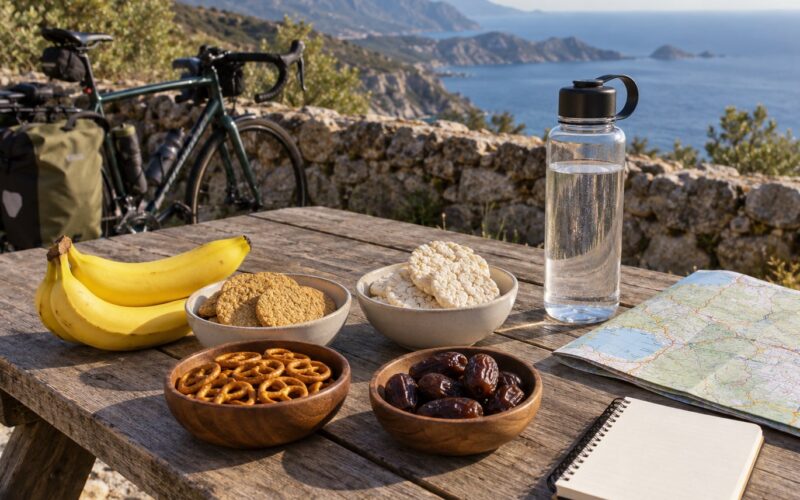
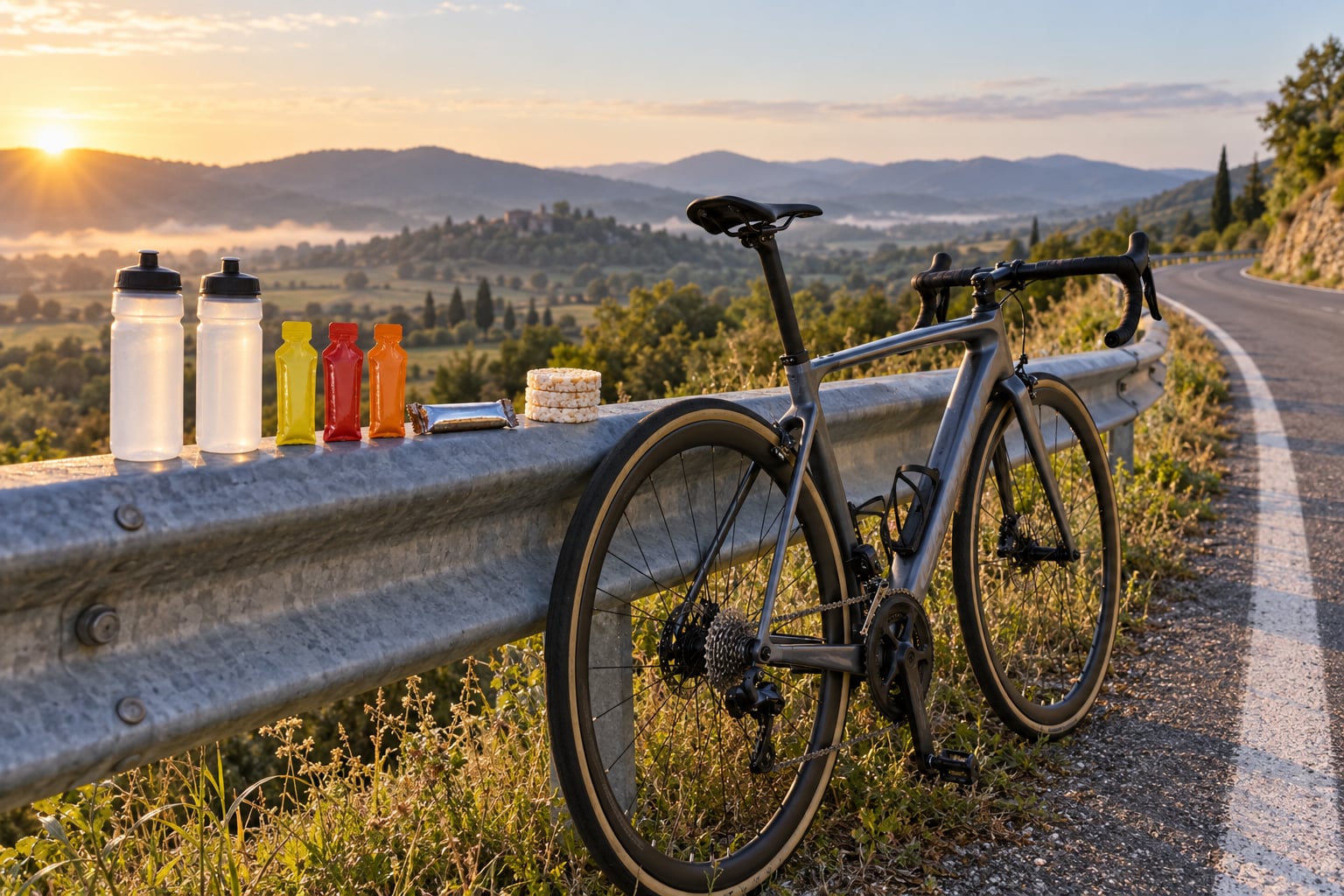
Practical options, roughly: a gel with 20 to 25g of carbs, an energy bar with 20 to 30g, a small flapjack, rice cakes with jam, a banana, or a handful of jelly babies. Riders who dislike sweet food do well with savoury options such as rice cakes, salted potatoes or pretzels, paired with sweet drink mix.
If your stomach is delicate, drop fibre, drop fat, and drop volume. That same r/Velo rider ate four oatmeal bars for a five-hour, 100-mile ride and found the last hour seriously tough going. Bars made of oats and fat sit in the stomach far longer than a drink mix, which is why solid-only plans fail on long days.
Drink to Match Duration and Conditions
Aim for 500 to 1000ml of fluid per hour, and pair each drink with food rather than drinking on a separate schedule. The combination is easier to remember and easier to actually do.
Small, frequent sips beat large volumes. Drinking 500ml in one go sloshes in your stomach and often comes back up on the next climb, which wastes both the fluid and the food sitting underneath it. Sip continuously instead, and drink most of your bottles during the first half of each hour rather than saving them for the end.
Estimate your own sweat rate on a familiar hot ride: weigh yourself dry, ride an hour, weigh again, and subtract what you drank. That number is far more useful than any generic guideline. Add sodium at 500 to 1000mg per hour, and treat that figure as a floor rather than a ceiling on a hot day.
Adjust for Heat, Hills, Rain, and Slower Pacing
In heat and humidity, your fluid target moves to the top of the range and your feeding gets easier, because you are drinking more often. Watch sodium too, since losses climb with sweat rate. Never force fluid past thirst or a comfortable stomach; over-drinking on a long ride is its own medical problem.
On long climbs, food you dislike at a low cadence becomes food you can actually get down. Steep gradients often slow gastric emptying, so spread feeding more evenly and favour liquid carbs through the climb. If you are riding slower than planned, cut the hourly target rather than eating the same amount at lower output. Rain and cold cap how much you can drink, so put more of your carbs into solid food and warm sweet drinks.
Common Mistakes to Avoid
- Rolling out with nothing in your pockets. The mistake is made hours before it hurts. Pack at least 25 to 30% more than your target needs.
- Waiting for hunger. Hunger arrives well after the deficit has started. Eat on the alarm.
- Relying on one food. If you only like gels, hour 4 becomes a punishment. Three to four options, in rotation.
- Drinking in gulps. Small sips, always.
- Ignoring sodium. Cramping and heavy sweating on a five-hour day are the classic signs of an under-salted plan.
- Trying something new. The worst possible time to discover a new bar.
Recover After the Ride
Inside about 30 minutes of finishing, get 1 to 1.2g of carbohydrate per kilogram into you along with roughly 20 to 30g of protein and a large drink. That is a chocolate milk, a recovery drink and a sandwich, not a formal protocol.
Then pay attention for the rest of the evening. If you are still ravenously hungry, still drinking litres of water, or your stomach has not settled hours after eating, that is useful information for your next ride. Persistent nausea, dizziness or unusual fatigue after a hard day is worth raising with a doctor, and a registered dietitian can help you build a plan that fits your own tolerance.
Common Mistakes
Almost every rider I see make the same handful of errors, and each one has a specific fix.
- No breakfast, or breakfast too close to the start. Finish 1-2g per kg of carbs two to three hours before roll-out.
- Fueling by hunger instead of by clock. Set a 15 to 20 minute alarm and treat it as the instruction.
- Under-fuelling during hours 2 to 4. If the ride feels easy, that is when the debt builds. Keep the hourly number steady.
- Too much liquid at once. Switch to continuous sipping and move most drinking to the front half of each hour.
- Ignoring sodium in heat. Add electrolytes from the first bottle rather than bolusing later.
- Testing new products on the day. Every item should have been eaten at least twice in training.
The fix that pays off over a season is gut training. Start at 30 to 40g per hour on your long rides, hold that for a few weeks, then step to 60g, and only later attempt 90g. Riders on the MTBR forums put it plainly: tolerance is trained, not innate.
This is general information, not an individual prescription. If you have diabetes, a history of eating disorders, kidney or heart conditions, or take regular medication, talk to your doctor or a registered dietitian before changing what you eat on long rides.
Frequently Asked Questions
How many calories should I eat on a 5 hour bike ride?
A five-hour endurance ride burns roughly 3,000 to 5,000 calories depending on your weight and pace, but you should not try to replace all of it. Carbohydrate is the limiting fuel on the bike, so aim for 300-450g across the ride, or 60-90g per hour. Fat and protein handle the rest, and chasing total calories with dense food usually ends in a stomach that stops emptying.
How much water should I drink during a 5 hour bike ride?
Most riders land between 500 and 1000ml per hour, so expect 2.5 to 5 litres across a five-hour day, and carry a margin in case you run short. Drink in small, frequent sips rather than large boluses, which tend to slosh and come back up. In heat and humidity, move toward the top of that range and pair every drink with a feed.
Are energy gels enough for a 5 hour bike ride?
Gels alone will get you to roughly 40g of carbs per hour at best, and riders usually report getting tired of them well before hour four. Use gels as part of the plan rather than the whole plan: put 30 to 60g of carbs per litre in your drink mix, then use gels and bars for variety and for the hours when solid food feels like too much volume.
Should I eat before a five-hour bike ride if I am riding early?
Yes, but you can move the food earlier rather than skip it. If a dawn start kills your appetite, eat a carbohydrate-rich meal with 1-2g per kg of body weight the night before, then take a smaller top-up, such as a banana or a slice of toast with jam, 30 to 60 minutes before rolling out. Going out completely fasted on a five-hour day is a hard way to learn this lesson.
What should I do if I feel hungry, shaky, or unusually tired during a long ride?
Take in carbs now, not in 30 minutes: a gel with water, a few sips of drink mix, and something salty if you have been sweating heavily. Shaking and sudden, disproportionate fatigue are common signs of low blood glucose, and they respond to fast-acting carbohydrate. If symptoms do not ease after eating and resting, or they come with chest pain, confusion or severe headache, stop and get medical help.
Conclusion: Start With Your First Hour
Fueling a 5 hour bike ride comes down to one number and one habit: 60 to 90g of carbohydrate every hour, taken on a clock rather than on appetite. Start tonight. Work out your hourly target using your body weight, pick three or four foods you have already eaten on the bike, load your pockets with a spare margin, and set a 15 to 20 minute alarm. Then test the whole setup on a three-hour ride before you rely on it for five.