Flying with a road bike comes down to three things: confirm your airline’s bicycle rules before you pay, pack the bike so nothing fragile can move or rub, and keep the tools you need to rebuild it in your cabin bag. Most of the horror stories on cycling forums come from skipping one of those three, not from flying with a bike itself.
A rider who packs carefully usually spends an afternoon and a couple of rolls of foam pipe lagging. What costs them an afternoon is turning up at the counter with a policy the check-in agent has never seen before.
Table of Contents
- What You Need
- Step-by-Step: How to Fly with a Road Bike
- How to choose the right airline and fare
- How to pack a road bike in a case or box
- How to check in and move through the airport
- How to reassemble and check the bike after the flight
- Common Mistakes
- Frequently Asked Questions
- Do airlines charge extra to fly with a road bike?
- Can I take my bike box as a regular checked bag?
- How far in advance should I reserve a bicycle on a flight?
- What should I do if my bike is damaged during the flight?
- Can I carry bike tools and CO2 cartridges in my luggage?
- Is it easier to fly with a bike case or a cardboard box?
What You Need
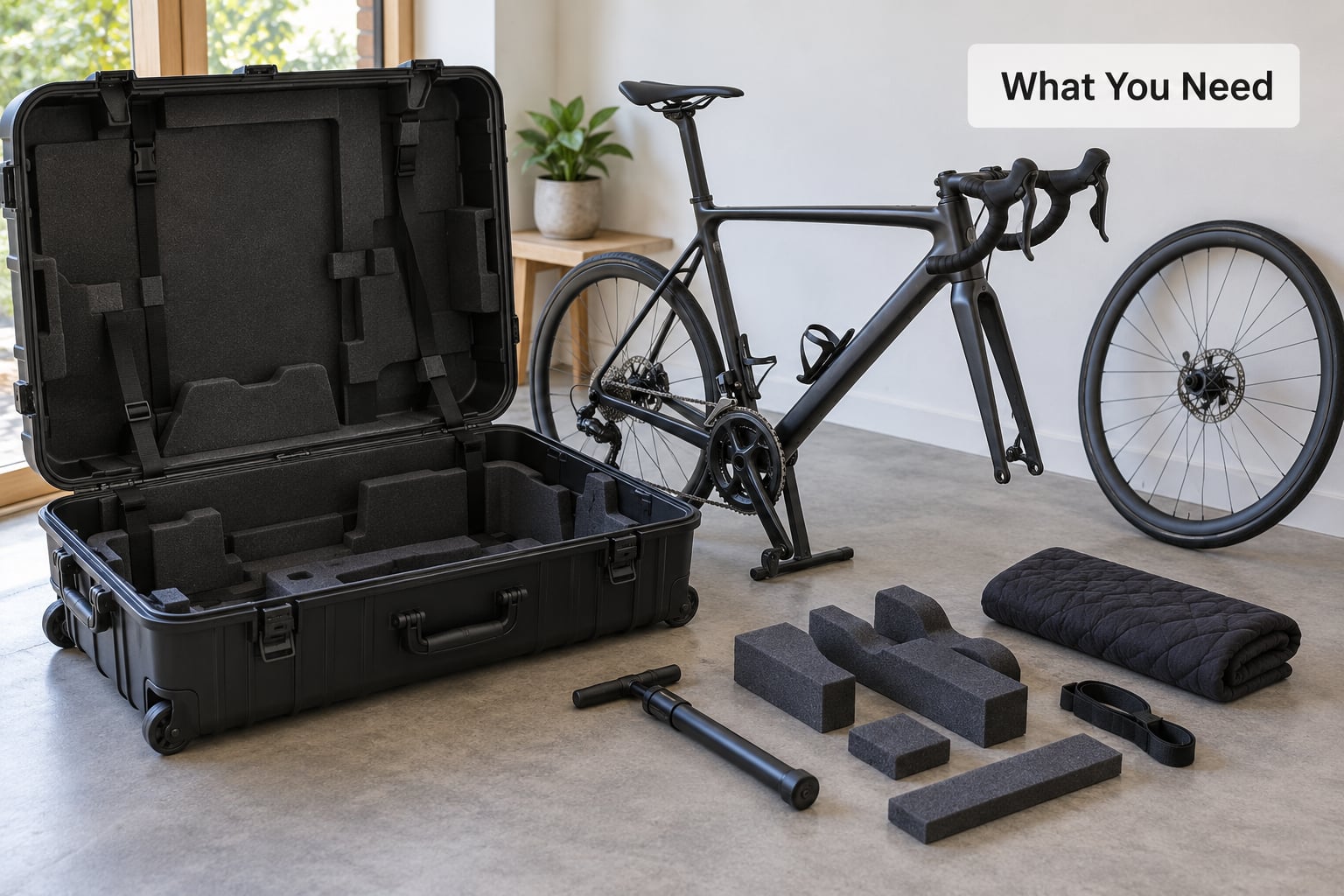
Start with the confirmation, not the box. Write to the airline before booking and ask the specific question: is a bicycle accepted, does it count against my checked bag allowance, do I need to reserve a sports equipment slot, and what are the weight and size limits? Get the reply in writing. Check-in staff have the final say in person, and a screenshot in your inbox is worth more than a general policy page when that conversation goes sideways.
Beyond that, the practical list:
- A container: a hard case, a soft bike bag, or a double-wall cardboard bike box from a shop.
- Foam pipe lagging, bubble wrap, a few zip ties, electrical tape and a tape measure.
- A pedal spanner, a multi-tool sized for the job, allen keys, and a small hand pump or mini inflator.
- Dropout spacers or axle adapters, and brake pad spacers for disc bikes.
- Your passport, visa or travel documents, plus contact details written on the case itself.
- Riding kit, helmet, shoes and pedals in your cabin bag so you are not stranded if the bike is delayed.
- A backup plan: a rental at the destination, or shipping the bike ahead instead.
Two numbers matter more than the rest. Most carriers cap checked sporting baggage at 50 lb, which is 23 kg, and treat anything over 62 in in linear dimensions as oversize, which usually adds a separate charge. A road bike packed in a typical box lands around 20 kg, so weight is usually fine and dimensions almost never are.
Step-by-Step: How to Fly with a Road Bike
How to choose the right airline and fare
Compare carriers on six things, not on the cheapest fare. Does the airline accept a bicycle in your chosen packaging, and does it accept a soft bag or a cardboard box, or only a hard case? Is the bike billed as a sports item at a set rate, or does it simply consume one of your checked bags? Does the route require an advance reservation for a bicycle, as Lufthansa does? What is the weight limit and the oversize trigger? And what happens on the return leg if the outbound is sold by one airline but operated by another?
That last point catches people out on code-share itineraries. Riders on cycling forums describe booking through one airline and being held to a different operating carrier’s rules on the way back, and some report a bike being accepted at the departure airport and refused at the return airport. Look up the operating carrier for every leg.
Connections add a third variable: a transit airport can charge its own oversized handling fee, which the booking airline never mentions. A route with two stops is a different proposition from a direct flight, and on a race weekend that extra handling is where a bent derailleur hanger usually happens.
On damage, read the liability terms rather than assuming. Soft bags and cardboard boxes often require you to sign a liability release or sign the case as limited liability, which tells the airline you accept the risk. A hard case is treated more favourably. Your homeowners or renters policy and some credit cards cover sporting equipment in transit, but only if you can produce a receipt and photographs.
How to pack a road bike in a case or box
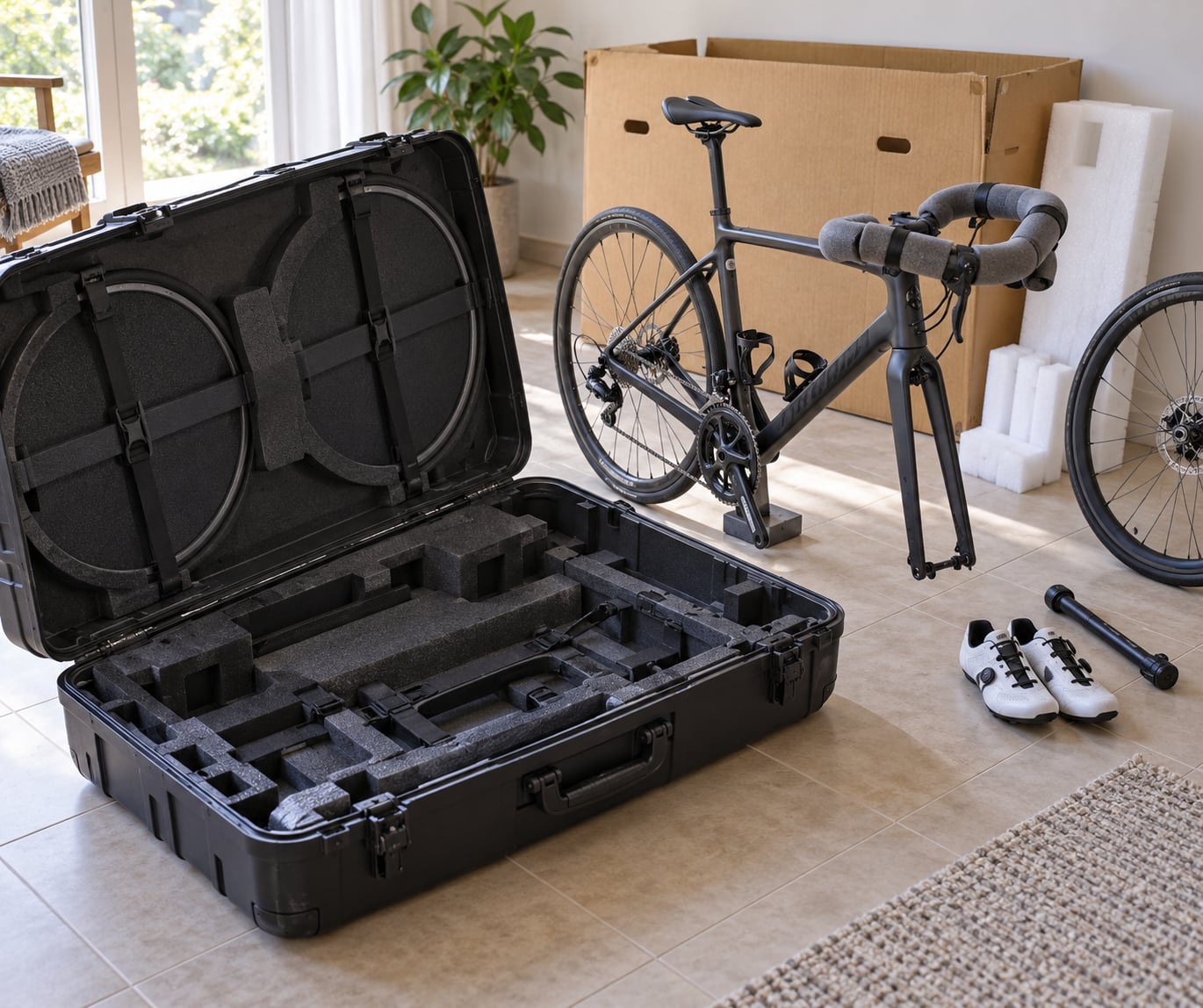
To learn how to pack a road bike for air travel, work from the frame outwards and treat anything that can touch something else as a point of failure.
Remove the pedals, mark your saddle height on the seat post with tape or a pen, and take the seat post out. Most hard cases and boxes are built around a bare seat tube, and a post plus saddle sticking up is the main reason a road bike will not fit. Integrated one-piece cockpits are the awkward exception, and some cases are made around them.
Turn the handlebars sideways if the case allows it. If your bars are fixed to the stem or your frame is a one-piece cockpit, pad the tops of the drops so nothing presses on the levers or the cables.
Take the rear derailleur off and tuck it into the rear triangle. This is the single most commonly reported damage on the forum threads for this topic, and it takes seconds with a hex key. Removing the front derailleur on older two-by drivetrains is the same job. The derailleur hanger is alloy and it bends easily, so pad the chainstay where the derailleur sits.
For disc brakes, remove both rotors and sandwich each one between two pieces of cardboard, then tape the sandwich. Do the same with the pads if they are hydraulic: slip a brake pad spacer or a folded piece of cardboard into each caliper so the pistons cannot creep together in transit. Pack carbon rotors separately from hard edges so a corner cannot take a bite out of the braking surface.
Remove the wheels and deflate the tyres by at least 1 bar, or 14.5 psi, below the maximum printed on the sidewall. You do not need to flatten them, because the cabin is pressurised to roughly the equivalent of 8,000 ft rather than vacuum. On tubeless tyres, let the air out slowly enough that the bead stays seated, and carry sealant. One rider reported a rear tyre blowing at altitude on a flight to New Zealand while running near the sidewall limit.
Drop the chain off the smallest cog or remove it entirely and run it through the derailleur, which stops it staining the chainstay. Pull the thru-axles or quick-release skewers out and pack them in a labelled bag, and fit dropout spacers so the dropouts cannot close on the pads or get crushed.
Pad the frame with foam pipe lagging along the chainstays, seat tube and any point where the wheels or bars will rest, and secure loose items with zip ties so a security agent can reassemble it quickly. Fill the dead space around the bottom bracket and chainstays with clothing. Weight your case and label it inside and out with your name and phone number; remove old barcodes and destination stickers first, and consider an AirTag inside the box.
How to check in and move through the airport
Go to the airline counter first, not the oversized desk, and have your booking reference and your written confirmation ready. Some airports will accept an unpacked bike at the oversized baggage counter while the check-in desk still refuses it, so start at the desk and let them route you.
Photograph the packed case before it disappears down the belt. If security wants to look inside, expect to repack the whole thing, sometimes quickly, and pack your tape with the bike rather than in your cabin bag, because tape gets confiscated. Keep tools in your cabin bag; anything with a blade or a hex shaft can be treated as a prohibited item.
At connections, the bike is usually offloaded and reloaded, which is another handling event. At your destination it will not come down the normal carousel in most airports; go to Oversized Baggage, and allow extra time, because oversized items often arrive after the belt has stopped.
Plan for lifting. A packed road bike box weighs roughly 20 kg, it is awkward rather than heavy, and airport lifts can be too narrow for a trolley plus a box. Don’t stack luggage on a soft bike bag, and check that the box will fit in the boot opening of whatever hire car you have booked, not just inside it.
How to reassemble and check the bike after the flight
Open the case away from other passengers before you leave the arrivals hall if you can, because the first inspection is much easier with daylight and space. Install the front wheel, secure the quick-release properly or torque the thru-axle to the manufacturer’s figure, and refit the rotors and remove the pad spacers.
Reconnect the rear derailleur and check that the hanger is straight by sight, then work through the gears. Squeeze both brake levers hard and hold them for a minute, which resets hydraulic pistons that crept during the flight, then spin the wheel and confirm the rotor is not rubbing. Inflate the tyres to riding pressure.
Give the bars, stem, seat post and pedals a torque check. Anything you cannot fix at the airport should be fixed at a shop before you ride, not on the first descent of a training camp. And keep your pedals, shoes and helmet with you, because if the bike is delayed by a day you can borrow one and still get the training in.
Common Mistakes
Booking without a written answer on the bicycle policy. Fix: email the airline before you pay and save the reply. If the answer is vague, call and note the name of who spoke to you.
Using a single-wall cardboard box or an oversized grocery box. Fix: get a double-wall bike box from a shop, or a purpose-made container. Riders report years of trouble-free travel in shop boxes when the frame is wrapped and the loose parts are tied down.
Leaving the rear derailleur and rotors in place. Fix: remove the rear derailleur and pad where it sits, and sandwich disc rotors between cardboard. This prevents the two most common failures on the road.
Putting tools in your cabin bag. Fix: pack tools and a small pump in the case and keep only the small essentials with you. A mini multi-tool is a judgement call; a full-size one will be confiscated.
Carrying CO2 cartridges. Fix: leave them at home and use a mini inflator with a built-in CO2 chamber or a hand pump. Pressurised cartridges are not permitted in either cabin or checked baggage.
Draining the hydraulic brakes before flying. Fix: don’t. No airline asks for this, and empty brake lines cost you a bleed and a bottle of fluid.
Riding before inspecting the bike. Fix: do the full brake and gearing check at the airport, or in a shop, before you get on the road.
Ignoring the return leg. Fix: check the operating carrier’s bicycle policy for every leg, and allow extra time at any connection.
Two habits cover most of the rest: pack a day or two ahead rather than the night before, and ride the bike for ten minutes at home after packing it to check nothing is rubbing. And if the trip is a race where the bike matters more than the holiday, compare the cost of shipping it ahead against the cost of flying it, then decide whether renting at the destination is a serious option.
Frequently Asked Questions
Do airlines charge extra to fly with a road bike?
It depends on the carrier. Some American carriers, including American, Delta and United, count a bike case as an ordinary checked bag at the normal rate. Others charge a separate sports equipment fee on top of your checked bag allowance. Budget European carriers often price bicycles high and add an oversize charge for anything over 62 in. Ask your airline in writing before booking rather than assuming from an old guide.
Can I take my bike box as a regular checked bag?
Frequently yes. On carriers with no bicycle fee, a packed road bike often uses one standard checked bag. A bike box is far past 62 in in linear dimensions, so an oversize fee is common even when the bike fee itself is zero. Some airlines additionally require you to declare a bicycle when you book, and some ask you to sign a limited liability release for soft bags and cardboard boxes.
How far in advance should I reserve a bicycle on a flight?
Reserve it when you book the flight, not later. Some carriers, Lufthansa among them, require the bicycle to be declared in advance so a sports equipment slot is allocated. Even where it is not mandatory, mentioning the bike at check-in avoids the counter surprise where the bag is refused or priced on the day. If your itinerary changes, re-declare the bike on every leg, including codeshare and return flights.
What should I do if my bike is damaged during the flight?
Photograph the damage at baggage claim before you leave the area, and keep the case, tag and any loose parts. File a diminished bag claim at the airline before you leave the airport, since most carriers want the report raised on the spot. Take the frame to a bike shop for a written assessment, then claim against the airline, your travel insurance, and your home or cycling policy, which often cover sporting equipment in transit.
Can I carry bike tools and CO2 cartridges in my luggage?
CO2 cartridges cannot travel in either cabin or checked baggage, so leave them at home and use a mini inflator or a hand pump instead. Tools vary by country: a full-size multi-tool or hex keys in cabin baggage can be confiscated at security. Carry the minimum you need, pack the rest in the bike case, and consider that several airports may ask to inspect the case contents and repack it.
Is it easier to fly with a bike case or a cardboard box?
A hard case is the easiest option for protection and usually for damage claims, because a bent hanger or cracked rotor is unlikely to survive a conveyor on its own. A soft bag is lighter and cheaper to fly with, and riders report years of trouble-free travel in one. A cardboard bike box from a shop is the cheapest and works if you pad the frame, remove the rear derailleur and rotors, and tie everything down.
Here is how to fly with a road bike in one line: get the airline’s bicycle rules in writing, pack the frame in a container that fits your route, take off the derailleur and rotors, pad everything that touches, keep your tools in the cabin, and photograph the case at both ends.