If you are new to multi-day riding, the honest answer to credit card touring vs self supported touring is that it comes down to weight against money. Credit card touring means carrying clothes, tools and a change of kit and buying beds, meals and repairs as you go. Self-supported touring means carrying a tent, sleeping kit, cookset and food so you can stop anywhere. Neither is better in the abstract. Credit card touring suits first-timers, riders who want predictable routing and anyone who would rather sleep in a bed. Self-supported touring suits experienced riders, tight budgets and routes where services thin out to nothing.
What most riders underestimate is how much of the decision is about comfort tolerance rather than adventure level. A rider who pitches badly in the rain on night two will usually bail to a guesthouse, and then wonder why they carried eight kilos of wet kit. The forum consensus, from a long-running thread on the Cycling UK community about camping touring against B&B touring, is worth repeating: each rider has their own acceptable level of comfort, and that level dictates what they carry. Work out yours before you buy anything.
Table of Contents
- Credit Card Touring vs Self Supported Touring at a Glance
- What Is Credit Card Touring?
- What Is Self-Supported Touring?
- Cost Differences: Card Perks Versus Carrying Everything
- Flexibility and Route Planning
- Comfort, Equipment and Bike Choice
- Choosing a bike for each style
- Food, Water and Everyday Logistics
- Safety, Weather and Reliability
- Which Should You Choose?
- The hybrid: doing both on one trip
- Frequently Asked Questions
- Is credit card touring cheaper than self-supported touring?
- Can self-supported bicycle touring be done without a tent?
- Do travel rewards cards work for cycling tours?
- What gear is essential for self-supported bike touring?
- Is credit card touring better for a first long-distance ride?
- Can you combine paid lodging with self-supported camping?
- Conclusion
Credit Card Touring vs Self Supported Touring at a Glance
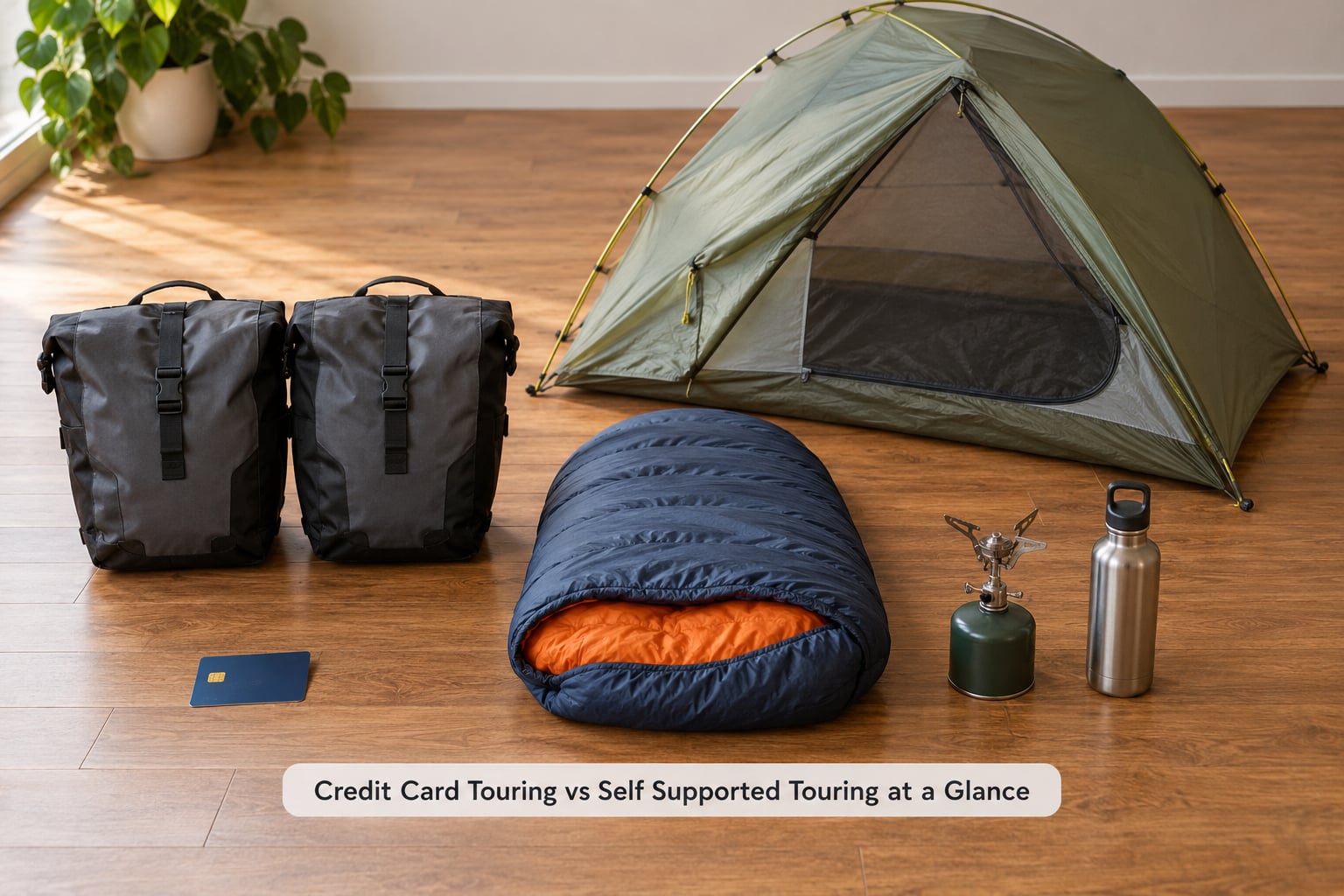
The table below is the fastest way to see where the two styles actually differ. Every figure is a typical range from touring practice, not a promise.
| Factor | Credit card touring | Self-supported touring |
|---|---|---|
| Total pack weight | 5-8 kg including bike and panniers | 12-20 kg including bike and panniers |
| Typical daily spend | Roughly 30-50 pounds for a guesthouse and restaurant meals | Roughly 5-10 pounds for a campsite and self-cooked food |
| Upfront gear spend | Clothes, tools, one good rain shell | Everything above plus tent, bag, mat, stove, cookset |
| Accommodation | Booked ahead, paid on arrival | Camp, free wild camp, or a campsite field |
| Realistic daily distance | 60-100 km without thinking about it | 50-80 km once kit weight and camp time are in the plan |
| Route changes | Locked in by bookings and deposits | Change the plan at the roadside if you want to |
| Bad weather nights | Dry room already paid for | Depends entirely on the kit you bought |
| Daily setup time | Ride, check in, eat, sleep | Add 20-40 minutes pitching, cooking and packing |
| Social contact | Hostels and inns, easy to meet people | You and whoever else is on that pitch |
| Best for | First tours, long riders, bad sleepers, cycleway-dense regions | Budget trips, remote routes, riders who want total freedom |
What Is Credit Card Touring?
Credit card touring is bike touring where you carry only what you need to ride and sleep, then pay for everything else as you go. Your panniers hold clothes, toiletries, a repair kit, a rain shell and a book. Food, accommodation, laundry, showers and bike repairs are bought with a card or cash at the point of need. The term comes from that swap: you carry less and you spend more, and the card does the carrying for you.
Several names float around for the same thing. Tourers say supported touring, hotel-to-hotel touring and saddle touring, and the awkward truth is that “supported” also means something else entirely, namely a company carrying your luggage between hotels. When you read a guide that calls it supported touring, check whether the support means a support crew or just a bed waiting for you. Ask other riders which term they actually use, because the naming is less important than knowing what is in your panniers.
You still need a few things to be comfortable. A proper sleeping system, even a cheap one, changes a trip. Most credit card tourers carry a bivvy or a lightweight bag so an emergency night is survivable, and many keep a micro stove, because people wake at 5am and cafes are not open. One rider on the Cycling UK thread described carrying a stove on an otherwise hotel-to-hotel tour for exactly that reason.
The constraint of the style is booking. Once tonight’s room is paid for, you are committed to reaching it, and that commitment fights your legs, the weather and an injury. It works brilliantly on routes with a bed every 40 km and terribly on a route with a 90 km gap between towns.
What Is Self-Supported Touring?
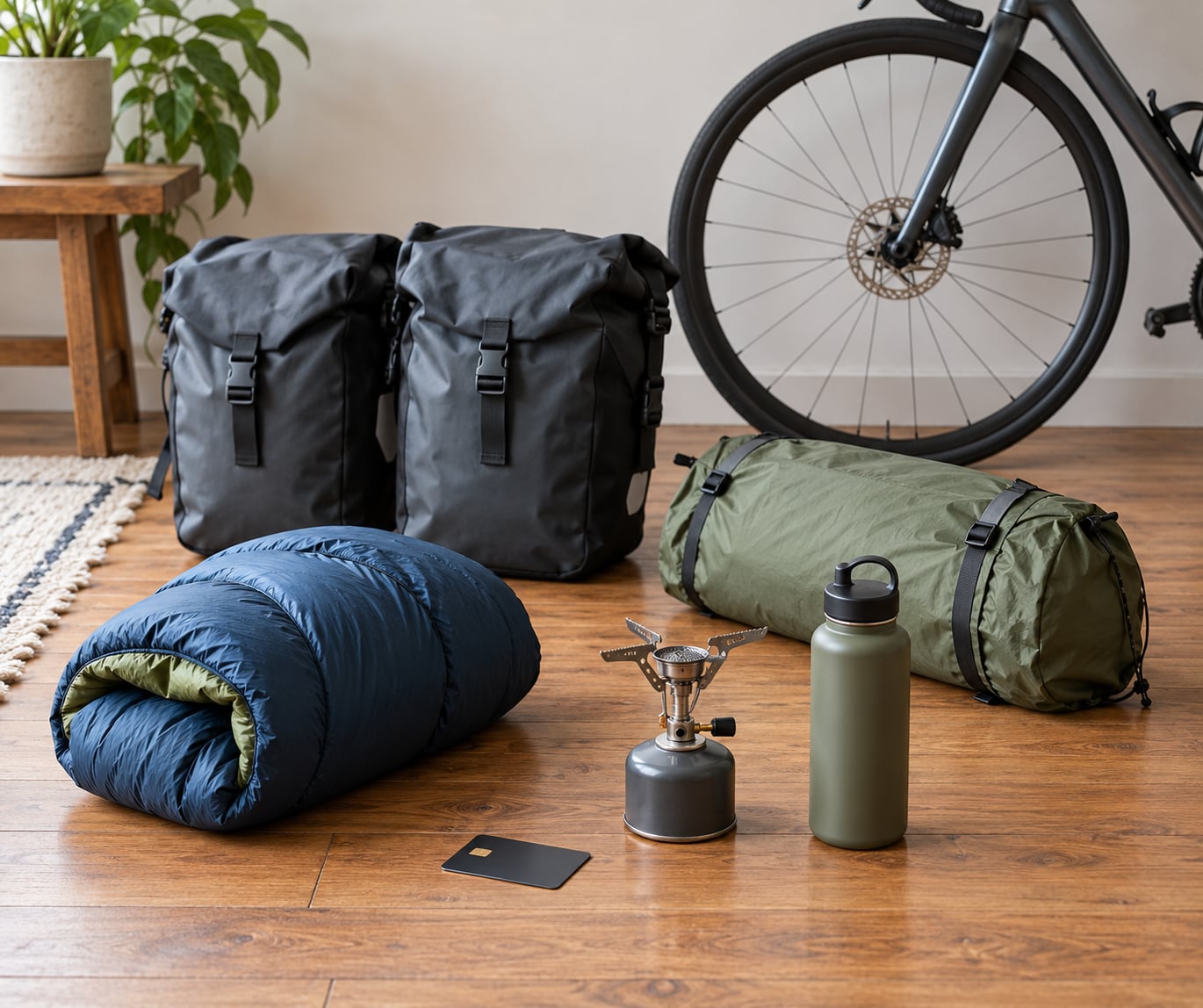
Self-supported touring means carrying everything required to camp, cook and manage the ride yourself for the length of the trip. A tent, a sleeping bag rated below the expected low, a mat, a stove, a cookset, food, water capacity, a tool roll and spares all come along. The bike forges ahead on its own. One writer put it better than any gear list: you will have to carry your bedroom, kitchen, living room and your closet all on your bike.
Water and food are the two systems that decide whether the style works. Water dictates where your route can go, because a remote route may sit 60 km from a fill point and your frame holds two bottles. Food dictates your resupply rhythm, which in turn dictates your route. Riders who resupply every third or fourth day tend to plan around towns with shops; riders hauling a week’s food in the panniers can go days without seeing one.
Repairs work the same way. You are not unsupported in the sense of having no help, you are unsupported in the sense that nobody is coming to hand you a spare part. A multi-tool, a couple of spokes, a patch kit, a spare brake pad and the confidence to replace a chain decide how far a mechanical problem pushes you. Learning to do those repairs before the trip is the difference between a delay and an abort.
Self-supported touring also means owning the setup time. Pitching, cooking, washing up, packing and finding a legal place to camp adds 20 to 40 minutes to a day, and riders consistently report that a comfortable camp is not a twenty-minute affair. Budget it honestly before you decide your daily mileage.
Cost Differences: Card Perks Versus Carrying Everything
The spending difference is the clearest number in the whole comparison, and it is large. What most guides do not do is put the two styles in the same table, so here it is. These are typical UK and Western European day rates in 2026; they vary by country, by season and by how central the town is, and they change over time.
| Daily cost | Credit card touring | Self-supported touring |
|---|---|---|
| Accommodation | Guesthouse, hostel or B&B, 25-45 pounds | Campsite pitch 5-12 pounds, or free wild camp where legal |
| Food | Supermarket plus a cafe or restaurant, 15-25 pounds | Self-cooked from resupplied food, 6-10 pounds |
| Incidentals | Laundry, showers, lockers, coffee | Occasional laundry, stove fuel, coffee in town |
| Daily total | Roughly 30-50 pounds a day | Roughly 5-10 pounds a day plus gear you already own |
Run a ten-day trip through that and the gap is around 200-400 pounds, which is real money and also close to what a full set of decent camping kit costs. Here is the catch: that kit is reusable, and hotel money is not. A rider doing two tours a year recovers the gear cost in a single trip; a rider doing one eight-day trip a year is closer to break-even, and any trip shorter than a week tilts toward camping on cost.
There is a second, less obvious cost on the credit card side. Rewards cards and annual-fee travel cards do soften the hit, but only if you would have spent the money anyway and only if you pay the bill in full. Points earned on a trip you fund with debt are negative points. Treat any rewards as a small offset, never as the reason to choose the style, and never a reason to spend more than you would have otherwise.
For self-supported riders the hidden costs are maintenance and logistics. Kit needs reproofing, tent poles bend, bags get patched, and stoves need servicing. You will also spend more thought on route planning because a mistake has no fallback. Both styles carry a contingency for a broken bike, but the camping rider’s fallback is a field repair and a longer push, while the hotel rider’s fallback is a taxi for the bike.
Flexibility and Route Planning
Flexibility is the trade-off that decides most trips, and it runs entirely in favour of carrying the kit. The moment a room is booked and paid for, the day’s plan is fixed. A headwind, a mechanical, a sore knee or a 48-hour rain band all become problems with a cancellation clock running.
Booking well softens this. The reliable version of credit card touring books one to two nights ahead, not the whole route, so a bad day costs you one night rather than the trip. Popular destinations in the peak season are the exception, and some routes through the most cycle-dense parts of western Europe are genuinely hard to book a year out. If the plan says the whole route is locked, treat that as a risk and price it in.
Self-supported touring can turn around at a junction. Bad weather ahead becomes a camp a kilometre back or a push into the next village, because you are not committed to a bed you have already paid for. That is a real freedom and it is the strongest argument for carrying a tent, particularly on routes where the distance between services is measured in tens of kilometres rather than in towns.
The daily distance you can realistically cover is a planning question more than a fitness one. Tour operators suggest 50-70 km on flat routes and 30-50 km on hilly routes as a full riding day, and beginners are commonly advised 50-80 km a day. Credit card riders usually hold a higher figure because the day ends at a door rather than a pitch. Whichever style you pick, plan the first two days short and let the trip tell you what it wants to be.
Comfort, Equipment and Bike Choice
Pack weight is where the two styles separate most visibly, and the extra kilos have a direct effect on your riding. Typical totals reported on touring forums are 5-6 kg of carried kit for a light credit card tour, around 12 kg for lightweight camping touring and 17-20 kg when a two-person tent, electronics and comfort items are included. The camping extras break down roughly like this.
| Extra item | Typical weight | Required or optional |
|---|---|---|
| Tent | 1.5-3 kg | Required unless you plan to use a bivvy |
| Sleeping bag | 0.7-2 kg | Required |
| Sleeping mat | 300 g-1 kg | Required |
| Pillow | About 100 g | Optional but most people keep one |
| Chair | 300 g-1 kg | Optional, and the first thing to cut |
| Cookset and stove | 500 g-1 kg | Required unless you eat cold food every day |
| Head torch | 50-100 g | Required |
| Towel, trowel, toiletries | 200-400 g | Small but adds up |
| Larger panniers to carry it | Framed, so no carried weight but more frame weight | Required |
The speed cost of that extra load is worth knowing, because it decides whether your plan is realistic. Riders report roughly a 1 mph loss per extra 10 kg on gently rolling terrain, closer to 2 mph at an average touring pace on mixed ground, and up to 4 mph on hilly terrain with a full camping load. Over a three-week climb that adds up to a lot of days you did not plan for.
Weight also changes how the bike feels. A heavily loaded bike is less willing to turn, slower to respond in corners and more awkward at a road stop, and it punishes a mechanical problem far more than an unloaded one. If you ride a fast road bike, the honest consequence is that the style picks you.
Choosing a bike for each style
What type of bike is best for touring? It depends on the style you are choosing, and gearing matters more than weight. For credit card touring, a light road, audax or fast gravel bike works well, and a bikepacking setup is more than enough. For self-supported touring you want rack mounts and braze-ons, wide tyre clearance, and a low enough bottom gear to climb with a full load. One rider running a nine-speed touring bike from a 22 inch low gear to a 118 inch high gear noted that the top gear is largely wasted on a loaded tour because you spend most of the day coasting downhill, and that the low end is what actually matters.
That advice generalises. Gearing anxiety is a common first-tour mistake: riders buy ultralight kit before they know whether they will reuse it, then find that gearing and rack mounts decide the trip far more than the weight saving does. A repairable steel frame with eyelets and a serviceable bearing ecosystem is a sensible insurance policy for a style where you are the support crew.
Food, Water and Everyday Logistics
Meals are the biggest daily difference. A credit card rider eats what the town offers, which is often excellent and occasionally a sit-down lunch that eats the day’s savings. A self-supported rider boils water, cooks from resupplied food and controls the calories, which is cheaper and much worse for morale on the fourth night in a row.
Water flips the rules again. Credit card touring lets you top up at cafés, public fountains and restaurants, so carrying capacity stays low. Self-supported touring needs planned fill points, a filter if the route crosses anything other than treated water, and enough bottle capacity for the longest gap between sources. Riders should assume roughly two litres per person per hour in summer and more in heat, which turns a remote route into a route-planning problem rather than a packing problem.
Resupply is where the styles diverge most sharply. The hotel rider walks into a supermarket. The camping rider has to plan where those supermarkets are, or carry a week’s worth of food and accept the weight. A common middle path is to book a hostel night every few days, use its kitchen, and shop there.
Everyday chores scale the same way. Laundry is a 24-hour spin cycle in a hotel versus a washbag in a hostel sink. Charging is a wall socket versus a power bank that adds weight. Bike security is a locked room or a visible frame versus a tent peg and a line through the frame, because a self-supported rider often has no unattended hours at all. On the plus side, the hotel rider gains hot showers, a table to spread maps out on and, in a good hostel, people to ask about the next day’s road.
Safety, Weather and Reliability
Neither style is safer in general, and the two trade risk differently. The credit card rider’s risk is being committed to a destination they cannot reach on a bad day. The self-supported rider’s risk is being exposed with no dry option. The honest framing is that the camping rider carries the consequence personally, while the hotel rider carries it in a booking.
Weather is the sharpest test. A severe weather warning, a heatwave or a multi-day rain band will stop most riders. The credit card rider checks the forecast, rides early and eats lunch slowly. The self-supported rider checks the forecast and hopes the pitch drains. The mitigations are different: know the campsite network in advance rather than hoping to find a field, and treat a wet-night bailout budget as part of the trip, not a failure. Several riders mention bailing to a hotel mid-camping trip when the weather breaks, and being honest that this may happen defeats the point less than pretending it will not.
Mechanical breakdowns reward preparation. Carry the tools you can actually use, learn to true a wheel and replace a chain before the trip, and know which towns along the route have a bike shop. A lodging operator or campsite with a workshop is a real advantage that credit card touring gets almost for free.
Water access and communication matter more in the self-supported style, because there are longer stretches where neither is guaranteed. A fully charged phone, a plan for the worst case and a route that a second person knows about are worth the same in both styles. The remote rider simply needs them more often.
Which Should You Choose?
Choose by rider profile and trip profile, and only then by gear. These criteria are the ones that actually decide it.
- Have you done a multi-day tour before? If not, credit card touring is the lower-risk answer. The failure modes are gentler and recoverable, and the booking is a net rather than a wall.
- What is the longest gap between services on your route? Beyond roughly 60-80 km with nothing useful in between, self-supported touring starts to make more sense than paying to ride past everything you could have used.
- How long is the trip? One trip of a week or less, camping usually wins on cost. Two or more trips a year, credit card touring wins once the gear is already bought.
- Can you sleep outdoors comfortably? If sleeping rough makes you miserable, carry less and sleep in beds. Carrying kit you resent on night ten helps nobody.
- Do you need to change plans daily? Weather-dependent, remote or exploratory trips argue for camping. Fixed point-to-point routes on cycleways argue for hotels.
- Will you be riding solo? Hostels and inns solve loneliness that a camp will not. Solo riders who value company have a strong practical case for credit card touring.
- What is the weather like at night? Check the overnight low and the comfort rating of the bag you would need. That number settles the argument faster than any opinion.
The hybrid: doing both on one trip
Most experienced tourers stop treating this as a binary. A pattern that works well is two camping nights followed by one paid night, which keeps the daily distance down and gives you a shower every third day. One rider planning the Outer Hebrides loaded the bike with an extra 17 kg as a test, found the weight fine on a 20-mile ride, and then chose a two-nights-camping, one-night-guesthouse rhythm to cover 120 miles over three days. Another prefers to credit card tour through England using budget travel lodges and camp in Scotland, where wild camping is easier. The style is regional as much as personal.
Gear that does double duty is what makes the hybrid cheap. A bivvy or lightweight quilt, a small mat and a micro stove weigh around 2-3 kg together and let you skip a booking without committing to a full camping load. Pack them in a small top bag and you can ride hotel-to-hotel most nights and camp when the weather or the wallet says so.
Bikepacking sits between the two extremes and is worth naming, because the terminology question comes up constantly. Where a pannier setup with a full camp kit turns towards self-supported touring, and a frame-bag setup with a bivvy and no stove leans towards credit card touring, bikepacking lives in between: minimalist, usually off-road leaning, no heavy kitchen and no heavy sleep system. It is a lighter end of self-supported touring, not a separate species, and the dividing line is really the pannier load rather than the label.
Frequently Asked Questions
Is credit card touring cheaper than self-supported touring?
On a per-day basis, no. A hotel-based day typically runs around 30-50 pounds once a guesthouse and meals are included, while a camping day runs around 5-10 pounds. The saving comes from the upfront gear cost instead, typically several hundred pounds for a tent, bag, mat, stove and cookset. That gear is reusable, so camping wins on cost for regular tourers and on trips of a week or more.
Can self-supported bicycle touring be done without a tent?
Yes. Plenty of riders tour with a bivvy or a lightweight tarp and no tent at all, and many credit card tourers carry only an emergency sleep system. What you give up is comfort and weather protection, especially in wind or heavy rain. Without a proper shelter, a bad night goes from uncomfortable to genuinely unpleasant, so test the setup on a weekend before relying on it.
Do travel rewards cards work for cycling tours?
They work, with caveats. Any card with no foreign transaction fee is the important one for touring abroad, because that fee hits every meal, coffee and campsite. Points and rewards can offset a portion of daily spending, but only if you pay the statement in full and only if you would have spent the money regardless. Do not apply for a card for one trip, and do not carry a balance to earn points.
What gear is essential for self-supported bike touring?
A tent, a sleeping bag rated below your expected overnight low, a mat, a stove and cookset, a tool roll with a multi-tool and spares, a head torch, water bottles and a way to treat water. Clothing and a rain shell come with any touring kit. Everything else, chairs, pillows, second cookware and gadgets, can be bought later once you know what you actually miss.
Is credit card touring better for a first long-distance ride?
Usually, yes. A first tour is about learning to ride a full day, manage effort and recover, and a booked bed removes the two things that most often end a first trip: a cold wet camp and the daily logistics of cooking and pitching. You also learn the route without fighting your load. Riders who dislike beds can still carry a 2-3 kg emergency sleep system and keep the option open.
Can you combine paid lodging with self-supported camping?
That combination is the most common long-distance pattern. Two camping nights followed by one guesthouse night keeps daily mileage realistic and gives you a shower every third day, and it works well when a route crosses regions with different camping rules. Carrying a bivvy, a small mat and a micro stove for emergencies adds only a couple of kilos and keeps both options open on any given night.
Conclusion
Credit card touring trades weight for money and flexibility for predictability. Self-supported touring trades money for weight and predictability for the freedom to change your mind at the roadside. Most riders land somewhere between the two, camping two nights and taking a bed every third day, and that is a perfectly good answer rather than a compromise.
Before you buy equipment or apply for a card, settle four things in order: pick the route and check the gap between services, set a realistic daily mileage for your fitness, decide honestly how you handle a night outdoors, and only then buy the kit to match. Do the route as a weekend shakedown first, and the rest of the decision gets a lot easier.