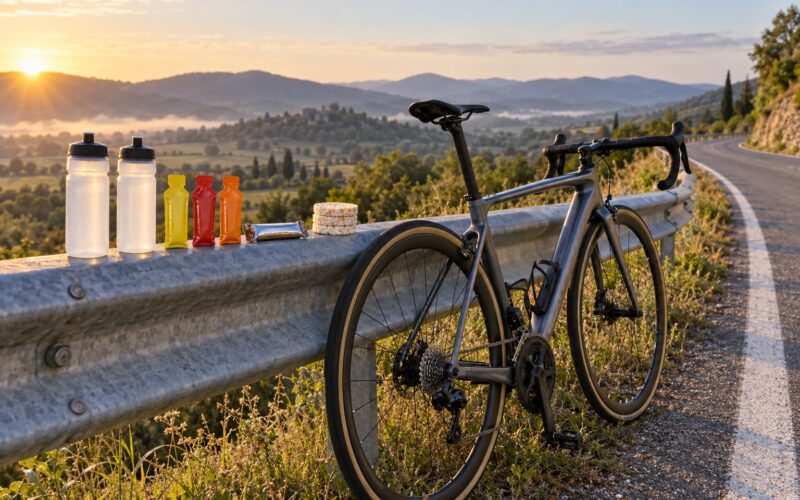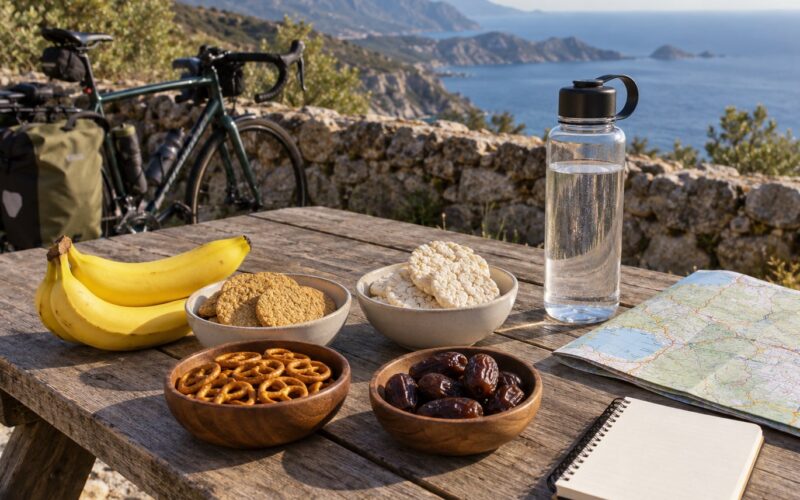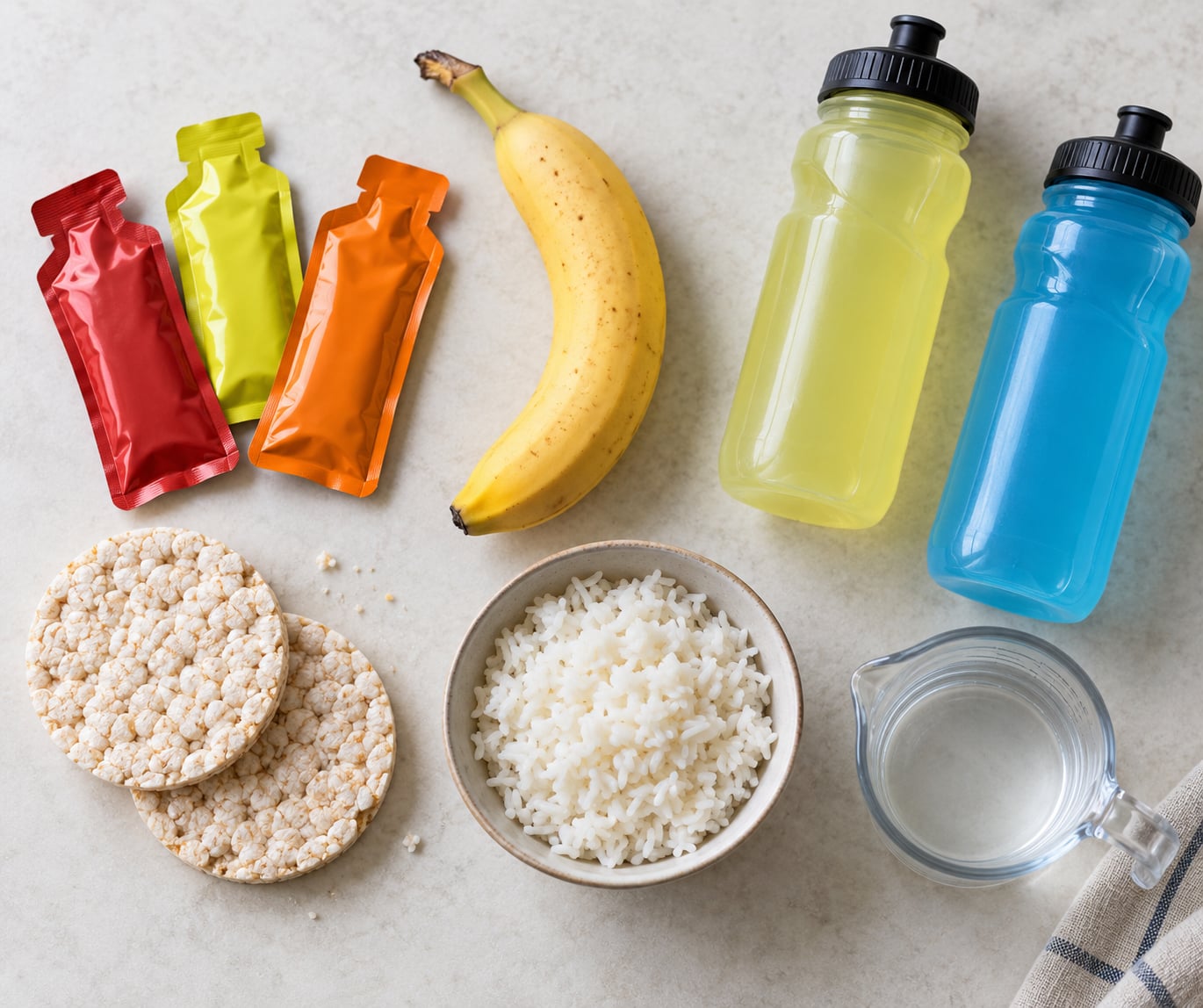
Most riders need 30 to 90 grams of carbohydrate per hour on any ride longer than about 90 minutes. Start at 60 g per hour for endurance riding, push toward 90 g for long rides, hard efforts and racing, and treat 120 g as a ceiling you earn through gut training rather than a number to chase on day one. How many carbs per hour cycling actually needs depends more on how long you are out and how hard you are going than on any single formula.
I have watched a lot of riders get this wrong in both directions. Some show up to a four-hour ride with a single bar in a jersey pocket and bonk at hour two. Others cram 120 g per hour into a two-hour spin, feel sick, and conclude that carb loading is nonsense. Both come from treating the number as a rule instead of a starting point.
Time to get practical. Below is the range the sports nutrition literature points at, what those grams look like in food you can actually carry on a bike, how to work out your own number, and how to build up to it without ending up bent over the handlebars at hour three.
Table of Contents
- How Many Carbs per Hour Should I Eat While Cycling?
- Short rides under 90 minutes: usually nothing
- Rides of 90 minutes to 2.5 hours: 30 to 60 g
- Rides over 2.5 hours: 60 to 90 g
- Hard efforts and racing: 75 to 120 g
- Which Carbs Are Best for Cycling?
- How Do Ride Duration and Intensity Change the Target?
- Riding for hours on consecutive days
- Matching your daily intake to the training week
- How to Calculate Your Carbs per Hour
- What Should You Eat Before and During a Long Ride?
- How Do You Avoid Bottling Up on Long Rides?
- Training Your Body to Use More Carbs
- Frequently Asked Questions
- Is 50g of carbs per hour enough for cycling?
- How many grams of carbs are in a gel?
- How much carbohydrate should I eat 3 to 4 hours before a long ride?
- Why do cyclists drink Coke after a race?
- Can you absorb more than 60g of carbs per hour while cycling?
- Will I lose weight if I eat 90g of carbs per hour on the bike?
- Conclusion: Start With One Consistent Plan
How Many Carbs per Hour Should I Eat While Cycling?
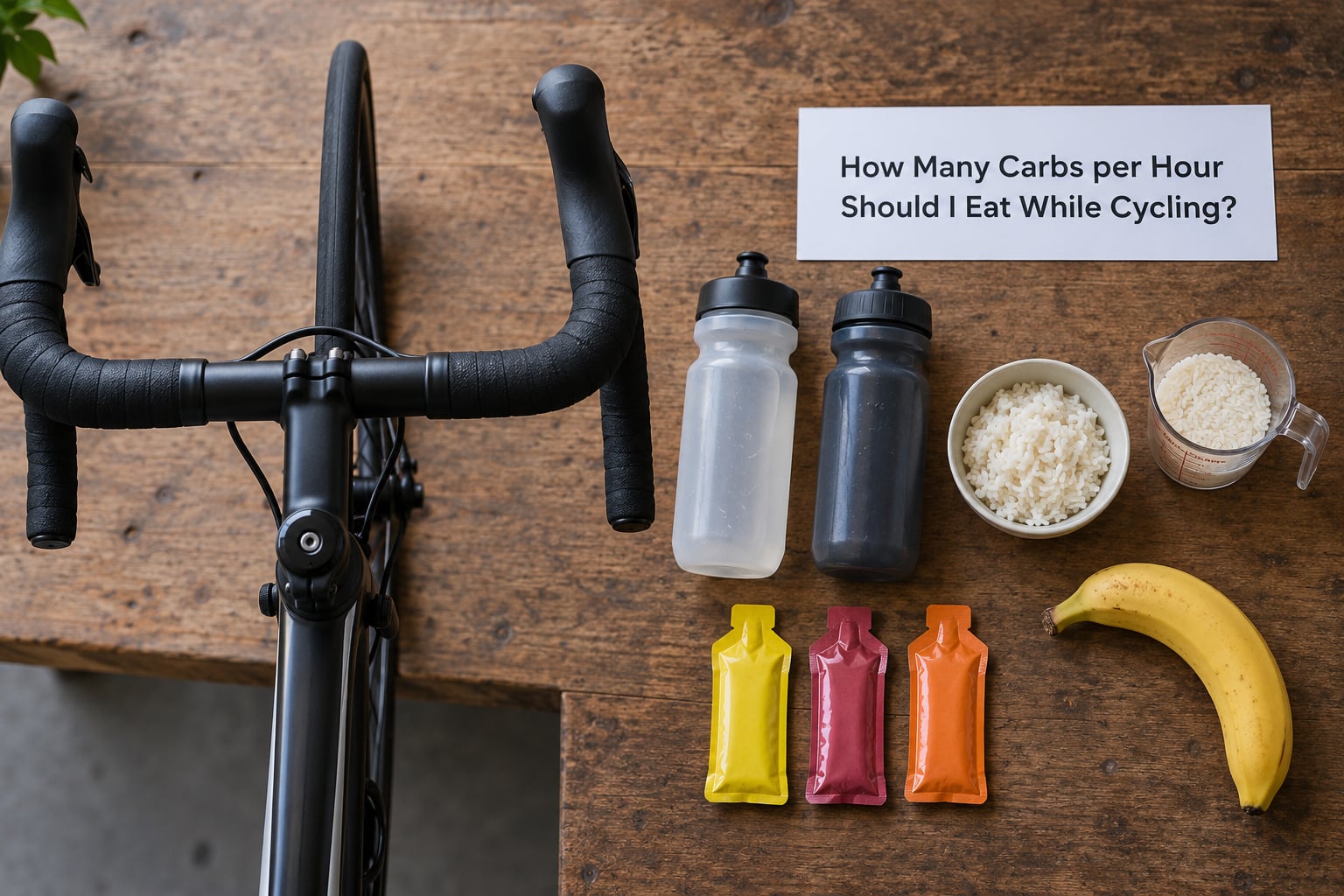
For any ride over about 90 minutes, aim for 30 to 60 g of carbohydrate per hour if you are new to fueling, 60 to 90 g if you have trained your gut, and up to 120 g if you are racing or riding very long ultra distances. Anything under 60 minutes usually needs nothing at all.
The table below maps ride duration against effort. Use the easy column for a social group ride, the hard column for anything with sustained climbing, intervals or a fast group pace.
| Ride duration | Easy or endurance pace | Hard pace, climbing or intervals | Racing or well gut-trained |
|---|---|---|---|
| Under 60 minutes | 0 g | 0 g | 0 to 20 g if needed |
| 60 to 90 minutes | 0 to 30 g | 30 to 45 g | 60 g |
| 90 minutes to 2.5 hours | 30 to 60 g | 60 g | 75 to 90 g |
| 2.5 to 4 hours | 60 g | 75 to 90 g | 90 to 120 g |
| Over 4 hours | 75 to 90 g | 90 to 120 g | 90 to 120 g, practice only |
Short rides under 90 minutes: usually nothing
A 45-minute Tuesday spin at zone 2 runs on stored glycogen and your last meal. Eating on that ride does nothing useful, and many riders feel queasy if they do.
Rides of 90 minutes to 2.5 hours: 30 to 60 g
This is the sweet spot for most club riders. One gel plus a couple of chews an hour, or a bottle of drink mix, covers it comfortably.
Rides over 2.5 hours: 60 to 90 g
Past two and a half hours, the maths changes. You are not topping off a tank any more, you are refuelling a system that is actively draining, and 60 g stops being enough for a hard ride.
Hard efforts and racing: 75 to 120 g
Above roughly tempo intensity, working muscles shift heavily toward carbohydrate. Riders who have trained the gut can hold 100 g or more per hour, but that intake belongs to trained racers, not to someone learning what a gel is.
Which Carbs Are Best for Cycling?
All carbohydrate is not equal on a bike. The difference comes down to which transporters in your intestine carry it, and how fast each one can work.
Glucose is absorbed through the SGLT1 pathway. Fructose uses a separate carrier called GLUT5. Research from Asker Jeukendrup’s group established that the glucose pathway alone tops out somewhere around 60 g per hour, no matter how much you swallow.
Once that ceiling is reached, more glucose just sits in the gut, draws water in with it and contributes to the bloated, sloshy feeling riders describe. That is the carb ceiling, and it is a transport limit rather than a strength limit.
The way past it is multiple transportable carbohydrates, usually a glucose and fructose blend in a ratio somewhere between 1:1 and 2:1. This engages two pathways at once and lifts the practical ceiling to roughly 90 to 120 g per hour. Most modern gels, chews and drink mixes are already built this way, so check the label before assuming yours is glucose only.
What slows things down is just as important as what speeds them up. Fiber delays gastric emptying, so bran, wholegrain bread, apples with skin and large portions of raw vegetables are poor choices mid-ride. Fat does the same, which rules out nuts, chocolate-heavy bars and most fat-rich energy foods in quantity. A big serving of milk protein has a similar effect, so if dairy settles badly in you, keep it out of the ride.
Finally, palatability is a physiological variable. Carb-dense chews and gels taste fine for an hour and become hard work by hour three. Variety is not fussiness; it is one of the cheapest ways to keep intake on target in the back half of a long ride.
How Do Ride Duration and Intensity Change the Target?
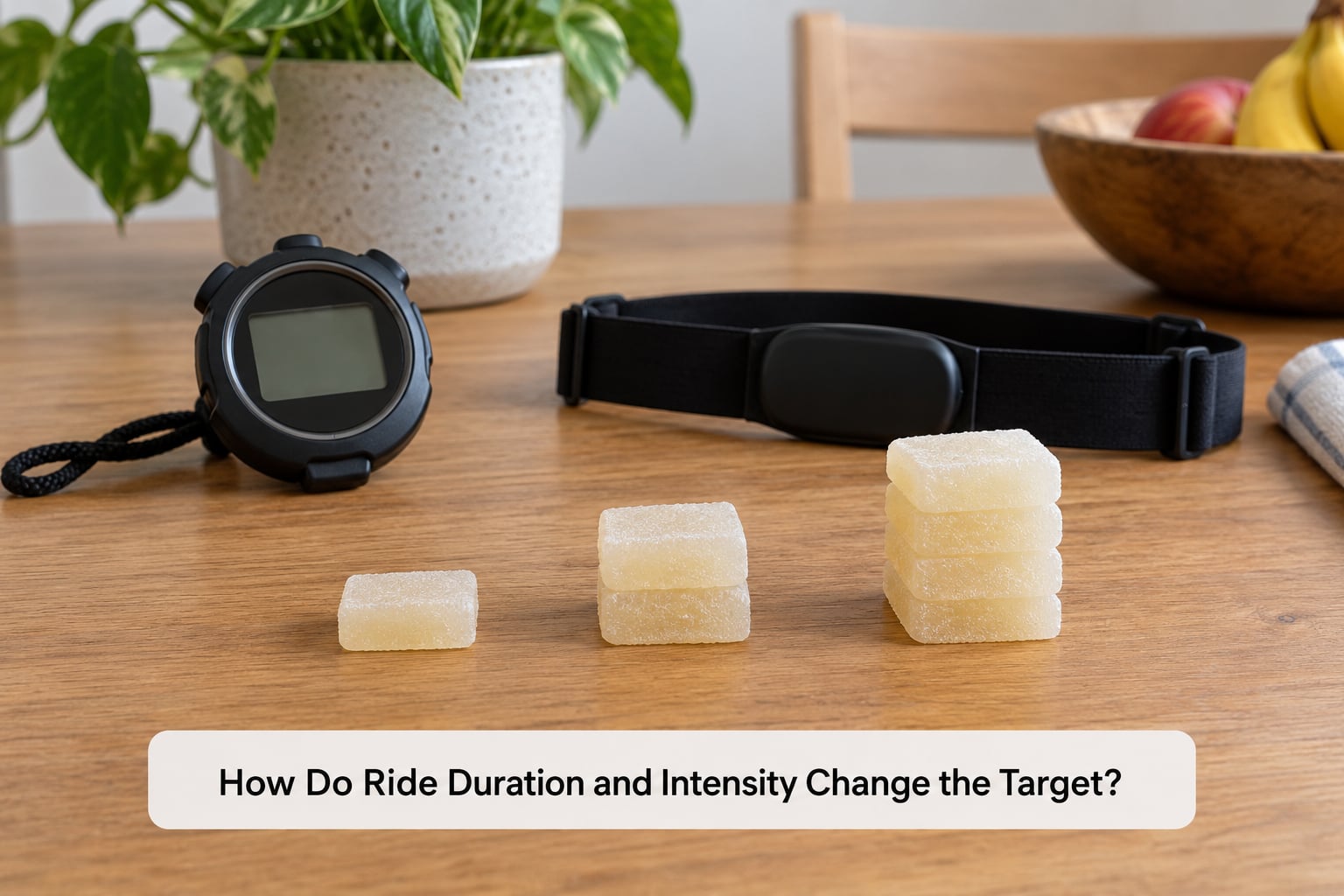
Duration is the obvious axis, but intensity moves the number just as much, and most riders only think about duration. On an easy ride at a conversational pace, fat oxidation handles a large share of energy production and a moderate carb intake covers you easily. Push the pace to threshold or above and the contribution from fat drops while carbohydrate use climbs sharply.
This is the crossover concept, and it is why the same rider needs 45 g per hour on a flat recovery loop and 90 g on the same loop with three sets of repeats in it. The session got shorter, not longer, yet the requirement went up.
Hard sessions also tend to compress your eating window. A hard group ride leaves you breathing hard and genuinely unwilling to chew, which is exactly when you most need the carbs for the recovery half of the ride. Liquids and gels become the practical choice on hard efforts for that reason, not because solids are inferior.
Riding for hours on consecutive days
Back-to-back long rides are where under-fueling shows up fastest, because glycogen stores start the second day already reduced. If you have a two-day block or a stage race in your calendar, push toward the upper end of your range from the first hour rather than saving the fuel for later.
Matching your daily intake to the training week
Hourly intake is only half the picture, because you also need enough carbohydrate across the whole day to refill stores. The sports nutrition bodies generally express this as grams per kilogram of body weight per day, and it moves with training load.
| Daily training load | Carbohydrate target (g/kg/day) | For a 75 kg rider |
|---|---|---|
| Rest or light recovery day | 3 to 5 | 225 to 375 g |
| Endurance, 1 to 3 hours per day | 5 to 7 | 375 to 525 g |
| High volume or moderate intensity | 6 to 10 | 450 to 750 g |
| Race week or extreme loads | 8 to 12 | 600 to 900 g |
That last column is where a lot of riders are quietly short. If you are eating 300 g of carbs a day but trying to take 90 g of that on a four-hour ride, the budget is doing the damage before the ride even starts.
How to Calculate Your Carbs per Hour
The simplest method is body weight multiplied by a target in grams per kilogram per hour. If you have never worked out how many carbs per hour cycling actually asks of you, this is the fastest route to a number you can test. For most training riders the useful range is 0.8 to 1.2 g per kilogram per hour, and you pick your place in that range based on the table above.
For a 75 kg rider: at 0.8 g/kg/hr that is 60 g per hour. At 1.0 g/kg/hr it is 75 g. At 1.2 g/kg/hr it is 90 g. For a 60 kg rider the same bands give 48, 60 and 72 g, which is the part most riders get wrong by borrowing a number from a heavier rider on a forum.
Now convert the grams into things you can eat on a bike. The counts below are typical, and labels vary enough that you should check yours.
| Fuel item | Approximate carbohydrate |
|---|---|
| Standard gel | 25 to 30 g |
| Energy chew | 4 to 8 g |
| Energy bar | 20 to 40 g |
| Rice cake with jam | 25 to 30 g |
| Banana | 20 to 27 g |
| Bagel with honey | 45 to 55 g |
| Two cups of cooked white rice | 70 to 80 g |
| Standard 12 oz can of regular cola | 35 to 40 g |
| One 500 ml bottle of drink mix at 6% | 30 g |
Hitting 60 g per hour from gels alone means two gels plus a few chews, which is a lot of packaging and a lot of sweetness. Splitting the load between drink and food works far better in practice: drink mix in your bottles, one gel or a bar every 30 to 40 minutes, chews in between.
Hitting 90 g is a different exercise. Two gels plus a 25 g chew twice an hour covers it, or a gel, a bar and drink mix. Most riders who reach 90 g do it with drink, not with solid food alone, and that is also why palatability stops being a problem at higher intakes.
What Should You Eat Before and During a Long Ride?
On-bike intake only works if you start with something to work with. Muscle and liver glycogen are finite, and the liver store is what keeps your blood glucose stable through the back half of a long ride.
Aim for a meal containing 1 to 4 g of carbohydrate per kilogram of body weight three to four hours before rolling. For a 75 kg rider that is roughly 75 to 300 g, which sounds large until you look at it as rice, pasta, toast with jam, or fruit and yogurt. Keep the fiber and fat in that meal low so it clears your stomach before you start.
Add a small top-up in the 15 to 20 minutes before rolling if the ride is long: half a banana, a few sips of drink mix, or a couple of rice cakes. Coffee with carbohydrate is a legitimate option for riders who tolerate it, since caffeine is well supported for endurance performance.
During the ride, start eating early rather than when the first hunger signal appears. Take your first 20 to 30 g within the first 30 to 45 minutes, then repeat at a steady interval on a timer rather than by feel. Setting a repeating watch alarm is the single most effective change most riders can make, because hunger is a lagging signal and by the time you feel it you are already behind.
Pair carbohydrate with fluid, aiming for roughly 200 ml every 15 to 20 minutes, more in heat or at altitude. Add sodium to match the fluid, and be more deliberate about it in hot weather or on very long days. Fluid taken without adequate sodium is one of the more common reasons riders feel queasy while fueling heavily.
Chewing things is an underrated technique. Chews, rice cakes and a small amount of real food stimulate salivary amylase, which starts breaking starch down in the mouth and takes some of the work off the stomach. Riders who chew what they eat tend to report fewer GI problems at the same intake.
How Do You Avoid Bottling Up on Long Rides?
The most common complaint at higher intakes is not a calorie problem, it is a stomach problem. Bladder pressure, reflux and nausea usually show up in that order, and the fix is almost always a smaller starting dose rather than more water or more discipline.
Start lower than you think you need and build across the ride. If your target is 60 g per hour, take 30 g in the first hour and increase to 45 to 60 g once your gut is moving. Riders who immediately hit their full number in hour one are the ones who spend hour three regretting it.
Then work out which of four things is actually causing the trouble, because the fix is different each time:
Fiber is the most common culprit. Wholegrain bars, bran-heavy products and large amounts of raw fruit all slow gastric emptying. Switch to white bread, rice cakes or refined products for long rides and see whether the problem goes away.
Fat is the second. Most energy bars and many gels have some fat for palatability, which is fine, but a high-fat product eaten in quantity on a hot ride is a well-known recipe for trouble.
Volume is the third, and it is the one riders miss. Three large bottles of heavy drink mix is a lot of liquid in your stomach regardless of how many grams of carbohydrate it contains. Splitting the drink across more, smaller bottles, and moving some of the carbohydrate to gels, often fixes it.
Unfamiliar food is the fourth. Something you ate once on a training ride and never repeated is not a proven fuel. For a century or a double century, a support car or resupply plan matters as much as any product choice, so check where the shops and water points actually are on the route before you commit to a plan.
There is no single ceiling for everybody. Some riders genuinely cannot exceed about 50 g per hour without discomfort, and that is a normal biological difference, not a failure of will.
Training Your Body to Use More Carbs
Gut training is the practice of raising your intake in deliberate steps so that the intestine, blood flow and tolerance all adapt. It is the difference between a rider who theorises about 90 g per hour and one who actually rides at 90 g per hour on race day.
A workable progression runs over six to eight weeks, and it only ever changes on long weekend rides, never on a hard weeknight session.
Weeks 1 to 2: 30 to 40 g per hour. This should feel almost too easy. The aim is to build the habit of eating on a timer and drinking with food, not to load up.
Weeks 3 to 4: 45 to 60 g per hour. Most recreational riders plateau here for years and lose nothing. Sixty grams per hour is a complete, professional-quality intake for a five-hour ride.
Weeks 5 to 6: 70 to 90 g per hour. Increase volume and sweetness gradually rather than on the same day, and keep sessions under three hours so you can recover from any GI symptoms.
Weeks 7 to 8: 90 to 120 g per hour. Only do this if a race or ultra event demands it. Use multiple transportable carbohydrate products, spread intake evenly, and make sure your daily carbohydrate budget supports it.
On a week when you have a hard interval session, a long drive or a demanding day at work, drop back a step. Gut training is progressive overload for the digestive system, and it responds to the same rules as any other training adaptation.
Not every session needs fuel. Short, low-intensity rides are the right place to train on water alone, and some riders deliberately train a low-carbohydrate session early in the week to raise fat oxidation. What matters is that the highest-intensity and longest sessions, which are the ones you care about, are fueled well.
The last rule is simple and gets broken every season: use on race day only the products you have used repeatedly in training. A brand new gel on the most important ride of your year is a coin flip, and the downside is a ruined day. A sports dietitian or registered dietitian can help you build a plan around your medical history, your tolerance and your specific event.
Frequently Asked Questions
Is 50g of carbs per hour enough for cycling?
Yes, for most riders 50 g per hour is a genuinely good target rather than a compromise. It sits comfortably inside the 30 to 90 g range, covers rides up to around three hours, and is well within what your intestine can absorb without glucose plus fructose blending. Riders on a forum in r/cycling commonly start near 45 to 50 g per hour for the same reason. If you finish a long ride with steady energy and no GI problems, there is little reason to push higher.
How many grams of carbs are in a gel?
A standard energy gel contains about 25 to 30 g of carbohydrate, which is why hitting 60 g per hour from gels alone means roughly two of them an hour. Chews usually carry 4 to 8 g each, bars 20 to 40 g, and a 500 ml bottle of drink mix mixed at 6% gives you around 30 g. In practice riders get further by splitting intake between drink and food rather than stacking gels.
How much carbohydrate should I eat 3 to 4 hours before a long ride?
The usual recommendation is 1 to 4 g of carbohydrate per kilogram of body weight, so roughly 75 to 300 g for a 75 kg rider. That sounds like a lot until you look at it as a plate of rice, pasta, or toast with jam. Keep fiber and fat low in that meal so it sits light, and add a smaller top-up such as half a banana in the 15 to 20 minutes before you roll.
Why do cyclists drink Coke after a race?
Regular cola is a cheap, high-sugar source of glucose and fructose, which means it uses both absorption pathways, and a 12 oz can contains roughly 35 to 40 g of carbohydrate. That combination is why riders reach for it during a race and again immediately afterwards. It is a reasonable choice rather than a cheat, though very cold fizzy liquid can upset some stomachs, and the caffeine adds up if you drink several cans.
Can you absorb more than 60g of carbs per hour while cycling?
Yes, and the research on this is reasonably settled. The older 60 g per hour limit reflects the ceiling of the glucose pathway alone, which uses a single intestinal carrier. Blending glucose with fructose in a ratio of about 1:1 to 2:1 engages a second transporter and lifts the practical ceiling to roughly 90 to 120 g per hour. Higher intakes still require gut training and a gradual build to stay comfortable.
Will I lose weight if I eat 90g of carbs per hour on the bike?
Weight change depends on your total energy balance over days and weeks, not on what happens during a five-hour ride. A 90 g per hour intake adds up to a lot over a long ride, but it also replaces energy you would otherwise spend drawing on stored glycogen, and it helps you train harder across the week. Riders focused on fat loss usually do better by setting a modest daily calorie target and keeping ride fueling at a level they tolerate comfortably. A registered dietitian can help you build that plan.
Conclusion: Start With One Consistent Plan
Pick one number based on your longest regular ride, write it on a piece of tape on your top tube, and practise it on a weekend long ride where nothing depends on the result. 60 g per hour is the sensible starting point for almost everyone, and most riders never need to go higher.
Adjust from there based on three signals only: whether your energy holds steady in the back half, how you felt, and whether your stomach was comfortable. Raise the number when the ride is longer or harder, lower it when you feel heavy, and give your gut six to eight weeks of gradual steps before judging what you can handle.
Get the number right once and how many carbs per hour cycling asks of you stops being a question you argue about on the forum. It becomes a habit, a timer on your watch, and a pack you load without thinking. Riders who do that are the ones still riding well at hour five.