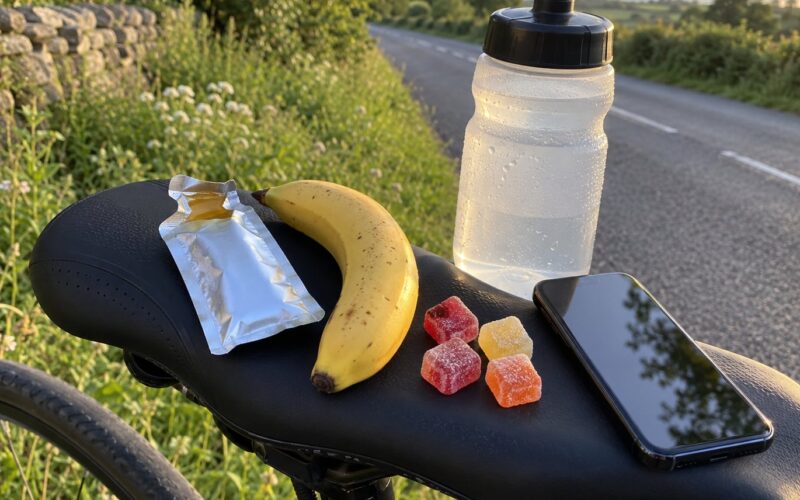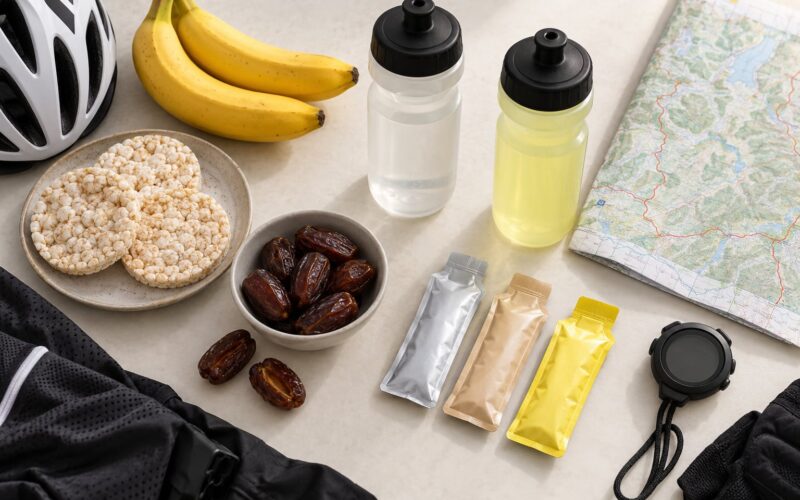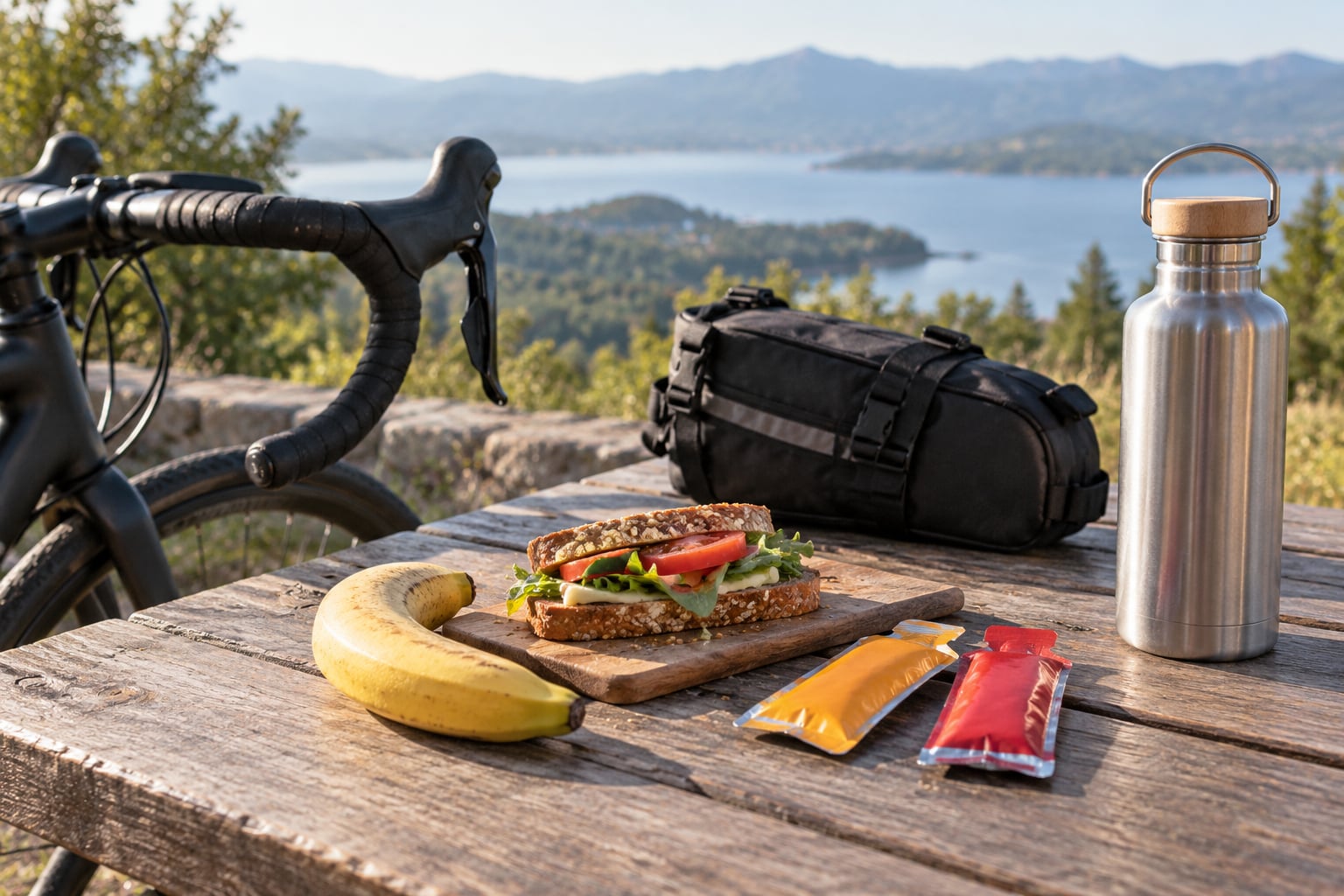
Real food vs gels on long rides is a timing question, not a purity question. Gels are predictable, portable and fast, so they suit racing and hard efforts. Real food fills the stomach, brings sodium and fibre, and costs a fraction as much, so it can carry most of a normal training ride. Riders who finish a century comfortably are usually the ones who use both and switch on purpose.
- Under 90 minutes: your glycogen stores cover it. Ride without fuel.
- 1.5 to 3 hours: aim for 30-60g of carbohydrate per hour, mostly real food or a bar plus drink mix.
- 3 hours and up: 60-90g per hour, and the mix matters more than the quantity.
- Racing or riding above threshold: gels and drink mix, because you cannot chew on a climb at that effort.
- Everything else: real food, staged so the bulky items go in early while you still have an appetite.
The rest of this piece works through where each fuel wins, what it actually costs you in effort and handling, and how to pack it. I have gone back and forth on this argument with riding partners for years, and the honest answer keeps being that a gel is a tool for a specific part of a ride rather than an answer to the whole day.
Table of Contents
- Real Food vs Gels on Long Rides at a Glance
- What Is the Difference Between Real Food and Gels?
- What counts as real food on a bike
- What a gel actually is
- Why the label matters less than the carbohydrate count
- How Do Real Food and Gels Compare for Energy?
- Which Is Easier to Carry and Use on a Long Ride?
- How Do They Affect Digestion and Hydration?
- What Do Real Food and Gels Cost Over a Century?
- Which Should You Choose?
- Short training rides under 90 minutes
- Century rides at moderate effort
- Double centuries and ultra-distance days
- Hot weather riding
- Riders with sensitive stomachs
- When you need fuel between climbs
- Frequently Asked Questions
- Are real foods better than gels for long rides?
- Can I eat a banana and take a gel on the same ride?
- How many calories should I eat during a century ride?
- Do gels provide enough hydration on their own?
- What is easier for riders with sensitive stomachs?
- Should I use real food or gels for a double century?
- What to Do on Your Next Long Ride
Real Food vs Gels on Long Rides at a Glance
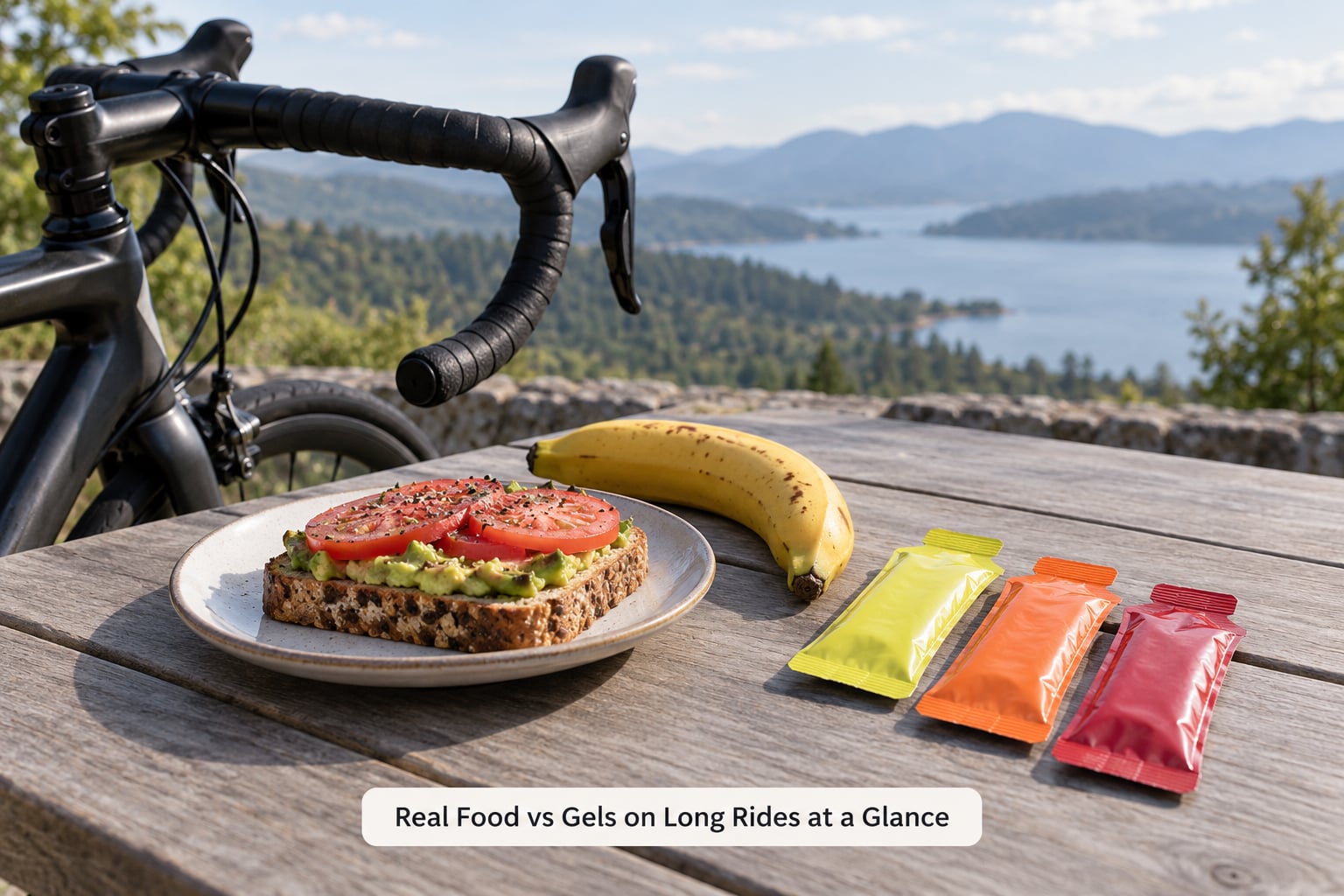
| Criterion | Real food | Energy gels |
|---|---|---|
| Carbohydrate per serving | Roughly 13-27g for a banana, a Medjool date, a couple of rice cakes or a small handful of pretzels | 25-35g per packet |
| How fast it arrives | Slower. Needs chewing, gastric emptying and time to move through | Absorbed within roughly 10-20 minutes, almost no chewing |
| Fibre, fat and micronutrients | Present in meaningful amounts | Almost none. Pure carbohydrate and water |
| Satiety | Real. Takes the edge off hunger for hours | Low. Glucose without gut volume, so hunger often stays |
| Sodium | Useful amounts in pretzels, salted rice cakes and some bars | Very little unless you buy a deliberately salty gel |
| Eating on a climb | Fiddly. Peels, crumbs and one hand on the bars | Easy. Tear, squeeze, swallow |
| Heat and storage | Dates and pretzels cope. Bananas and sandwiches do not | Shelf stable in a foil or plastic pouch |
| Packaging | A reusable bag or a resealable pouch | One wrapper per packet, thrown away on the road |
| Cost per ride | Low. Bought by the bunch and shared across several rides | High per gram of carbohydrate |
| Palatability over eight hours | High variety, so you can rotate | Repeats fast. The seventh packet is where riders quit |
| Best use | Early and mid-ride, easier miles, ultra-distance days | Racing, the final hours, hard efforts, hot conditions |
Read that table row by row and the pattern is clear. Gels are a delivery system with excellent packaging. Real food is a delivery system with volume, variety and a much better cost per gram.
What Is the Difference Between Real Food and Gels?
What counts as real food on a bike
On a bike it means ordinary, shelf-stable, hand-eatable food: dates, bananas, rice cakes, pretzels, boiled potatoes in a tub, fig bars, applesauce pouches, sandwiches made the night before. Nothing exotic and nothing that needs a fork.
That list is not arbitrary. It excludes anything high in fat, because fat slows gastric emptying and slows carbohydrate absorption, and anything high in fibre for the same reason. It also excludes anything that falls apart in a jersey pocket or melts in a saddle bag at 34 degrees.
What a gel actually is
A gel is a thick, water-based syrup of glucose and fructose in a sealed pouch, and most packets carry 25-35g of carbohydrate plus a little sodium. That is genuinely useful energy. It is not a food in the way a sandwich is a food, and it does not pretend to be.
Gels also come in formats that differ in ways that matter: caffeinated versions, ones with added sodium, and ones with 20% or more fructose, which use a second transport pathway in the gut and are easier on some riders than straight glucose.
Why the label matters less than the carbohydrate count
A gel and three rice cakes with honey deliver a similar carbohydrate load. The difference is what comes with it: fibre, sodium, fat, chewing, volume, satiety, packaging and cost. Decide which of those you care about for the ride you are doing.
How Do Real Food and Gels Compare for Energy?
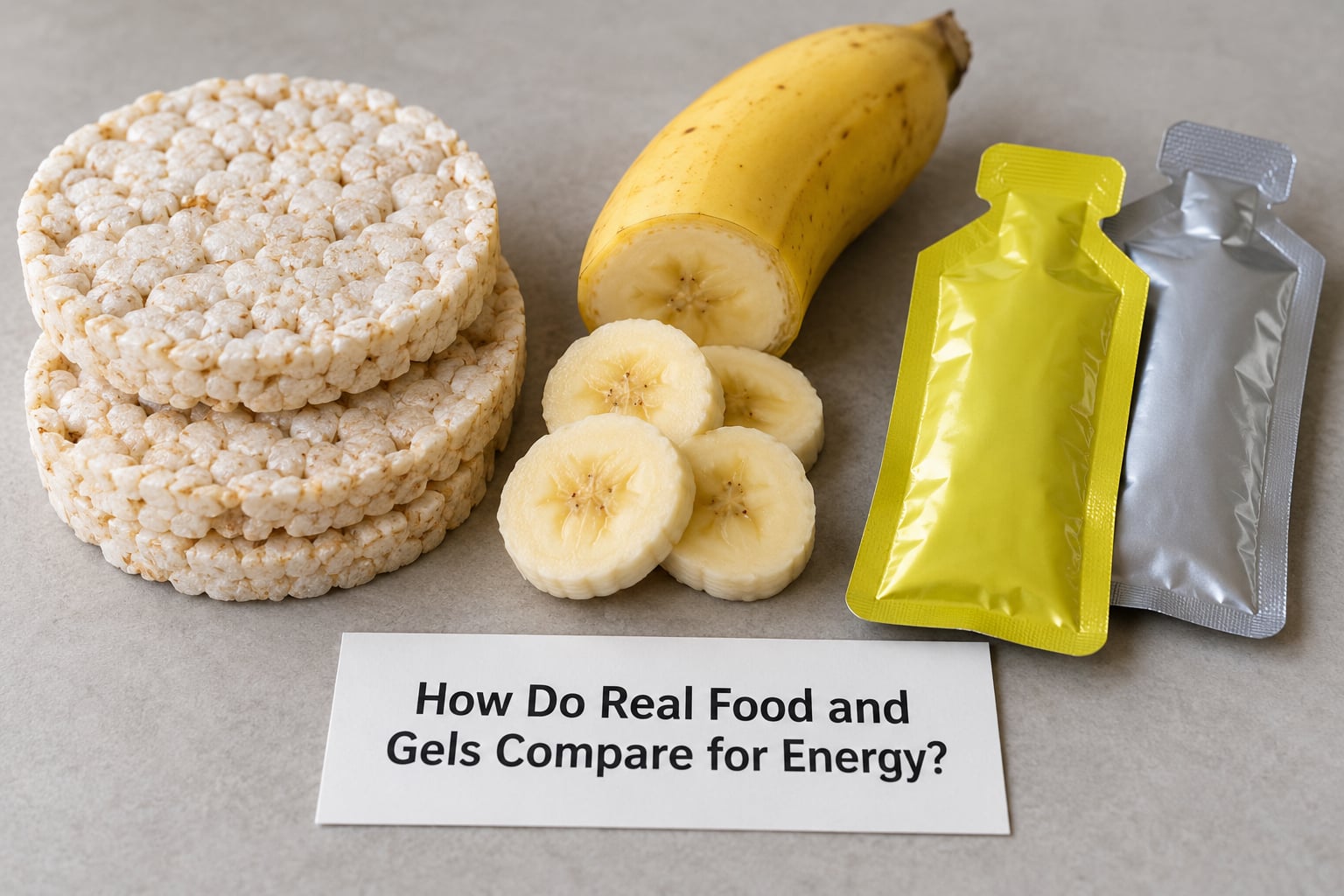
Both fuels work by topping up muscle and liver glycogen and by keeping blood glucose rising as the stores fall. Neither is more efficient than the other. The differences are in speed, density and what else you get.
| Ride duration | Carbohydrate per hour | What usually works |
|---|---|---|
| Under 1 hour | None needed | Water, or nothing at all |
| 1 to 1.5 hours | 20-30g | A banana or half a bar |
| 1.5 to 3 hours | 30-60g | Real food, bars, or drink mix |
| Over 3 hours | 60-90g | Both, staged across the ride |
The ceiling matters more than most riders realise. Your gut can absorb roughly 60g of carbohydrate per hour on single-transportable sugars, which is why glucose-only gels and drink mix run out of headroom. Training the gut can raise that toward 90g per hour, and combining glucose with fructose is what makes that number reachable.
Real food rarely beats gels on raw energy density. Dates are the exception most riders care about: a single Medjool date carries close to 18g of carbohydrate, which is why they show up in almost every long-ride thread. On that contradictory glycemic index question that keeps resurfacing on forums, both camps are half right. Dates have a moderate glycemic index, and what matters for absorption is the total load, not the index in isolation. Two dates beat one for the same reason a big meal beats a small one.
| Real food | Approximate carbohydrate | Equivalent to a 25-35g gel? |
|---|---|---|
| One banana | 27g | Yes, about one packet |
| One Medjool date | 18g | Two dates make a packet |
| Two plain rice cakes | 26g | Yes |
| A small handful of pretzels | Around 25g | Yes, plus sodium |
| One fig bar | Around 22g | Close enough |
| One applesauce pouch | 18-20g | Nearly a packet |
| One tablespoon of honey | 17g | Two tablespoons |
Fat, fibre and volume are where real food wins on energy delivery over a long stretch, not on grams. A sandwich or a bowl of potatoes delivers less carbohydrate per bite than a gel, but it also occupies the stomach, which is what stops the hollow, empty feeling riders describe after an hour of gels.
Which Is Easier to Carry and Use on a Long Ride?
Gels, by a wide margin, and it is not close. A gel pouch is 33-40g, fits flat in a jersey pocket, survives heat, needs no preparation and leaves no crumbs. Twelve of them in a stack is about the volume of a paperback.
Real food needs a system. The best one I have used is simple: a resealable bag or a couple of small zip bags in the rear pocket, with the bulky or messy items at the bottom and the quick-hit items on top. Dates and pretzels go straight in. Bananas need protecting from the bars, the derailleur and your own body heat.
The honest objection to real food mid-ride came up on a CyclingForums thread about gels and Zone 2, and it holds up: trying to eat a banana on a steep climb is awkward, messy, and leaves sticky hands on the bars. Same with a peanut butter sandwich. On the flat and on the descents it is fine. On a 12% ramp it is not, which is why the answer is to eat before you hit the wall rather than during it.
There is also spoilage to think about. On a hot summer century, a sandwich in a jersey pocket is a gamble. Dates, pretzels, rice cakes and shelf-stable pouches are not, which is why they are the ones that actually show up on the bike.
One more practical point: sticky hands and shifting. Date syrup, honey packets and fig bars all get into a glove or a bar tape. So do gels, to be fair, which is a small point in the gels column.
How Do They Affect Digestion and Hydration?
The most common complaint about gel-only fueling is hunger that does not go away. Glucose alone gives you energy, but it does not give the stomach anything to work on, so a rider can eat 60g an hour and still feel as though the tank is empty. Real food fixes that particular problem and creates a different one: fibre and fat slow gastric emptying, so too much solid food in too short a window sits heavy.
Then there is palatability. Gel fatigue is real and it is a calorie problem, not a taste problem. Riders report being unable to face another packet somewhere around hour six, and the hour after that is where the deficit shows up. Rotating real food is the cheapest insurance against that.
Hydration is separate from fuel. Gels contain water, but not nearly enough to count as a drinking plan, and relying on them for fluid is how riders finish a hot ride dehydrated while convinced they stayed on top of it. Drink to your sweat rate, use drink mix for the carbohydrate you cannot stomach as solid food, and treat sodium as a daily number rather than something you chase in the last hour.
None of this is fixed by choosing one fuel over the other. It is fixed by training the gut, which is genuinely trainable, in small steps.
- Start at 30g per hour on a two-hour ride and hold it for two or three weeks.
- Add 15g and go back to a shorter ride until the new number feels ordinary.
- Only add the last 15g on rides longer than three hours.
- Split the increase between glucose and fructose sources, which is what buys the extra absorption capacity.
- Test every new food on a training ride first, never on the day.
What Do Real Food and Gels Cost Over a Century?
Whole-food fueling wins on cost, and not narrowly. The comparison comes down to what a gram of carbohydrate costs you, not to what a packet costs, because a rider doing a 100 mile day is looking at somewhere between 60g and 90g of carbohydrate an hour across seven or eight hours on the bike.
A gel is a manufactured, single-use, individually packaged item bought one at a time. Rice cakes, dates, pretzels and bananas are bought by the bunch or the kilo, and the leftovers come home and get eaten. Across a training block, where the same food is refuelled week after week, that gap is large enough that it changes how you plan a season.
The comparison gets starker the more often you ride long. One packet per hour on a Saturday century is a rounding error. The same pattern across a six-week block of Saturdays is a real line in your budget, and it is the reason many club riders eat real food in training and gels on race day.
There is a cost that is not money. An eight-hour double century at 70g an hour can mean a dozen or more discarded wrappers, and the packaging is the part riders on those forums consistently dislike most about the gel-only approach. Whole food in a reusable bag is close to zero waste. Prices in both categories move and differ by region, so treat the direction as the useful part of the answer rather than any single figure.
Which Should You Choose?
Match the fuel to the ride, and stage it. Here is the short version of how that works for the situations most riders actually care about.
Short training rides under 90 minutes
No in-ride fuel for most riders. Take a banana if you like it, but do not build a system you do not need.
Century rides at moderate effort
Real food carries hours one through four. Dates, rice cakes with honey, pretzels, a sandwich at the halfway point. Add a gel or two in the last two hours, and more if the final third has climbs. That progression is the most widely used pattern in training and it works because early solid food is cheap and keeps the stomach full when you can still eat.
Double centuries and ultra-distance days
Real food dominates, and it is not close. Somewhere between 70g and 90g an hour across ten hours cannot come from packets alone without becoming intolerable. Plan a genuine meal at every aid station you can, plus a handover bag with wraps, boiled potatoes and fruit, and keep gels for the sections where you are working too hard to chew.
Hot weather riding
Heat changes the maths because drinking volume rises and gut comfort falls. Drink mix carries carbs without chewing or swallowing anything solid, which makes it the better option in the heat, while real food stays useful early before the sweat rate climbs.
Riders with sensitive stomachs
Usually gel-based, and usually because gels cause nausea, reflux or bloating when mixed with large volumes of water. Take gels with a smaller sip of plain water, dilute drink mix rather than drinking it strong, and introduce any new real food on an easy training ride. If gels are the problem rather than the solution, plain sugary coffee and rice cakes are the low-fuss middle ground.
When you need fuel between climbs
Gels, every time. On a climb above 10% you cannot chew, you need both hands and you want carbohydrate quickly, which is precisely what a gel is. Save the solid food for the flat and the descent where your hands and your jaw are free.
Frequently Asked Questions
Are real foods better than gels for long rides?
Neither is better in general. Real food gives you fibre, sodium, volume and satiety at a lower cost, so it works well early in a ride. Gels give you 25-35g of carbohydrate fast with no chewing, which matters when you are working hard or climbing. Most riders use solid food for the first half and add gels later.
Can I eat a banana and take a gel on the same ride?
Yes, and plenty of riders do. They are complementary rather than competing. A banana carries about 27g of carbohydrate plus potassium and some fibre, while a gel is faster and more concentrated. Pairing one with the other spreads your intake over both solid and liquid carbohydrate, which many riders find easier on the stomach than either alone.
How many calories should I eat during a century ride?
Work from carbohydrate rather than total calories. A century takes roughly seven hours on the bike, and the practical target is 60-90g of carbohydrate per hour, so somewhere between 400g and 600g across the ride. Riders riding harder can sustain a higher hourly number than riders cruising. Most of that carbohydrate comes from food and drink, not from fat.
Do gels provide enough hydration on their own?
No. A gel pouch holds roughly 30-40ml of water, so even eight over a day is nowhere near what a rider loses to sweat. Treat fueling and drinking as separate jobs. Use plain water and drink mix to hit your sweat rate, and take gels with a small sip rather than a large gulp, since a full stomach of gel and water at once is a common cause of nausea.
What is easier for riders with sensitive stomachs?
It depends on the trigger. If gels cause nausea, reflux or bloating, move toward plain real food with low fat and low fibre, such as rice cakes, pretzels or white bread with honey, and dilute your drink mix. If solid food sits heavily, try gels with small sips of water, or chewables, which release carbohydrate more gradually than a gel.
Should I use real food or gels for a double century?
Mostly real food. Ten hours at 70-90g of carbohydrate per hour is far beyond what packets alone can deliver without becoming intolerable. Plan a proper meal at every aid station, carry a handover bag with wraps, potatoes and fruit, and reserve gels for climbs and the final hours. Taste-test everything in training, and pack backup gels in case your stomach refuses the plan.
What to Do on Your Next Long Ride
Decide the carbohydrate number first, from your expected duration, then choose the food that gets you there with the least fuss. Pack real food for the first two-thirds of the ride, keep enough gels in the pocket for the last third and any climbing, and drink to your sweat rate rather than to your gel count.
Then do the part that actually decides whether this works: run that exact plan on a training ride, at the same intensity, with the same food. A fuel plan that has never been tested is just a hope with a spreadsheet attached.