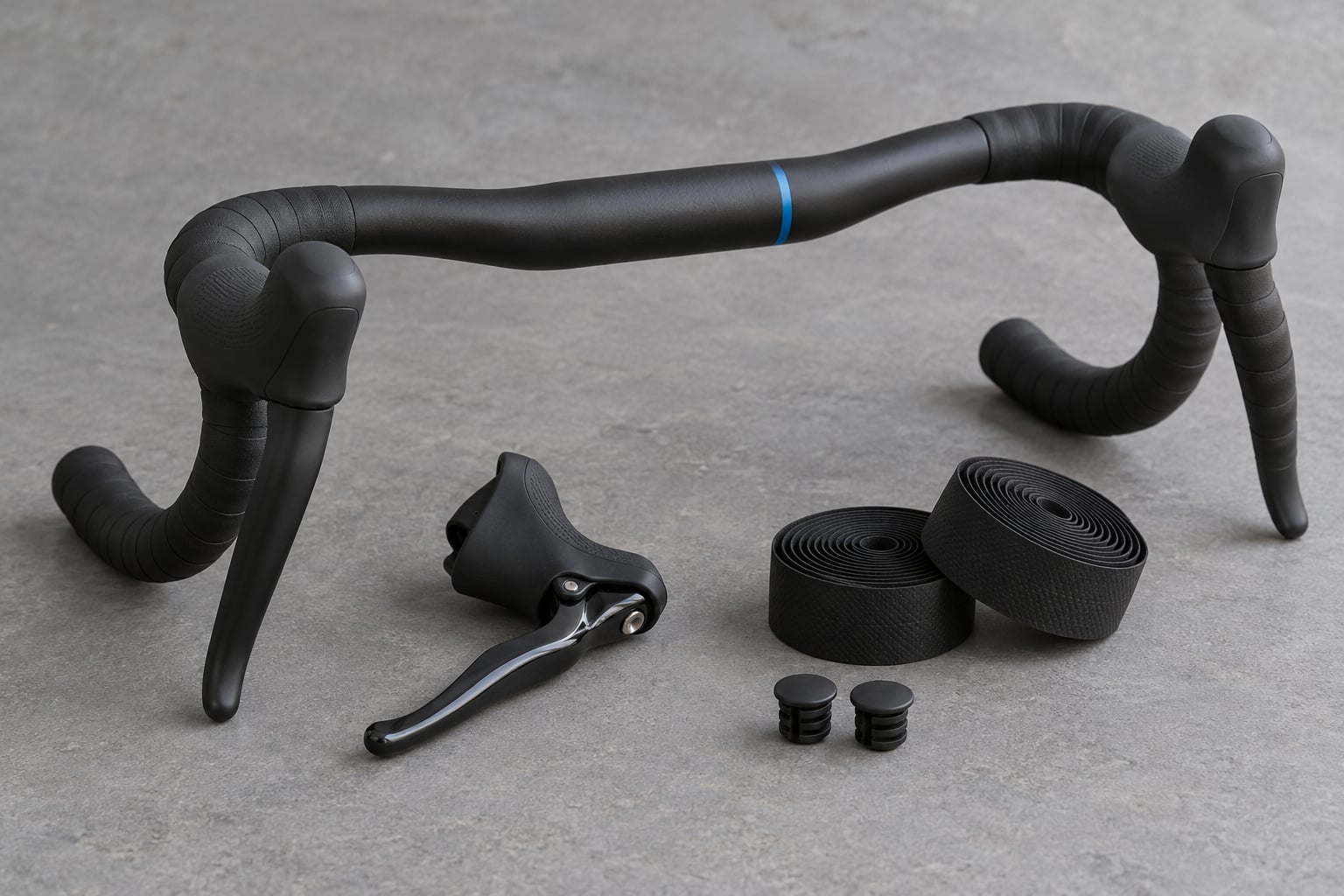
The hoods are the padded tops of your brake levers, where your palms rest while you sit fairly upright. The drops are the curved lower section of the drop handlebar, where you get lower, put more weight on the front wheel and trade visibility and comfort for aerodynamics and steering leverage.
Here is the short version of hoods vs drops hand positions explained for road cyclists: the hoods are your default for most of the ride, and the drops are a tool for specific moments. Get that right and the bar becomes four positions instead of one. Updated for 2026, this guide covers what changes between them, which terrain suits each, and how your own fit decides which one is actually comfortable.
Table of Contents
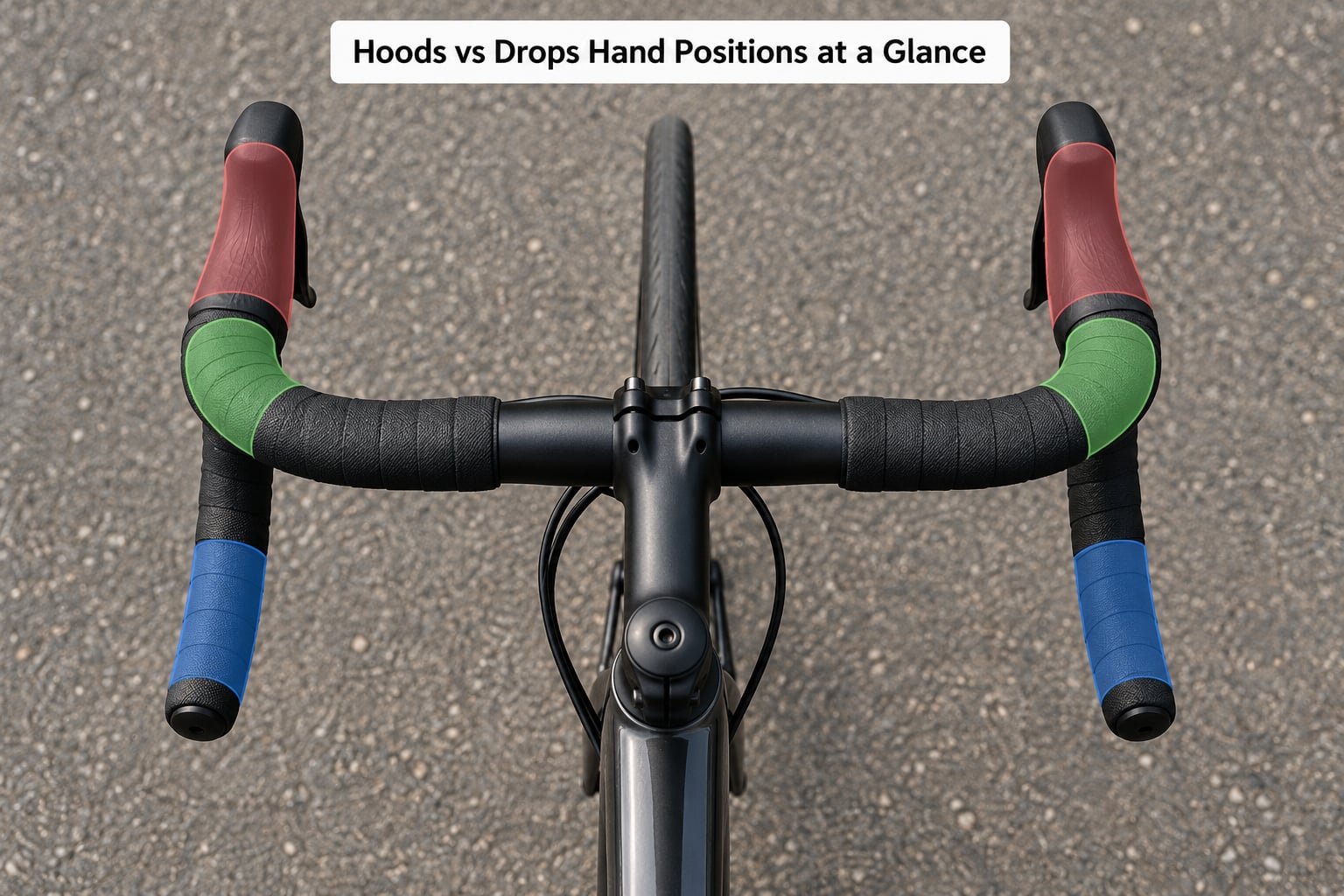
- Hoods vs Drops Hand Positions at a Glance
- What Are Hoods and Drops?
- How Do the Two Hand Positions Feel?
- Hoods vs Drops Hand Positions Explained by Bike Fit
- Which Position Gives Better Control?
- Which Position Is Better for Climbing?
- Which Position Is Better for Descending?
- Are Drop Positions More Aerodynamic?
- How Do Comfort and Injury Risk Compare?
- Can You Switch Between Hoods and Drops?
- Which Should You Choose?
- Frequently Asked Questions
- Should road cyclists spend most of their time on the hoods or drops?
- Are drops always better for aerodynamic drag?
- Why do my hands or fingers go numb on the drops?
- What hand position should I use while descending a steep hill?
- How do I know whether my drops are fitted correctly?
- Can switching hand positions repeatedly cause problems?
- Bottom Line
Hoods vs Drops Hand Positions at a Glance
| Factor | Hoods | Drops |
|---|---|---|
| Body height | Higher, torso more upright | Lower, torso flatter |
| Long-ride comfort | High, wrists supported | Lower, pressure on the palm |
| Steering and control | Calm, predictable at low to medium speed | Quick, direct, best at higher speed |
| Brake access | Fingertips on the lever, instant | One lever under the thumb, slower |
| Aerodynamics | Good when the forearms are flat | Lowest position, front area reduced |
| Climbing | The standard choice | Occasional option on long climbs |
| Descending | Fine at moderate speed | The standard choice at speed |
| Visibility ahead | Full view of traffic and hazards | Head down, less warning time |
| Riders who prefer it | Newcomers, commuters, older riders, anyone training indoors | Riders chasing aero, descending fast, riding in the drops with confidence |
What Are Hoods and Drops?
A drop handlebar is one continuous bar with several places to put your hands. Naming them clearly makes everything else easier, and it stops people mixing up where the hands go with where the brakes are.
- Tops — the flat section of bar either side of the stem. Upright, great for climbing out of the saddle and for riding with hands-free of the levers.
- Ramps — the bend between the tops and the hoods. A transitional grip, and honestly more of a passing place than a place to spend time.
- Brake hoods — the rubber covers on top of the brake/shift levers. This is the main position for most riders.
- Hooks — the forward-facing curve just under the levers, roughly level with the hoods.
- Drops — the lowest, most vertical part of the curve, hanging below the bar.
Brake placement does not move with your hands. The levers stay where they are on the hoods, so braking from the drops means hooking a thumb under the lever blade rather than reaching forward with a fingertip.
How Do the Two Hand Positions Feel?
Moving from the hoods to the drops brings your chest toward the bar and shifts your centre of gravity forward. More of your weight goes through the front wheel, and the bike feels planted and eager to turn.
Your arms change shape too. On the hoods, elbows are usually bent to roughly 90 degrees, which is the reference riders in bike fit forums point to as the comfortable baseline. In the drops your arms straighten and reach outward, which feels powerful at speed and tiring after an hour.
Perceived effort changes too, mostly through your neck and shoulders. A flatter torso takes weight off your lower back and hands, but your neck has to hold your head up against gravity in a position it was not built for.
Hoods vs Drops Hand Positions Explained by Bike Fit
There is no universal best position, because the bar is fitted to you rather than the other way around. Bar width, the reach and drop of the curve, the spacing between the hoods, the stack height and your saddle height all change how the two positions feel.
A deep drop with a long reach may be unreachable for a rider with a short torso, and a rider with tight hamstrings and a low stack may find the drops rotate their shoulders further than they want. Riders moving from flat bars often need weeks, not rides, before the drops stop feeling odd.
If one position feels out of reach, that is a fit conversation before it is a technique conversation.
Which Position Gives Better Control?
The hoods give calmer control; the drops give sharper control. Your weight is more central on the hoods and more forward on the drops, which is why a bike feels planted in the drops and neutral on the hoods.
Steering response follows the same pattern. The drops put you closer to the front axle with more leverage for quick corrections at speed, while the hoods give you a slower, more predictable steering input that suits traffic, rough roads and low speeds.
Neither is automatically safer. What matters is whether you can see the road, know where your brakes are and correct a wobble without panicking. Riders new to drop bars usually build confidence on the hoods first.
Which Position Is Better for Climbing?
The hoods win on climbs, and it is not close. Sitting back on the hoods with elbows bent keeps your shoulders relaxed, your breathing steady and your grip loose, which is what you need when the gradient climbs past 8%.
Out of the saddle, the hoods also give you leverage for rocking the bike side to side to keep the pedals turning. On the drops you can still climb, but you are supporting your upper body with straightened arms for the whole pitch.
Long climbs are the one case where moving down briefly feels good, mostly as a change of pressure. Treat it as a reset rather than a default.
Which Position Is Better for Descending?
The drops are the standard answer for fast descending, because more weight on the front wheel and a lower centre of gravity make the bike settle rather than skate.
Braking access is the trade-off you have to manage. From the drops you brake with a thumb hooked under the lever blade, which is a different movement from the fingertip squeeze you use on the hoods. Practise it before you need it.
On moderate descents at traffic speeds, the hoods are perfectly fine and keep your head up where you can see the junction ahead. There is no prize for being lower than the road requires.
Are Drop Positions More Aerodynamic?
Lower is usually less drag, but the drops are no longer automatically the fastest position. A well-set hand position on the hoods with forearms close to horizontal, elbows bent and a flat back is now understood to be about as quick as the drops, and sometimes quicker, because it keeps the shoulders narrow and the head tucked.
Aerodynamic research and coaching forums have converged on that point: several current setups put the forearms horizontal on the hoods rather than dropping into the curve, since the position is easier to hold and loses very little time. Riders following this approach report matching the drops with less neck and shoulder strain over an hour.
Getting there takes the rest of your geometry working together. Saddle height and setback set how low you can actually get, elbows near 90 degrees keep the front narrow, and a head tucked between the shoulders removes the biggest single source of drag.
How Do Comfort and Injury Risk Compare?
The hoods carry far less load, so most hand problems come from the drops or from a position held for too long. Pressure builds under the ball of the thumb, along the outside of the palm and across the base of the fingers.
Numbness and tingling usually point at the ulnar nerve, which runs through the heel of the hand and is compressed when you grip hard or lean on the drops for hours. Numbness on the hoods instead tends to come from gripping the levers tightly or from a stem that is too short.
Wrist and forearm strain follow the same pattern: on the drops the wrist bends upward and outward to reach the curve, and over time that angle loads the forearm. Angle the hoods roughly 10 to 15 degrees up, the range riders in bike fit forums recommend for most people, and the wrist sits closer to neutral.
Neck and shoulder tension is the drops version of the same complaint, and the fix is posture and duration rather than strength.
Stop and reassess rather than pushing through if numbness lasts more than a few minutes after you change position, if you lose grip strength, or if the discomfort builds ride after ride. Lingering numbness or weakness that does not clear is a reason to see a clinician, and a bike fitter for the setup side of it.
Can You Switch Between Hoods and Drops?
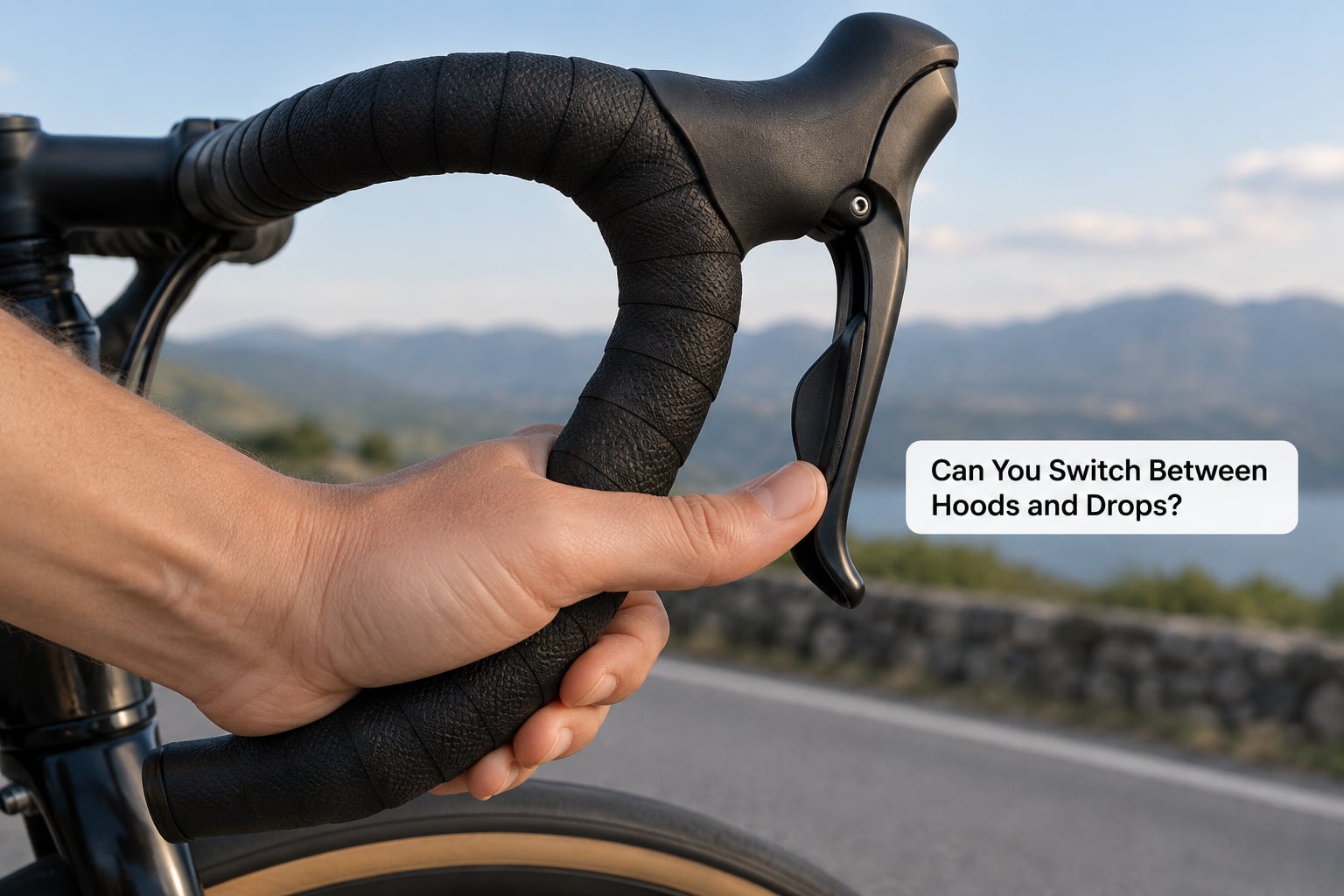
Yes, and doing it well matters more than choosing one position forever. Move between them on a straight, flat, low-traffic stretch, not mid-corner and not while braking.
- Start on the tops with a relaxed grip as you settle into pace.
- Slide forward onto the hoods one side at a time, thumbs resting on the lever bodies.
- Shift your weight slightly back before moving down, so the front wheel is not suddenly loaded.
- Move into the drops by rotating your hands forward and down, thumbs wrapped under the bar, keeping your elbows soft rather than locked.
- To brake from the drops, hook one thumb under the lever blade and pull. Add the second hand for hard braking, but keep the first on the bar.
- Move back up the same way, one side at a time, before you need a turn.
Most riders settle somewhere around three quarters of the ride on the hoods and use the drops for the fast parts. Changing position every 15 to 20 minutes on a long ride is a reasonable habit for keeping pressure moving.
Which Should You Choose?
Choose by rider type and by the ride in front of you, not by which one looks fast in a photograph.
- New to drop bars, commuting, city riding, or riding indoors — hoods are a complete and correct strategy. You can ride every session without ever using the curve.
- Long-distance endurance riding — hoods by default, with the drops as a pressure-relief option.
- Fast club riding and group riding — hoods, because you need your head up to hold your line in a pace line.
- Competitive riders chasing speed on open roads — use both, and test whether the forearms-horizontal hoods position suits you before committing to a deep tuck.
- Riders returning from injury or with limited flexibility — hoods, and get the fit checked before adding the drops.
A quick self-check: from each position, can you see clearly ahead, reach the brakes without lifting your torso, hold the position for 20 minutes without grip fatigue, and stay relaxed at the speed you ride? If any answer is no, that position is not fitted for you yet.
Frequently Asked Questions
Should road cyclists spend most of their time on the hoods or drops?
Most riders should spend the majority of a ride on the brake hoods. They keep your torso higher, your view of the road clear and your wrists supported, which makes them the sensible default for climbing, cruising and group riding. Use the drops for fast descents, sprints and open-road sections where the lower position helps, then move back up when the terrain or traffic asks for it.
Are drops always better for aerodynamic drag?
No. Lower hand position usually reduces frontal area, but current aerodynamic work and pro setups favour forearms close to horizontal on the hoods, with bent elbows and a flat back. That position can match the drops while being far easier to hold for an hour. Judge the two positions on a repeatable time trial rather than on how low you can get.
Why do my hands or fingers go numb on the drops?
Pressure on the heel of the hand compresses the ulnar nerve, which runs through that area, and gripping hard makes it worse. On the hoods, numbness more often comes from squeezing the levers or from a stem that is too short. Angle the hoods up around 10 to 15 degrees, loosen your grip, and if numbness lingers after changing position, get the bike checked and see a clinician.
What hand position should I use while descending a steep hill?
Use the drops for fast, technical descents, since the forward weight and low centre of gravity make the bike settle and turn predictably. Brake with a thumb hooked under the lever blade and add the second hand only when you need more power. On moderate descents at traffic speeds the hoods are fine and keep your head up to read the road ahead.
How do I know whether my drops are fitted correctly?
Signs of good drop fit are that you can hold the position with relaxed shoulders for 20 minutes or more, reach the brake blade with a thumb without lifting your torso, and keep a neutral wrist. Signs of poor fit are tingling within 30 minutes, shoulders rising near your ears, or feeling like you are hanging off the bar. Bar reach, drop depth and saddle height all change the answer.
Can switching hand positions repeatedly cause problems?
No. Moving between the hoods and drops often is good practice, because it spreads pressure across different parts of the hand and reduces fatigue on long rides. What causes trouble is moving abruptly while cornering, braking hard or riding one position for hours without relief. Make transitions on straight, flat sections with the pedals roughly level.
Bottom Line
The hoods are where most of your ride belongs, and the drops are where you go when the road, your speed or your training demands a lower, firmer, more aerodynamic position. Modern evidence suggests a well-set position on the hoods with horizontal forearms can match the drops, so the drops are worth learning rather than obligatory.
Your first move is simple: on your next ride out, run a familiar loop twice, once almost entirely on the hoods and once with regular drops on the descents and fast sections. Note which position leaves your hands comfortable, your view clear and your brakes easy to reach, then keep the drops only once that is true.