If you are searching for how long does it take to ride 100 miles on a bike, the honest answer is that most trained recreational cyclists need 5 to 7 hours of riding time, or 6 to 8 hours once rest stops are added. A well-trained club rider can go under 5 hours. A genuine beginner on a first attempt should budget a full 9 or 10 hours.
A 100-mile ride is called a century, which is 161 km, and it sits somewhere between a hard half-century and an amateur marathon in effort. Events like Bike to the Beach, the Wildflower Century and Bike Ride Across Georgia are built around it, as is the 430-mile RAAM stage race.
Table of Contents
- How Long Does It Take to Ride 100 Miles on a Bike?
- Realistic 100-Mile Cycling Times by Rider Level
- How to Estimate Your Own 100-Mile Ride Time
- What Changes the Time for a 100-Mile Ride?
- How to Pace a Century So It Feels Manageable
- Training for a 100-Mile Ride
- Frequently Asked Questions
- How long does it usually take to bike 100 miles?
- How long does it take the average person to cycle 100 miles?
- Can you cycle 100 miles without training?
- Is riding 100 miles on a bike hard?
- How long does it take to train for a 100 mile bike ride?
- How long does a 100 mile bike ride take with stops?
- Conclusion
How Long Does It Take to Ride 100 Miles on a Bike?
The short answer: 5 to 7 hours of riding time for most recreational riders, 6 to 8 hours from start to finish including stops. Anyone holding 18 mph or better for 100 miles is riding in under 5.5 hours, and anyone under 13 mph is looking at 8 hours of saddle time.
Two numbers matter, and confusing them is the most common mistake in planning. Moving time counts only the hours your wheels are turning. Elapsed time counts everything from the moment you roll out to the moment you stop, so rest stops, aid stations, mechanicals and the group that decides to stop at the bakery all count.
On a well-run organized century you might add 30 to 60 minutes of stops. On a self-supported route where you are hunting for water and fixing your own punctures, 90 minutes is realistic. One CycleChat regular plans every 100 miler at 7 hours 40 minutes, which is 6 hours 40 of moving time at 15 mph plus a flat hour of stops. That planning discipline is the whole trick.
Here is the conversion nobody else publishes cleanly. Take your realistic average speed, find it in the table, and you have your riding time before you leave the house.
| Average speed (mph) | Riding time for 100 miles | Typical rider who rides here |
|---|---|---|
| 10 | 10 hours 00 min | Very occasional rider on a heavy touring bike |
| 12 | 8 hours 20 min | Beginner with a fitness base, flat routes only |
| 14 | 7 hours 10 min | Steady weekend rider, most charity centuries |
| 15 | 6 hours 40 min | Regular recreational club rider |
| 16 | 6 hours 15 min | Comfortable hilly-route rider |
| 17 | 5 hours 53 min | Fitter club rider on rolling terrain |
| 18 | 5 hours 33 min | Experienced club rider, gran fondo pace |
| 19 | 5 hours 16 min | Trained amateur chasing a personal best |
| 20 | 5 hours 00 min | Well-trained rider on flat, calm roads |
| 22 | 4 hours 33 min | Racing-fit amateur and serious gran fondists |
| 24 | 4 hours 10 min | Racing only, in a supported group |
Reverse it if you have a target time instead. Finish in 5 hours means 20 mph flat out. Finish in 6 hours means 16.7 mph. Finish in 7 hours means 14.3 mph. Every extra mph you can hold saves about 20 to 25 minutes across 100 miles, which is why small fitness gains show up so clearly in a century time.
Realistic 100-Mile Cycling Times by Rider Level
These are practical estimates built from logged ride data and rider reports, not fitness guarantees. Your age matters far less than your current weekly mileage and how the route is built.
| Rider level | Example speed | Moving time | Elapsed with stops | Who fits this band |
|---|---|---|---|---|
| First-timer, little riding background | 11 to 13 mph | 7 hours 40 min to 9 hours | 8 hours 30 min to 10 hours | Weekend rider who normally does 20 to 30 miles |
| Casual recreational rider | 13 to 15 mph | 6 hours 40 min to 7 hours 40 min | 7 hours 30 min to 8 hours 30 min | Rides two or three times a week, comfortable past 50 miles |
| Regular club rider | 16 to 18 mph | 5 hours 33 min to 6 hours 15 min | 6 hours 15 min to 7 hours | Organized group rides most weekends, handles 2,000 feet of climbing |
| Experienced trained rider | 19 to 21 mph | 4 hours 46 min to 5 hours 16 min | 5 hours 30 min to 6 hours | Trains with a plan, may already have a century under 5 hours 30 |
| Racing-fit amateur | 22 mph and up | under 4 hours 33 min | 5 hours or less | Racing, fast group rides, one Facebook rider reports a 6 hour 2 minute century PR |
One useful readiness test circulates among experienced riders: if you can comfortably ride 40 miles in 2.5 hours, a century is realistic. That comes out to 16 mph, which is a solid mid-range century pace. TrainerRoad forum regulars put the same idea differently, describing 100 miles as a 5 to 7 hour effort that needs real conditioning and time on the bike.
Watch the slow tail. One CycleChat rider finished 100 miles with his father in 12 hours, including two punctures and an unscheduled stop in the middle of nowhere. Days like that happen, and they are why nobody should book a tight evening flight after a century.
How to Estimate Your Own 100-Mile Ride Time
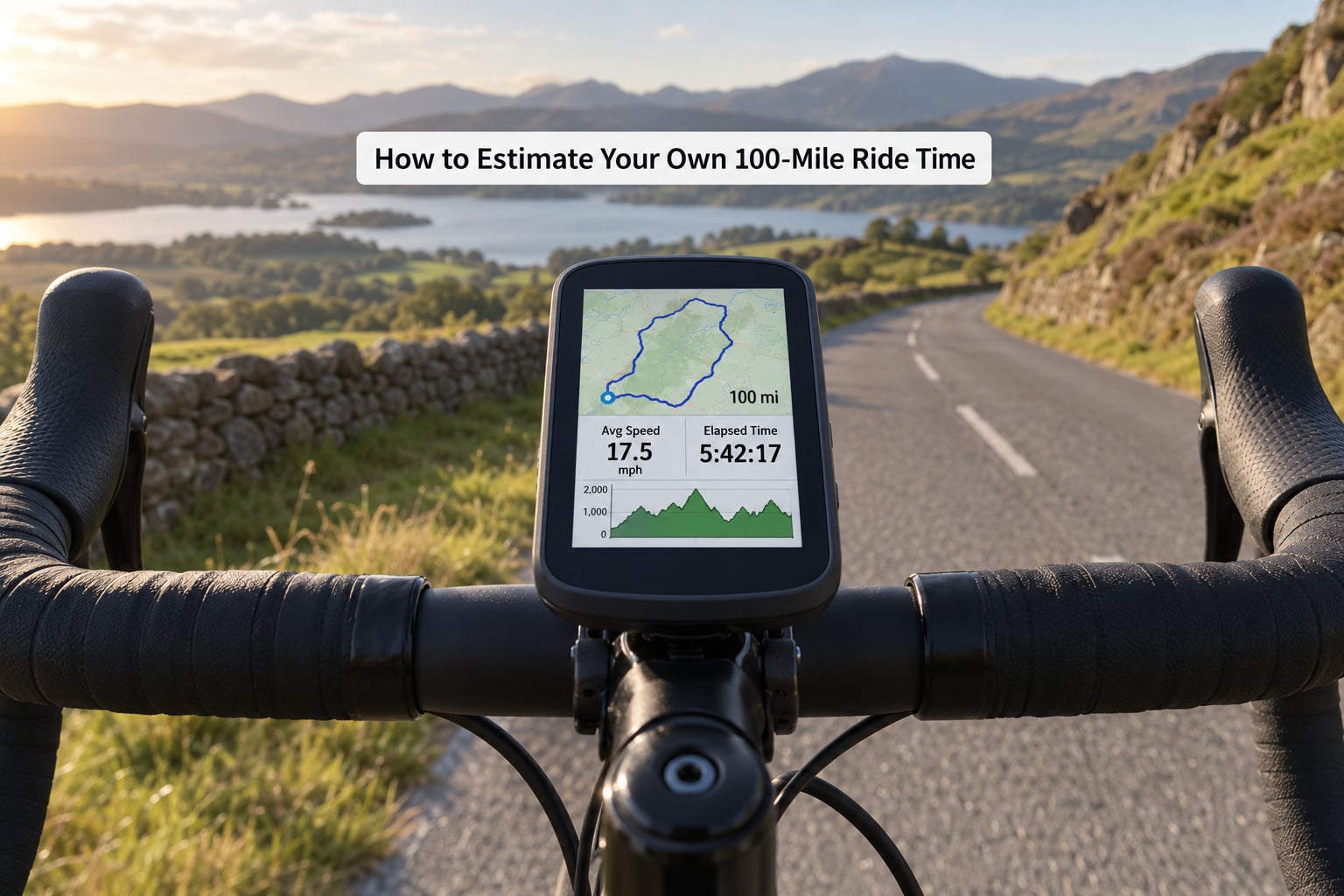
Work in this order. It takes five minutes and beats guessing every time.
- Find your honest average speed. Take your last three long rides, not your sprint best. Use the moving-time average from your bike computer or Strava. If you ride flat rides mostly, add 1 mph for hills. If you are a strong climber, subtract 1 mph instead.
- Divide 100 by that number. That is your moving time. RideWithGPS and Strava both project a ride time for a mapped route, and the estimate is usually within a few percent once the elevation profile is included.
- Add the terrain penalty. Use the table below. Rolling terrain costs about 10 percent, sustained hills cost 20 to 30 percent, and a serious headwind on an exposed route costs another 10 to 20 percent.
- Add your stops deliberately. Budget 5 to 10 minutes for each food or water stop, plus one 15 to 20 minute rest stop roughly halfway. On a supported event with feed zones, that drops to 20 or 30 minutes total.
- Add contingency. Ten percent for a mechanical, a wrong turn, or a headwind you did not forecast. This is the number that keeps a 6 hour plan from turning into a 9 hour day.
Worked example. A rider with a 16 mph moving average on a route with 3,500 feet of climbing, two planned stops and one open water stop:
- Moving time at 16 mph: 6 hours 15 min
- Hilly terrain penalty, about 12 percent: 45 min
- Two planned stops, 10 minutes each: 20 min
- Contingency: 30 min
- Realistic elapsed finish: about 7 hours 50 min
Now take that final number and turn it into a start time. If the century rolls at 7:00 am and you expect to finish around 2:50 pm, you are done with enough daylight left for the drive home and a recovery meal that you will actually want to eat.
What Changes the Time for a 100-Mile Ride?
Distance alone predicts very little. Terrain, weather and how you spend your energy decide the difference between a 5 hour day and a 9 hour day.
| Condition | Effect on riding time | What it looks like |
|---|---|---|
| Flat, calm, tailwind | Baseline | Paved, low-traffic roads, no wind |
| Rolling terrain, 1,000 to 2,000 feet | Add 5 to 10 percent | Short rollers, you never really get a break |
| Hilly, 3,000 to 5,000 feet | Add 15 to 30 percent | Sustained climbs, descents you cannot use for speed |
| Tailwind, 15 mph or more | Subtract 5 to 10 percent | Fast paved sections, the ride feels short |
| Headwind, 15 mph or more on an exposed road | Add 10 to 20 percent | Constant grinding, a tailwind turns into a fight |
| Heat above 85 F with high humidity | Add 10 to 15 percent, risk of cooling stops | Slower pace, more time at the water bottle |
| Supported group ride with drafting | Subtract 10 to 20 percent | Rotating pace lines, fewer personal slow patches |
| Solo on open roads with traffic | Add 5 to 10 percent | Red lights, narrow lanes, no wheel to follow |
Then there are the things that do not show up in a map. Starting too fast costs more than it looks: the riders who blow up at mile 85 usually rode their first hour faster than they rode their fifth. Hitting a puncture costs 20 to 30 minutes if you carry a spare tube and 45 minutes or more if you do not. And a group that stops every 20 miles for a bakery adds up fast, because every stop is 5 minutes of standing around plus the 30 seconds to get rolling again.
Bike type shifts the numbers too. A gravel bike at 14 mph takes longer than a road bike at 18 mph on the same loop. An e-bike with a 20 mph assisted top speed can turn a 7 hour day into a 5 hour one, and support riders use them to carry gear rather than to race. A recumbent sits in the same speed band as a road bike but with none of the saddle pressure that ends some rides early.
How to Pace a Century So It Feels Manageable
The goal on a first century is not a fast time. It is a ride you can describe without drama, and that takes even pacing rather than effort.
Start slower than feels right. The first hour should feel almost too easy, because the last 20 miles are ridden on whatever you saved. A rider who starts at 19 mph and drops to 13 mph usually finishes slower than one who holds 16 the whole way. Even effort beats fast starts, and it is the single biggest predictor of a good century time.
Hold a cadence you can sustain rather than chasing speed. Somewhere around 80 to 90 rpm on the flats and a comfortable gear on the climbs keeps your heart rate steady and burns far less than grinding up in a low gear at a sprint pace.
Plan the stops before you roll, and stick to them. A support car or a supported ride changes the calculus entirely because it removes the fear of running dry at mile 80. On a self-supported century, plan water and food every 25 to 30 miles and know where the next town is.
Fuel on a schedule, not on hunger. Start eating at 30 minutes and take in 60 to 90 grams of carbohydrate an hour, which is a banana, a couple of gels, a bag of chews, or most of a sandwich. On the r/cycling threads about 100-mile pacing, riders describe stored glycogen lasting roughly two hours or about 35 miles, which is exactly why the bonk hits when it does. Drink to a plan as well, adding electrolytes if you are out for more than two hours in the heat.
Save something for the end. If you are still able to hold your pace at mile 90, you paced correctly. Riders who empty the tank in the first 60 miles discover a different, unpleasant version of the last 20.
Training for a 100-Mile Ride
How long you need to train depends almost entirely on what you ride now. The rule experienced riders use is simple: your long ride should reach about 80 percent of century distance roughly two to three weeks before the event.
| Current weekly mileage | Lead time | What the block looks like |
|---|---|---|
| Under 20 miles a week | 16 weeks | Build to 40 to 50 miles on the weekend ride before the distance ever matters |
| 20 to 40 miles a week | 12 weeks | Long rides every weekend, adding about 30 minutes each week, with a recovery week every fourth week |
| 40 to 60 miles a week | 8 to 10 weeks | One long ride of 60 to 80 miles, one steady aerobic ride, one harder effort session |
| 60 miles a week or more | 4 to 6 weeks | Longer rides, back-to-back days, and a dress rehearsal on the actual route |
Add some climbing if your route has it, because hills at mile 70 hurt differently from hills at mile 15. Rehearse your fueling on every long ride so that eating a gel at hour four is automatic rather than a fight. And test your equipment: a saddle that works for 40 miles can be a problem by hour six, which is the most common physical complaint riders report in forums.
If you are starting from a sedentary baseline, or you have a health condition, a conversation with a clinician before committing to a 7 hour day is the sensible move. Nothing here is medical advice, it is planning advice.
Frequently Asked Questions
How long does it usually take to bike 100 miles?
For most trained recreational cyclists, 100 miles takes 5 to 7 hours of riding time, or 6 to 8 hours including rest stops. Club riders who hold 18 mph finish in around 5 hours 33 of moving time. Beginners at 12 mph should plan on a 10 hour day. Check the mph-to-time table above to match your own average speed.
How long does it take the average person to cycle 100 miles?
The useful measure is your current average speed, not your age or your gym fitness. Someone riding 15 mph for 50 miles every weekend will finish 100 miles in about 6 hours 40 of moving time. Someone riding 40 miles a week can expect closer to 8. Doubling your usual long ride roughly doubles the time, minus the small efficiency gain.
Can you cycle 100 miles without training?
You can finish it, but it will be slower than you expect and much harder than the numbers suggest. Riders who jump from 50 miles of recent riding to a century usually need 9 to 10 hours and bonk somewhere past mile 60. The widely used readiness test is simple: if you can comfortably ride 40 miles in 2.5 hours, a century is realistic with a sensible stop.
Is riding 100 miles on a bike hard?
Harder than most riders expect, mostly because of duration rather than distance. The effort is moderate in the first two hours and climbs steadily from there. The difficulty is more about seven hours in the saddle, chafing, saddle pressure and depleted glycogen than about any single hill. A fit rider cruising at 18 mph will tell you it was fine.
How long does it take to train for a 100 mile bike ride?
Eight to 16 weeks is the realistic range, and where you start inside that range depends on weekly mileage. Under 20 miles a week, plan 16 weeks. At 40 to 60 miles a week, 8 to 10 weeks is enough. Aim for a long ride reaching about 80 percent of century distance two to three weeks out, then taper so the event is your biggest effort of the season.
How long does a 100 mile bike ride take with stops?
Stops typically add 30 to 60 minutes on a well-run organized event with feed zones, and 60 to 90 minutes on a self-supported route. Budget 5 to 10 minutes per food or water stop plus one longer rest around the halfway mark. A rider planning 6 hours 40 of moving time at 15 mph should expect to cross the finish line near 7 hours 40.
Conclusion
A 100-mile ride takes most trained recreational cyclists 5 to 7 hours of riding time, or 6 to 8 hours from start to finish. Everything else on this page is a modifier on that number.
Do three things this week. Pull your moving-time average from your last three long rides and read your finish time off the table. Pick a route whose elevation profile you can actually handle rather than the one that looks nicest on paper. Then add your planned stops, your terrain penalty and ten percent for the unknown before you set a finish time, and protect the last 20 miles by starting slower than feels right.