Most group ride mistakes come down to one idea: riding as if you are alone. Holding too little space, braking late, drifting sideways without a word, or surging on a climb turns a calm bunch of riders into a chain reaction. Below are 14 group ride mistakes to avoid, each with the risk it creates and a fix you can use on your next club ride.
I ride with a club that mixes first-timers, roadies who have raced, and a few e-bike owners who show up on the same Saturday loop. Almost every mess I have seen on a ride traces back to a small, fixable habit rather than bad intentions. Updated for 2026, this is the checklist we go through before we roll.
Table of Contents
- Group Ride Mistakes to Avoid at a Glance
- 1. Group Ride Mistakes to Avoid: Losing Safe Wheel Spacing
- The one-bike-length rule
- 2. Overlapping Wheels During a Paceline
- 3. Sitting Up Too Early or Too Late
- 4. Using Unclear or Late Hand Signals
- The signals every club ride agrees on
- 5. Holding a Line That Does Not Match the Group
- 6. Drafting Without Leaving an Escape Route
- Beginner drills that prevent group ride mistakes
- 7. Sudden Braking in the Middle of the Group
- 8. Ignoring Crosswinds and Changing Drafts
- 9. Riding Faster Than the Slowest Rider
- 10. Choosing a Draft That Is Too Large
- 11. Starting Every Climb at Maximum Effort
- 12. Ignoring Mechanical Problems Until the Group Stops
- 13. Leaving the Route or Event Plan Unclear
- 14. Neglecting Hydration, Nutrition, and Cold or Heat Stress
- Frequently Asked Questions
- What is the safest distance to ride behind another cyclist?
- Should experienced riders always take the front of a paceline?
- How do hand signals work in a fast group ride?
- What should a rider do when the group starts running too fast?
- How can beginners avoid making mistakes when taking a draft?
- Where should a group regroup after traffic lights or a mechanical problem?
- What to Do First on Your Next Group Ride
Group Ride Mistakes to Avoid at a Glance
| Mistake | Why it hurts | Quick fix | Where it bites hardest |
|---|---|---|---|
| Riding too close to the wheel ahead | No escape space if the rider in front swerves or brakes | One to two bike lengths, minimum half on descents | Pinch turns and wet roads |
| Overlapping wheels | Front tire brushes the lead bike under pressure | Follow the rear tire, not the rider’s hips | Sprints, headwinds, crowding |
| Sitting up too early or too late | Gap opens or closes without warning | Read the wheel ahead, hold the gap you can see | Rolling terrain and pace changes |
| Late or unclear hand signals | Hazard reaches the back rider too late to act | Signal early, loudly, and repeat the call back | Gravel, glass, potholes, cars |
| Holding a line that splits the group | Everyone behind has to react at once | Match the group’s line unless you call a hazard | Debris, wind shifts, lane hazards |
| Drafting with no escape route | Last-second moves cause wheels to cross | Signal, wait for space, follow the rider ahead | Moving up through the bunch |
| Sudden braking mid-group | The accordion effect turns one stop into a pileup | Scan ahead, call it, downshift, brake smoothly | Traffic lights and unexpected stops |
| Ignoring crosswinds | Sudden gusts pull bikes into each other | Drop the shoulders, wait for a calmer line | Open roads and bridges |
| Riding faster than the slowest rider | Gaps grow, everyone fatigues, regrouping is frantic | Pace to the group, not to your ego | Social rides and the back row |
| Taking a draft that is too large | Sudden surge or exit at high speed | Stay small unless the front gap is safe | Sprint finish lines and bridges |
| Attacking every climb | Surge, fade, drop riders, frantic chase back | Start at a pace the middle of the group can hold | Hill repeats and rollers |
| Ignoring mechanicals until the group stops | Long roadside waits for everyone | Signal early, move aside, ride your own fix | Rear wheel punctures and rub brakes |
| Unclear route or event plan | Missed turns split the ride into chaos | Review the route and regroup points before rolling | Unknown routes and rest stops |
| Skipping food, water, and temperature checks | Bonking, cramping, and cold or heat distress | Fuel on a timer and drink before you are thirsty | Long rides, summer heat, winter starts |
1. Group Ride Mistakes to Avoid: Losing Safe Wheel Spacing
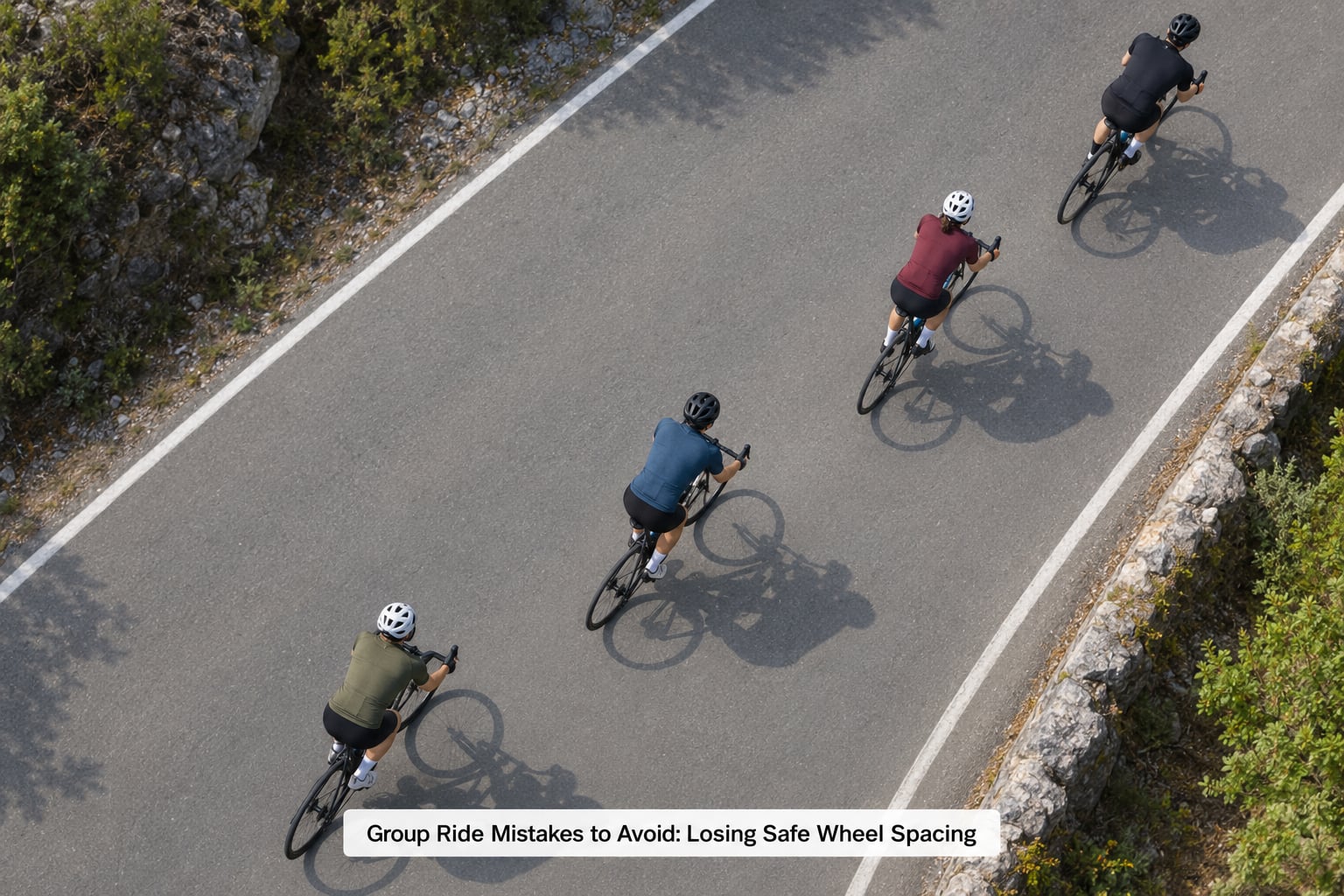
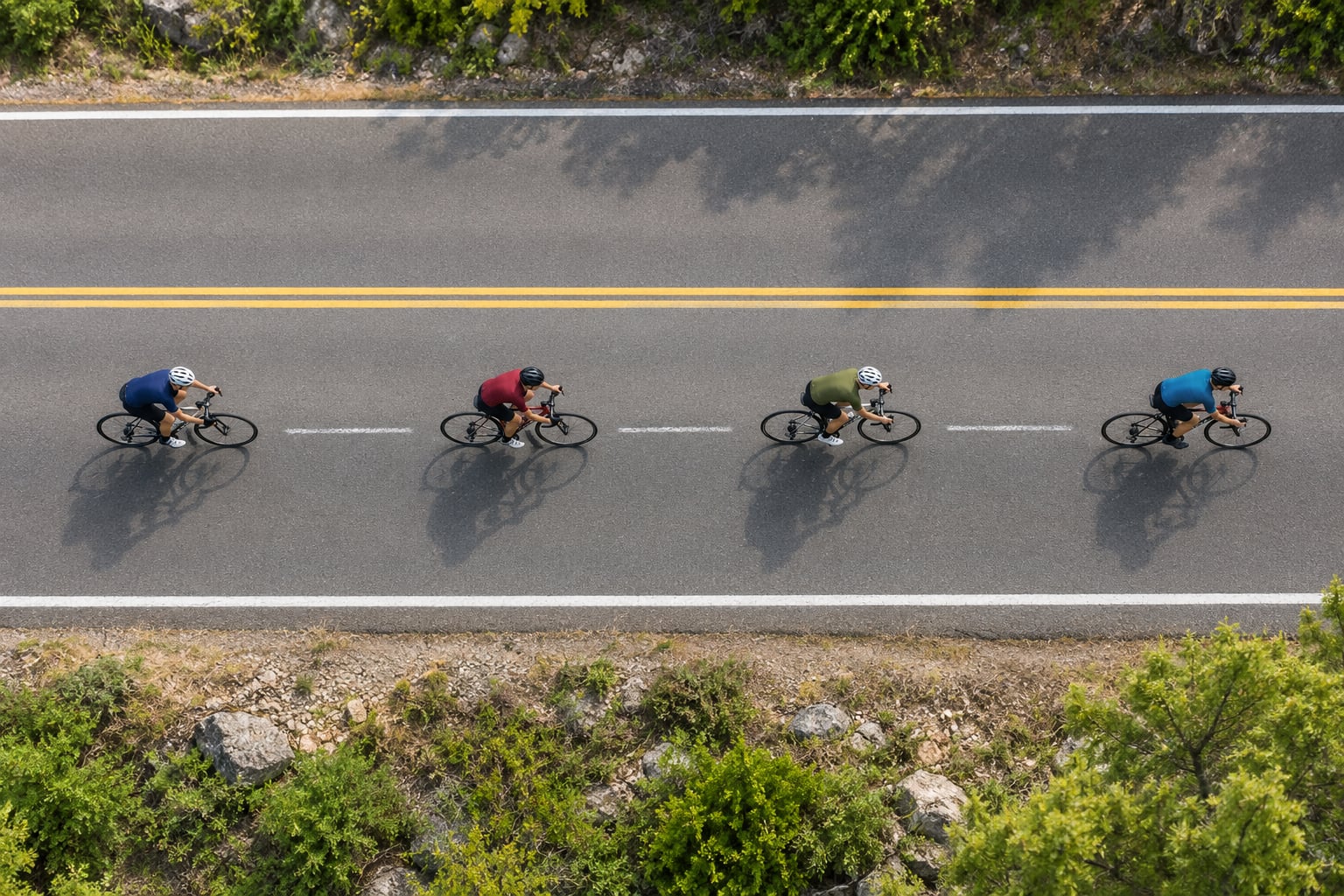
Spacing is the single biggest lever you control. Sit one to two bike lengths behind the rider ahead on the flat, and at least half a bike length when you are descending or riding in bunched conditions.
The one-bike-length rule
Why the gap matters: the rider in front needs room to react. If their tire blows or a car door opens in their line, they have one bike length to move. You need the same room yourself, and you only get it if the person behind you also left it.
Think of the group as an articulated truck. The rider in front steers, and everything behind follows. That works when everyone leaves a gap; it fails the second somebody crowds, and the accordion effect starts moving riders forward one at a time.
On a recent club ride on a wet road into the headwind, one rider tucked in tight behind a friend. A truck passed close and the friend moved left. The tight wheel went down, and two more bikes went with it. Nobody was riding badly on purpose. The gap was simply too small to absorb a surprise.
The practical test: if you cannot see the road surface between the two bikes, you are too close. That view is your early warning for debris, glass, and water.
2. Overlapping Wheels During a Paceline
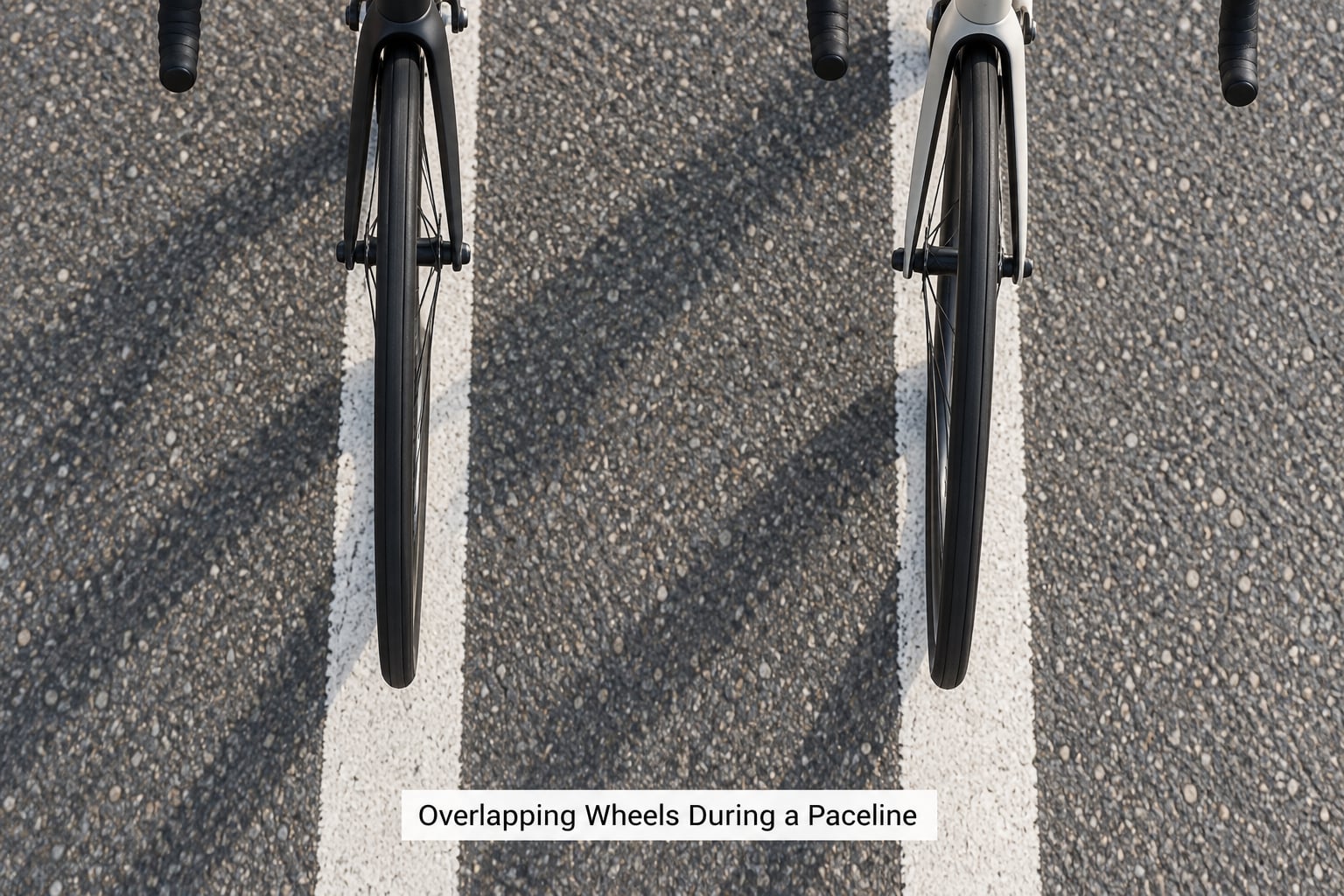
Wheel overlap means your front tire travels through the same patch of road as the rear tire of the bike ahead. It feels fast and efficient, and it is the most common cause of wheels touching in a paceline.
Here is the reason people overlap: they aim at the rider’s back or hips instead of the rear tire. Aim at the tire, and the geometry holds you in the sweet spot automatically. When you aim high, every small wobble gets amplified into overlap.
Overlap becomes dangerous the moment pressure arrives. In a crosswind, on a rise, or under braking, the rear wheel ahead moves slightly and your tire catches it. Riders call this a kickback, and it is how a small wobble becomes a group crash.
The situations that demand extra distance: fast descents, a bunch of more than eight riders, wet pavement, and any time the group compresses after a stop. In those moments, back off a bike length even if it feels like losing time.
To move out and forward safely, ease off the pedal, signal a move, drift up alongside the wheel ahead of you rather than through it, and settle into the gap that opens. That is the difference between moving up and barging through.
3. Sitting Up Too Early or Too Late
Sitting up too early opens a gap the rider behind has to close at speed. Sitting up too late means you are effectively drafting with no escape space, which is the overlap problem wearing a different hat.
Rather than guessing the distance from how the group feels, read the bicycle ahead of you. Watch the gap between that rider’s rear wheel and the road, and match it. When the group stretches, hold the stretch. When it compresses, ease off the saddle a touch.
Staring at the rear wheel is a habit worth breaking early. It fixes your gaze on the one part of the road where problems appear latest. Look at the road surface, then up at the shoulders of the riders ahead, so you see the group and the road at the same time.
Rolling terrain is where spacing judgment gets tested, because the gap changes constantly without anyone signalling. As the road tips downhill, the rider ahead accelerates out of sight and you close up quickly. As it tips back uphill, they slow and you drift into a gap you did not plan. Good riders manage this by watching the road rather than the rider, and by accepting that their gap will breathe.
One more thing worth adding to your pre-ride preparation: if you are new to holding a wheel, tell the person you plan to follow. A simple agreement, follow my wheel at about this distance and call it if I move, removes most of the anxiety that leads to sudden braking.
4. Using Unclear or Late Hand Signals
Signals only work if everyone means the same thing by them. The vocabulary is short, and clubs settle on a version at the pre-ride briefing.
The signals every club ride agrees on
- Car back called and pointed down the road, so the warning travels to the back.
- Slowing with an open palm, then a voice call if anyone is still out of position.
- Stopping with a flat hand held up, so riders behind get a chance to unweight their bikes.
- Hazard on the road pointed at, then down toward the offending spot.
- Pointing down and swiping for gravel, sand, glass, or a pothole.
- Rolling down or pulling off with a thumb toward the shoulder.
- Going to the bathroom announced early, not as a surprise stop in the lane.
Timing matters more than the gesture itself. A gravel warning called two seconds before the hazard does nothing for the rider four bikes back. Call it early, loud enough to carry, and point with your hand so the message has a direction.
Concrete example: on a recent ride a rider spotted fresh gravel across the lane and passed silently through the middle of the bunch. Four riders behind swerved at once. The group had agreed on the swipe-down call, and a hand signal would have given everyone the two seconds they needed.
Verbal calls matter as much as hand signals, because a hand gesture disappears behind a body. Use both, and have the group agree that anyone who hears the call repeats it. That repetition is what makes the warning reach the last row.
5. Holding a Line That Does Not Match the Group
Holding your line means riding predictably where the group is going. It becomes a mistake when you drift sideways without telling anyone, because the riders behind you inherit your movement without knowing why.
The safe version of moving across the bunch: call the hazard first, move at the speed of the road, and rejoin where the group is already heading. Riders on the wheel ahead should not have to change their line to avoid you.
There is a recognised exception in cycling groups, and it is worth knowing because it looks like breaking the rule. Many riders use a slight, deliberate drift toward the side of the hazard, called tire brushing, to communicate without turning their head or shouting. It only works if the group has agreed on it in advance.
Debris on the road, a lane split at a junction, and a sudden crosswind shift all call for the same response: point, call, and move together.
6. Drafting Without Leaving an Escape Route
Drafting is the point of a group ride, but you can only draft safely if you could get out of the slipstream in a second. No escape space means the gust hits you sideways with nowhere to move.
Three habits cause most of this. Entering the slipstream too abruptly, so the group leader feels you arrive. Overlapping the draft, so the front wheel sits in the turbulent air behind the front wheel rather than the clean zone behind the hips. And last-second moves, where a rider crosses three lanes of riders to reach a wheel just as it accelerates.
The fix is a three-step habit: signal your intention, wait until the space ahead of you is clear, and follow the rider already in that position rather than cutting to the front. When the line changes, go early and slowly instead of late and fast.
Beginner drills that prevent group ride mistakes
Newcomers can shorten the learning curve with a simple drill. On a flat road, follow a friend’s wheel for two minutes at three bike lengths, then close to one, then to half. Repeat until the close position feels boring rather than exciting.
7. Sudden Braking in the Middle of the Group
Late or panicked braking is the classic chain-reaction mistake. One rider stops hard, the rider behind copies it, and the accordion effect delivers the bike ahead into the wheel in front.
A smooth stop starts with the eyes. Scan well beyond the obstacle so you have time to plan the speed. Warn the group before you slow, not as you slow. Shift into an easier gear so the brakes do the decelerating instead of your legs. Then brake progressively, harder at first and lighter at the end, so the bike behind can read the change.
Many riders brake on the first movement and think they are being gentle. Small early pressure is gentler than one hard squeeze, and it gives the rider behind an audible and visible cue.
A useful club habit is the word stop, said before the brakes go on. Riders at the back know to stop descending power, and riders in the middle stop pedalling rather than finding out from a shouted warning.
On descents the same logic applies in reverse, because gravity does the accelerating. Leave a larger gap downhill than you would on the flat, since a small change in speed covers a lot more ground per second when the road falls away. Pick a braking rhythm early and hold it through the turn rather than braking hard on entry and coasting on exit, which is what surprises the rider directly behind you.
8. Ignoring Crosswinds and Changing Drafts
In a crosswind the front half of a group works hard and the back half gets a break, then it reverses. Riders on the sheltered side relax and drift, and the gap between them and the exposed rider grows without anyone deciding it.
Watch for the gust rather than the steady wind. Gusts arrive in waves, and the wave is when bikes drift. Ease your pressure off and let the bike roll for a few seconds, and let your shoulders stay low and loose rather than bracing upright against the bars.
An echelon formation, where the group staggers to share the wind, is the advanced answer, but recreational riders rarely need it. Staying in one comfortable line and accepting that the exposed rider works harder is fine on most club rides.
When a gust is strong enough to unbalance you, wait for a calmer gap rather than battling through it. A short pause costs less than a sideways collision.
9. Riding Faster Than the Slowest Rider
On a no-drop ride, pace belongs to the slowest rider, not to the strongest. Riding above it builds gaps, which means every rider is sprinting to close them, which means everyone arrives at the next stop tired.
The concrete example: a group labelled a social ride enters a climb and the front row attacks. Within two minutes the front is out of sight, the back is at a crawl, and the ride has become a time trial nobody agreed to.
The stronger riders have a specific job, and it is often called strong protect weak. That means sitting near the back, keeping the group together, and riding at the pace the least confident rider can sustain rather than the pace the front row enjoys.
If you are the one always setting a hard pace in a group advertised as social, ask yourself whether you are riding your ride or the group’s. Most clubs solve this with A, B, and C pace groups announced at the start, so you can pick the line that matches your speed.
10. Choosing a Draft That Is Too Large
A large draft saves energy, but it hides speed changes from the rider in front. The leader accelerates for three seconds and does not know you moved, which is exactly how a rear-end collision happens on a fast road.
Small drafts are more controllable. Sit close enough to the rider ahead to see their brake lights, hand signals, and pedal speed, and no further. If you cannot see their hand, you are too far back to react to a hazard call.
The less experienced you are, the closer to the front you should sit. Near the front you have clear visibility, you control your own line, and nobody is relying on your reaction time. Sit near the front of the group, not on the very front, until you are comfortable moving back.
Above about 25 mph the aerodynamic math changes too. A large gap produces a draft with real energy in it, so leaving that draft suddenly is hazardous. Whatever the speed, remember that in a group your exit is a decision other riders have to react to.
11. Starting Every Climb at Maximum Effort
Climbing mistakes are the most common pacing errors in group riding. The surge at the bottom, the fade in the middle, and the frantic regroup at the top cost more energy than a steady effort would have.
Start at a pace where you can still speak in a short sentence, and one the middle of the group can match. On a long climb the mistake is almost never too slow at the bottom. It is too fast.
Use three inputs to pick that pace: how the road rises, how the group has been moving for the last hour, and your own breathing. If your breathing has gone ragged within thirty seconds of the gradient, you started too hard.
Position matters. A rider in the front pays the most on a climb, so pace the climb for the middle of the group rather than for your own legs. On the flat, where a bigger group creates a bigger wind, the front is the sheltered spot, which is why the front rider is often the one with the freshest legs on a rolling route.
12. Ignoring Mechanical Problems Until the Group Stops
A rubbing brake, a loose handlebar, a drivetrain that skips, a rear tire losing pressure: all of these are worth catching in the first minute rather than the tenth.
Notice the small warnings. A brake that stays warm after the descent. A handlebar that rotates slightly when you push. A chain that drops every few minutes. A hiss at the bottom of a fast section. Repeated chain drops often mean the chain or cassette is worn, and riding on a damaged chain can break the chain and end your ride.
When something feels wrong, signal, move to the side of the road, and deal with it there. Do not wait until the group has ridden on, because that creates a roadside repair that holds up everybody. One rider reported having to wait twenty minutes for a spare tube while a whole group stood around a country lane.
Carry two tubes, a pump or cartridges, tire levers, a multitool, and a chain tool on any ride where a rescue is not close. A group that rides with a sweeper or a designated mechanic-adjacent rider can stop sooner, but nobody is holding spare kit on the assumption that you do not have any.
Before every departure, spend two minutes on a quick mechanical check. Squeeze the levers to feel firm pressure, spin the wheels for a wobble, check that the bolts are snug, and look at your tires in daylight for cuts or embedded glass. Most roadside problems are visible at the start line and invisible at speed.
A punctured tire is the case riders rehearse most. Move to the shoulder, take the wheel off, check the tube before you patch it, and be honest about how long the fix will take so the group leader can decide whether to wait or press on. Riders who offer their kit to the group without being asked are the ones clubs build their reputation around.
13. Leaving the Route or Event Plan Unclear
Unclear plans cause the most avoidable confusion. A missed turn splits the ride into groups that may not know where the others went, and riders who regroup at a different point can end up cycling home alone.
Agree the essentials before departure: the full route or turn-by-turn directions, the regroup locations, whether the ride splits into pace groups, the return time, and what happens to a rider who is separated. If the ride is a fundraise or event, agree the cut-off and the plan for riders who miss it.
A concrete example: two riders left a coffee stop separately, both assuming the other would wait. Twenty minutes later they set off in opposite directions. One sentence at the briefing would have prevented it.
For longer rides, share the route with a family member or leave it with someone at home. It is the most useful preparation step, and it is the one riders skip.
14. Neglecting Hydration, Nutrition, and Cold or Heat Stress
Fueling is one of the two group ride mistakes most likely to end your ride early, and the other one is mechanicals. Rides regularly move at a speed where you cannot eat without planning, so plan ahead.
Eat on a timer rather than on hunger, because hunger lags badly at speed. Most riders need roughly 30 to 60 grams of carbohydrate per hour on a two-hour-plus ride, taken in small pieces at intervals. Pre-cut bars into quarters, keep gels in a bar bag or jersey pocket you can reach while pedalling, and take a mouthful of water before each mouthful of food so you can swallow without braking hard.
Drink before you are thirsty, and drink more in heat than you expect to. A common failure is riders who start with full bottles and empty them in the first hour, then have nothing for the climb.
Temperature is the other half. Layers that are too warm at the start cause riders to suffer on the climb, then everyone is cold at the regroup. Carry a light layer that fits in a jersey pocket, and on hot days plan for shade stops rather than faster riding.
Finally, check the riders around you. If someone has stopped and is standing in the sun looking unsteady, do not assume they will sort it out. Ask them directly, ride with them if they are struggling, and tell the ride leader. That one habit does more for a club’s reputation than any amount of smooth cornering.
Frequently Asked Questions
What is the safest distance to ride behind another cyclist?
One to two bike lengths on the flat, and at least half a bike length when descending, in bunches, or on wet roads. The test is simple: if you cannot see the road between the two bikes, you are too close. That gap is what lets the rider ahead swerve and gives you room to do the same.
Should experienced riders always take the front of a paceline?
Not always. On the flat and in a crosswind, the front is the hardest place to ride, since it takes the full force of the air. On climbs the front rider sets a pace that is hard to hide from, so experienced riders often ride near the back to keep the group together. Agree this before the ride rather than negotiating it at the first climb.
How do hand signals work in a fast group ride?
Signals are agreed in the pre-ride briefing and repeated back through the group. Common ones include car back, slowing, stopping, rolling down, and pointing at road debris with a downward swipe. Call hazard warnings early and loud enough to carry, then have each rider repeat the call so the rider in the back still gets it.
What should a rider do when the group starts running too fast?
Say so early, while the group is still comfortable, rather than after it has strung out. On a social ride the fix is to slow down and let the back catch up. If the ride is meant to be fast, group leaders should call a pace group split at the regroup point so riders choose their own speed instead of being stranded between two groups.
How can beginners avoid making mistakes when taking a draft?
Keep a visible gap, follow the rider’s rear tire rather than their back, and avoid sudden entries. Drill it: follow a friend’s wheel at three bike lengths for a couple of minutes, then one, then half, until the close position feels boring. Sit near the front of the group at first, where the view is clear and nobody is relying on your reactions.
Where should a group regroup after traffic lights or a mechanical problem?
Pick a specific safe spot before the ride and say it aloud at each regroup: a wide shoulder, a parking lot entrance, or a junction where everyone can wait clear of live traffic. Riders regroup one at a time through the intersection rather than bunching at it, and the last person out counts the group in. If a rider splits off, someone should wait at the regroup point.
What to Do First on Your Next Group Ride
You do not need to fix all fourteen at once. Start with four things and most of the list takes care of itself.
- Agree the signals and the pace at the start, while everyone is still standing still.
- Check the route, the regroup points, and your own bike and kit before the first turn.
- Leave a visible gap on every straight and every descent, and hold it when the road opens up.
- Stay predictable: signal early, call hazards out loud, and move at the speed of the road.
- Regroup only somewhere wide and clear of traffic, and let the last rider count everyone in.
The group ride mistakes worth worrying about are the ones that travel. A gap, a signal, a smooth brake application, and a bottle of water cost almost nothing and protect everyone behind you. That is the whole reputation to build on a club ride.