To draft on a bike safely, sit one to three bike lengths behind the rider ahead, offset your front wheel so it never overlaps their rear wheel, and stay out of the lowest-pressure part of their wake until you trust your own braking. Drafting cuts the energy you spend by roughly 25 to 40 percent, so it is the fastest free speed on a road bike. The catch is that most of that saving disappears the moment your hands twitch toward the brakes.
I have run club rides for years and the crashes we see are almost never dramatic. They are a gap that closed by half a bike length, a rider who grabbed a bar instead of softening it, and the chain reaction that followed through eight riders. Everything below is what I brief before we roll.
Table of Contents
- What You Need
- Step-by-Step
- Choose When and Where to Draft
- Get Into Position Behind a Lead Rider
- Match Speed Without Constantly Surging
- Communicate Every Move Clearly
- Rotate Without a Sudden Acceleration Burst
- Account for Crosswinds, Turns, and Hills
- Leave the Draft and Join the Line Safely
- Common Mistakes: How to Draft on a Bike Safely
- Frequently Asked Questions
- How far behind the front rider should I stay when drafting?
- Is drafting behind a wheel dangerous for beginners?
- How do I signal that I am pulling off the front?
- Should I draft in strong crosswinds?
- Why does the group speed up after I move to the back?
- How do I draft when the ride uses a rotating paceline?
- Conclusion
What You Need
Drafting is a group skill before it is a physical one. You need riders who can hold a line, call hazards, and stay predictable when the road narrows. If half the group is new to spinning, practise on a flat loop with no traffic rather than introducing it on the descent back from the ridge.
Agree the basics out loud before the first turn. Most groups settle on three calls: hole for something in the road, man for a person or vehicle they are about to move into, and back or a raised open palm for a slowing rider. Pick one way of saying each thing, because four different words for the same hazard is the same as no call at all.
Equipment matters less than people expect. A helmet and gloves are the baseline. If your brakes are lever-pull rather than disc, expect your stopping to be slower than the rider in front and plan a slightly wider gap until you know your own hands.
Conditions decide whether drafting is a good idea that day. Wide, straight, well-surfaced roads with light traffic are ideal. Narrow lanes with blind bends, gravel, painted lines that are slick when wet, and gusty crosswinds are where a comfortable gap stops being comfortable.
Step-by-Step
Choose When and Where to Draft
Start drafting on open, straight sections with light traffic and a crosswind that is helping rather than fighting you. Success looks simple: you settle roughly a bike length back, the rider ahead stays steady, and nothing in the road forces you to close the gap. That last part is the real test, because a bend or a bad surface will not negotiate.
Skip the draft entirely on sharp bends, poor surfaces, and gusty conditions where a rider’s line can shift suddenly. A headwind is fine; an unpredictable crosswind is not, because both the lead rider and you get pushed toward the shoulder at different moments.
Get Into Position Behind a Lead Rider
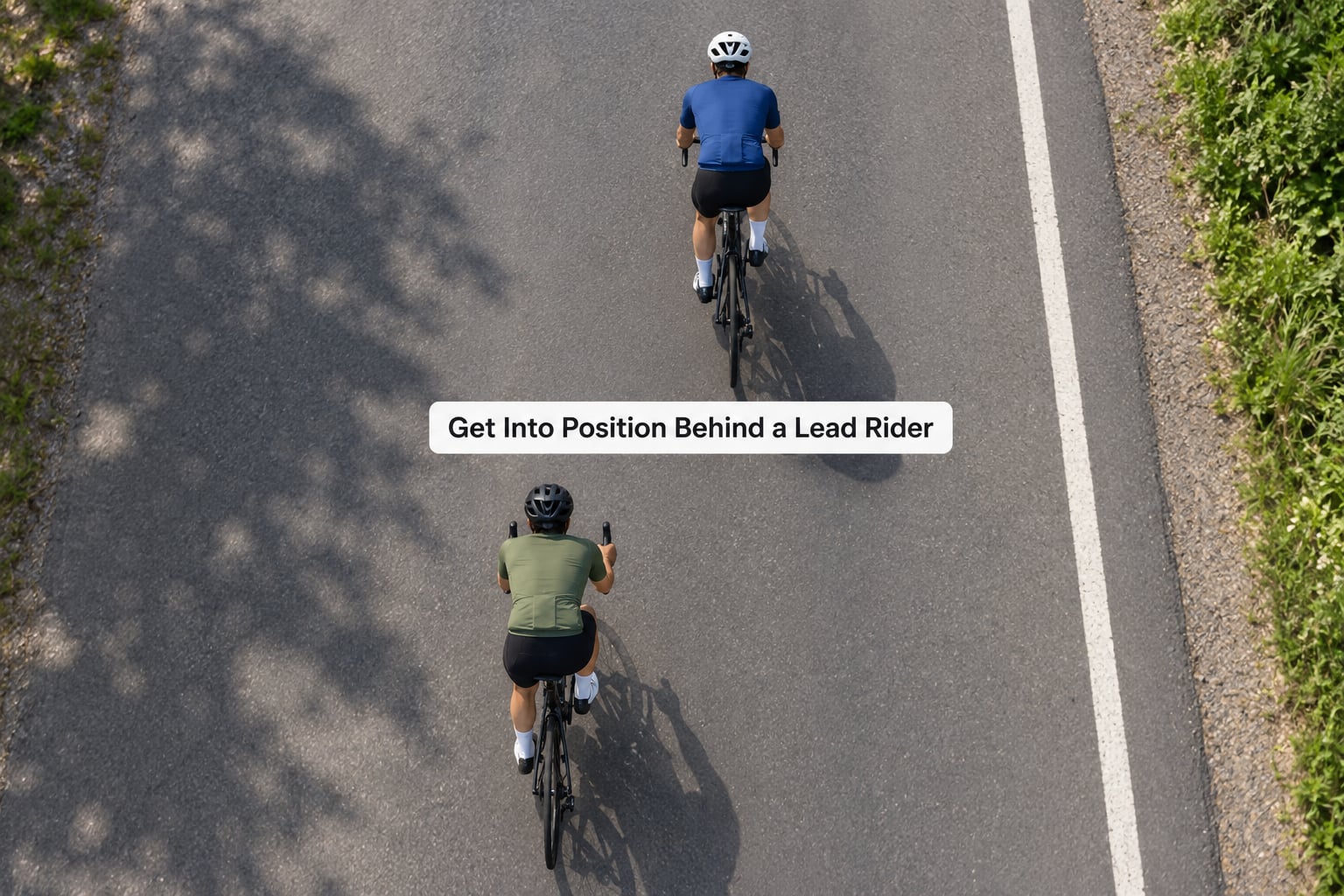
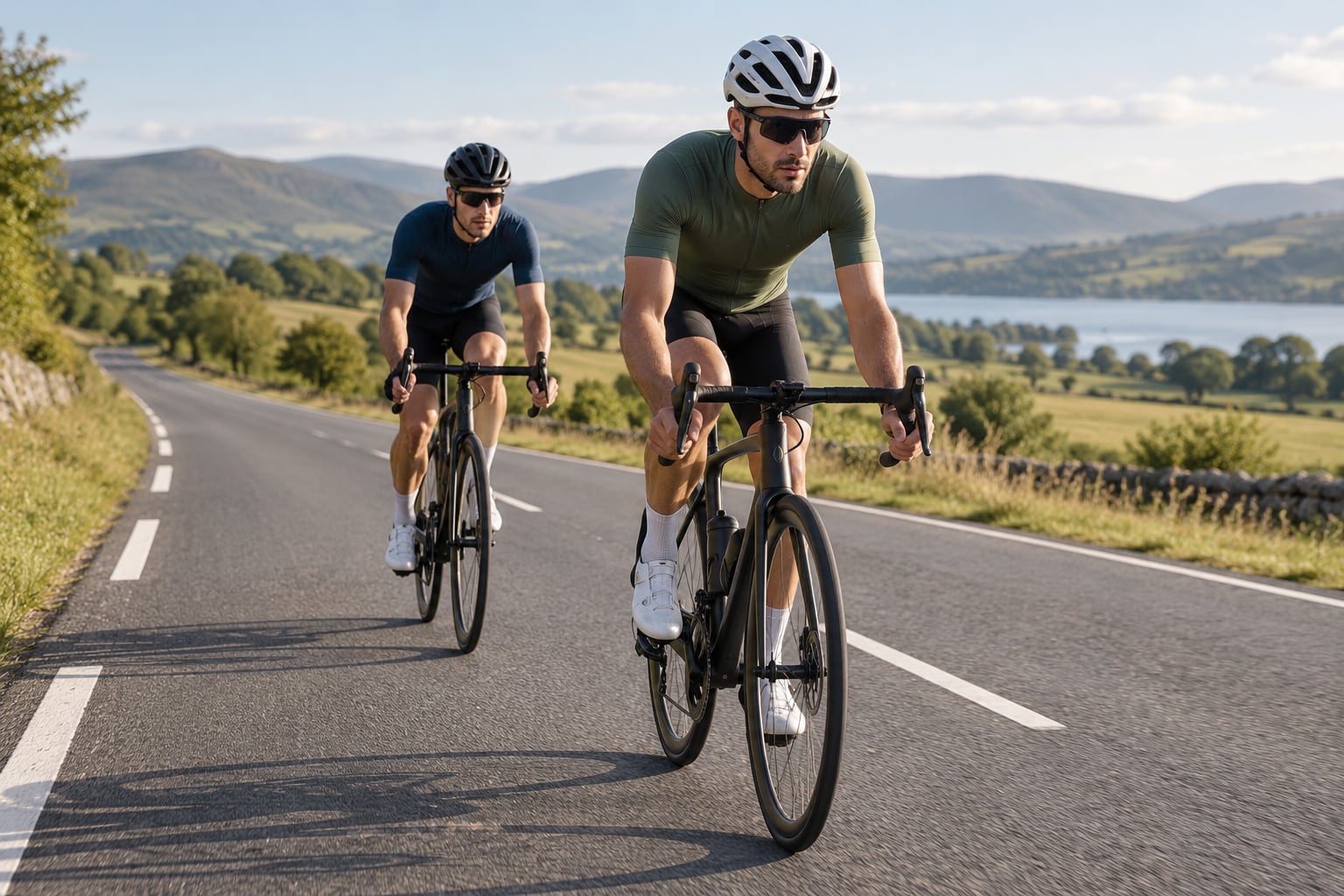
Sit slightly to one side rather than directly in line, so your front wheel tracks beside their rear wheel instead of behind it. That offset is the single most useful thing a new rider learns, because it gives you a visible escape line if they brake suddenly. Keep your hands on the hoods with fingers ready on the levers, and look past the rider to the road twenty metres ahead, not at the wheel itself.
How far back you sit depends on speed more than on confidence. These are the gaps most club riders settle into once they stop thinking about it:
| Riding speed | Comfortable gap | Minimum for experienced riders in a smooth group |
|---|---|---|
| 10 mph / 16 km/h | 2 to 3 bike lengths | 1 bike length |
| 20 mph / 32 km/h | 2 to 3 bike lengths | 1 to 1.5 bike lengths |
| 30 mph / 48 km/h | 3 to 4 bike lengths | 2 bike lengths |
| 40 mph / 64 km/h | 4 to 5 bike lengths | 2 to 3 bike lengths |
Those numbers come up in arguments on every forum, so here is how to read them. A single bike length is a racing distance, not a learning distance. Three to four feet is what a cautious rider needs before braking response becomes predictable. Beginners should start wide and close the gap over weeks: sit two to three bike lengths back, work in over time, and only shorten it once stopping smoothly feels automatic.
Match Speed Without Constantly Surging
Adjust speed with cadence and pressure, not with braking. If you are closing too fast, back off the pedals slightly rather than reaching for a lever. If you are drifting away, add a little pressure for a few seconds. Small changes in, small changes out; you should never be the reason the gap appears and disappears.
Watch for the ripple effect. One rider brakes, the next closes and brakes harder, the third closes more, and by the back of the group there is a pile-up. If you notice the gap shrinking in front of you, hold your current speed and let it open. A group that has to reset its spacing has just lost the whole benefit of drafting.
Know when smooth pacing matters more than maximum draft. On a long climb, a rough surface, or a road with gravel at the edges, staying upright and quiet is worth more than the extra few watts you would save by sitting in.
Communicate Every Move Clearly
Say what you are doing before you do it. The standard hand signals cover most of it: an open palm held flat behind your back means slowing down, a downward flick of the elbow with the hand angled away means peel off, a hand waved across the body means move over, and a pointed finger at ground level means hazard in the line. Call the hazard twice, because the rider in front of the caller may not have heard it.
One rider gives one instruction at a time. If three people are shouting different things about the same corner, the group slows for all three and the smooth line is gone. When a hazard is called, the rider who heard it looks up immediately rather than waiting their turn; that is what makes the call propagate back through a long line.
If you ride with music, one earbud in at most, and take the earbud out on descents, junctions, and whenever the group is tight. You need to hear the brakes and the breathing of the rider behind you.
Rotate Without a Sudden Acceleration Burst
When it is your turn to pull, move up on the outside with a spoken call, then hold the front for the agreed time, usually a minute or two. Anyone who wants in behind you says so before you move, and a rider calls gap before they accelerate. The point of rotating is to share the work evenly, and that only works if the front position is genuinely harder than the back.
The mistake almost everyone makes is the surge on rejoining. After a minute in the wind your legs are heavy, you slot into the draft, and the group speed jumps for a few seconds. Aim to rejoin at the same speed the group is already doing, sit up slightly, and settle in rather than dropping onto the wheel. Riders ahead report that a sudden rejoin is more unsettling than a slow rider, and it is the fastest way to lose the group.
Account for Crosswinds, Turns, and Hills
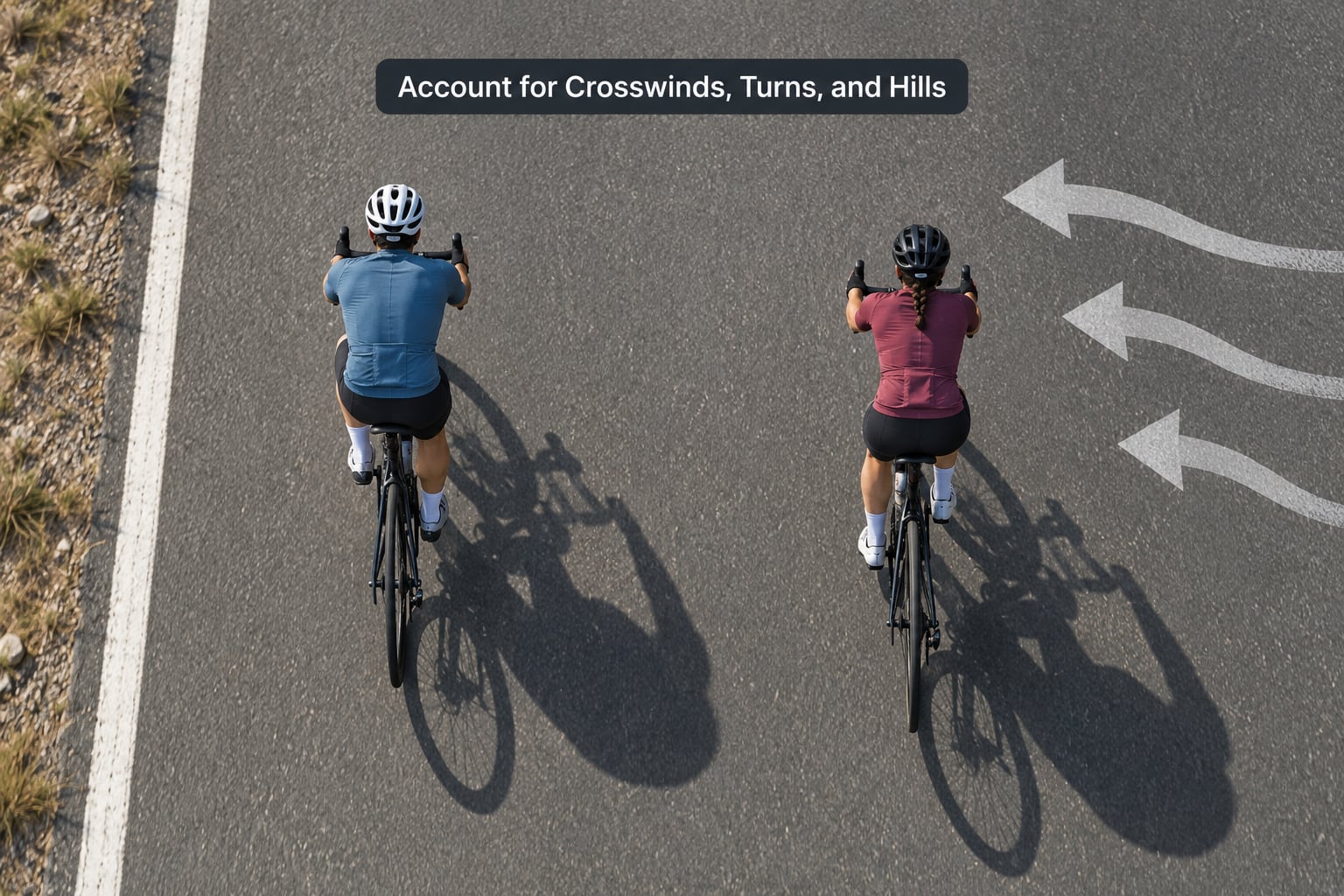
Wind and corners change what a safe gap means. In a crosswind, hold your line on the sheltered side and increase the lateral offset, because a gust can push the rider in front across the lane without warning. On a descent, your stopping speed is higher and the road surface is less forgiving, so double the gap and stop leaning on the draft for steering confidence.
Grades also matter. On a steep pitch the group stretches, gaps open on their own, and that is fine. On the flat after the pitch the gaps close quickly, which is where a group that spread out too far on the climb tends to fracture. Rolling terrain and long descents with cars nearby are the two conditions where I ask riders to sit slightly wider than feels efficient.
Wet roads deserve their own rule. If you would not enjoy stopping in a straight line in the dark, do not tuck in tightly behind a wheel you cannot see through. Spray from the wheel ahead also blinds you, which is reason enough to open the gap for your own sake.
Leave the Draft and Join the Line Safely
To peel off, check behind first, signal with the elbow flick or a voice call, move to the side rather than straight back, and say peeling loudly enough for the nearest riders to relay. To rejoin, come up alongside, check that the gap behind you is real, and enter the line with space to spare. Never cross another rider’s front wheel path to get there; the dodge left or right is more dangerous than holding a longer gap.
The same sequence applies when you drop in behind a group from behind. Wind up, give yourself room to get up to speed, and ask rather than merge. A stranger’s wheel is not a free ride, and the riders in front of you have no idea you are there.
Common Mistakes: How to Draft on a Bike Safely
Sitting too close to be useful. A gap of a few centimetres feels aero-optimal and gives you nothing to react with. Fix: start at two bike lengths and let your hands rest easy on the hoods with a finger on the brake. If you cannot pedal calmly there, it is too close.
Staring at the rear wheel. You end up blind to everything beyond it and panic when it disappears. Fix: set your eyes on a point far down the road and let the wheel sit in the lower part of your vision.
Grabbing the brakes to control speed. This is what creates the ripple through a line. Fix: soft pedal to slow, and save the levers for real obstacles.
Moving without warning. Swerving to grab a wheel or surging into a gap catches whoever is behind you. Fix: call the move, check over your shoulder, then go.
Letting the gap breathe without telling anyone. Disappearing leaves riders guessing, and guessing riders brake. Fix: when you need space, call it out loud. Gaps announced stay open; gaps created by acceleration always close.
Drafting in conditions that will not allow a safe gap. Traffic, blind corners, gravel, and gusty crosswinds mean any wheel you cannot see is a hazard rather than a saving. Fix: sit up, spread out, and let the group stay together instead of linking up.
If a wheel does touch, stay on the bike, stop pedalling, and let yourself drift to the side of the road. Do not try to regain your line. The rider in front will usually know immediately and will slow or move over. Most wheel touches end with everyone stopping; the ones that hurt start with a panicked correction.
Frequently Asked Questions
How far behind the front rider should I stay when drafting?
Beginners are safest at two to three bike lengths, which gives room to brake without closing. The gap widens with speed: roughly two to three bike lengths at 20 mph and three to five at 40 mph. A single bike length is a racing distance for experienced riders in a smooth group, not a starting point. Whatever the number, your front wheel must never overlap the rear wheel of the rider ahead.
Is drafting behind a wheel dangerous for beginners?
The wheel itself is not the danger, the reaction time is. A new rider tends to look at the wheel instead of the road, then grab a brake when the gap closes, and that braking is what causes pile-ups. Work up to drafting gradually: sit two to three bike lengths back on a flat loop first, get comfortable soft pedalling to control speed, and only shorten the gap once stopping smoothly feels automatic.
How do I signal that I am pulling off the front?
Voice works best. Say pulling off or off the front before you move, then hold the lead for the agreed minute or two. If you must use a signal, the standard one is a downward flick of the elbow with the hand angled away, visible to the rider beside and behind you. The rule that matters more than the gesture is announcing the move before making it, so nobody reacts to a surprise acceleration.
Should I draft in strong crosswinds?
Usually not closely. A gust can push the rider ahead across the lane without warning, and being tight on their wheel leaves you nowhere to go. In crosswinds, hold the sheltered side, increase the lateral offset between your wheels, and widen the gap. Strong headwinds are more manageable because the whole group is leaning into the same pressure, though gaps still tend to open on rises.
Why does the group speed up after I move to the back?
It usually is not the group speeding up so much as your first seconds in the draft feeling faster than it is. Fresh from the front, your legs are heavy and you cannot match the pace immediately, so the gap closes and you accelerate hard to catch it. That surge is what the group feels. Rejoin at the speed the group is already doing, sit up slightly, and settle in before you try to hold the wheel.
How do I draft when the ride uses a rotating paceline?
In a rotating paceline, everyone takes a turn at the front, so the mechanics stay the same and the position changes. Move up on the outside after calling it, take your minute or two, then call your intention to come off the front. When the rider ahead pulls off, wait for the gap behind to appear rather than moving immediately, and enter it on the same speed the group is riding. Announce the gap if you cannot see it.
Conclusion
If you remember one thing from this guide, make it the first fifteen minutes of a ride. Agree on your calls, pick a straight and open stretch of road, start two to three bike lengths back, and hold that gap until soft pedalling to control your speed feels like something you do without thinking about it.
From there, the rule is simple and unbreakable: every time visibility, wind, traffic, or road surface gets worse, the gap gets bigger. Drafting saves you a quarter to nearly half of your effort, which is why it is worth learning properly. It is not worth a single broken collarbone, and a group that rides at the speed its worst conditions allow is a group that keeps its riders.