Hand signals for group rides are arm gestures a rider makes to warn everyone behind about turns, hazards, speed changes, and stops when shouting is not an option. At speed, in wind, or in rain, voice communication fails completely, so the group falls back on a small shared vocabulary of signals that get passed back through the pack rider by rider. Learn the core set, practice it, and brief your group before the first mile.
Table of Contents
- Hand Signals for Group Rides: Quick Reference
- Why Hand Signals Matter in a Group
- The Essential Hand Signals for Group Rides
- Direction and position signals
- Slowing and stopping signals
- Hazard and road condition signals
- Group management and comfort signals
- How to Signal a Turn
- How to Signal Road Hazards
- Signals for Passing, regrouping, and mechanical problems: the signals riders miss
- Communicating Safely in Different Riding Conditions
- How to Use Hand Signals Without Losing Control
- Group-Ride Signal Etiquette and Common Mistakes
- A Simple Pre-Ride Briefing for Your Group
- Frequently Asked Questions
- What does two fingers down mean for bikers?
- What does it mean when a cyclist puts a fist up?
- Are cycling hand signals legally required in the USA?
- Who repeats the hand signal in a group ride?
- Should both hands stay on the bars when group riding?
- Conclusion
Hand Signals for Group Rides: Quick Reference
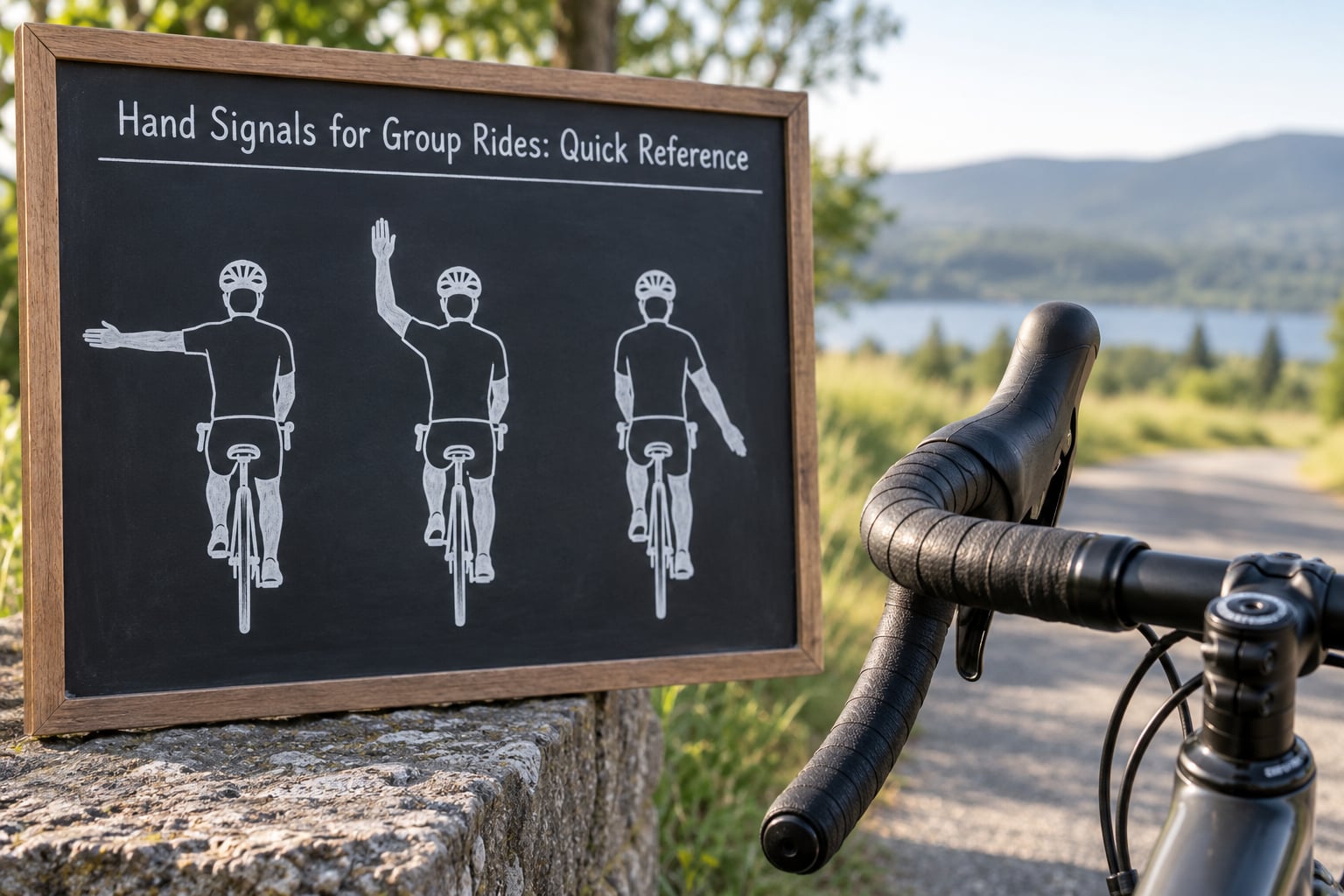
Here is the short version. The signals below cover most of what a group actually needs, and the last column matters as much as the gesture: without someone passing the message along, nobody at the back ever heard it.
| Signal | How to perform it | What it means | How riders acknowledge it |
|---|---|---|---|
| Left turn | Extend the left arm straight out horizontally | Group turns left | Rider behind repeats the arm, or calls the turn aloud |
| Right turn | Extend the right arm straight out, or bend the left arm up at 90 degrees | Group turns right | Repeat the arm or call the turn |
| Slowing down | Open palm facing down, patting up and down like a gentle bouncing motion | Reduce speed, ease off the pace | Rider behind echoes the palm and says “slowing” |
| Full stop | Raise a closed fist high above the shoulder | Stop, and it is urgent | Fist up in reply, then braking begins down the line |
| Road hazard | Point the index finger down toward the offending part of the road | Pothole, glass, gravel, or debris ahead | Point down in reply and call “hole” |
| Obstruction on one side | Point across the lower back, toward the side of the hazard | Something to avoid, and where it sits | Echo the point and call the side |
| Slippery or loose surface | Wave an open hand up and down over the road surface | Wet paint, gravel, mud, or sand | Echo the wave |
| Pass me on the side I’m pointing to | Point down and slightly to one side of the saddle | Request, not a warning | Pass with a spoken “on your left” |
| Move to the front | Pat or tap the shoulder a few times | Come up and take a turn pulling | Rider moves off the back |
| Group needs to regroup | Pat the top of the head, or wave the rider back in | Regroup at the next safe spot | Front rider eases off and waits |
| Mechanical problem | Flick the elbow sideways | Tire, chain, or shifting problem ahead | Rider drops back to help |
| Take over pulling | Tap your hip | Hand over the front duty | New puller moves to the front |
Why Hand Signals Matter in a Group
A group rides as one object only when everybody reacts within about the same second. Miss that window and the front of the pack brakes while the back is still accelerating, which is how a single pothole turns into a chain-reaction crash across twenty bikes.
The arithmetic is blunt. At 30 km/h (about 19 mph) a rider covers roughly 8 meters every second. If the rider ahead notices a hazard and takes one second to react and signal, the rider behind has already travelled eight meters before the message starts. In a two-wheel-length gap, that leaves almost no room to fix anything.
Predictions make it worse. A rider who is uncertain about a signal either brakes suddenly or does nothing, and the next rider cannot tell which one it was. Braking without warning is what riders complain about most on long rides, and a good signal set removes the guesswork.
Communication is also a two-person job: noticing something, and telling someone. One rider in the middle of the pack who sees a car oversteering ahead needs to get that to the leader and to the sweeper. That is what the relay habit is for, and experienced riders treat it as the single rule that matters most. Riders in r/cycling put it plainly: if they know someone is behind, they signal before slamming the brakes for any reason.
The Essential Hand Signals for Group Rides
There are dozens of gestures in circulation, but no group needs all of them. These cover nearly everything: where the group is going, what is in the road, and whether the pace is changing.
Direction and position signals
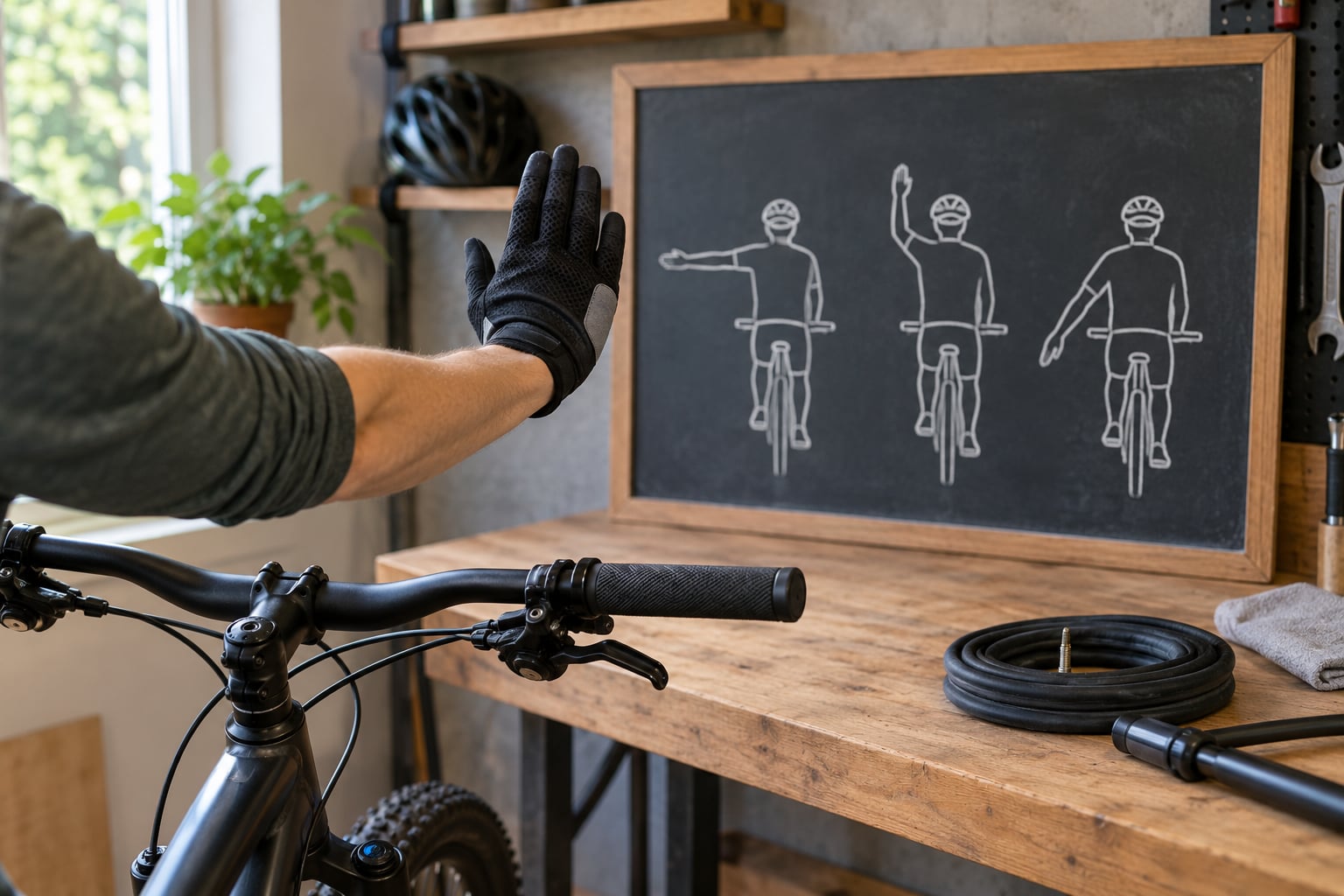
The left arm extended straight out is a left turn. For a right turn, extend the right arm straight out, which many American groups prefer because drivers can more easily see a signal out of the driver’s-side window. Plenty of riders instead bend the left arm upward at a 90-degree angle, keeping one hand on the bar and avoiding any cross-body movement.
Pointing across the lower back means there is an obstruction on that side, such as a drain, a parked car door, or debris. Swiping or pointing your hand behind your lower back is the common version.
Slowing and stopping signals
An open palm facing backward, patting up and down, means the group is slowing down and the rider ahead is off the saddle. The same open palm held flat and motionless behind the rider means everyone should stop. A raised fist is the emergency version: stop now.
That distinction trips people up. In a lot of clubs the palm-down motion is agreed as “slowing”, while an open palm held up toward the back is “stop”, and a fist is “stop, something is wrong”. Agree it in the briefing rather than assuming.
Hazard and road condition signals
Two fingers pointed down at the tyre line means there is an obstacle right where you are about to ride. Riders regularly ask what two fingers down means, because a downward point can be a pothole, a stick, glass, or a drain cover, and the exact object is often not visible from the back.
Point at what you can see and add a word when it matters. A flat patch of gravel gets the open-hand wave over the surface; a dog on the path gets a point and the word “dog”; a car pulling out gets a point plus “car”.
Group management and comfort signals
An elbow flick means a mechanical problem ahead, so a spare tube or chain tool can come forward. Tapping your hip hands over pulling duty when you are tired, which keeps a long ride from burning out one rider.
A wave of the hand across the body, or patting the top of the head, asks the group to regroup. Riders also point down beside the saddle to ask to be passed on a particular side, and pat a shoulder to call someone up to take a turn at the front.
How to Signal a Turn
Start the signal before the group needs to move, not when you arrive at the intersection. At a normal group pace, most riders need two to three seconds of warning to shift position safely, and more if the group is strung out.
Keep the arm straight and the hand relaxed. A limp or floppy arm reads poorly in peripheral vision, so lock the elbow and hold the hand flat or gently cupped. Extend the left arm for a left turn; for a right turn, either mirror it with the right arm or bend the left elbow to 90 degrees.
Say it out loud too. Most state vehicle codes in the US require bicycle riders to signal turns with the left arm, so the gesture is not just club etiquette, it doubles as a legal signal to drivers when the group is on the road. Legal requirements vary by state, so check yours if you ride somewhere unusual.
In a paceline, the rider at the front signals and every rider behind repeats the gesture within a second or so, so the message travels to the back. In a two-abreast formation, the rider on the inside takes the signal and the outside rider echoes it.
How to Signal Road Hazards
Hazard signalling is where hand signals earn their keep. Glass in the tyre line, a patch of gravel that came off a truck, a pothole hidden in shadow, a storm drain the group is about to run over with one wheel.
Keep control first. Look ahead, set your line away from the hazard yourself, then signal one-handed while maintaining a straight path. Riders often twist their shoulders toward the problem and steer into it, so keep your eyes forward and signal with the arm, not the torso.
Give the rider behind a chance to choose their own line. Pointing down says “there is something there”, while a side point says “avoid it this way”. Riders behind will sometimes take a different line than the one you chose, which is fine as long as they know it is coming.
Signals for Passing, regrouping, and mechanical problems: the signals riders miss
Some of the most useful gestures are the least known. Riders who have ridden solo for years often have never seen a group use them, and new members usually never ask.
Pointing down and to one side of the saddle asks the rider behind to pass you on that side. It is a request, not a warning, so it should be echoed with a spoken “on your left” and does not mean anything is wrong ahead.
A pat on the shoulder means come up and take a turn pulling. Tapping your hip means the same thing when a rider is getting tired, and it is how experienced groups avoid burning out the strongest climber. A hand wave or a pat on the head asks the group to regroup at the next safe place rather than chasing a strung-out line.
An elbow flick is the mechanical problem signal. It says a tire, chain, or shifting issue is coming, so a mechanic with tools moves forward. If you are the one with the problem, signal it too, then drop to the back of the group rather than trying to fix it in line.
Communicating Safely in Different Riding Conditions
Rain changes everything about signalling. Grips are slippery, gloves are bulky, and spray from the rider ahead can make an arm invisible. Assume that in bad weather your group needs voice calls more than gestures, and pair every important signal with a shouted word.
At night, arm position is still readable if it is held high and out, but hand shape is not. Use the big, simple shapes, and put a bright rear light on every bike so riders can at least see that an arm went up.
Wind is often worse than darkness. A headwind takes your voice away from the group, so calls made by the rider behind you arrive faint. Wind also pushes a one-handed bike around, which makes extended arms more disruptive, so use bent-elbow versions in a crosswind.
On descents, riders are usually quieter and more focused, and a sudden corner or gravel washboard appears faster than anyone expects. Signal bends well before they arrive, and use the open-hand wave over the surface for anything that changes grip.
In urban traffic with mixed speeds, the sweeper’s job gets heavier. Riders at the back call out vehicles so the group can move to single file, and the sweeper should use full arm signals rather than hoping a voice call carries.
Mixed-ability and family groups need more lead time than anything else. Riders at different speeds see hazards from different angles and at different moments, so the standard here is to signal early and repeat every message twice.
How to Use Hand Signals Without Losing Control
One hand comes off the bar and the other stays on. That is the whole safety rule, and beginners sometimes get it backwards by taking the left hand off in traffic, where they have the least room to wobble.
Keep the signalling arm loose rather than locked, and avoid oversteering. Small corrections with the remaining hand are enough at group speed, and most wobbles come from twisting the upper body instead of the handlebars.
Signal early enough for the group to act, not early enough to be elegant. Two seconds at a junction, and immediately for a hazard you are about to reach.
Acknowledge what you receive. Riders who ignore a signal send a message back to the group that nobody is paying attention, and the whole system quietly stops working. A raised fist or an echoed palm costs nothing and keeps the chain intact.
Group-Ride Signal Etiquette and Common Mistakes
Riders frequently signal only to the rider directly behind them, then forget that nine more people exist. The gesture dies at the second bike.
Groups also invent local meanings mid-ride without saying so, which is how an open palm ends up meaning three different things in one hour. If you change a signal, explain it out loud while there is no pressure on anyone.
Another common error is riding so close that a signal cannot be made. Signals need a bike length of space, not half of one, and the same goes for the rider behind you.
Two more that come up constantly: standing up or surging without calling “up”, and dropping off the back of a paceline without warning. Both change the group’s speed and both should be announced.
Half-wheeling, where your front wheel overlaps the rear wheel of the rider ahead, is the etiquette rule riders argue about most and the one with the worst consequences. Give a full bike length when you cannot see the road under their rear wheel, and expect the same.
One thing worth saying plainly: signals do not transfer responsibility. A commenter on r/bicycling put it as a rule of thumb for crashes, whoever is performing the maneuver is at fault, and no gesture or shout relieves that. Signal early, but signal for your own rider.
A Simple Pre-Ride Briefing for Your Group
Most group communication failures come from assumptions nobody stated. Five minutes at the start of the ride fixes most of them, and this is the checklist our own ride leaders go through.
- Name the roles. Who pulls at the front, who sweeps at the back, and who takes over when a rider needs to drop back.
- Agree the core set. Left arm for left, right arm or bent elbow for right, palm-down patting for slowing, open palm up for stop, raised fist for emergency stop, downward point for hazards, side point for obstructions, elbow flick for mechanicals.
- Set the hand position your group will use for right turns, so nobody has to guess at a junction.
- Agree the words that go with the gestures. Car back, car up, on your left, on your right, hole, slowing, stopping, and the name of the animal or vehicle when there is one.
- Set formation rules. Two abreast maximum, no half-wheeling, call before passing, regroup at the top of any hill.
- State the relay rule out loud: every signal is repeated by the rider behind and passed to the back.
- Plan for incidents. Where you stop, how someone signals a crash or a rider off the back, and who carries the first aid kit.
- Ask every new rider to name the stop signal before you roll. That question alone catches most misunderstandings.
Frequently Asked Questions
What does two fingers down mean for bikers?
Two fingers pointed down toward your line warn of an obstacle in the road: a pothole, glass, gravel, a stick, or a drain cover. Point at what you can actually identify, because riders behind often cannot see the object itself. When the hazard matters, add a word such as hole, glass, or dog so the group knows how much avoidance it needs.
What does it mean when a cyclist puts a fist up?
A raised closed fist is the most urgent signal in group riding and means stop. Riders often confuse it with a fist held low near the hip, which in some clubs means take over pulling. If your group uses both, agree the difference in the pre-ride briefing, since a mistimed stop signal on a descent is genuinely dangerous.
Are cycling hand signals legally required in the USA?
Most US state vehicle codes require bicycle riders to signal turns and stops with the left arm, treating a bicycle as a vehicle for those rules. Exact wording differs by state, and hand signals to other group riders are club convention rather than law. Riding with a left-arm signal is still the smart move because drivers expect it.
Who repeats the hand signal in a group ride?
Everyone behind the person who made it. The rider directly behind repeats the gesture or repeats the call, then the next rider does the same, so a hazard spotted by rider three reaches rider twenty within a few seconds. This front-to-back chain is the single habit experienced riders insist on, because a signal that is not echoed is a signal nobody heard.
Should both hands stay on the bars when group riding?
One hand comes off the bar and the other stays on, and the hand that stays on should be the one with the most room to steer. Extending the left arm means keeping the right hand on the bar, which is usually safer in traffic where there is little lateral space. Keep the signalling arm loose and avoid twisting your upper body toward the hazard.
Conclusion
Learn five things before your next group ride: left arm for left, right arm or bent elbow for right, palm-down patting for slowing, open palm up for stop, and a downward point for hazards. Practise them at walking pace on a quiet road until your hand does the right thing without you thinking about it.
Then agree the set with your group out loud, including anything local, and make the relay rule explicit. Hand signals for group rides only work when everyone expects the same gesture and everybody passes it back.