If you’re searching for why does my lower back hurt on the bike, the short answer is that most riders are holding a folded position longer than their body is happy with, on a bike set up for somebody else. Fit, hip mobility, trunk endurance and training jumps all feed the same ache, and pain that is severe or keeps coming back needs a doctor rather than a forum post.
It is the most common complaint I hear from riders who have just moved from casual spinning to longer road rides, and it usually shows up in one of two ways: a dull ache that builds through the ride, or a sharper spot on one side of the lower spine that lingers for days afterwards.
Table of Contents
- Why Does My Lower Back Hurt on the Bike?
- What Are the Common Causes of Cycling Lower Back Pain?
- Holding one bent position for too long
- A bike that does not fit your body
- Muscles and hips that give out early
- Training jumps and riding technique
- Earlier injuries and spinal conditions
- Why does my lower back hurt on the bike during a long ride?
- How Can I Tell Whether the Bike Does Not Fit?
- What Changes Should I Make to My Bike and Riding Position?
- How Can I Improve Trunk Strength and Endurance?
- When Should a Cyclist Stop Riding and Get Checked?
- Frequently Asked Questions
- Can cycling cause lower back pain even with a properly fitted bike?
- Should I stretch before or after a ride if my lower back hurts?
- Does lower back pain mean I need a new saddle or bike fit?
- How long should I wait before riding again after lower back pain?
- When is a professional bike fitting worth trying?
- Conclusion
Why Does My Lower Back Hurt on the Bike?
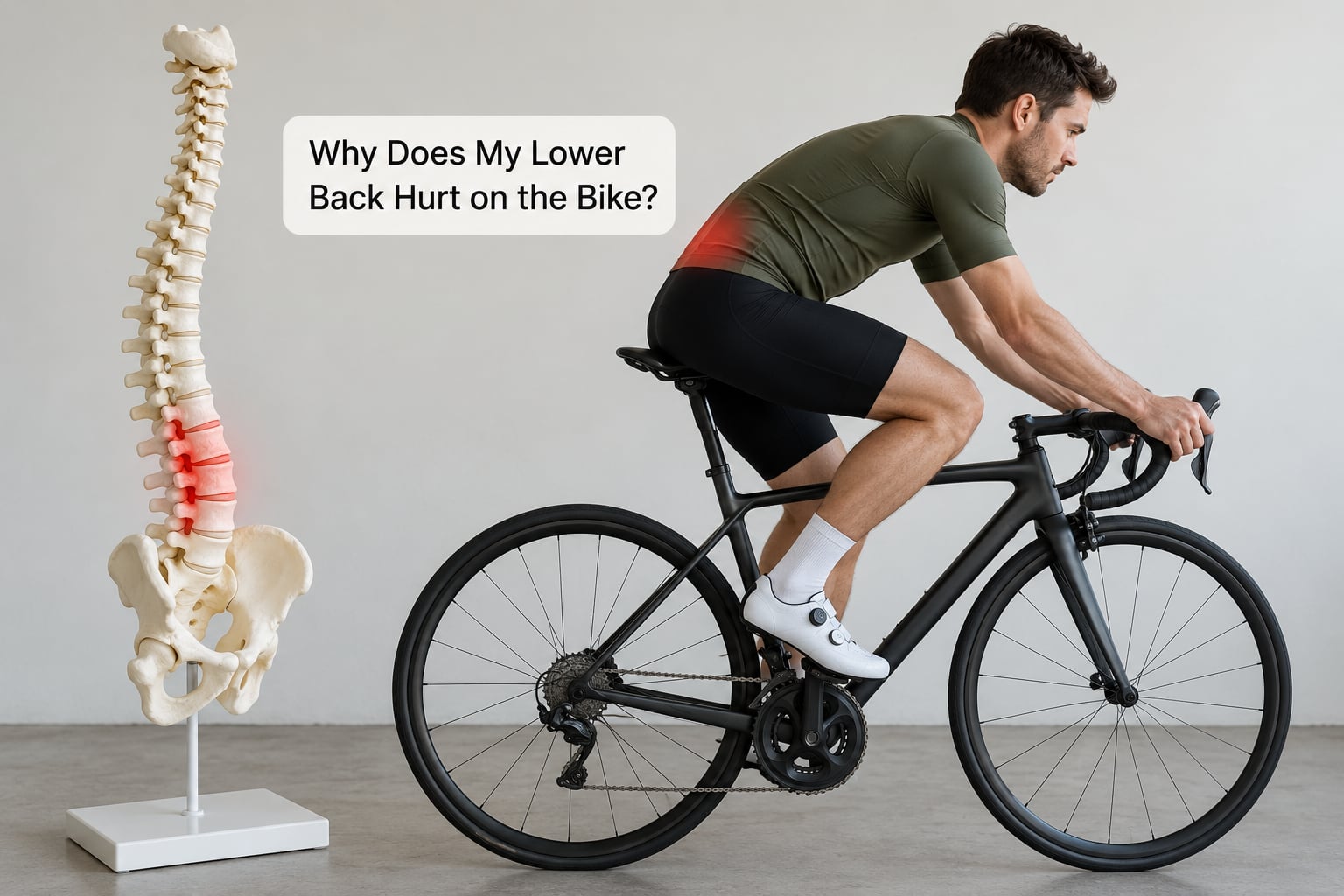
Discomfort on the bike usually comes from spending hours in a bent, forward position, a bike whose saddle height or reach does not match you, muscles and hips that give out early, or a riding technique that loads the spine unevenly. Severe or persistent pain should not be diagnosed from symptoms alone.
One thing worth saying up front: where the pain sits rarely tells you what is causing it. A rider with a saddle that is a few centimetres too high can feel it across the middle of the back. A rider with tight hamstrings can feel it in exactly the same place. That is why the fixes below are ordered by how often they turn out to be the answer, not by where the ache shows up.
What Are the Common Causes of Cycling Lower Back Pain?
Holding one bent position for too long
Riding is not a movement sport. Your pelvis stays put for hours, your spine stays in one general shape, and the muscles holding that shape do quiet, low-level work the entire time. On a two-hour ride that is fine. On a six-hour ride in an aggressive position, a spine that never changes shape starts to complain.
Outdoors you get some relief from road buzz, steering corrections and standing on the climbs. On a trainer at home, the bike does not move under you at all, which is why the same rider can be fine outside and sore inside on the same day.
A bike that does not fit your body
Experienced fitters will tell you an unsuitable saddle height is the first thing to check, and riders usually agree. A saddle that sits too high pushes the pelvis forward into a more folded shape and asks the back to hold the difference. A bike with too much reach or too much drop does the same thing, and riders often try to fix it by gripping the bars harder, which loads the shoulders and neck instead.
The other common culprit is a saddle that is simply wrong for your sit bones. Riders rock side to side or stand up on every climb trying to relieve pressure they cannot describe accurately, and the lower back picks up the correction.
Muscles and hips that give out early
Riders describe the same chain constantly: tight hamstrings pull the pelvis into a more rounded shape, restricted hip motion means the hips cannot open on the pedal stroke, and the lower spine absorbs the difference. Weak trunk endurance shows up the same way, just later in the ride, when muscles that started fresh are no longer fresh.
Forum threads are full of the same debate: is this a fit problem or a strength problem? Usually it is both, in roughly equal measure, and changing one while ignoring the other is why some riders get frustrated.
Training jumps and riding technique
Effort beyond what you are used to is a very common trigger. Doubling your longest ride, moving to rough roads, or racing hard when your week was meant to be easy can produce lower back soreness that has nothing to do with your setup.
Technique matters too. Riders who push and pull the bars constantly, or who pedal with visibly bent knees and their hips rocking, keep tension in the trunk instead of the legs.
Earlier injuries and spinal conditions
Disc degeneration, arthritis, a previous injury that never fully settled, or a structural difference in leg length can all change how a rider tolerates the same position. If pain started after a specific incident, or appears on a bike position you have ridden comfortably before, that history matters more than any adjustment on this page.
Why does my lower back hurt on the bike during a long ride?
On a long ride the pain builds gradually because several things stack up: time in one flexed posture, accumulated vibration through the saddle, muscles tiring in the second half, and riders who stop hydrating or eating properly. Most long-ride back pain shows up somewhere in the last hour, which is the tell that endurance and setup, not injury, are doing most of the work.
There is a difference worth tracking. Pain that appears early in a ride and fades with warm-up often points at setup. Pain that only arrives after you get home, or that is worse the next morning, tends to point at how hard you rode and how long you sat still. Neither pattern is a diagnosis, but they steer where you look first.
How Can I Tell Whether the Bike Does Not Fit?
You do not need a fitting studio to rule out the obvious. Most setup problems announce themselves as a sensation you can describe, and each one has a first adjustment worth testing before you touch anything else.
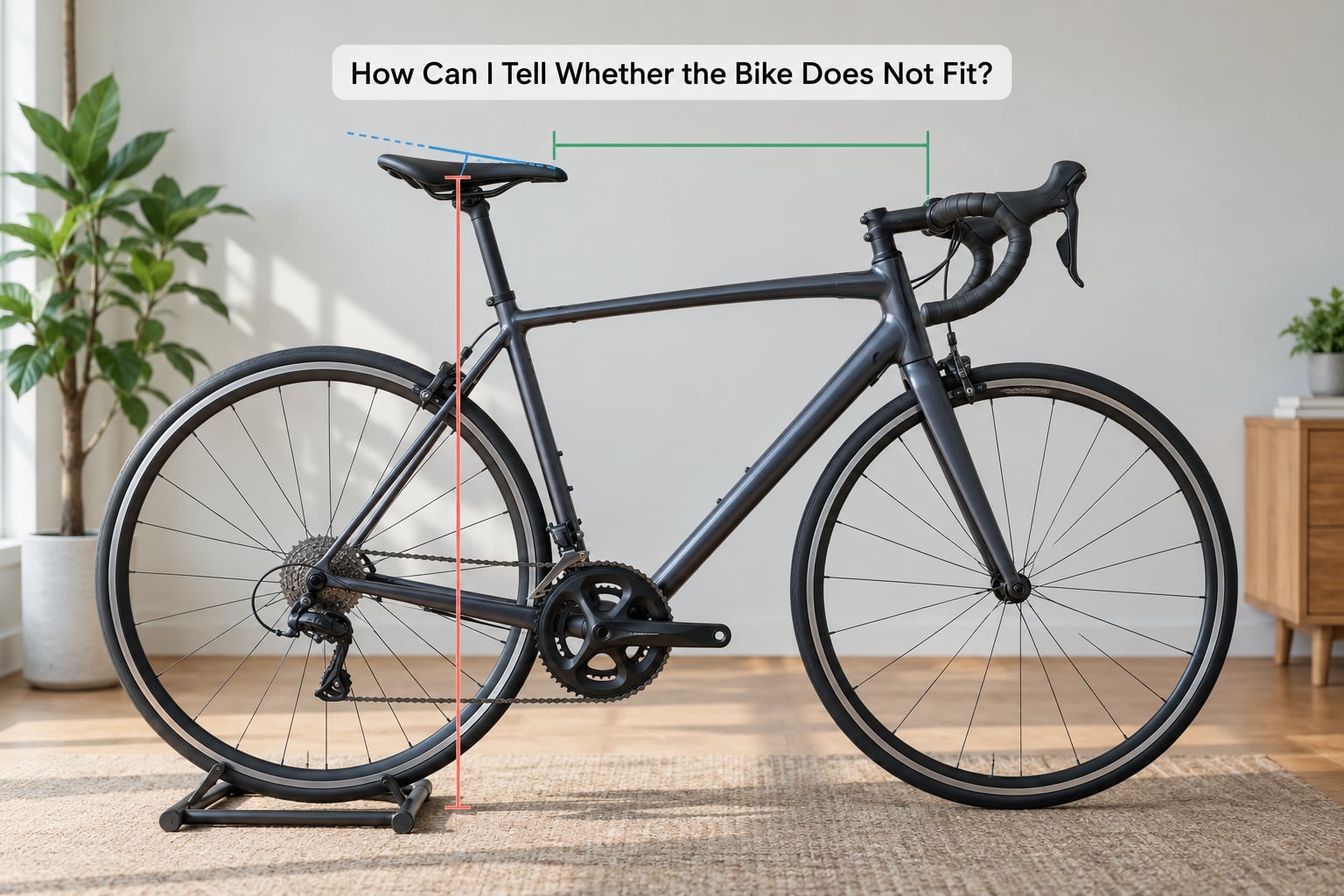
| Setup issue | What you might notice | Test first |
|---|---|---|
| Saddle too high | Aching across the lower back, especially when seated and pedalling hard | Lower the saddle a few millimetres and ride the same route |
| Saddle tilted nose up | Lower back and hip flexor soreness, sliding forward on the saddle | Bring the saddle level, then recheck height |
| Too much reach or drop | Tight shoulders and neck alongside lower back tension | Shorter stem or a spacer under the stem, one change at a time |
| Crank length too long | Restricted hip opening, discomfort on the seatbone side | Have the cranks checked against your inseam and frame size |
| Uneven pedalling or leg length difference | One-sided ache, one hip higher, rocking at a low cadence | Check cleat alignment and, if needed, ask about a structural versus functional difference |
| Saddle shape or width | Rocking side to side, standing up on every climb | Sit bone width, not fashion, decides saddle width |
Change one variable at a time and ride the same route for two or three outings. A single long ride tells you almost nothing; a repeatable comparison on familiar terrain tells you a lot.
What Changes Should I Make to My Bike and Riding Position?
The best adjustment is a small one you can keep. Riders who drop the saddle three centimetres and swap the stem on the same weekend usually end up back where they started and blame their back.
Saddle height and tilt. Small changes, measured in millimetres, are usually enough. Level the saddle first, then adjust height. If you want a larger change than that, a fitting session is cheaper than a month of sore rides.
Handlebar reach. A shorter stem or a small spacer stack brings the bars closer and lets the torso sit a little more upright. If your hands are flat on the tops and your elbows are bent, the reach is probably not the problem.
Hip angle. The angle between your torso and thighs changes constantly as you move through the saddle, so treat any rigid target as approximate. The practical test is whether you can hold a comfortable position for an hour without shifting your weight constantly.
Pedalling mechanics. Aim for a relaxed, round stroke with a cadence that does not force you to rock. If your knees visibly drift forward at the top of the pedal, that is worth a cleat adjustment check.
Position breaks. Standing for a minute or two, changing saddle position slightly, or riding a section upright gives the spine something it does not get in a static position. Riders on long rides get more out of three or four changes of position than they do from trying to hold one perfect shape.
Sudden large changes are the mistake here. Dropping the bars a full inch shifts weight to the saddle and can trade lower back discomfort for hand and neck problems.
How Can I Improve Trunk Strength and Endurance?
Strength work helps, but on its own it rarely rescues a setup that forces you into a position you cannot hold. Most riders need both, and they need them in the same order: make the position holdable first, then build the capacity to stay there.
Build riding exposure gradually. Adding time in small steps teaches the muscles to do the quiet holding work. Riders who jump straight to their longest ride of the year rarely get the adaptation, they just get the ache.
Add comfortable trunk and hip strengthening. Planks, bridges, side-lying hip work and dead bugs are common choices because they train holding, not movement. Keep them easy enough to do with good form, and stop when the quality drops.
Work mobility at your current range. Gentle hip and trunk rotation between rides helps if it stays comfortable. Forceful stretching into pain, or an aggressive routine on a cold back, tends to make the next ride worse.
Recover properly. Sleep, food and hydration matter more here than most riders expect. A ride fueled badly is a ride where the muscles fatigue early, and fatigue is exactly what the back feels first.
If you are currently in pain, get individualized advice before starting any program. A physiotherapist can tell you what your body will tolerate; a generic article cannot.
When Should a Cyclist Stop Riding and Get Checked?
Stop the ride and contact a healthcare professional if any of these show up. Mainstream guidance treats these as reasons not to push through, and none of them are things to assess on a bike.
- Severe pain, or pain that is rapidly getting worse
- Weakness in a leg, or numbness and tingling that affect your legs
- Numbness in the saddle area that does not clear quickly once you get off the bike
- Loss of bladder or bowel control
- Pain after a significant fall, crash or other impact
- Back pain that does not settle, or that keeps coming back across several weeks
Numbness in the groin or saddle area while riding is one people routinely push through and should not. Stop, and get it looked at the same day.
Frequently Asked Questions
Can cycling cause lower back pain even with a properly fitted bike?
Yes. Fit removes the avoidable causes, but it does not remove fatigue, tight hamstrings, limited hip motion or a training jump your body is not ready for. Plenty of riders with textbook setups still get a dull ache in the last hour of a long ride. If the pain keeps returning with a good fit, the conditioning and training side of the equation is usually where the answer is.
Should I stretch before or after a ride if my lower back hurts?
Gentle mobility before a ride, when the back is not irritated, tends to help more than aggressive stretching. After a ride, light movement is fine, but do not push into pain. Forceful stretching of a sore lower back frequently leaves it more sensitive for the next day, which makes the following ride worse rather than better.
Does lower back pain mean I need a new saddle or bike fit?
Not automatically. Riders often change saddles or buy a whole new bike when the real cause was a saddle two centimetres too high or a stem that was too long. Change one variable at a time and test it on the same route for a few rides. If small adjustments to the bike you already own do not help, that is when a professional fit or different equipment makes sense.
How long should I wait before riding again after lower back pain?
There is no fixed number, because the causes range from a sore muscle to a disc problem. Most riders who strain their back can return to easy riding as the pain allows, keeping the first ride short and gentle. If pain is present at rest, spreading down a leg, or accompanied by numbness or weakness, stop riding and see a doctor before you try again.
When is a professional bike fitting worth trying?
A fit is worth it when you have already tested saddle height, saddle tilt and stem length yourself without lasting change, when the pain keeps returning across several months, or when the bike was set up by someone else and you have never been measured. Fitters work in small increments, usually millimetres and a few degrees, and riders over 50 or returning after injury get the most out of it.
Conclusion
First, check the warning signs. If any of them apply, stop riding and speak to a doctor rather than adjusting the bike.
If none of them apply, note when the pain starts and how long it lasts, then make one small change. Saddle height and saddle tilt first, then handlebar reach, one variable at a time on the same route. If the discomfort persists, recurs or gets worse, get individualized advice from a healthcare professional, and consider a professional bike fit when the bike itself checks out.