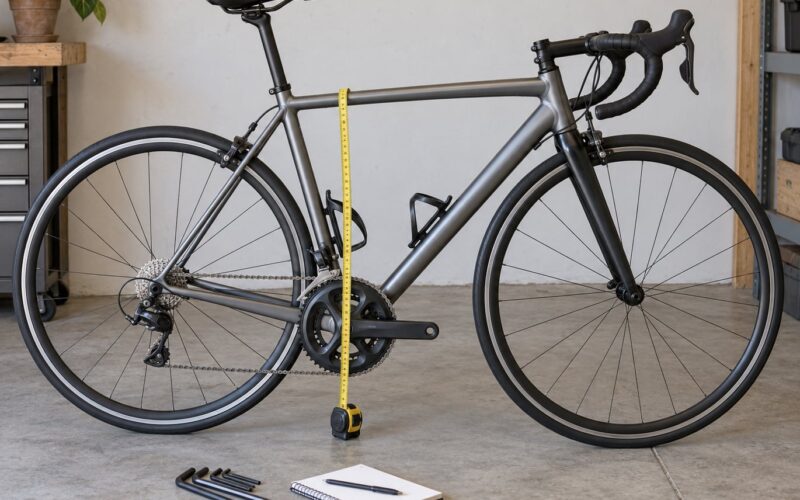
If your neck hurts on the bike, the most common reason is that riding asks you to hold your head up and slightly forward for hours while your shoulders and upper back do the stabilising. Usually something in the setup makes that harder than it needs to be — bars too low or too far away, a heavy helmet, a locked-in grip, or simply more hours in the saddle than your neck is used to. Riders with desk jobs often find out that the cycling position exposes posture problems built up over the rest of the week, rather than causing them on the road.
The good news is that most of it is fixable without a new bike. This guide walks through the causes, the adjustments that make the biggest difference, and the signs that mean you should stop riding and talk to a doctor instead.
Table of Contents
- Why Does My Neck Hurt When Cycling?
- What Are the Common Causes of Cycling Neck Pain?
- Looking too far ahead instead of down the road
- Handlebars set too low or too far away
- Locked shoulders and a death grip on the hoods
- Helmet weight, strap and fit
- When training load outruns your fitness
- How Can Bike Fit and Handlebar Position Help?
- What Riding Posture and Techniques Reduce Neck Strain?
- How Do Strength, Warm-Up, and Recovery Affect Neck Pain?
- When Should a Cyclist Stop Riding and Get Medical Advice?
- Frequently Asked Questions
- Does neck pain mean I need a new bike?
- Can a heavy helmet or a handlebar bag contribute to neck pain?
- Can my neck pain actually be coming from my shoulders?
- What should I do if neck pain starts in the middle of a long ride?
- How long does it take to get used to drop bars?
- What are the symptoms of cyclist’s palsy?
- What Should You Do First?
Why Does My Neck Hurt When Cycling?
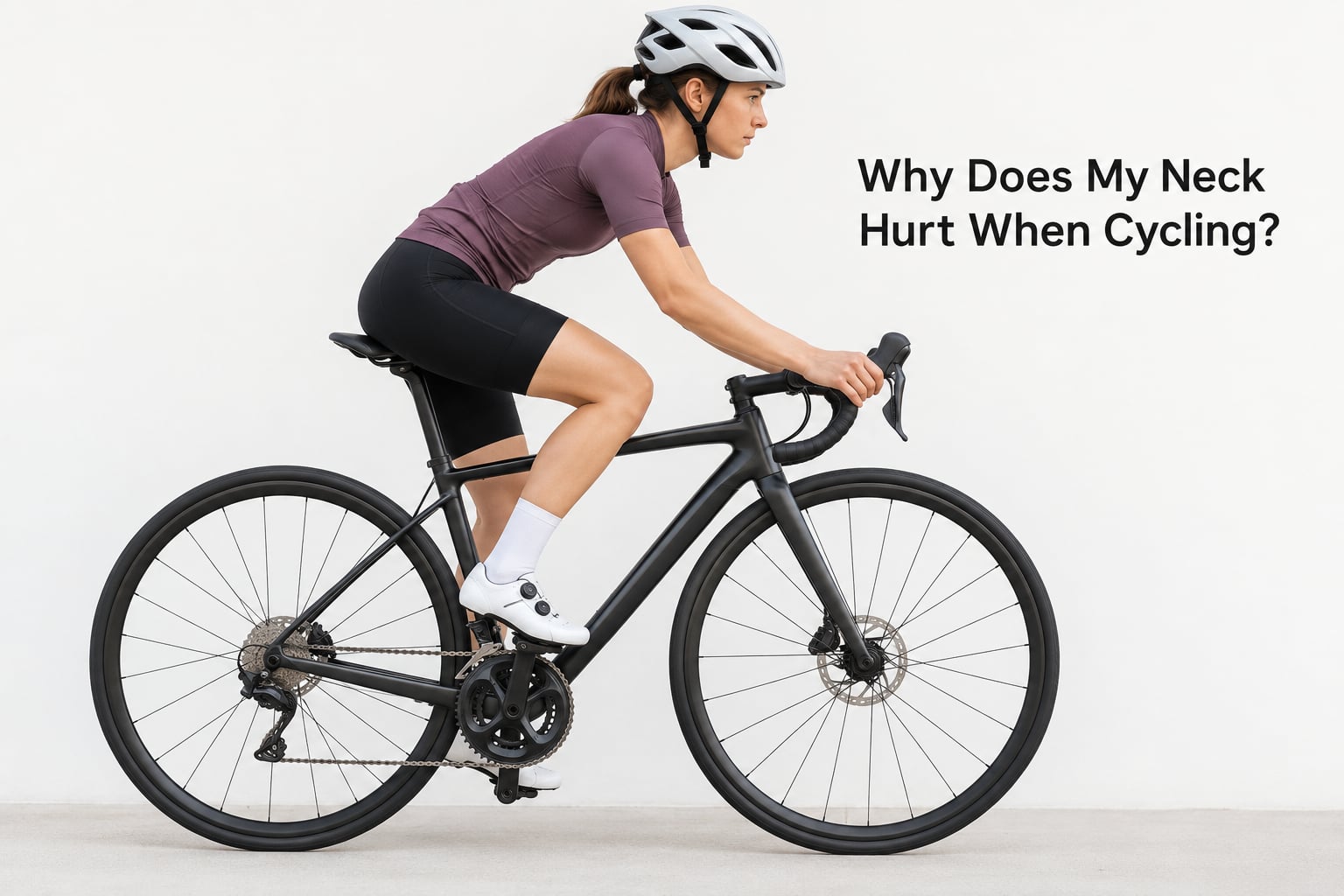
Answering directly: why does my neck hurt when cycling? Because the riding position holds your cervical spine in mild extension — the head tips back slightly so you can see ahead — while the muscles that should hold your head steady go quiet. Everything else, the drop of the bars, the reach, the helmet, the training load, just adds to that.
Your head is heavy, roughly the weight of a small bag of flour, and the deep neck flexors at the front of the neck are not built to hold it up alone for three hours. When they tire, the upper trapezius and levator scapulae on either side of the neck step in to hold your head in space. They are not designed for that job, so they start to ache, feel tight, or refer pain into the shoulder blade and the base of the skull.
That is why pain so often arrives on a long ride rather than on the way out. Twenty minutes in, everything feels fine. At ninety minutes, on a technical descent with a low head position, the compensating muscles reach their limit and you feel it between the shoulder blades, on one side of the neck, or as a dull ache at the base of the skull.
Pain that shows up right after a change to your bike points somewhere else. New stem, new bars, new saddle height, or a helmet you have worn for five years can all tip a previously workable setup over the edge. Chronic riders get surprised by this because nothing about them changed, yet the geometry did.
The everyday habit that shapes all of this is worth naming plainly. Someone who sits at a desk for eight hours and then holds a phone for two more has very little thoracic mobility and very tired deep neck flexors before the bike even leaves the house. The ride is the stressor, but the setup at the kitchen table did most of the work.
What Are the Common Causes of Cycling Neck Pain?
Looking too far ahead instead of down the road
If your eyes are fixed on the horizon, your chin lifts and your neck extends to hold that line of sight. Your line of sight should track about 15 to 20 metres ahead of the front wheel, not the skyline, which lets the head stay in a much more neutral position. Riders who fix only this often feel a bigger change than any cockpit adjustment gave them.
Handlebars set too low or too far away
Two separate problems wearing the same name. Bars set too low force you to drop your head and reach down to them, which puts the neck straight into extension. Bars set too far away stretch you out over the front wheel, so the shoulders round forward and the upper back collapses into a rounded shape that the neck then has to fight.
Locked shoulders and a death grip on the hoods
Gripping the hoods hard is the single most common thing riders do without noticing. Tight shoulders cannot sit low, and low shoulders are what free the neck. Riding with elbows bent and loosely held hands puts the tension where it belongs, in your forearms and fingers, instead of in your neck.
Helmet weight, strap and fit
A helmet adds weight to the end of a lever that is already working hard, and a helmet that sits too far back or sits too low pushes your head into extension. The straps matter more than most riders think. Straps that are too loose let the helmet shift with every bump, and your neck spends the ride correcting for it.
When training load outruns your fitness
Riding distance and intensity that rise faster than your capacity is a muscle gets used to it will do the same thing to your neck. A rider comfortable for ninety minutes who suddenly commits to a six-hour ride is not dealing with a fit problem. They are dealing with a tissue tolerance problem.
How Can Bike Fit and Handlebar Position Help?
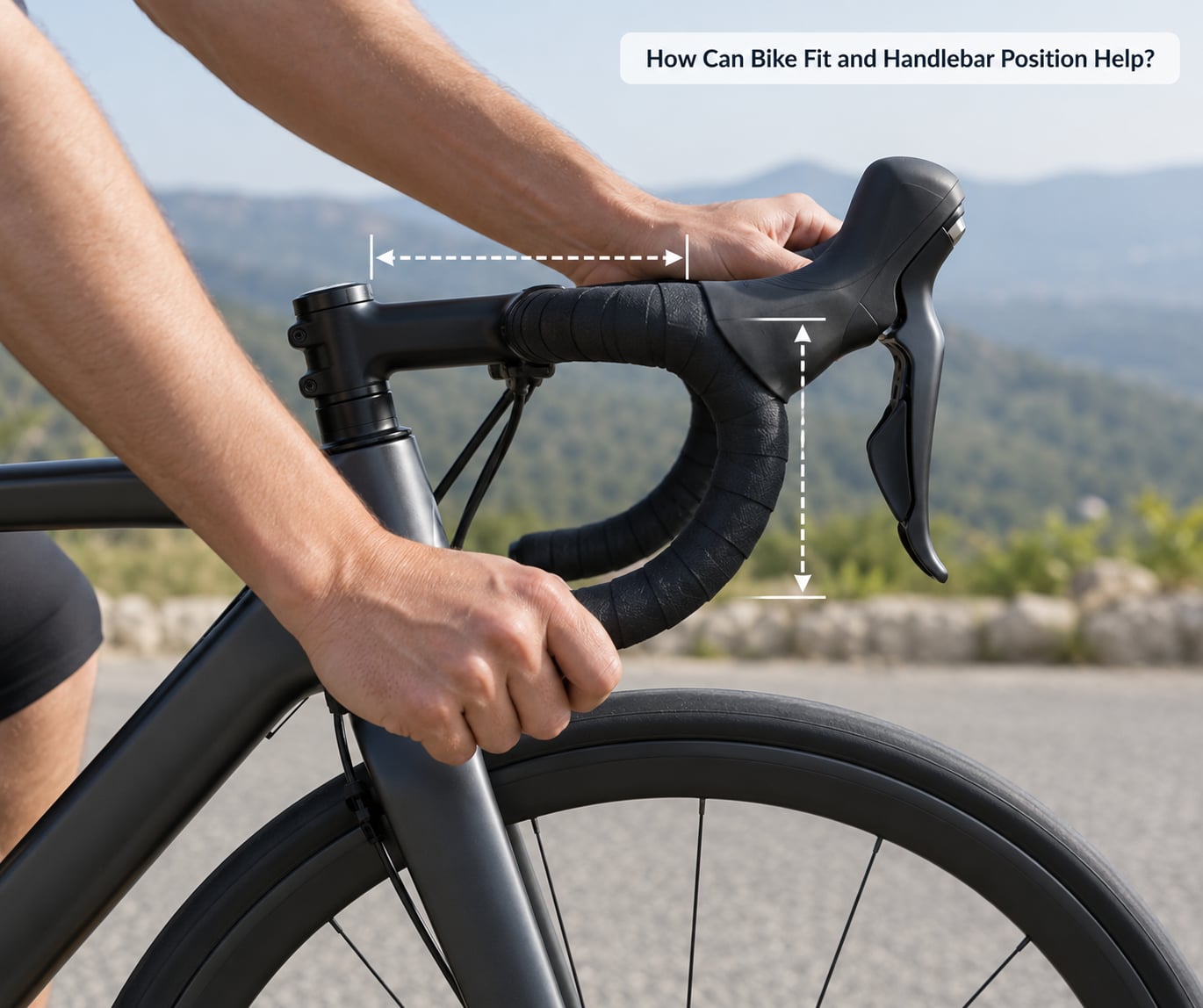
Fit changes fix a surprising share of cycling neck pain, and they are cheap to try. The trick is changing one thing at a time and riding in it before deciding whether it worked.
Saddle height and setback set the base. Saddle height changes how much you open the hip and thus how much you round through the upper back. Saddle setback decides how far forward you sit, which decides how much reach you need to the bars. Riding with the saddle too far forward pushes your hips back, your shoulders forward and your neck into a long reach to compensate.
Handlebar drop is the biggest lever for position. Drop is the vertical difference between the tops of the bars and the hoods. More drop means a lower hood position and more neck extension; less drop means a flatter position. Riders with tight hamstrings and limited thoracic mobility usually do better with a shallower drop than they expect.
Stem length controls reach. A shorter stem brings the bars closer and lets you ride more upright. A longer stem stretches you out and pushes your head further from the hoods. If you already ride a short stem and still feel stretched out, the problem is more likely the frame and bars than the stem.
Spacers and stem angle raise the cockpit cheaply. Adding spacers under the stem or flipping the stem to a higher rise angle raises the bars without buying anything. A 10 to 20 millimetre change is usually enough to notice, and riders on bike forums frequently report that length of stem change as the fix that finally worked.
Bar width and reach matter more than people expect. Wider bars and bars with less reach bring your hands closer to your shoulders, which reduces the rounding through your upper back. Switching from a traditional bend to a flared or shallower shape often resolves neck pain on gravel and endurance bikes in a single ride.
If you make changes, go in this order: spacers and stem angle first, then stem length, then the handlebar itself, then saddle setback and height. Make one adjustment, ride for a few weeks, and only then decide whether to keep it. Riders who stack three changes on one weekend frequently end up with a position they cannot explain and no idea which change helped.
One caution: do not force a pain-free position that costs you control. If the only way to stop the pain is a position where you cannot see around your front wheel or steer smoothly, that is not a solution.
What Riding Posture and Techniques Reduce Neck Strain?
The target position is boring and repeatable: head neutral, eyes on the road about 15 to 20 metres ahead, shoulders low, elbows softly bent, hands light on the hoods. If you can hold that for four hours, your fit is probably close enough to correct.
Change hand positions. Moving between the drops, the hoods and the tops every five to ten minutes keeps the load moving through different muscles. Long stretches in the drops are where neck pain concentrates, because that position has the least headroom and the most reach.
On climbs, sit up more than feels necessary. Rising out of the saddle and rolling shoulders a few times per minute gives the neck a break when the position is otherwise fixed for a long effort.
On descents, stay loose. Death-gripping the hoods on a fast descent is the classic route to a sore neck for the rest of the week. Soft hands, bent elbows and a strong core do more than grip strength ever will.
Take breaks on the long stuff. On a century or a double century, every 90 minutes stop, get off the bike, and let your neck return to a normal position for a few minutes. Rolling the shoulders and gently turning the head side to side is enough.
One warning about stretching while riding: end-range neck stretches under load compress the facet joints at the back of the neck. Gentle movement is fine, forcing your head back to prove a point is not.
How Do Strength, Warm-Up, and Recovery Affect Neck Pain?
Tissues adapt, and the timeline matters more than most advice suggests. Riders in cycling forums report four to six weeks for neck and upper back muscles to adjust to a genuinely new position, and that expectation alone settles a lot of anxiety.
Weeks one and two. Some achiness in the neck, shoulders and upper back is normal as you spend time in a new position. Keep rides shorter than you think you can handle and expect to be sore the next morning.
Month one. The constant background ache usually eases. If it is still there on every single ride and getting no better, that is your cue to change something rather than wait.
Month three. The position should feel ordinary. If pain is still appearing at this stage, something is more likely wrong than unadapted.
Strength work matters because the deep neck flexors and the scapular stabilising muscles take over the load from the upper traps. Chin tucks, thoracic extension over a chair back or foam roller, and scapular work such as push-ups or rows are the exercises most often recommended by physiotherapists I have read on the topic. Planks and dead bugs help the trunk hold its shape so the upper back does not collapse.
Strengthening is not a treatment for an injury. If you suspect one, stop and get assessed rather than working through it, and use general guidance from a physiotherapist or doctor who can actually examine you.
Warm up before long rides with a few minutes of easy spinning and some neck and shoulder movement. Afterward, a short easy spin or a walk does more for the neck than sitting down immediately. Most importantly, build ride duration gradually instead of jumping from ninety minutes to six hours in one weekend.
When Should a Cyclist Stop Riding and Get Medical Advice?
Muscular fatigue from a bad position feels like a broad, dull ache or tightness that builds through the ride and eases when you stop. That is uncomfortable and worth fixing, but it is not the same thing as the symptoms below.
Get medical advice before riding again if you have:
- Severe or worsening pain after a crash, fall or collision
- Numbness, tingling or pins and needles in an arm, hand or fingers
- Weak grip, dropping things, or trouble controlling the bike
- Persistent pain at night or pain that wakes you from sleep
- A headache that arrives with the neck pain, especially with visual changes, nausea or light-headedness
- Fever, or neck pain following an infection
- Pain that has not improved after several weeks of reduced load and adjusted position
- Any change in walking, balance or bladder or bowel function
Symptoms that come and go with riding, and are clearly tied to a position or a long effort, belong with a doctor or a qualified clinician rather than an internet forum. Sudden or severe symptoms warrant urgent medical care.
Two named conditions get searched for often enough to be worth defining. Cyclist’s palsy, usually ulnar neuropathy, describes numbness, tingling or weakness in the ring and little fingers or an aching band along the inside of the forearm, typically appearing on longer rides and easing afterward. Thoracic outlet syndrome is compression of nerves or blood vessels where they pass between the neck, collarbone and chest, and it can produce similar arm symptoms with a worse recovery. Both are diagnosed by clinicians, not by riders guessing at forum posts.
Get a professional bike fit when pain keeps returning after simple setup changes, when the same problem has lasted beyond about three months, or when you simply cannot work out what to change next. Get a physiotherapist assessment when pain persists despite a setup you trust.
Frequently Asked Questions
Does neck pain mean I need a new bike?
Usually not. Riders often assume the bike is wrong, but on an existing frame the cockpit is what carries the neck angle, and spacers, a flipped stem, a shorter stem or a different handlebar can shift the position meaningfully. Try those first. A different bike becomes worth considering when the frame geometry itself is the limit, such as a very aggressive race frame that leaves you permanently stretched out.
Can a heavy helmet or a handlebar bag contribute to neck pain?
They can, and the factor is usually easy to test. A heavy helmet adds load to the base of your skull and the muscles holding your head steady, and a bar bag or heavy handlebar-mounted load shifts your centre of mass forward, which increases the effort needed to hold your head position. Ride without the bag for a long ride and compare. Check helmet straps are snug too, since a helmet shifting with every bump keeps your neck correcting.
Can my neck pain actually be coming from my shoulders?
Very often, yes. Pain around the shoulder blades, at the top of the shoulder, or where the neck meets the skull is frequently referred pain from the upper trapezius, levator scapulae and rhomboids rather than the cervical spine itself. A useful clue is that the ache changes when you change hand position or ride more upright. If it does not change at all with position or load, have it checked by a clinician.
What should I do if neck pain starts in the middle of a long ride?
Do not push through sharp or worsening pain. Ease the effort, move to a more upright position, drop the hands to the tops, and take short breaks every ten minutes to let the neck return to a normal angle. If the pain settles and you were in a low position, note it and raise the bars slightly before the next long ride. If it does not settle, finish the ride gently and get it assessed.
How long does it take to get used to drop bars?
Most riders reporting back on cycling forums describe four to six weeks for neck and upper back muscles to adapt to a new position, and longer if they are also increasing ride duration at the same time. Keep early rides short, keep the head neutral rather than gazing ahead, and change hand positions often. Pain that is still constant at three months is unlikely to be simple adaptation.
What are the symptoms of cyclist’s palsy?
The most common form, ulnar neuropathy, shows up as numbness, tingling or pins and needles in the ring and little fingers, sometimes with an aching band along the inside of the forearm or hand. Symptoms usually build over a long ride and ease afterwards, which is why it gets mistaken for ordinary fatigue. Grip weakness or dropping objects is a sign to see a clinician rather than keep adjusting the bike.
What Should You Do First?
Stop or ease the ride if the pain is sharp or getting worse rather than trying to finish. Then work through four quick checks: what changed in your setup in the last month, what has your training load done, where exactly the pain sits, and whether it settles when you ride more upright.
Make one small adjustment from that list, ride in it for a couple of weeks, and see what happens. Bring the symptoms to a doctor or physiotherapist if pain is severe, persistent or comes with numbness, tingling, weakness, or headaches. That is general information rather than a diagnosis, and only someone who can examine you can tell you which it is.