You need a bike fit if pain keeps coming back in the same place, if your hands or saddle go numb, if you cannot hold one position for more than a few minutes, or if your power has drifted down while your training has not. Any of those, repeating ride after ride, is fit-related until proven otherwise. Below are ten warning signs, what each one usually points to, and what you can check yourself in ten minutes before booking a session.
One thing to keep in mind: pain is not a rite of passage in cycling. It is information, and most of the time it points at something adjustable rather than something you have to simply endure.
Table of Contents
- 10 Signs You Need a Bike Fit at a Glance
- 1. Your Knees Hurt During or After Rides
- 2. You Have Hand or Wrist Pain
- 3. You Experience Numbness in the Hands, Feet, or Saddle Area
- 4. Your Lower Back or Hips Ache on Longer Rides
- When a bike fit will not fix your back pain
- 5. You Cannot Maintain Your Riding Position Comfortably
- 6. Your Power Drops or You Ride More Cautiously Than Before
- 7. Your Bike Handles Poorly or Feels Unstable
- 8. Your Saddle Is Uncomfortable Despite Adjustments
- 9. Your Feet, Shoes, or Drivetrain Produce New Problems
- 10. You Have Recently Changed Bike, Components, or Riding Position
- Frequently Asked Questions
- How can I check if my bike is fitting properly?
- Can a bad bike fit cause knee pain?
- Can bike fitting help with lower back pain?
- Do you really need a bike fit if the bike was fitted when you bought it?
- How often should I get a bike fit?
- What should I do about pain that appears while cycling?
- Conclusion
10 Signs You Need a Bike Fit at a Glance
| Warning sign | What it often points to | First thing to check |
|---|---|---|
| Knee pain during or after riding | Saddle height, reach or foot position | Heel-down leg check for a rough height |
| Hand or wrist pain | Bar width, drop reach or hood position | Weight on the hands while riding |
| Numbness in hands, feet or saddle area | Pressure concentrated on a nerve | Bar width and saddle width |
| Lower back or hip ache on long rides | Cockpit length and pelvic position | Whether your hips stay quiet when pedalling |
| Constantly shifting or rocking | Saddle height, reach or bar position | Ten minutes of easy pedalling, watching your hips |
| Power sliding away | Unstable pedalling and excess steering effort | Whether you can hold a steady power test |
| Bike feels nervous or unpredictable | Bar height, steering geometry, front-end load | Tires, brakes and headset before anything else |
| Saddle sore despite tweaks | Wrong width or shape, or a tilted saddle | Saddle level and nose angle |
| New foot or knee tracking issues | Cleat position or crank length | Cleats centred on the forefoot |
| New bike, parts or goals | An old fit applied to a new situation | When you were last fitted |
1. Your Knees Hurt During or After Rides
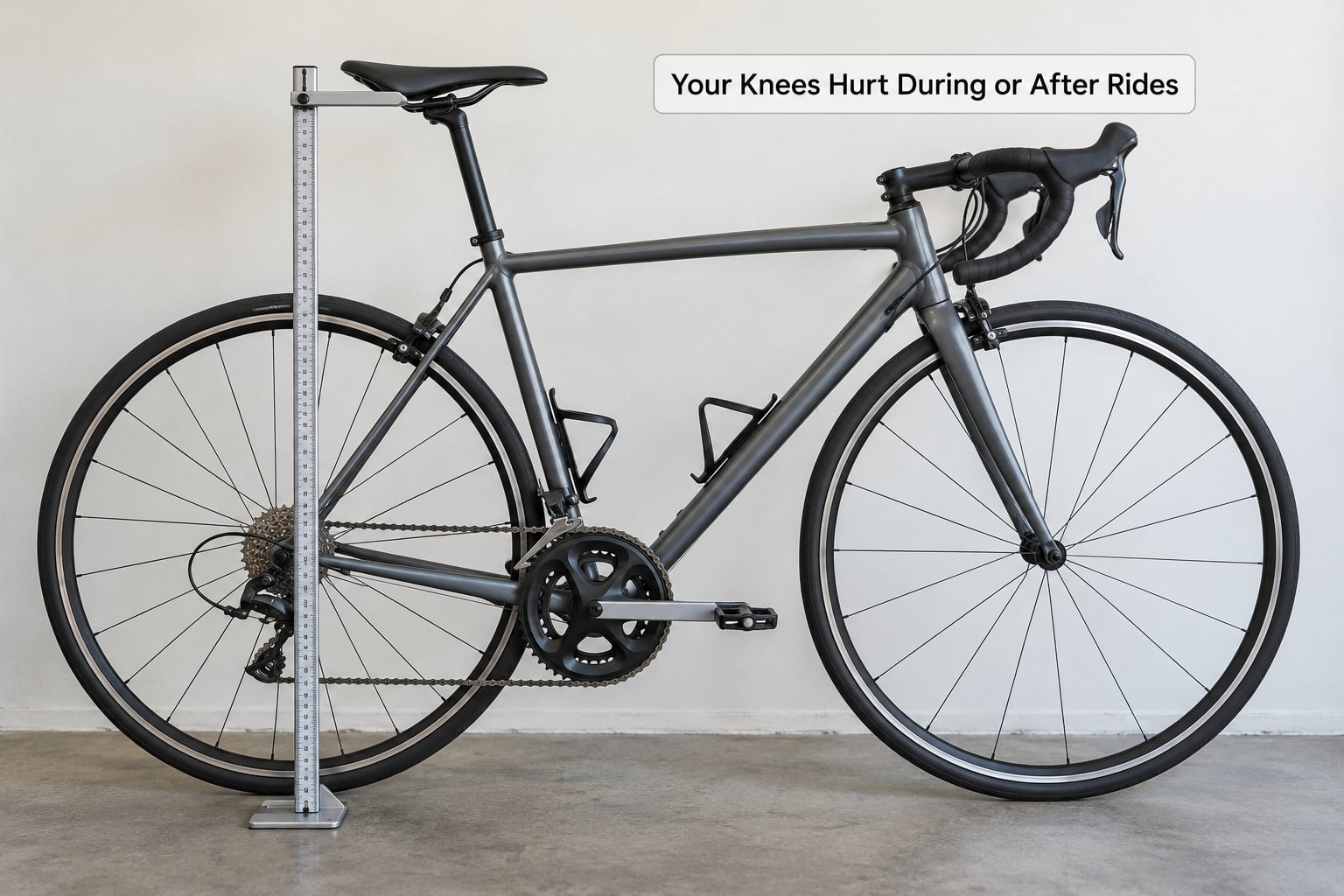
Knee pain is the sign riders notice first, and it is the one most often blamed on the bike being wrong in size. Most of the time it is position instead: saddle height off by more than a few millimetres, too much reach to the bars, or feet set in a way that pushes the knee in or out.
Where it hurts matters. Pain at the front of the knee, under the kneecap, usually points at saddle height being too low or a saddle set too far back. Pain on the outside of the knee tracks more toward foot position and how much you wobble on the bike.
Ask yourself one question: does it show up on the same ride every time, or only after a week where you added distance or hills? Pain that appears after a genuine jump in volume is more likely a training-load problem than a fit problem. See a doctor or physiotherapist if swelling, locking, instability or pain that lasts more than a few days shows up.
2. You Have Hand or Wrist Pain
Sore hands after a long ride usually mean too much weight is on them. Narrow bars, a bar rolled far forward, or a cockpit set high enough that you are resting your weight on the tops will do it every time.
Wrist pain is a different story, and often a reach problem. When the bars sit too far forward, the angle through the wrist stops being neutral and you carry the load through an awkward joint rather than through the forearm.
A quick tell: if you ride most of the ride with your palms flat on the tops rather than on the hoods, something in the cockpit is off. Moving the hoods back and down a few degrees often helps before anything else.
3. You Experience Numbness in the Hands, Feet, or Saddle Area
Numbness is the one symptom you should never ride through. It means something is pressing on a nerve or cutting off circulation, and the longer it stays, the longer the nerve has to recover.
In the hands, the usual causes are a bar too narrow or too wide, or a lot of pressure on the hoods and drops. In the feet, it is usually the cleat position or hard pedalling pressure. In the saddle area, a saddle that is too wide or narrow, or tilted, concentrates load in the wrong spot.
If numbness does not clear within a few minutes of stopping, or it keeps coming back across rides, that is a doctor or physiotherapist conversation, not a tweak-it-and-see situation. Stop riding through it.
4. Your Lower Back or Hips Ache on Longer Rides
Back and hip ache on longer rides usually shows up in the last hour, when the small muscles across your lower back have been holding your torso steady the whole time. A cockpit that is too long forces you to reach, and a torso that cannot hold that reach starts to rock.
Restricted mobility matters as much as geometry here. Riders who cannot rotate the pelvis and hips over the pedals absorb the difference with their lower back instead.
When a bike fit will not fix your back pain
A fit can change position and pressure. It cannot treat a disc problem, a nerve issue or a genuine strength deficit, and it will not resolve pain that shows up at rest, at night, or that travels down a leg. Those belong with a doctor or physiotherapist, and getting fit help first is still sensible so you are not training around a problem.
5. You Cannot Maintain Your Riding Position Comfortably
A good position should be boring. If you are rocking side to side, lifting your hips out of the saddle, standing up every few minutes or shifting back and forth constantly, your position is being held by effort rather than by the bike holding you there.
Saddle height that is too low forces the hips to rise at the top of the stroke. A reach that does not match your size can push you up and forward out of the saddle on any effort. Both are fixable, and both cost you power as well as comfort.
Try this: ride twenty minutes at an easy, conversational pace and notice how often you move. Once or twice to stretch is normal. Constant repositioning is a fit signal.
6. Your Power Drops or You Ride More Cautiously Than Before
When a position stops matching you, the first casualty is not comfort, it is efficiency. A lot of riders notice the drop in a test before they notice the discomfort.
Unstable pedalling wastes force. If you cannot hold a steady effort because you keep shifting, and the bike feels like it needs constant steering input to stay in line, part of your power is going into holding yourself on the bike rather than into the pedals.
Be honest about the timeline. A plateau that lines up with a harder training block or a poor week of sleep is probably fitness or recovery. A plateau that arrived slowly, alongside a bike that stopped feeling right, points much more at position.
7. Your Bike Handles Poorly or Feels Unstable
Some handling complaints have nothing to do with fit, so rule out the mechanical causes first: tire pressure, brake rub, a loose headset or a worn cable. A fitter will check all of that, and it is worth checking yourself so you are not paying for a session to be told your front brake is dragging.
Once the bike is mechanically sound, position is the next suspect. Bars sitting much higher than they should make the steering heavier. Too much forward lean moves weight onto the front wheel and makes the bike nervous. A bar that is too wide makes you ride with your arms out, which changes how the bike responds under you.
One more honest caveat: some riders describe handling problems that a mechanic finds are just the bike. Not every twitchy ride is a fit issue, and a good fitter will tell you so.
8. Your Saddle Is Uncomfortable Despite Adjustments
Saddle discomfort is the most over-adjusted area of any bike. Riders move the saddle forward, back, up, down, then buy a different saddle, and the discomfort comes back a month later.
Start with width. A saddle too narrow pushes you onto your sit bones; too wide puts you on soft tissue that was not designed for the load. Then check level and nose angle, because a tilted saddle pushes you off one side and creates pressure you did not intend.
Moving the saddle around cannot rescue the wrong saddle. If you have adjusted height and tilt and still cannot sit through a two-hour ride, the shape or width is the problem, and a fitter should pressure-map it rather than guess.
9. Your Feet, Shoes, or Drivetrain Produce New Problems
New shoes or new cleats change the relationship between your foot and the pedal, and that shows up further up. Clipping in with the cleats too far forward or too far back moves the load through the wrong part of the foot and shifts how the knee tracks on every stroke.
Crank length matters too. Cranks that are too short leave the hips cramped at the top of the pedal stroke, and cranks that are too long create a lot of hip and knee travel on every revolution. The effect on your saddle height is direct, so crank changes and saddle height changes have to be considered together.
If your knees start pointing in, or your feet feel like they are rolling off the pedals on a long ride, book the session rather than nudging cleat position a millimetre at a time.
10. You Have Recently Changed Bike, Components, or Riding Position
Fits expire quietly. Nobody’s body stays the same for a decade, and the fit you had when the bike was new is not the fit that suits you now. Physiotherapist and fitter Alyssa Hillaby, quoted by Bicycling, puts the useful life of a fit at roughly two years.
A major change invalidates an old fit faster than time does. That covers a new bike, a switch between road, gravel or time trial, recovery from an injury, a significant weight change, and new goals that ask for a more aggressive position than the one you ride now.
The equipment side counts too. New bars, a different stem, a saddle swap, different cranks or new cleats all move one of the three contact points, and every contact point affects the other two. A fit is a system, so changing a part of it means the rest needs checking.
Book the follow-up. A rider I know had a fitting on a new bike and felt fine for weeks, then found their hips moving and their knees complaining on the first long ride back. That is normal after a position change, and it is exactly what a four-to-six week check is for. If the change made things worse, say so; adjustments at that stage are usually quick.
Frequently Asked Questions
How can I check if my bike is fitting properly?
Ride for twenty minutes at an easy pace and watch what happens. Check whether your hips stay still in the saddle, whether your heel just grazes the pedal at the bottom rather than lifting your hip, whether you carry noticeable weight on your hands, and whether you feel pressure spread across both sit bones. If you are shifting, rocking, or standing up to relieve pressure, your position is not holding you.
Can a bad bike fit cause knee pain?
Yes. Saddle height that is too low, too much reach to the bars, or feet set so the knee tracks inward are all common causes of cycling knee pain. Pain under the kneecap usually points at saddle height or setback; pain on the outside of the knee points more at foot position and pedalling stability. Pain with swelling, locking or instability needs a doctor, not a fitter.
Can bike fitting help with lower back pain?
Often, yes, when the pain is driven by position. A cockpit that is too long, a saddle set too far back, or limited hip mobility forces the lower back to hold the torso steady for hours. A fit can correct the geometry and a fitter will check your mobility. A fit cannot treat a disc, nerve or strength problem, so pain that travels down a leg, wakes you at night or shows up at rest belongs with a doctor.
Do you really need a bike fit if the bike was fitted when you bought it?
Usually eventually. The position that suited you on the day you bought it drifts as your body, equipment, discipline and goals change, and riders are rarely told a fit expires. Treat a fit like a service interval rather than a one-off. If nothing hurts, you can ride happily for years without one. If the same ache keeps returning, the old position is worth revisiting.
How often should I get a bike fit?
Every year or two for regular riders, sooner after a major change: a new bike, a discipline switch, an injury or recovery, a significant weight change, or a shift in training goals. Anyone riding in pain should not wait for a schedule. Do schedule a quick check four to six weeks after a new fit, because a position that feels fine on the shop floor can show problems on the first long ride.
What should I do about pain that appears while cycling?
Stop riding through it and check the mechanical basics first: tires, brakes, cleats, bar tape. If pain settles once you adjust position by a few millimetres, you have a fit problem worth sorting. If it persists, worsens across rides, or comes with numbness, swelling or instability, stop and see a doctor or physiotherapist. Fitness help cannot substitute for medical assessment of those symptoms.
Conclusion
Start with the sign you keep repeating. Ride twenty easy minutes, check your hips, heels, hands and pressure points against the table above, and rule out the mechanical basics. If the same discomfort keeps coming back, or numbness shows up, book a qualified fitter. And if pain carries swelling, numbness or travels down a leg, see a doctor first.
Last updated: October 2026.