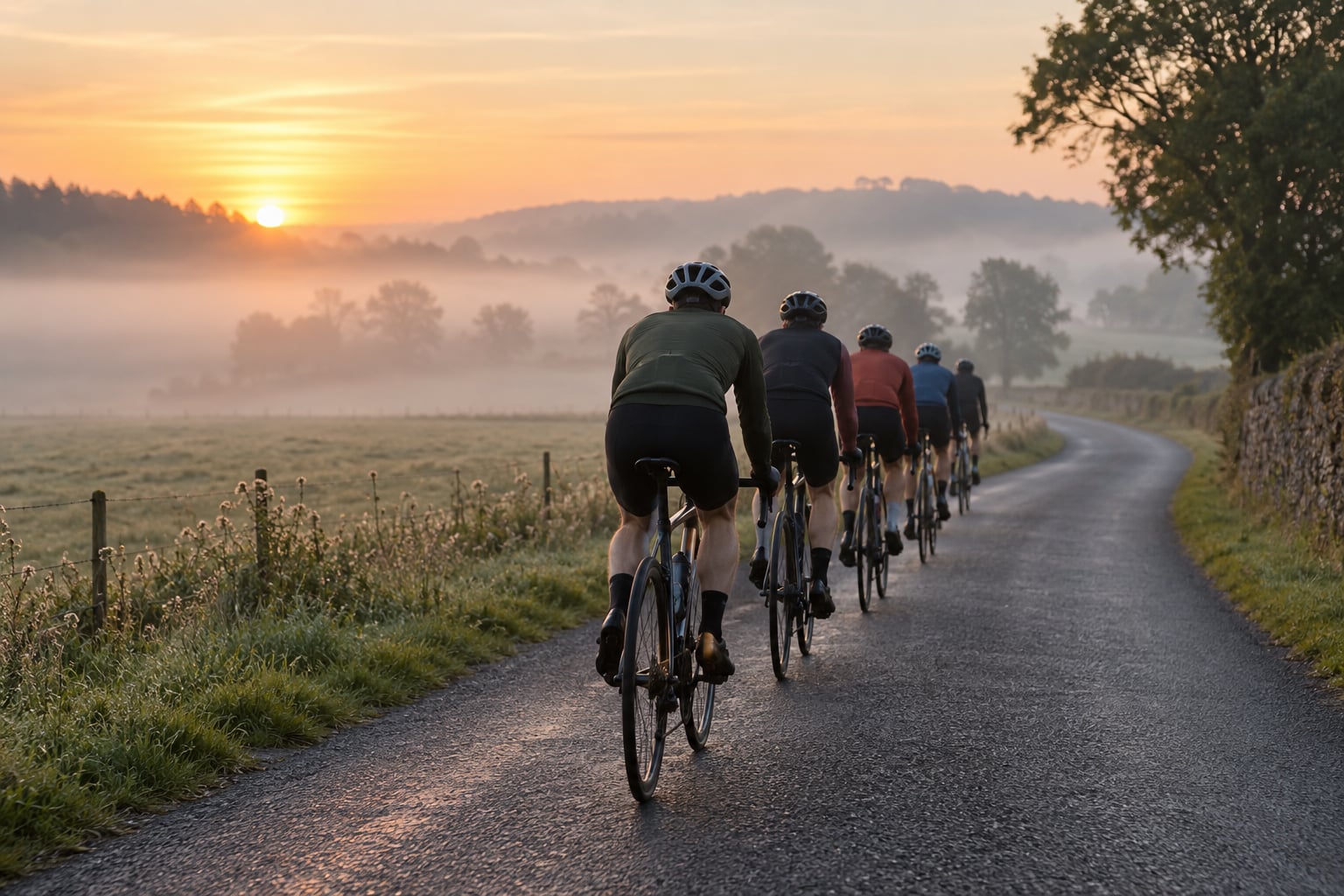
What to expect on your first group ride: a friendly roll-out, a single or double line of bikes rotating through the front, a pace chosen for the slowest rider, planned regroup points, and a coffee stop at the end. Nobody is racing you, and nobody expects you to know the signals yet.
I have run Saturday-morning rides for a local club for years, and the thing that catches new riders out is almost never fitness. It is proximity. Twenty centimetres of handlebar in front of you, at speed, is a completely different skill from riding alone, and it takes two or three rides before your hands stop drifting.
Table of Contents
- What to Expect on Your First Group Ride
- How Group Rides Are Usually Structured
- The hour-by-hour version
- How to Prepare Before the Ride
- What It Feels Like to Ride in a Group
- How the Pace Line Works
- Group Riding Etiquette New Cyclists Should Know
- Predictable riding
- Communication
- Regrouping and dropping back
- Other basics
- What to Expect on Hills, Descents, and Turns
- Breaks, Food, Hydration, and Changing Conditions
- How Fast and Far Should You Expect to Ride?
- How to Tell When You Want to Turn Back
- Frequently Asked Questions
- How fast should I ride on my first group ride?
- What should I do if I cannot keep up with the group?
- Is it okay to draft behind another rider?
- What should I do if I have a flat or mechanical problem?
- How do I know whether the group expects me to regroup?
- How should I prepare for my next group ride?
- Conclusion: Start Small and Ride Safely
What to Expect on Your First Group Ride
Here is the honest short version. Nine things will happen, in roughly this order:
- You arrive, introduce yourself, and nobody minds that you do not know anyone yet.
- The ride leader explains the route, pace, regroup points and where the regroup spots are.
- You roll out slowly, usually single file, for the first few kilometres.
- The group forms a pace line and the strongest riders take the first turn at the front.
- You settle into the sweet spot of the line and hold a wheel rather than a rider’s jersey.
- You will be asked to take your pull at some point, and it is easier than it looks.
- The group stops at scheduled points, waits for everyone, and reforms before rolling again.
- Climbs split the group slightly and then pull it back together at the top.
- You finish together, usually at a cafe, and somebody asks you back next weekend.
That is the shape of nearly every first ride. The details change from club to club, but the rhythm does not.
How Group Rides Are Usually Structured
Most club rides follow the same skeleton: a meeting point with ten to fifteen minutes to spare, a roll-out, rotating sections of flat road, a few climbs, and a regroup after each significant change in pace. After about an hour the group usually settles into its first real rhythm, and the pace line stops looking chaotic and starts looking like a single organism.
| Element | What it usually looks like |
|---|---|
| Expected pace | Posted as an average speed or a range, often 15 to 19 mph for a beginner club ride |
| Ride duration | 30 to 75 minutes for most weekend social rides |
| Regrouping | Every 20 to 30 minutes, and always after a climb, at a named spot |
| Breaks | One or two scheduled stops, plus a cafe or shop at the finish |
| Effort level | Conversational most of the time, with brief hard efforts at the front |
| Who leads | A ride leader at the front and a sweep rider at the back with a spare tube |
The hour-by-hour version
The first fifteen minutes are the social part. Introductions at the car park, a check that everyone has a helmet and water, and a leader walking through the route. The next twenty minutes are the hardest for a new rider, because everyone is bunched and nobody wants to cause a chain reaction.
By the middle of the ride, the group has found its pace and the rotation has become automatic. This is when riding in a group feels good, and it is also when people stop thinking and start drifting. The last fifteen minutes bring regrouping, a short chatty stretch, and the group pulling together for the finish.
How to Prepare Before the Ride
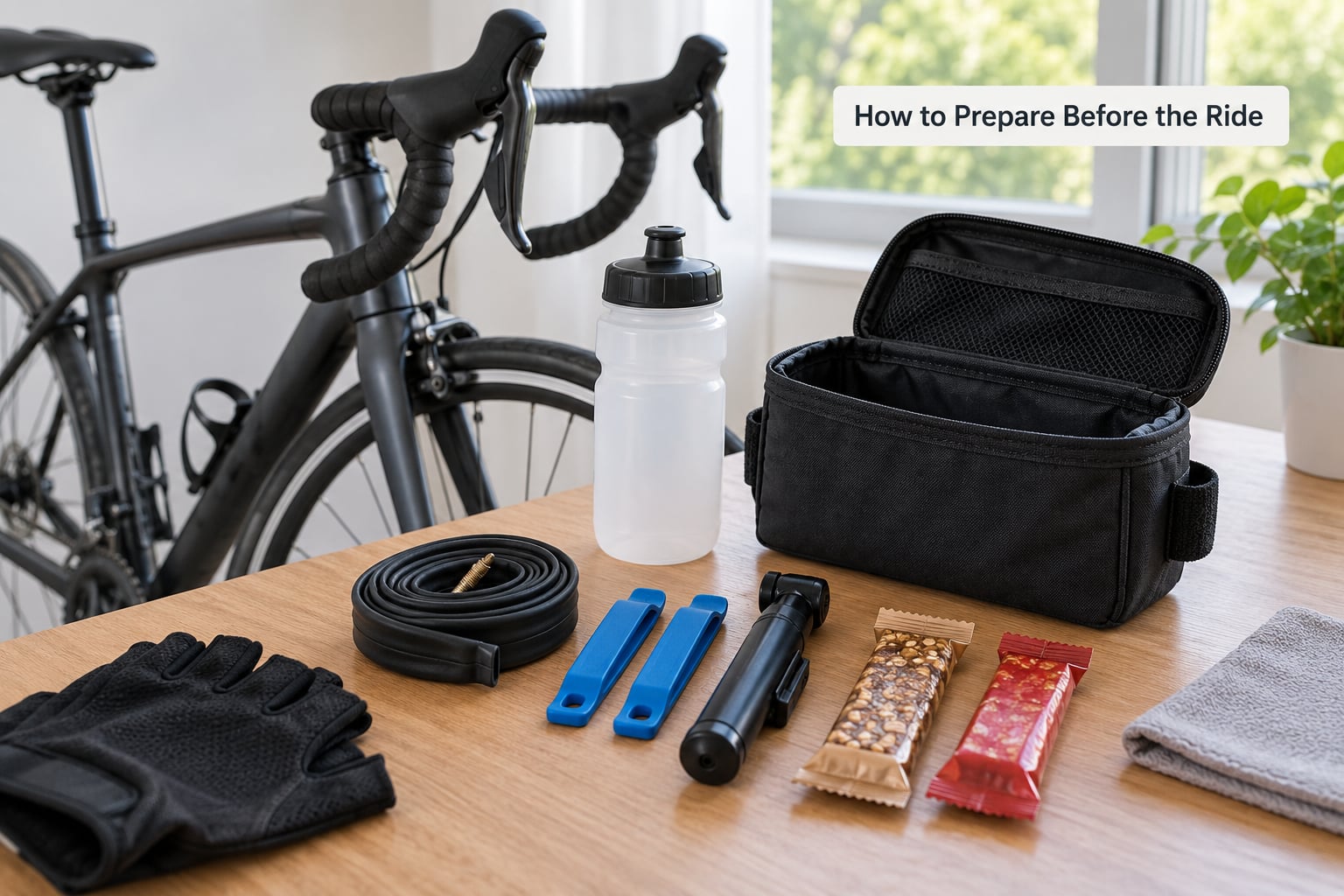
Preparation for a first group ride is mostly administrative, and doing it the night before removes almost all the stress. Work through this list and you will never be the person rummaging in a jersey pocket at the regroup.
- Route details. Distance, hill profile and the finish point. Ask whether the finish is a cafe or a parking lot, because that tells you the social tone.
- Arrival time. Show up ten to fifteen minutes early. On a first ride, arriving after the roll-out is the most common way to feel like an outsider.
- Bike condition. Check tyre pressure against the sidewall recommendation, look for cuts in the casing, and make sure both brakes bite before you go.
- Helmet. Many clubs will not let you ride without one, and it is the one piece of kit with no exceptions.
- Flat kit. Spare tube, CO2 cartridge, tyre lever, and a multitool with a chain breaker. Even a cheap kit beats borrowing tools.
- Water and food. Roughly one bottle per hour and about 100 calories of food per hour. Bars, dates, or plain sandwiches all work.
- Lights. Front and rear lights if there is any chance of returning near dusk, even in summer.
- Layers. Cotton is a mistake once you start working. A packable wind vest covers most weather changes.
- Emergency details. A contact name and number for whoever is at home, and an emergency contact you told last week.
- Honesty about ability. Tell the leader you are new, and say roughly how much you ride. It changes how the group paces itself and removes all guesswork.
One more thing worth doing: ask the leader whether the ride is a true no-drop ride. “Friendly” and “no-drop” are not the same thing, and clubs use both labels loosely. See the next section for what each ride type actually means.
What It Feels Like to Ride in a Group
The first thing you notice is the wind disappears. Drafting behind another rider cuts aerodynamic drag by up to 50%, and because air resistance can account for up to 95 percent of a cyclist’s energy at speed, riding in a line is dramatically easier than riding alone at the same effort. That is why a group holds a pace on a headwind that would have you walking up the road solo.
The second thing is noise and smell. Hub hum, wind, tyre roar, someone clipping their cleats, a chain dropping on a hill. It is more sensory input than riding alone, and your head will be busy for the first twenty minutes before it settles.
Then the tactical part changes. You cannot drift across the road to look at a nice view, because someone is drafting your tyre. You need to look ahead through two wheels before you steer, and you need to signal anything you cannot see around. Small mistakes that were invisible alone become group events.
How the Pace Line Works
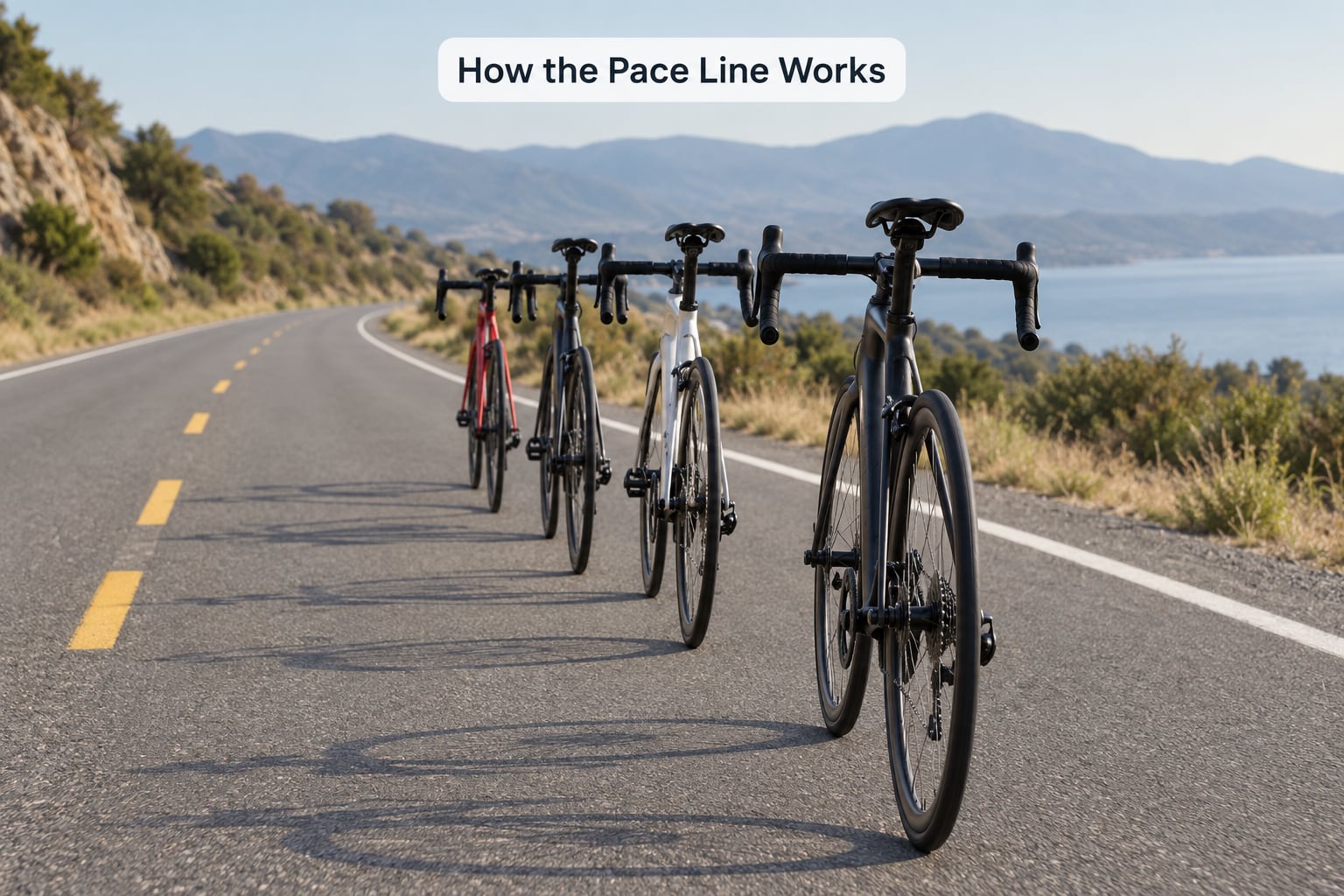
A pace line is simply a line of riders taking turns at the front, where the wind and the effort are highest. The rider at the front is called the lead. When they peel off, the rider directly behind them becomes the new lead and everyone shifts back one place. That rotation is the whole system, and it is less technical than it sounds.
Three rules cover almost everything. First, leave a wheel’s length of space between your front wheel and the wheel in front of you, and never overlap wheels, however slow the group is going. Second, when you peel off, look over your shoulder, say “pulling off”, and move across smoothly at the pace of the group, not faster. Third, if you are joining, get in behind the last rider, call “joining”, and match the pace before you slot into the wheel.
When should you move up? Move up when you are genuinely fresh, not when the group is going slowly and you are impatient. Sit comfortably for a stretch first, feel how the line breathes, and take your pull once you know the rhythm. Riding your first pull harder than anyone else is the fastest way to lose the back of the group.
On a windy day or a wide road, some groups ride a double line, echelon formation, where pairs rotate across the road to share the headwind. It is efficient but harder to read, so follow the person in front of you rather than copying the rider across the road.
Group Riding Etiquette New Cyclists Should Know
Group etiquette is less about rules than about predictability. Riders who crash are almost never the ones who did something wrong, they are the ones whose move nobody else could read. Everything below comes down to making your intentions obvious before you act on them.
Predictable riding
Good behaviour looks like this: you check over your shoulder before moving across the road, you hold your line through a corner, you brake before the corner rather than in it, and you accelerate back to the group speed instead of bolting. Poor behaviour looks like this: drifting, sudden braking, riding on the wrong side of the road, or sprinting across two lanes because you want to get to the front.
Communication
Say what you see, out loud. “Gravel”, “Hole”, “Car back”, “Clear”. If you find something on the road that nobody else has seen yet, the whole group slows, which is a rough bill for the person who did not speak up. If you see something, say something.
Regrouping and dropping back
If you drift off the back, do not sprint to catch the group. Wave for the group to wait, or call “give me a minute”, and ride on at your own pace until they slow down. Leaders are used to this. If the ride leader says the group waits for everyone, take them at their word and get back on as soon as you safely can.
Other basics
Stop fully at stop signs. Obey lights. Take your pull at a steady pace rather than an all-out sprint. Do not half-wheel your friend, which means sitting beside them so they cannot see the road ahead. And be slow to offend and be slow to be offended, because every group has a dominant personality and it is rarely you.
What to Expect on Hills, Descents, and Turns
Climbs are where groups reorganise. Riders fan out to pick a line, effort rises for a minute or two, and then the group reforms at the top. This is called sag climbing, and it simply means riding the climb a little above your natural pace and settling back down immediately after. Beginners often lose the group here by pushing hard at the bottom and then having nothing left.
Before a turn or descent, get into a gear that lets you pedal around the corner comfortably rather than one that forces you to coast. On a descent, the back of the group brakes hardest because everyone in front has already slowed down. Keep a slightly larger gap than usual through a corner, and if the leader says “car back”, expect to wait a moment before the group accelerates away again.
My advice for a first ride is simple: let the faster riders go ahead on a climb, then use the regroup point to rejoin the group. Nobody remembers who rode up a hill fastest on their first outing.
Breaks, Food, Hydration, and Changing Conditions
Rest stops are normal. Most groups plan one every 20 to 30 minutes, more often in summer, and it is the perfect moment to eat, refill, adjust your gloves, and ask somebody a question about the route. Riders who want more time signal it early, because a group that has not yet left a stop will happily wait.
Drink roughly one bottle of water per hour and eat about 100 calories of food per hour, which for most riders means a bar every 20 minutes or so. Take a small emergency snack even on a short ride, because the ride that goes wrong is rarely the one you planned for. If you feel overheated, dizzy, or unwell, say so to the leader rather than pressing on.
Weather turns plans around. A headwind that was fine outbound can turn a return leg into a slog, and rain changes how carefully a group packs together. A mechanical usually means a stop of ten to twenty minutes, a group chat about whether someone needs a lift, and regrouping. Ride leaders carry a spare tube, which is why the sweep rider matters.
How Fast and Far Should You Expect to Ride?
Expect a range, not a number. A beginner social ride might hold 14 to 16 mph on the flat, a mid-level club ride might sit at 18 to 20 mph, and a ride advertised as a training ride might average well above that. Most groups set the pace at something the least experienced rider can hold all day, which usually means the strong riders are riding below their own solo pace.
That is why the useful rule of thumb is to choose a pace you could sustain for two hours on your own, not the fastest you have ever held for twenty minutes. On a first ride, control, communication and finishing together matter far more than the number on your cycling computer.
Also expect the ride to take longer than the distance suggests. A 40-mile route with regrouping, a cafe stop, and a slow tail end can easily eat four hours. Build your first ride around a morning, not a whole day, so the experience ends while you still want another one.
How to Tell When You Want to Turn Back
If what to expect on your first group ride included turning back, you would not be in trouble. Plenty of people ride half a loop, feel their legs go, and ride home with the group. Leaving early is a legitimate choice, and how you handle it matters more than whether you do.
Reasons to stop or turn back include persistent exhaustion that does not ease when you slow down, feeling overheated or dizzy, shaking or numbness, pain that changes your riding position, a mechanical you cannot fix, and simply realising the group is far faster than you want to ride on a regular basis.
Tell the ride leader before you peel away, not after. “I am going to turn in at the cafe, I will see you next week” is all it takes. Do not diagnose yourself or anyone else, and if symptoms are worrying or persistent, stop and get advice from a doctor rather than riding it out. Riding with other people also means they can watch for signs that you have stopped noticing.
Frequently Asked Questions
How fast should I ride on my first group ride?
Ride at the pace the group posts, not the fastest you have ever gone. Beginner social rides commonly sit between 14 and 16 mph, mid-level clubs around 18 to 20 mph. If the pace feels wrong for how much you ride, ask the leader before you commit rather than after. One easy ride beats three that end badly.
What should I do if I cannot keep up with the group?
Do not sprint to close the gap, because you will arrive exhausted and lose more time. Wave for the group to wait, or call out that you need a moment, and ride at your own pace until they slow down. Genuine no-drop groups will stop or regroup for you. If they do not, that tells you something useful about the group before you sign up again.
Is it okay to draft behind another rider?
Yes, drafting is the entire point of riding in a group, and it is what lets everyone hold the same speed. Just do it properly: leave a wheel’s length of space, never overlap wheels, match the wheel in front, and rotate to the front when it is your turn. Drafting illegally by shooting across a lane to catch a wheel is a different thing and gets you spoken to.
What should I do if I have a flat or mechanical problem?
Pull off the road as far as you can and out of the traffic lane, then tell the ride leader so the group knows you have stopped. Fix what you can with your kit: tube, tyre lever, CO2 cartridge, multitool. The sweep rider usually carries spares and will offer you a lift. Do not rejoin the group mid-line, and do not peel across the pack to do it.
How do I know whether the group expects me to regroup?
Ask the leader before the ride starts, and listen for the answer every time. The clearest confirmation is that the group actually stops and waits at the agreed points. Friendly does not mean no-drop, and many clubs run rides at very different speeds under similar labels. If nobody answers the question, treat that ride as a drop ride and plan for it.
How should I prepare for my next group ride?
Write down what felt hard on the first ride, whether it was nerves, pace, hills or position, and work on that one thing. Ride solo beforehand so your legs know the route pace, then go back with the same group, because familiarity is what turns a hard first ride into an easy third one. Bring the kit you did not think you needed last time.
Conclusion: Start Small and Ride Safely
What to expect on your first group ride in 2026 comes down to this: introductions, a rolling pace line, scheduled stops, and a ride that finishes together. Bring a helmet, a flat kit, water and food, arrive early, and tell the leader honestly how much you ride.
The single best first action is to sign up for an introductory or beginner no-drop ride rather than the fastest club loop. Tell people it is your first time, stay in the middle of the pack, focus on holding a wheel and calling out hazards, and let the ride end comfortably. That is how the second ride gets booked, and the tenth ride stops being frightening.