Road cycling safety tips for beginners come down to a short list of habits you repeat on every ride: a helmet that actually fits, a bike that passes a quick check before you roll, lights on even in daylight, a straight predictable line, and eyes up looking for trouble early. None of it is complicated. The hard part is doing the same five things when the road is busy and you are nervous.
Most beginners I have ridden with were not scared of the bike. They were scared of the road. That fear is normal, and it fades in a predictable order — empty parking lot, quiet residential street, a road with a bike lane, then a road with traffic. Skip a stage and the nerves come back on the day. This guide walks the stages in order, with the gear and technique details that matter at each one.
A note on honesty: nothing here makes you uncrashable. Visibility gear gets you seen more often, it does not make you invisible-proof. A helmet reduces the severity of a head injury, it does not prevent a crash. What these habits do is shrink your chance of being the person nobody saw coming.
Table of Contents
- Road Cycling Safety Tips for Beginners at a Glance
- How do the 12 tips fit into one ride?
- 1. Wear a Properly Fitted Helmet
- 2. Check the Bike Before Every Ride
- 3. Use Front and Rear Lights
- 4. Make the Bike Visible to Drivers
- 5. Ride Predictably and Obey Traffic Laws
- 6. Scan for Hazards and Keep a Safe Line
- 7. Control Speed for Conditions
- 8. Use the Right Braking Technique
- 9. Ride Safely in Groups
- 10. Wear Appropriate Clothing and Footwear
- 11. Carry Basic Repair and Emergency Supplies
- 12. Know What to Do After a Crash
- Frequently Asked Questions
- What is the 2 2 2 rule for bike helmets?
- What lights do I need to ride legally at night?
- Where do most cycling crashes happen?
- Should I ride in the bike lane or take the whole lane?
- Is it normal to feel scared of riding in traffic as a beginner?
- What are the most common beginner mistakes to avoid?
- Conclusion
Road Cycling Safety Tips for Beginners at a Glance
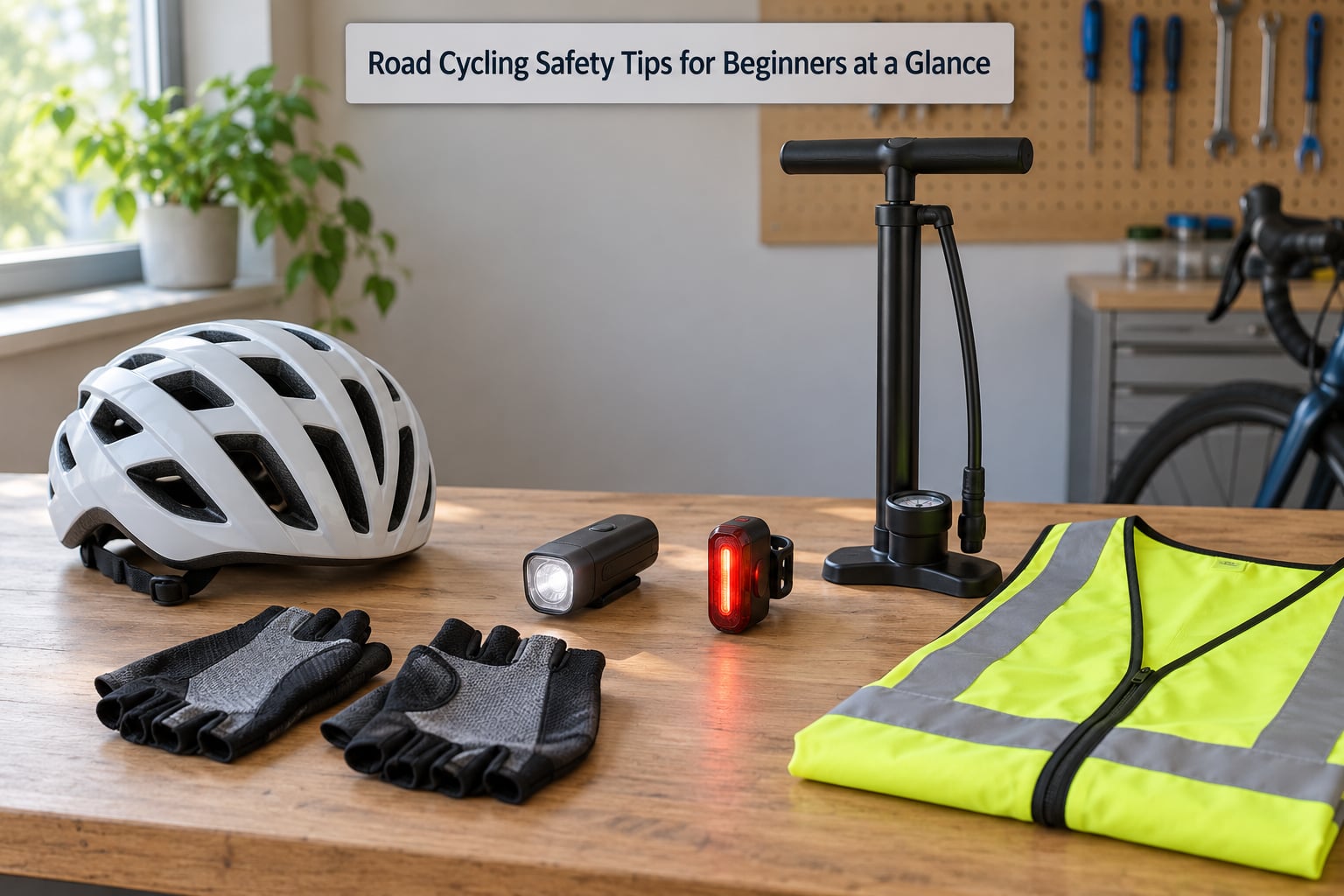
Here is the whole set on one page, so you can see when each tip actually gets used.
| Tip | When it applies | What to check | Why it matters |
|---|---|---|---|
| 1. Helmet fit | Before every ride, and again after any fall | Level, low on the forehead, straps snug, no movement | Only works if it stays in place through an impact |
| 2. Bike check | Start of every ride | Tires, brakes, chain, quick releases, bolts | Catches the failures that strand or injure riders |
| 3. Lights | Any ride in low light, dawn, dusk, fog or rain | White front, red rear, charged batteries | Most drivers decide they saw you in the first two seconds |
| 4. Visibility | Every ride | Bright clothing, clean lenses, steady line | Being seen and being predictable are both required |
| 5. Predictable riding | Every ride on public roads | Signals, lane position, markings, stopping | Drivers plan around riders they can read |
| 6. Hazard scanning | Continuously while rolling | Driveways, gravel, potholes, debris, wet patches | Time to react is the only thing you cannot buy back |
| 7. Speed control | Continuously while rolling | Traffic, curves, surface, fatigue, group size | Speed is your main tool for staying out of trouble |
| 8. Braking | Before every hazard, and when following | Smooth front and rear pressure, enough gap | Sudden stops cause most falls from the front wheel |
| 9. Group riding | Whenever riding with others | Spacing, single file, calls, regroup points | The group can only protect you if it stays together |
| 10. Clothing | Every ride, in every weather | Padding, gloves, layers, footwear, helmet clearance | Discomfort pulls attention away from the road |
| 11. Repair kit | Every ride, however short | Tube, levers, pump, multitool, phone, water | Turns a long walk into a five-minute delay |
| 12. Crash response | Low frequency, high consequence | Airway, bleeding, movement, reporting | What you do in two minutes shapes the next month |
How do the 12 tips fit into one ride?
Tips 1 to 3 happen before you move. Tips 4 to 8 happen while you ride, on repeat, and they use the same scanning habit. Tips 9 and 10 only matter if you ride with others or in bad weather. Tips 11 and 12 are the fallback plan for the day something goes wrong, which is exactly why they are worth practising before you need them.
1. Wear a Properly Fitted Helmet
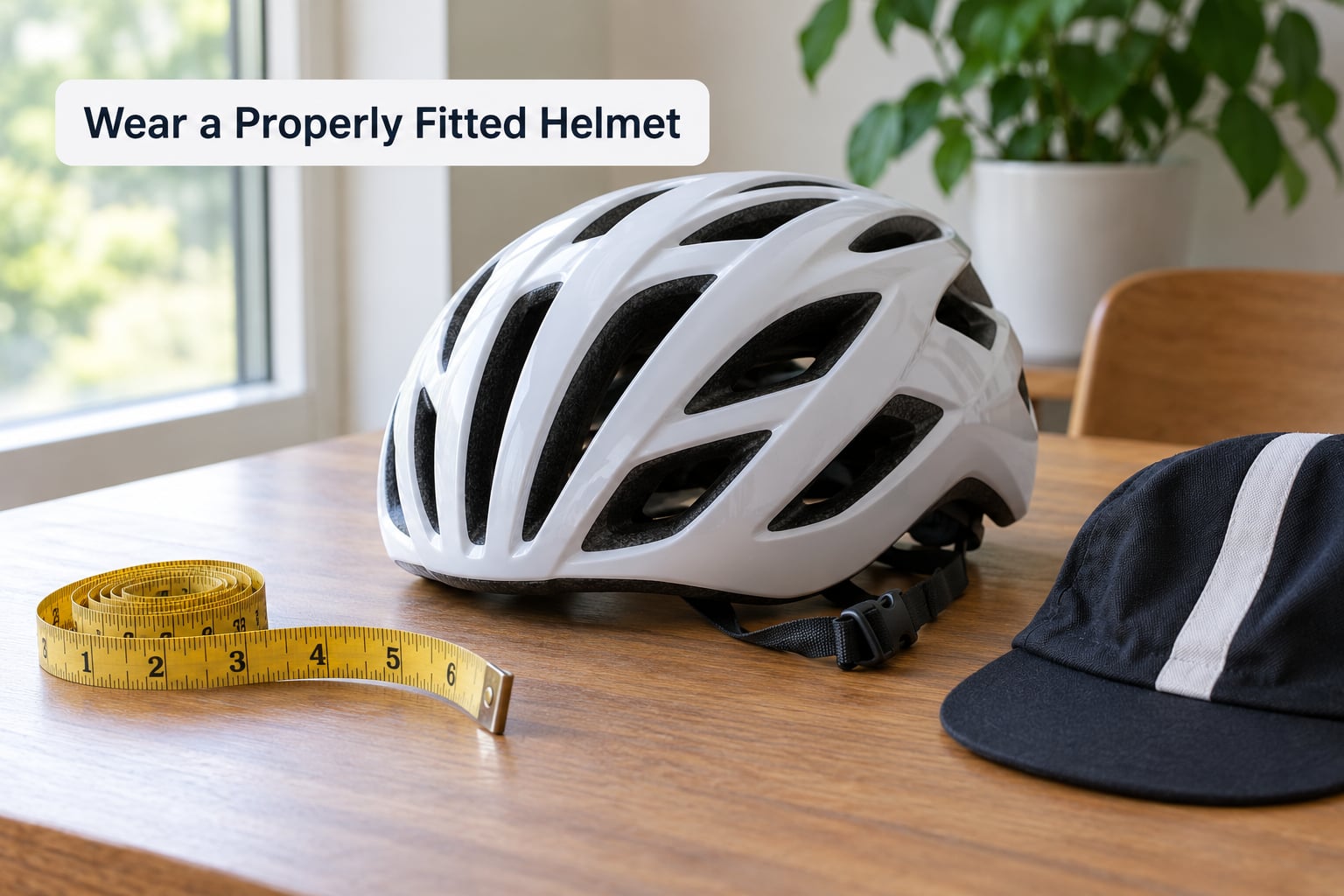
A helmet has to sit level, low and still, and most of the ones I see worn on group rides are doing neither. The 2-2-2 rule is the quickest check: two fingers’ width above your eyebrows, two fingers between each strap and your ear, two fingers under your chin when you close your mouth.
Fit it, then push it forward. If it slides toward your eyes, the front straps are too loose. If it lifts off the back of your head when you pull the rear straps, they are too loose. If it rotates side to side when you shake it, tighten the rear cradle or swap to a smaller shell.
Buy one carrying a recognised certification mark for your market, and never ride in a helmet after a hard impact, even if the shell looks fine. Foam compresses once and does not recover. Most riders get through a decade without a crash, and the handful who do need the helmet to have been fitted properly the first time.
2. Check the Bike Before Every Ride
Two minutes at the bike saves an afternoon. Squeeze both brake levers hard and confirm each one pulls and the wheel slows, then check the tire pressure against the range printed on the sidewall, not a number you remember. Spin the wheels and watch for a wobble or a rubbing brake pad.
Run your fingers along both brake cables and look for fraying at the ends of the housing. Check that the chain is on the chainring and cog, then pedal once around and listen. On quick-release models, close each lever by hand and make sure the wheel is seated straight; on thru-axles, confirm the lever clicks fully home.
Finish with a look at the bolts that hold the bars, stem and saddle, and a glance at the underside of the saddle and the tire sidewalls for cuts. A rattle you can hear at 15 km/h is a bolt or a spoke telling you something. Fix it before you leave.
3. Use Front and Rear Lights
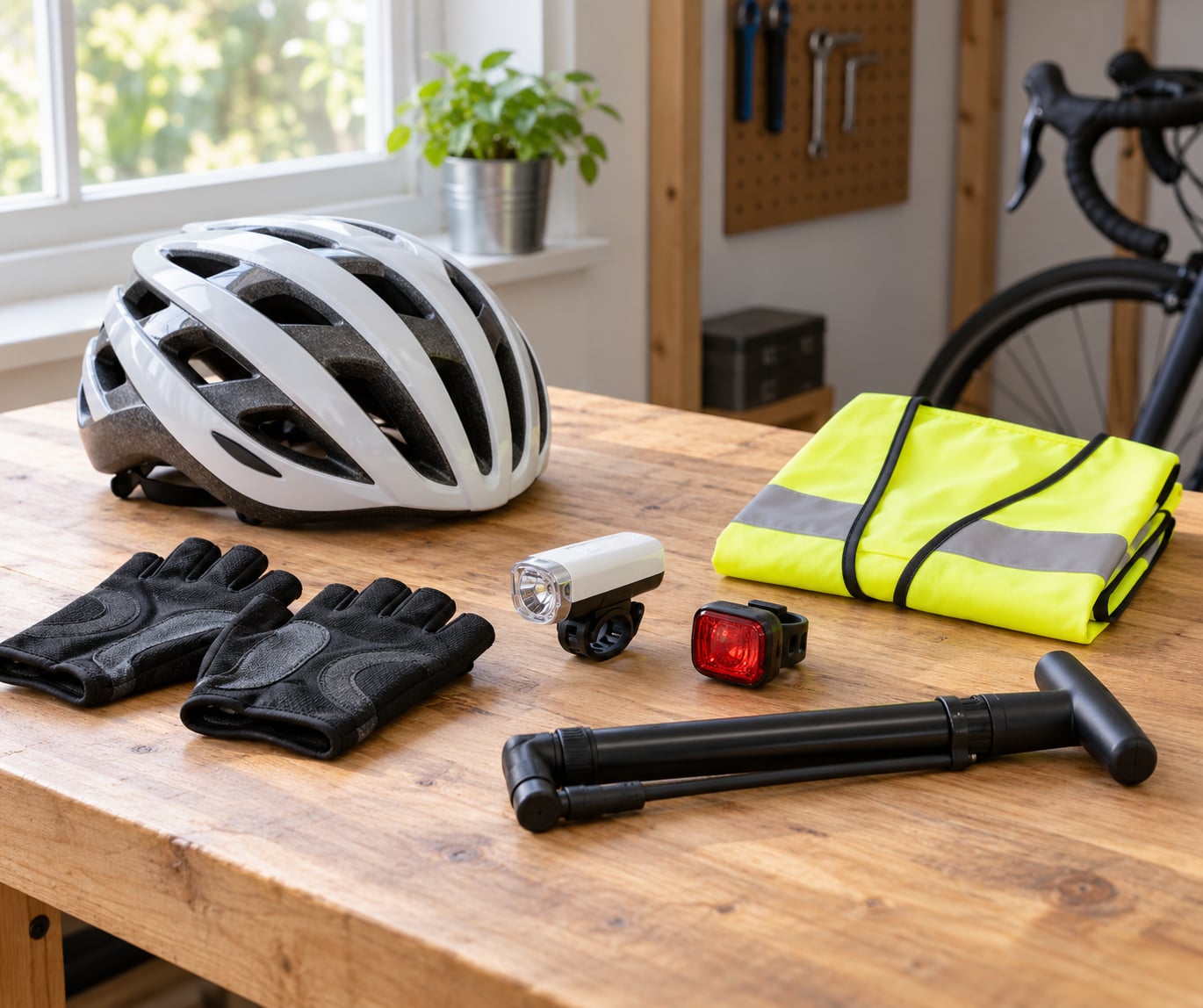
A white front light and a red rear light are the minimum in low light, and many riders run them in daylight too because they are the only part of the bike that moves. Point the front beam down the road, not into the eyes of drivers behind you, and keep the red light at the back at all times, not just after dark.
Reflectors do the quiet work. Pedal reflectors, spoke reflectors and a rear reflector need ambient light, so they help at dusk, in fog and in headlights, and they do nothing in bright afternoon sun. Treat them as a backup layer rather than a replacement for a powered light.
Carry a spare battery or keep a charge cable in your bag. A light that dies two kilometres from home with no shops open is a common and avoidable problem, and it turns an ordinary evening ride into a long unlit walk along a road.
4. Make the Bike Visible to Drivers
Bright clothing raises the odds of being noticed, particularly at junctions where drivers are looking for other cars. Reflective elements help when light hits them from a headlight or street lamp, so a light-coloured jersey plus reflective details beats a dark outfit with one reflective stripe.
Keep glasses and helmet visors clean. A smeared visor at dusk cuts contrast dramatically, and many riders never notice because the smear only shows when the light is low. Check them the same way you check your bike.
Then ride where you can be seen. Being visible also means being where drivers expect cyclists to be: not hugging the far edge of a road, not in a blind spot beside a truck, not hidden behind a row of parked cars at a junction. Visibility and positioning are the same habit seen from two angles.
5. Ride Predictably and Obey Traffic Laws
Signalling early is the single clearest thing a beginner can do to make a driver behave well around them. Signal your intention, check over your shoulder, then move. Signal, check, move — in that order, every time, and you will never be the cyclist a driver claims did not see them.
Hold a straight line inside the lane and ride with the flow of traffic rather than against it. Where a bike lane exists, stay in it while it is clear; when a car is parked in it, at a junction, or when traffic is simply too close for comfort, move into the lane and take your space. Rules vary by state and country, so check what applies where you ride.
Stop fully at signs and red lights, not a rolling slowdown. Riders lose legal protection and physical protection the moment they roll through. Predictable means a driver can tell what you are about to do, and almost every conflict on the road comes from a surprise on one side.
6. Scan for Hazards and Keep a Safe Line
Look far ahead first, then out to the sides, then briefly at your front wheel. That three-part scan is a habit worth drilling in a quiet car park before you rely on it at speed. Hazards are rarely in the spot you are staring at, because the thing you are staring at is already under you.
Watch driveways and side roads, where a car can appear at walking pace with no warning. Watch the line where cars queue, where a door can open, and where a tyre has dropped grit or oil. On a wet road, painted lines, metal drain covers and manhole covers get slippery first, so cross them at an angle where you can.
Choose your line early and commit to it smoothly. Small corrections at speed are what put a front tyre into a puddle. Where you must avoid something, check behind you first and signal, then move decisively rather than drifting around it.
7. Control Speed for Conditions
Speed is your primary safety tool, and the number that feels right changes with the road. Beginners tend to carry too much speed into a bend and too little on a flat straight with cross traffic, which is the opposite of what keeps them out of trouble.
Slow for anything you cannot see around, for wet or shiny surfaces, for gravel and sand, for a junction where you would need to stop quickly, and for darkness. Slow for the group in front, because if the rider ahead is on wet leaves, so are you.
Slow for yourself when you are tired. Fatigue shows up as narrower attention and slower reactions, usually in the last part of a long ride, which is exactly when most road crashes happen. A short ride finished early beats a long one finished badly.
8. Use the Right Braking Technique
Brake with both levers in stages. Front brake gives most of your stopping power, but squeeze it progressively; a sudden grab locks the front wheel and puts you down. Rear brake stabilises the bike, so bring it in slightly earlier than you think you need it, not later.
Leave room behind whatever you are following. A rough rule many riders use is to allow about one bike length of gap for every 10 km/h you are riding, so a fast group ride needs much more space than a slow one. Leaving room gives you the option to brake, which is the option that saves you when a hazard appears early.
Cover both levers before hazards you have already spotted, and ride one hand on the hoods rather than in a tight aero tuck when the road is busy or the surface is poor. Being able to brake without rearranging your hands is worth more than a few seconds of drag at 30 km/h.
9. Ride Safely in Groups
Wheel-to-wheel spacing keeps the group working without making it a train. Hold about a half wheel to two seconds behind in a straight line on clean road, and far more in the wet or when descending. Once you get a gap, close it steadily rather than sprinting, because the move that creates the danger is the one that creates the gap.
Drop to single file for anything narrow, for painted lines, for descents and for debris. Rotate the rider at the front, who works hardest holding wind. When someone calls a hazard, say what and where: “gravel, left of the wheel ahead” beats a sudden squeal that frightens half the group.
Never call “brake” as a surprise. Agree on a signal before the ride, regroup at every junction and after every turn, and ride the whole group to the end rather than leaving riders scattered across a road. A group that stops together is a group nobody gets left alone after a fall.
10. Wear Appropriate Clothing and Footwear
Padded shorts are the biggest comfort upgrade for a beginner, because an ordinary seat pushes in ways a long ride makes impossible to ignore. Add a simple jersey or top that fits close enough not to flap, and gloves to take the sting out of a palm on the bars and to improve grip when they are wet.
For feet, wear something with a stiff sole and a heel that holds your foot in place. Flat pedals let you put a foot down easily at lights, which is worth more to a beginner than cleats. If you do move to clipless pedals, clip on at a standstill and unclip with a twist rather than a yank.
Dress in layers you can remove on the move, and keep your helmet compatible with whatever you wear. A jacket collar that lifts, glasses arms that press, or a strap under a hood will all shift a helmet off its correct position, which undoes the fit you worked on.
11. Carry Basic Repair and Emergency Supplies
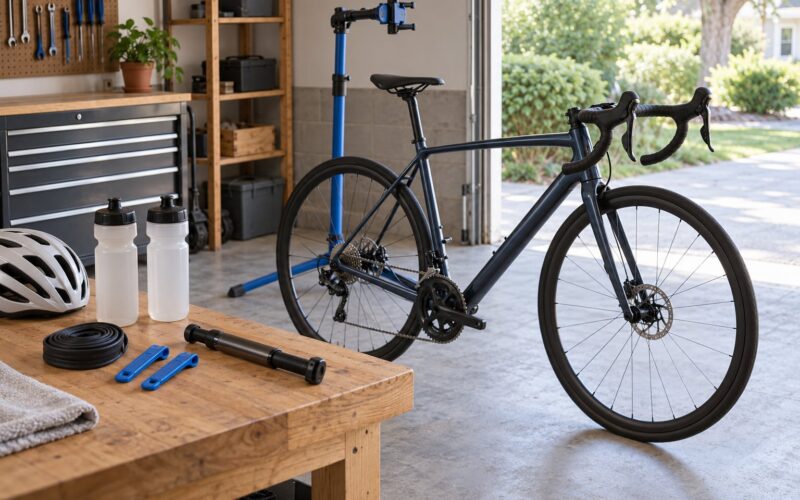
A compact saddle bag holds everything a beginner needs: a spare tube, tyre levers, a patch kit, a small multitool and a mini pump or CO2 inflator. Add a tube, not a tub of sealant alone, because a single thorn that reaches the tube ends the ride otherwise.
Carry your phone, charged and in a pocket you can reach while stopped, plus a card or note with emergency contacts and any medical details. Water matters even on short rides in warm weather. A reflective vest or a pack with reflective panels is useful if a ride goes later than planned.
Practise a wheel change once at home before you need it on a road with traffic. Changing a wheel is a five-minute job with practice and a twenty-minute ordeal without it, and the difference is entirely preparation.
12. Know What to Do After a Crash
After a fall, check yourself before you check the bike. Do not get up immediately if you hit your head, your neck, or if there is severe pain anywhere. Stay still, ask for help, and call emergency services if there is a loss of consciousness, confusion, severe pain, bleeding that will not stop, or a suspected neck or back injury.
If you are unhurt, move out of the road only when it is safe to do so, and signal traffic to slow down before you stand up in a lane. Get off the road first, then assess the bike. If someone else is hurt, do not move them unless they are in immediate danger from traffic or fire.
Take photographs of the scene, vehicles and injuries if it is safe, note the time and location, and keep the helmet and any damaged parts. Exchange details with the other party where relevant. Report the crash, seek medical advice after a head impact even if you feel fine, and give yourself a few days before deciding whether fear means stop or simply means slow down.
Frequently Asked Questions
What is the 2 2 2 rule for bike helmets?
The 2 2 2 rule is a fit check you can do in ten seconds. Two fingers wide above your eyebrows, two fingers between each strap and your ear, two fingers under your chin with your mouth closed. It keeps the helmet low on the forehead and the straps tight, so the helmet stays in place during an impact instead of rotating off your head.
What lights do I need to ride legally at night?
In most places a white front light and a red rear light are required after dark, and many riders run reflectors and bright clothing as well. Rules differ by state and country, so check what applies locally. In practice, run a steady or flashing front beam, a red light at the back, and keep a spare battery in your bag.
Where do most cycling crashes happen?
Most cyclist deaths happen at junctions and intersections, especially where drivers turning right or left cross a cyclist going straight, and in daylight among ordinary traffic. Right-hook and left-cross collisions account for a large share of serious incidents. That is why scanning, positioning where drivers expect you and signalling early matter more than top speed.
Should I ride in the bike lane or take the whole lane?
Ride in the bike lane while it is clear and usable. Take the lane when the lane is blocked by parked cars, when you need to pass a hazard, when a junction or driveway interrupts it, or when traffic is too close for comfort. Signal before moving out, check over your shoulder, and merge smoothly rather than drifting across the line.
Is it normal to feel scared of riding in traffic as a beginner?
Yes, and it is the most common reason people give up cycling, not the most common reason they crash. Fear usually fades with exposure in a fixed order: empty car park, quiet residential street, a road with a bike lane, then a road with real traffic. Ride with an experienced person early on, repeat familiar routes, and raise the difficulty only when the last ride felt ordinary.
What are the most common beginner mistakes to avoid?
The usual mistakes are hugging the curb while a fast car closes, signalling late or not at all, riding with hands off the levers in traffic, following too closely behind vehicles, braking hard on the front wheel in a panic, and looking at the rider ahead instead of the road ahead. Fixing those six removes most of the risk that a new rider actually controls.
Conclusion
If you do only four things this week, fit the helmet properly using the 2-2-2 rule, run the two-minute bike check before every ride, fit white and red lights to the bike, and pick clothing that makes you easy to see. Those four cover the failures that hurt beginners most often and take less than an hour between them.
Then ride the stages in order rather than skipping to traffic. Start in a car park, move to a quiet street, add a road with a bike lane, and only then take a road with cars. Work through these road cycling safety tips for beginners one at a time until each is automatic, and the road stops being the thing that worries you.