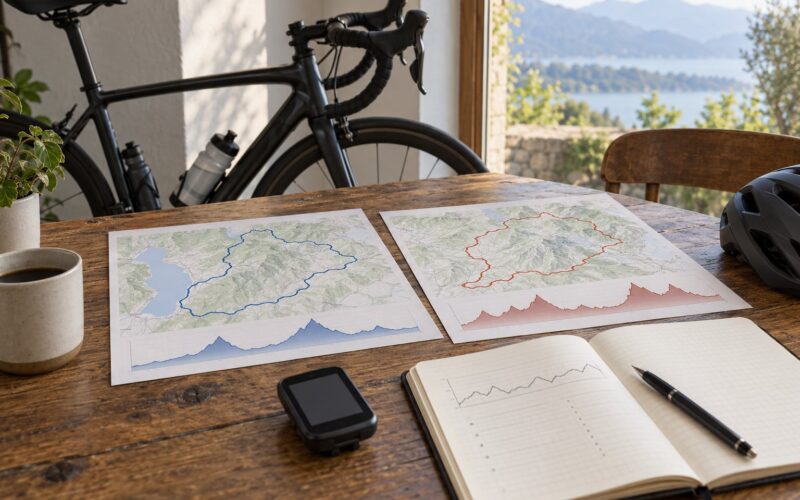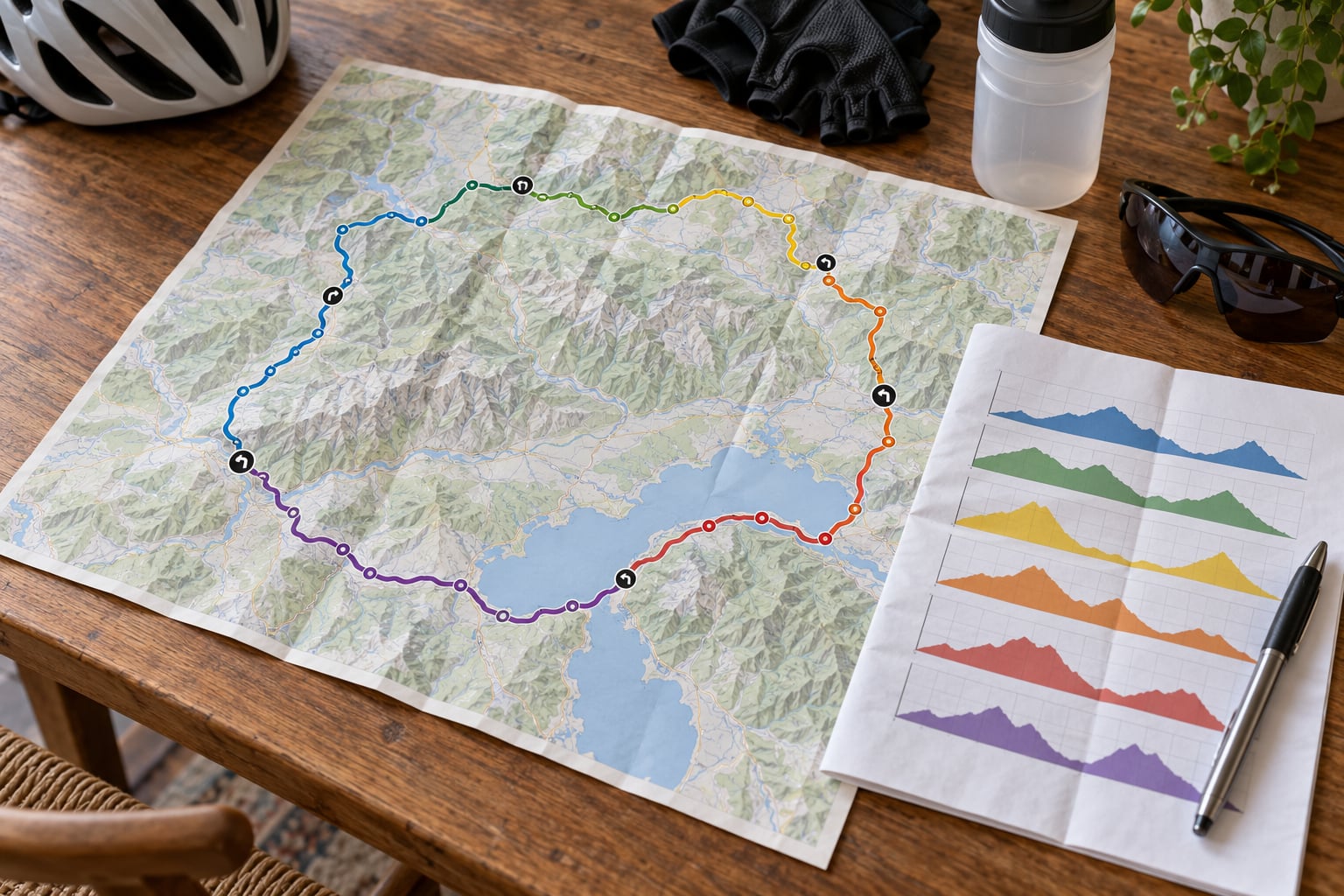
There are two jobs hiding in this question, and the fix for each is different. Training splits break one long endurance ride into two or more sessions across the week; route splits cut a multi-day master route at each overnight stop so your head unit shows today’s distance instead of the whole trip.
Either way, here is how to split a long ride into segments without losing the training stimulus or confusing your navigation. It takes about 30 minutes with a route file in front of you, and it works for club centuries as well as self-supported tours.
The short version: split on terrain and regrouping points, not on equal mileage. Then write down what each segment should cost you in time and effort before you roll out.
Table of Contents
- What You Need Before You Split Anything
- Step-by-Step: How to Split a Long Ride Into Segments
- Set the Ride Goal and Identify Checkpoints
- Divide the Route by Terrain and Regrouping Points
- Build a Segment Table With Realistic Targets
- Plan Fuels, Fluids, and Transitions
- Test and Adjust the Plan
- Common Mistakes When Splitting a Long Ride
- Frequently Asked Questions
- How long should each segment be on a long ride?
- Should I split a long ride by time or distance?
- How do I set segment targets in a mixed-speed group?
- Where should riders take their first long break?
- Can this method work for a double century?
- How should the segment plan change in bad weather?
- Conclusion
What You Need Before You Split Anything
A usable segment plan needs seven inputs, and if any one of them is missing the targets you set will be fiction. Most riders have a route file and nothing else, which is why the first segment always overruns.
- The route file and its elevation profile. A GPX track or a planned route in RideWithGPS, Komoot, Strava, or cycle.travel. You need to see where the climbing sits, not just the total number.
- Total distance and total elevation gain. Two separate numbers, because 100 miles of flat road and 100 miles with 9,000 feet of climbing are not the same ride.
- Your best realistic moving time. Take a recent comparable ride, not your fitness theory. Add the time you actually stop for food, water, and regrouping.
- Group ability range. On a club ride that is often 15 to 25 mph on the flat. Write down the slowest rider in the group, not the fastest.
- Bike and fueling setup. Two bottle cages plus a top tube or seat pack capacity caps how far you can be from a shop, which sets your segment boundaries.
- Communications. A group chat thread where the current segment number gets posted. Split rides fall apart quietly when people cannot tell where the group is.
- Weather, including wind direction for the return leg. A headwind on the way out means your outbound segments are slower than the same terrain on the way home.
If you are still choosing a tool, the four route planners above all handle daily legs differently, and the difference matters more than the map quality.
Step-by-Step: How to Split a Long Ride Into Segments

The method below runs in five steps and works for both meanings of the split. Steps one through four apply whether you are splitting a training week or a 200-mile route.
Set the Ride Goal and Identify Checkpoints
Start by deciding what the finish looks like, then find the landmarks that tell you whether you are on track. Write down total distance, estimated moving time, the finish or turnaround clock time, and two or three reliable landmarks such as a fuel stop, a town water fountain, or a bridge you cannot miss.
One clarification, because the word causes confusion: in cycling, a segment has three unrelated meanings. One is a single crank revolution on a bike computer. The second is a stretch of road with its own leaderboard record. The third is a block of a workout or a stretch of a route. This guide uses the third one.
Pick the boundaries after the checkpoints, not the other way around. A segment that ends somewhere a rider can describe out loud is worth three that end at arbitrary mile markers nobody can verify.
Divide the Route by Terrain and Regrouping Points
Cut the ride where the terrain changes character or where the group naturally stops anyway. Climb tops, valley floors, town water stops, and the turnaround of an out-and-back all make better boundaries than equal distances.
Equal distances fail on any ride with hills. Five 20-mile segments sounds tidy, but one of those segments might hold 2,000 feet of climbing and another might be dead flat, so identical distances produce wildly different days. Terrain-based cuts keep each segment honest.
For route splits specifically, drop a waypoint at each overnight stop in the route planner and cut the line there, then save each leg under its own name. Cycle.travel does this cleanly through the multi-day adventure planner, and most other planners handle it through a delete-before or delete-after option on a via point.
Build a Segment Table With Realistic Targets
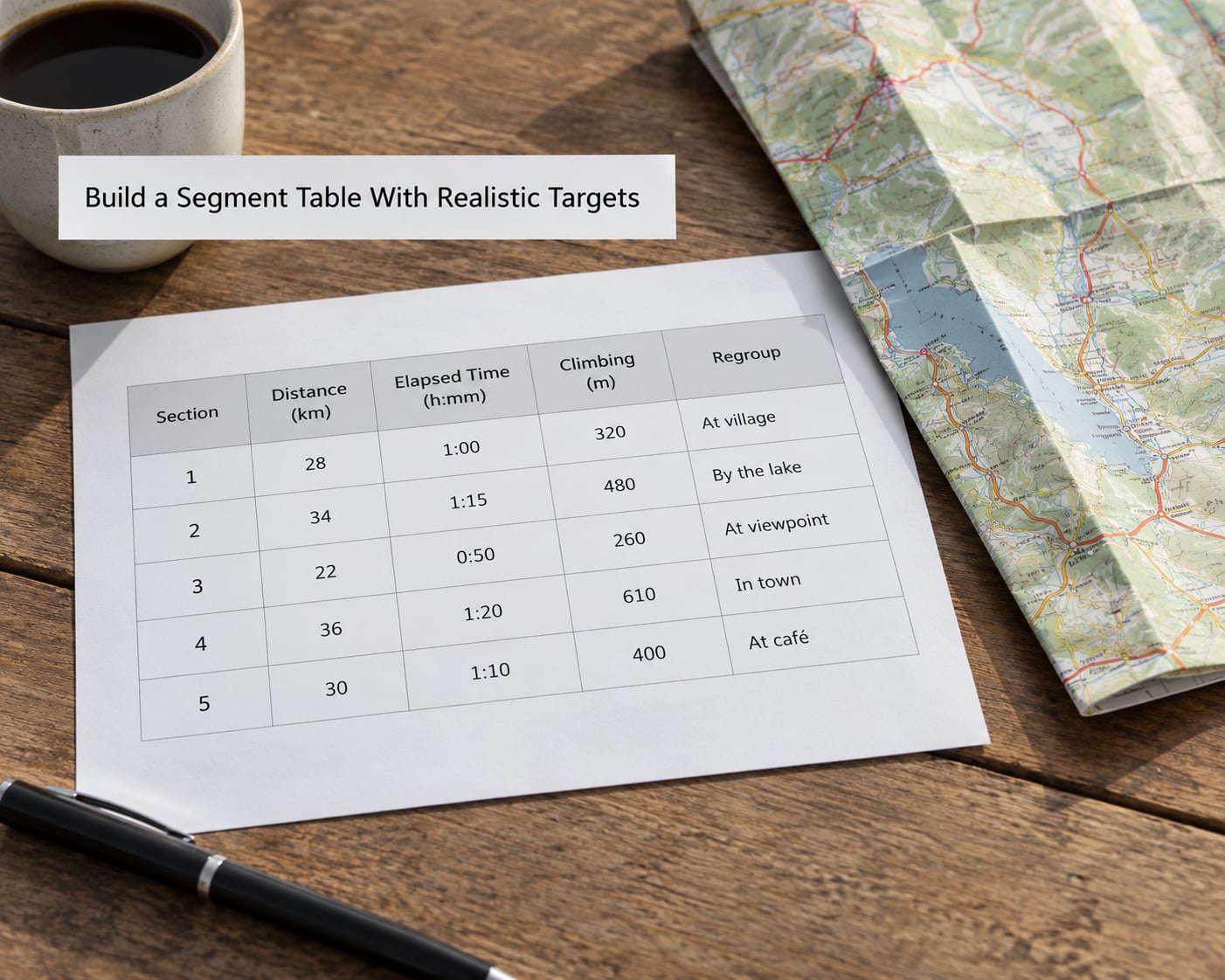
Write the plan as a table with one row per segment, then run it against a recent ride before the day itself. Here is an example for a 100-mile club century on rolling terrain, roughly 3,500 feet of climbing, with a mixed-ability group.
| Segment | Distance | Elapsed time | Climbing | Target effort | Regroup |
|---|---|---|---|---|---|
| 1. Town to first fuel stop | 20 mi | 1h 00 to 1h 10 | 400 ft | Easy, conversational | Stop together |
| 2. Rolling middle | 22 mi | 1h 10 to 1h 25 | 700 ft | Steady, rollers at effort | Rolling, no stop |
| 3. Main climb block | 18 mi | 1h 20 to 1h 40 | 1800 ft | Settle into climb effort | Summit store |
| 4. Descent and recovery | 20 mi | 55 min to 1h 05 | 300 ft | Recovery spin | Halfway store |
| 5. Final push | 20 mi | 55 min to 1h 05 | 250 ft | Tempo, then coast | No regroup |
Two things make this table work. The first column pair is elapsed time, not moving time, so the stops are already built in. And every segment has a stated effort in words the rider can feel rather than in watts they may not own a meter for.
Check it against reality. Compare each segment’s projected time with how long the equivalent stretch took on your last long ride, then adjust the whole table by a single percentage rather than fiddling row by row.
Plan Fuels, Fluids, and Transitions
Attach food and drink to the ends of hard segments, not to the clock. If segment three holds most of the climbing, eat before it starts and refill bottles at the regroup stop at the top, which turns a hard block into two manageable ones.
The 60-odd grams of carbohydrate per hour that most riders aim for on long rides applies across the whole day, whether it is one ride or three. What changes with a split is the reset. Between sessions you go off the bike, and carb storage and digestion get a break that a continuous ride never gives you.
For that reason, start each new segment slightly fuller than feels natural, and keep the first 20 minutes easy. A cold start on tired legs is where most split rides lose ten minutes they never get back.
Test and Adjust the Plan
A segment table is a guide, not a contract, so give riders a rule for changing it in real time. The simple version: the regroup leader posts the current segment number and the running clock, and the group adjusts its target to the plan or accepts the slip without panicking.
Write down three separate plans for a training split, because fitness and weather vary. Plan A is the full duration, Plan B is the same segments with 15 percent less time, and Plan C is four shorter segments for a bad-weather or bad-legs day. Riders pick a plan at breakfast instead of negotiating it at mile 60.
Then log it the way you want it counted. Most head units record each segment as its own file, and several riders merge them afterward into one long ride so the training load stays intact. That choice matters more for your training log than for your fitness, but it is worth deciding on purpose.
Common Mistakes When Splitting a Long Ride
Most bad segment plans fail on one of six predictable mistakes, and every one has a quick fix. Here they are with the correction.
- Equal-distance segments. Twenty miles is twenty miles only on paper. Fix: cut at terrain changes and at stops the group will actually take.
- Targets built on average speed. One flat average hides the fact that you will be at 12 mph on the climb. Fix: set a target per segment and let the average fall where it falls.
- Overloading the early segments. Fresh legs plus good spirits produce a first hour that is far too hard to recover from. Fix: make segment one deliberately easy and boring.
- Treating elapsed time as moving time. Four hours of elapsed time with no stops planned is not four hours of riding. Fix: add your expected stop time into every range before you publish the plan.
- One target for riders with different abilities. A fixed pace either strands the slow riders or strands the fast ones. Fix: target the slowest rider’s effort and let the front group self-select.
- Treating the original table as fixed. A plan with no fallback turns a bad day into a failed day. Fix: write Plans A, B, and C and choose one in the morning.
One more habit pays for itself: write the effort target as a feeling, such as “can chat” or “steady and quiet,” next to the time range. Riders hold a sensation far better than they hold a number.
Frequently Asked Questions
How long should each segment be on a long ride?
Aim for segments of 60 to 90 minutes of moving time on a training split, and 3 to 5 hours for the daily legs of a multi-day route. Shorter than 45 minutes and you spend more time changing clothes than riding. Longer than two hours of steady riding in one block and most recreational riders start losing form. Terrain should still decide the real boundaries.
Should I split a long ride by time or distance?
Use time for training splits and distance or terrain for route splits. Time-based splits work best when the goal is total weekly duration, because two 90-minute sessions hold volume better than one 3-hour ride. Route splits should follow the ground, since a 40-mile leg through hills is nothing like 40 flat miles.
How do I set segment targets in a mixed-speed group?
Set the target for the slowest rider rather than the fastest, and describe it as an effort instead of a speed. Publish the clock time for the regroup so nobody has to guess whether the group is late. Riders who want to go faster can leave at the regroup stop and know where to rejoin.
Where should riders take their first long break?
Take it before the hard part of the day rather than after. On a typical century that means a real stop at the first fuel stop around 20 to 25 miles in, before the main climbing block. Eating and drinking there means you start the climbing with full bottles and full legs instead of managing both at once.
Can this method work for a double century?
Yes, and a double century is where segment planning pays most. Break 200 miles into four or five legs of 40 to 50 miles, schedule a real break between each one, and put the hardest climbing early in the day when your legs are fresh. Riders who report using decreasing-length segments as the day goes on find it easier to finish than riders holding one pace all day.
How should the segment plan change in bad weather?
Move to the shorter version of your plan rather than the same segments at a slower pace. Cold rain plus headwind on a century is a good day for Plan C, the four shortened segments. Keep the regroup points the same so the group stays together, and add ten minutes of sheltered time at each stop in genuinely poor conditions.
Conclusion
To split a long ride into segments, map the terrain first, mark the places where the group will stop anyway, and cut the route there. Write one table row per segment with elapsed time and a felt effort, then write a shorter version you can fall back on.
Start with your next long ride: pull up the elevation profile, mark the climbs and the fuel stops, and you will have a segment table in about half an hour.