Measuring cycling progress comes down to repeating a small number of tests under identical conditions and comparing each result to your own last one. Functional Threshold Power (FTP) is the most useful of those numbers, followed by weekly volume, heart rate zones, resting heart rate and a repeatable time trial. Get that habit in place and a decade of scattered ride files turns into a trend line you can actually read.
Here is the short version of what to measure, in the order most riders find useful:
- Functional Threshold Power — the highest average watts you can hold for about an hour, not your sprint peak.
- A repeatable time trial — the same course, same conditions, timed. The time is the benchmark, not the watts.
- Weekly volume — hours and distance ridden each week, tracked as a rolling average rather than a single week.
- Heart rate zones — where your heart rate sat relative to your own threshold, which works without any power meter at all.
- Resting heart rate and HRV — morning numbers that tell you whether the training is being absorbed or simply accumulating.
None of these work well alone. The trick that most guides miss is repeatability: the same test, the same time of day, the same rough weather, the same equipment. If you know the margin of error on your test, you stop chasing noise and start seeing real change.
Table of Contents
- What You Need
- Step-by-Step: How to Measure Cycling Progress
- 1. Establish a Consistent Baseline
- 2. Track Fitness With a Standard Ride
- 3. Measure Cycling Progress on Long Rides With Endurance Trends
- 4. Watch Recovery and Consistency
- 5. Set Progress Milestones and Review Them
- Common Mistakes
- Frequently Asked Questions
- How often should I repeat an FTP test?
- Is FTP really 95 percent of your 20 minute power?
- What is a good FTP by age?
- Is 250 watts a good FTP?
- How can I measure progress without a power meter?
- Do I need a power meter to track progress?
- Conclusion
What You Need
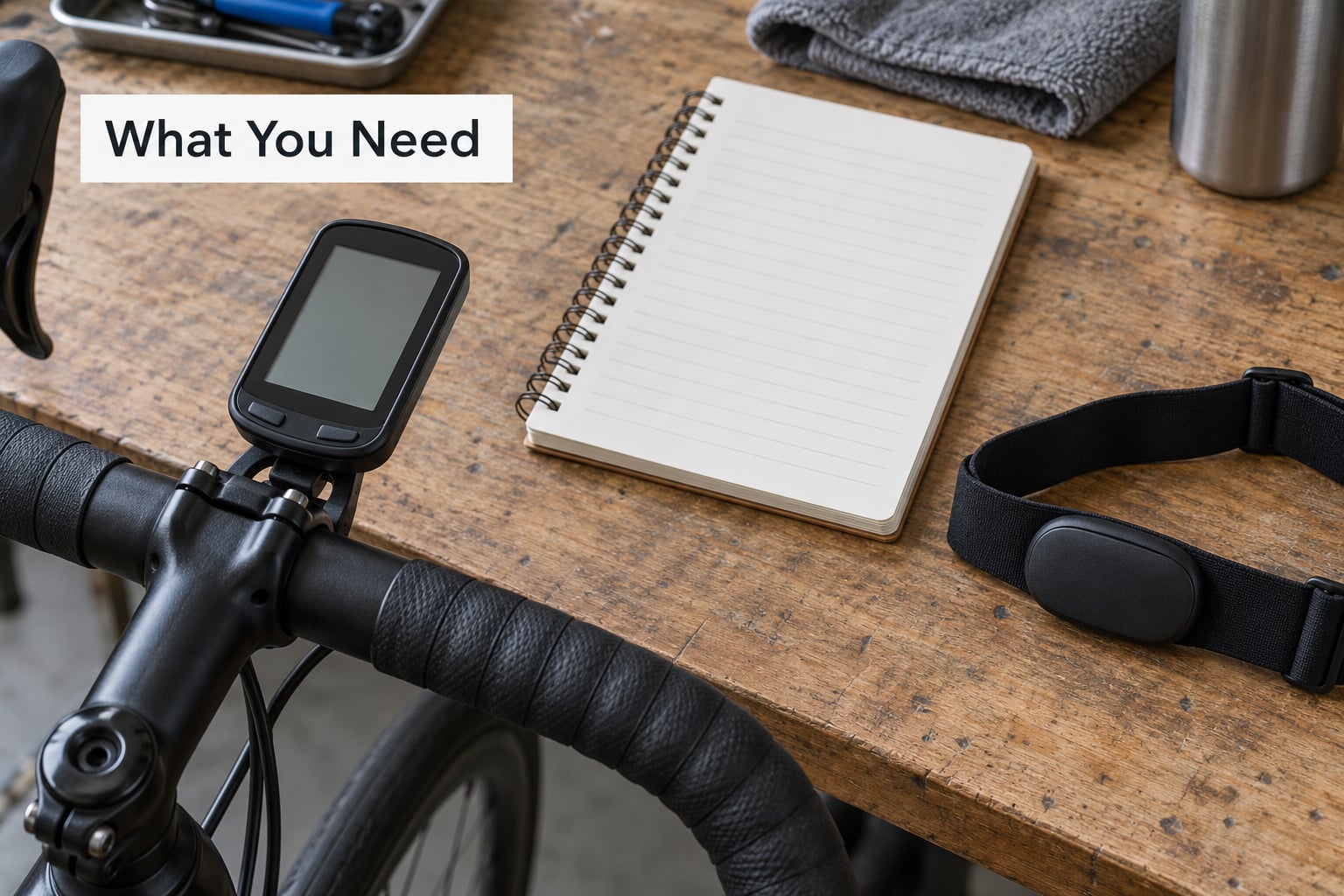
You need less kit than most riders assume. The list below is the whole setup, and every item on it has a job that none of the others can do.
- A GPS bike computer or phone mount. Records distance, time, elevation and speed. GPS elevation is noisy on bridges and in tunnels, so treat elevation figures as approximate rather than exact.
- A chest-strap heart rate monitor. Wrist and bar sensors are convenient, but the strap is still the more consistent reading, especially on an out-and-back where you want the same number as last month.
- A power meter, if you own one. Not required, and for many riders the single most useful upgrade they will ever make to their data. Crank- and pedal-based meters give the same core number; dual-sided adds left-right balance.
- A training log. An app, a spreadsheet, or a notebook in a bag. The tool matters far less than the fact that you write something down every single ride.
- Consistent long-ride and weekly records. One standard route and one standard workout, repeated, so you always have something comparable to point at.
On apps, each one has a distinct job rather than a full set of overlapping features:
| Tool | Best at |
|---|---|
| Strava | Automatic ride upload, segment comparisons and a rough fitness trend. Its estimated FTP is a starting point only, not something to build zones from. |
| TrainingPeaks | Planning workouts against a weekly volume target and reading training load over weeks and months. |
| Zwift | Indoor sessions with a smart trainer, where weather and traffic cannot spoil a comparison. |
| Garmin Connect and Wahoo | Pulling sensor data straight off your bike computer, including your power curve and long-term trends. |
Note that data lives in different places depending on what you own. Pick one place where every ride lands, or your trend analysis will stay manual and you will lose interest by August.
Step-by-Step: How to Measure Cycling Progress
1. Establish a Consistent Baseline
Choose two to four ordinary weeks and treat them as your starting point. Record duration, distance, elevation, heart rate and any power you capture, then write down what a normal week looks like for you rather than what a good week would look like.
The point of a baseline is to give the later numbers something to be compared against. Once you have a few weeks of ordinary data, you know your typical weekly hours and your usual heart rate at a given effort, and that becomes the line you measure against.
Do not treat a rough start as failure. A baseline week that included two bad nights and a stressful day at work still tells you where you were on that week, which is exactly what you need.
2. Track Fitness With a Standard Ride
Repeat one familiar route or one set workout under broadly similar conditions, and compare average power or pace, average heart rate and perceived effort against the same ride a month earlier. Familiarity is what makes it a measurement rather than a memory.
Riders on r/cycling and r/trainerroad threads ask the same question constantly: whether to trust watts, heart rate or speed when they disagree. The short answer is power first, heart rate second, speed a distant third, because speed changes with wind, terrain, traffic and whether you are sitting on the front or the back. Average speed is the weakest of the four for tracking progress, even though it is the one most people quote.
There is also normalized power to understand. Average power treats a ride with three sprints and a steady hour as identical. Normalized power uses a rolling 30-second average and weights the hard efforts more heavily, which is why an interval session can show a higher NP than AP even when AP looks reasonable. NP should never come out below AP; if your app says otherwise, the reading is a data error.
Avoid drawing conclusions from hilly rides, strong headwinds or days when you felt awful. Those rides still count for volume and enjoyment. They just do not count as a fitness measurement.
3. Measure Cycling Progress on Long Rides With Endurance Trends
Compare weekly long-ride distance, duration, elevation, fueling and how you finished across several rides rather than one. For anyone training for a century or a double century this is the section of the log that matters most, because the event is decided in the last two hours, not the first.
Look at heart rate drift across a long ride at steady effort. If your heart rate climbs several beats per minute hour after hour at the same power, that is aerobic decoupling, and it usually points to fatigue, heat, or under-fueling rather than fitness. Holding the same pace with a lower heart rate six weeks later is genuine progress even when the average power looks identical.
Fueling is part of the measurement. A long ride that ends with a bad patch of the legs tells you more about what you ate and drank than about your fitness. Write down what you took in next time so the comparison is fair.
4. Watch Recovery and Consistency
Sleep, resting heart rate, soreness, energy and missed sessions reveal whether training is being absorbed. Take a resting heart rate reading every morning before you get up, sit still for a minute, and build a baseline from seven to ten mornings before you decide anything.
A morning reading sitting 5 to 10 bpm above your baseline and staying there for several days is a signal to back off, not to push through. This is a recovery indicator, not a medical measurement. Persistent, unexplained or extreme changes in heart rate or fatigue deserve a conversation with a doctor rather than an adjustment to next week’s training plan.
Consistency is the least glamorous measure and the one that predicts results best. Riders who finish most planned sessions for a year usually out-perform riders who ride hard in three-week bursts. Count your sessions, not just your hours, because a missed session inside a planned block breaks the block.
5. Set Progress Milestones and Review Them
Set four- to eight-week goals with one primary measure and one secondary measure. Primary is usually FTP or your repeat time-trial time; secondary is usually weekly hours or resting heart rate stability. Then review the log once a month, not after every ride.
Be realistic about the size of a real gain. A rider testing by ramp test two months apart described roughly a 10 watt gain over those two months as solid progress, and that is a fair expectation for a self-trained rider on a decent block. A change of 5 watts between two tests is usually noise. A change of 5 percent is probably real.
Riders often ask whether to apply a new FTP immediately or ease into it. Most coaches suggest leaving it alone and letting your easy and tempo sessions drift up naturally over a couple of weeks, rather than jumping straight into threshold work at the new number. If your weekly volume goes up and progress stalls, the honest answer is usually that you needed a de-load week, not a harder one.
When progress stops for two review cycles, change one thing at a time: volume, intensity, or recovery. Changing all three at once tells you nothing about which one worked.
Common Mistakes
Comparing rides on different routes. A hilly morning and a flat evening are not a progress check. Fix the route, or fix the workout, and vary as little else as you can.
Chasing power numbers on a bad recovery day. Test when you are rested, and stop the test if your heart rate climbs faster than your power does. A hard morning on a tired body produces a number you cannot repeat, and an unrepeatable number is not a benchmark.
Starting too hard on a time trial. This is the most common self-reported testing error. Hold an even pace for the full duration; going out hard usually costs more than it gains.
Changing several variables at once. New pedals, a different route, harder sessions and more volume in the same month means you will not know in six weeks which one helped.
Measuring only speed. A tailwind, a group ride and a downhill can all flatter average speed without a single watt of fitness improvement behind them.
Reading soreness or fatigue as a diagnosis. DOMS and a flat week are normal training artefacts. If symptoms persist, get them checked by a clinician instead of interpreting them from a dashboard.
Ramping volume too fast. The widely used 10 percent rule — raise weekly volume by no more than about 10 percent at a time — exists because tendons and connective tissue adapt slower than legs.
Two habits that help more than any dashboard: write one sentence about each ride the day you do it, and keep a paper log beside the app. The app stores numbers; the sentence captures how the ride actually felt, which is the context you will want when you are trying to work out why a week went sideways.
Frequently Asked Questions
How often should I repeat an FTP test?
Every four to eight weeks for most riders, using the identical protocol each time. Trainers working periodized plans sometimes test every four weeks; others consider two-month intervals more realistic through a heavy interval block. Testing more often than every few weeks adds fatigue and noise rather than information. Use the same test, on the same equipment, at a similar time of day, and give your new number a couple of weeks to settle before changing your zones.
Is FTP really 95 percent of your 20 minute power?
Yes. The standard protocol takes the average watts you held for the full 20 minutes and multiplies by 0.95, because you cannot hold the same effort for a full hour. So 250 watts for 20 minutes becomes an FTP estimate of roughly 238 watts. Riders who skip the correction end up with a training number they cannot reproduce outdoors, which is exactly the kind of result that destroys trust in the whole exercise.
What is a good FTP by age?
Look at watts per kilogram rather than absolute watts, because comparing raw numbers across different body weights tells you very little. Broadly, trained club riders tend to sit around 4.0 to 5.5 W/kg in their twenties, 3.6 to 5.0 in their thirties, 3.2 to 4.5 in their forties, 2.9 to 4.0 in their fifties and 2.6 to 3.6 in their sixties. Background matters more than age, so treat these as bands and compare against your own history.
Is 250 watts a good FTP?
For an 80 kg rider, 250 watts works out at about 3.1 W/kg, which is a solid recreational figure and enough to ride a century comfortably. For someone at 65 kg the same number is nearly 3.8 W/kg and genuinely strong. Riders with a competitive or structured background often sit well above these bands, and newer riders are frequently in the 2.0 to 2.8 range. Weight, age and training history decide whether the number is good, not the number itself.
How can I measure progress without a power meter?
Use three things: a repeatable field time trial on the same course, heart rate zones measured against your own threshold rather than a generic formula, and morning resting heart rate over a rolling fortnight. Repeat the time trial every four to eight weeks and treat the finishing time as the benchmark. Zone 2 without a heart rate monitor is workable too: ride at a genuinely conversational pace where you can speak in full sentences, and expect the time trial to confirm what the pace felt like.
Do I need a power meter to track progress?
No, but it makes several measurements far easier. Heart rate gives you intensity and recovery signals, a repeatable time trial gives you a clear endurance benchmark, and weekly volume plus consistency tell you whether the training is happening at all. A power meter adds an objective effort number that does not drift with heat, caffeine or nerves, and it lets you compare efforts against yourself across different rides. Plenty of riders get most of the value first, then add a meter later.
Conclusion
Start with one thing: pick a repeatable test, run it this week, and record the result as your baseline. Then repeat it every four to eight weeks under the same conditions, keep an eye on your long rides and your morning resting heart rate, and review the whole picture once a month rather than after every ride.
Give it a season. The riders who look dramatically fitter are almost never the ones with the best head start, they are the ones who measured the same thing for long enough to see it move.