To ride safely in traffic you have to be visible, predictable and ready for what drivers do next: hold a steady line where a motorist expects a bicycle, stay clear of the door zone and truck blind spots, signal early, and never cross in front of a vehicle that is still moving faster than you.
That sounds like a lot, but it breaks into a handful of habits you can practise on a quiet street before you ever take on a four-lane road. Most of it is repetition, not talent.
Table of Contents
- What You Need
- Step-by-Step
- How to Ride Safely in Traffic Before You Leave
- Position Yourself Where Drivers Can Predict Your Moves
- Scan Early and Signal Clearly
- Handle Intersections and Traffic Changes Predictably
- Adjust Speed, Braking, and Cornering
- React to Doors, Driveways, and Roadside Hazards
- Common Mistakes
- Extra Tips for Safer Club and Group Rides
- Frequently Asked Questions
- Are cyclists required to ride in the bike lane or travel lane?
- How early should a cyclist signal a turn or lane change?
- Can cyclists ride two abreast in traffic?
- What lights and reflectors are best for riding after dark?
- Is it safe to wear earphones while cycling in traffic?
- What should a cyclist do when a vehicle turns across their path?
- Conclusion
What You Need
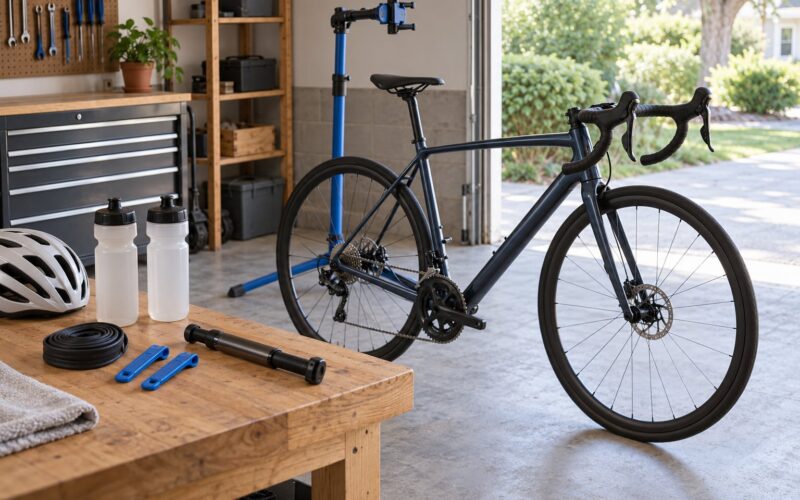
You do not need a gadget list to ride safely in traffic. You need the basics working, and a few things that make you easier for drivers to see and to read.
- Helmet, correctly fitted. Level, snug, two fingers’ width above the brows. This is the one item that is non-negotiable.
- Front and rear lights that work. A white front light and a red rear light, both charged, both mounted so they cannot be stolen at a light.
- Reflective elements. Rear reflector, pedal reflectors, reflective tape on your helmet or bag. Reflectors only work when a light is pointed at them, so they are a supplement, never a substitute.
- Bright clothing. Anything that is not dark blue, grey or black when the sun is low. A fluorescent jacket in the morning and an ordinary bright layer in the afternoon works.
- Bell or audible signal. Required in many places, useful everywhere.
- Tire repair kit and pump. A spare tube, tire levers, patch kit, and a way to get a flat repaired at work rather than walking home.
- Water and identification. One bottle for anything over an hour, and a card or phone contact number with an emergency contact in your pocket.
- Charged phone. For the call after a near miss, and for navigation when a road closure forces a detour.
Optional but genuinely useful: a helmet or handlebar mirror, a rear radar unit if you ride in the dark regularly, fenders for wet-weather grime, and a small frame bag that keeps your weight low and your hands free.
Less obvious but worth the habit: a quick brake and tire check before you leave. Squeaky brakes and a soft tire are both easy to fix at the door and both make handling noticeably worse in traffic.
Step-by-Step
Each stage below covers one decision point. Read it in order the first time, then use it as a checklist in the order it actually happens on the road.
How to Ride Safely in Traffic Before You Leave
Before the wheels turn, decide how hard the ride is going to be. That is the part riders skip, and it is where a bad afternoon gets set up.
- Run the brakes and check the tires by hand. Spin each wheel and watch the rim for a wobble.
- Look at the route and note the junctions you will cross, plus one alternative that avoids the worst of them.
- Check weather and daylight. If it will be dark before you finish, commit to lights now rather than deciding at the roadside.
- Decide your bail-out options: a bike shop, a cafe, a quiet side street, a ride home with a friend.
- On an unfamiliar commute, pick the lower-stress version of the route for the first few rides. The same road at 7am is a completely different road at 5pm.
You know it worked when you leave the door without a reason to stop. If you are hunting for a pump or checking a light at the kerb, the first few minutes of the ride were already spent distracted.
Position Yourself Where Drivers Can Predict Your Moves
Ride in a place a driver can see you without having to guess. That is the whole principle, and it decides most positioning arguments.
Where there is no bike lane, ride a steady line roughly two feet from the kerb or parking edge in ordinary conditions. Move further into the lane when you are passing a hazard, when a parked car blocks the space, or when a junction means a vehicle could turn across you.
Where there is a bike lane, use it unless it is unsafe: blocked by bins, ending into a bus stop, painted right next to parked cars, or full of debris. Some jurisdictions let you leave the lane for exactly those reasons. Most riders who feel boxed in simply take a smooth line into the lane without signalling, and that is what annoys motorists.
Claim space early and early is the advice that comes up constantly in rider forums. Riders in r/cycling repeat the same line to newcomers: take the lane, ride in a position where a car has to go around you, and stop pretending to be a squeezed car. That is legal and it is recommended in most traffic codes, because a squeezed position is an invisible one.
Two zones to stay out of entirely: the door zone along parked cars, and the blind spot beside a truck or van. If a vehicle could merge into you without moving its wheels noticeably, you are too close.
You know it worked when a car behind you moves out of your way without a honk or a slow-down. That only happens when your line was readable from far enough back.
Scan Early and Signal Clearly
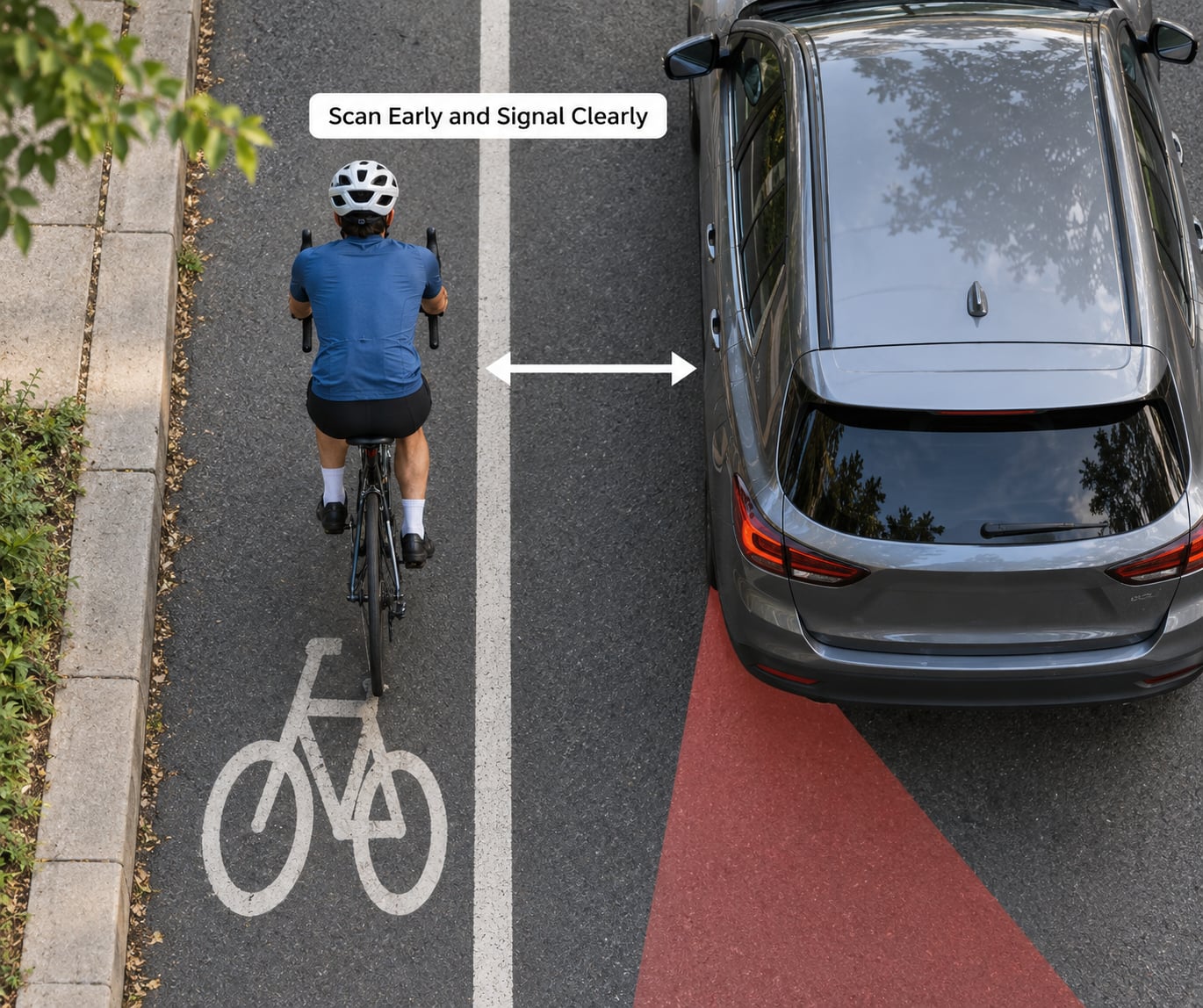
Look far ahead, then come back to the near ground in a rhythm: maybe ten seconds of eyes-up, one glance down at the road surface. Riding with your head down at the wheel is the most common cause of surprise braking in traffic.
Check over the appropriate shoulder before moving laterally, before turning, and before entering the road. A mirror helps with the routine, but the habit of looking back matters more than the hardware.
Signal early and hold your hand out for a couple of seconds, at minimum, before the manoeuvre begins rather than during it. Then complete the manoeuvre and return your hand to the bar. Waving vaguely while drifting sideways does not count as a signal to anyone.
Eye contact is useful but unreliable. A driver who glances at you has seen you; a driver who does not may still be checking a mirror or a phone. Never treat eye contact as permission to assume you have been seen, and never treat a lack of eye contact as a threat.
If you are going to ride with an e-bike or with audio, many riders on bikecommuting forums say a rearview mirror and running lights cut anxiety more than any technique change. Cheap, and worth trying.
Handle Intersections and Traffic Changes Predictably
Intersections are where most urban collisions happen, because they are the one place where paths cross and nobody is going straight.
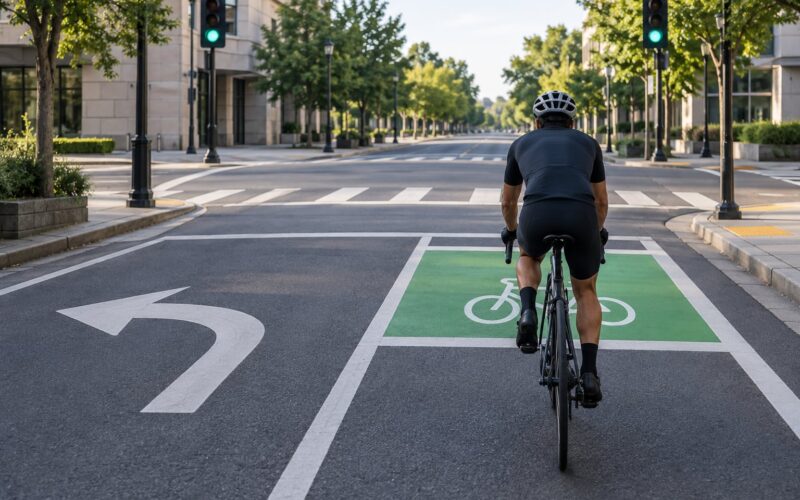
For a right turn, move toward the kerb early, signal, then check the shoulder and take the turn. For a left turn across oncoming traffic, position yourself as a driver would, look back at the traffic you are about to join, signal across the whole journey, and only move when there is a genuine gap. If a vehicle is still closing on you at the junction, stay behind it and turn late. A late turn is a small delay; a turn in front of a fast car is a serious collision.
Never sprint across a lane to get in front of a turning vehicle. Slow down instead, and let the car pass.
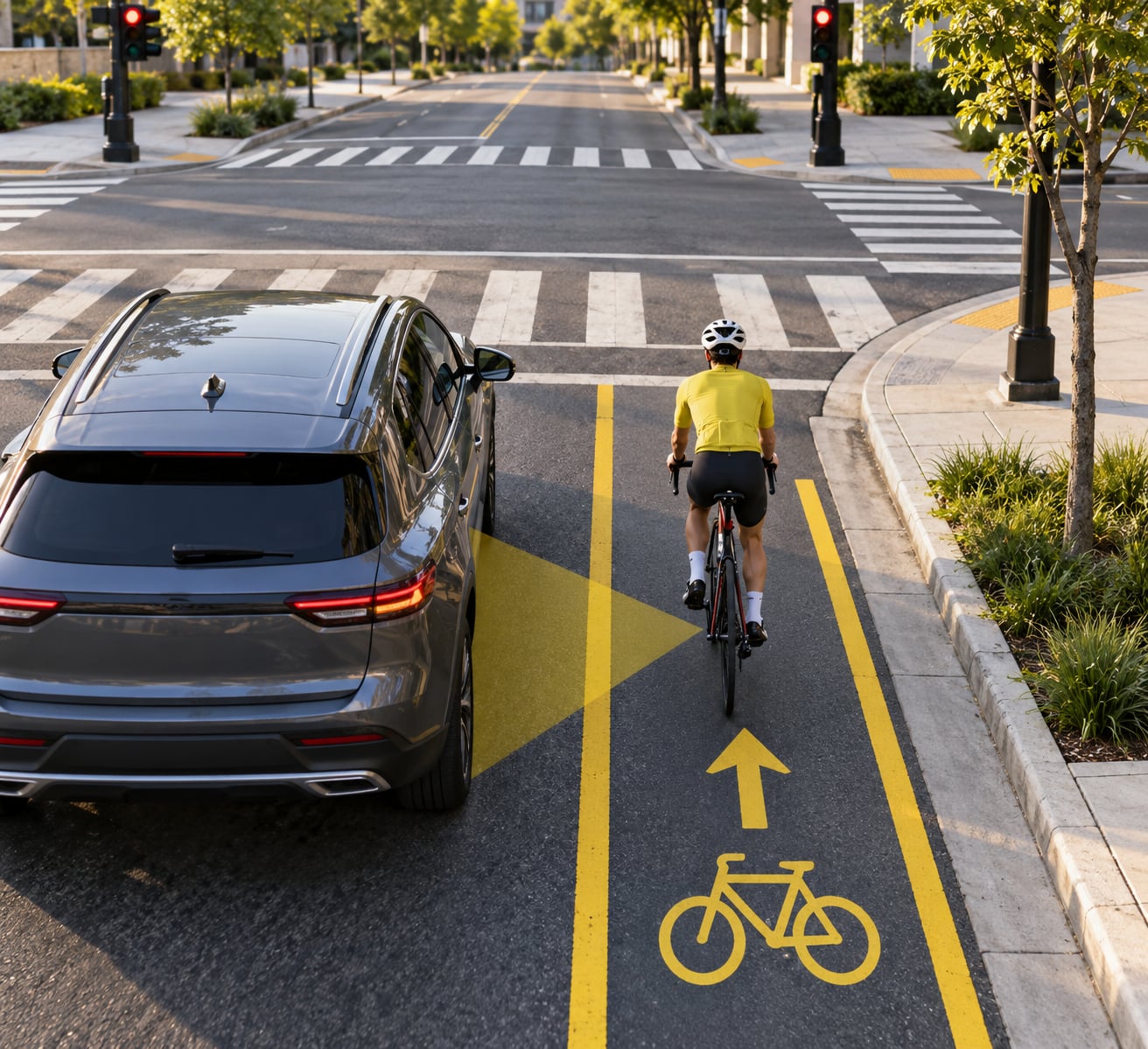
On multi-lane junctions, remember that vehicles turning left or right come from behind and to the side. That is the blind spot that produces the right hook, the collision most riders fear. Watch the front wheels of any vehicle behind you near a junction, not the wheels further back.
At roundabouts, pick your lane before you enter and signal on approach and on exit. Circulating riders hold a steady line; look right before you join and check your mirror before you exit. The common near miss is a driver behind you who intends to exit and does not know you are still circulating.
Entering the road from a side street or parking lot is its own hazard. Stop with your front wheel near the edge, look both ways, make eye contact with the driver who is nearest, and only pull out in front of them. Never enter behind a vehicle that is blocking your view and hope the driver behind it sees you.
Adjust Speed, Braking, and Cornering
Speed is your largest safety margin. Match it to what you can actually see and to what the surface allows, not to what the traffic around you happens to be doing.
Brake with both levers progressively rather than stabbing one. On descents in traffic, stay in a lower gear so you are braking the bike rather than fighting it, and take corners on the brakes before the turn rather than in the middle of it.
Keep a following gap of roughly two seconds behind the vehicle in front, and much more when the road is wet or the view is short. Two seconds is the gap that lets you stop in the same space the car ahead stopped in.
Stay out of the gutter, out of painted drain covers, and off the strip where cars splash. When the surface is wet, gravelly or painted, change your line rather than your speed if you can. Brake on the clean asphalt before the hazard and coast through the messy part.
You know it worked when you round the corner behind a slow driver without braking harder than you did on the straight. If you are braking in the corner, you entered it too fast.
React to Doors, Driveways, and Roadside Hazards
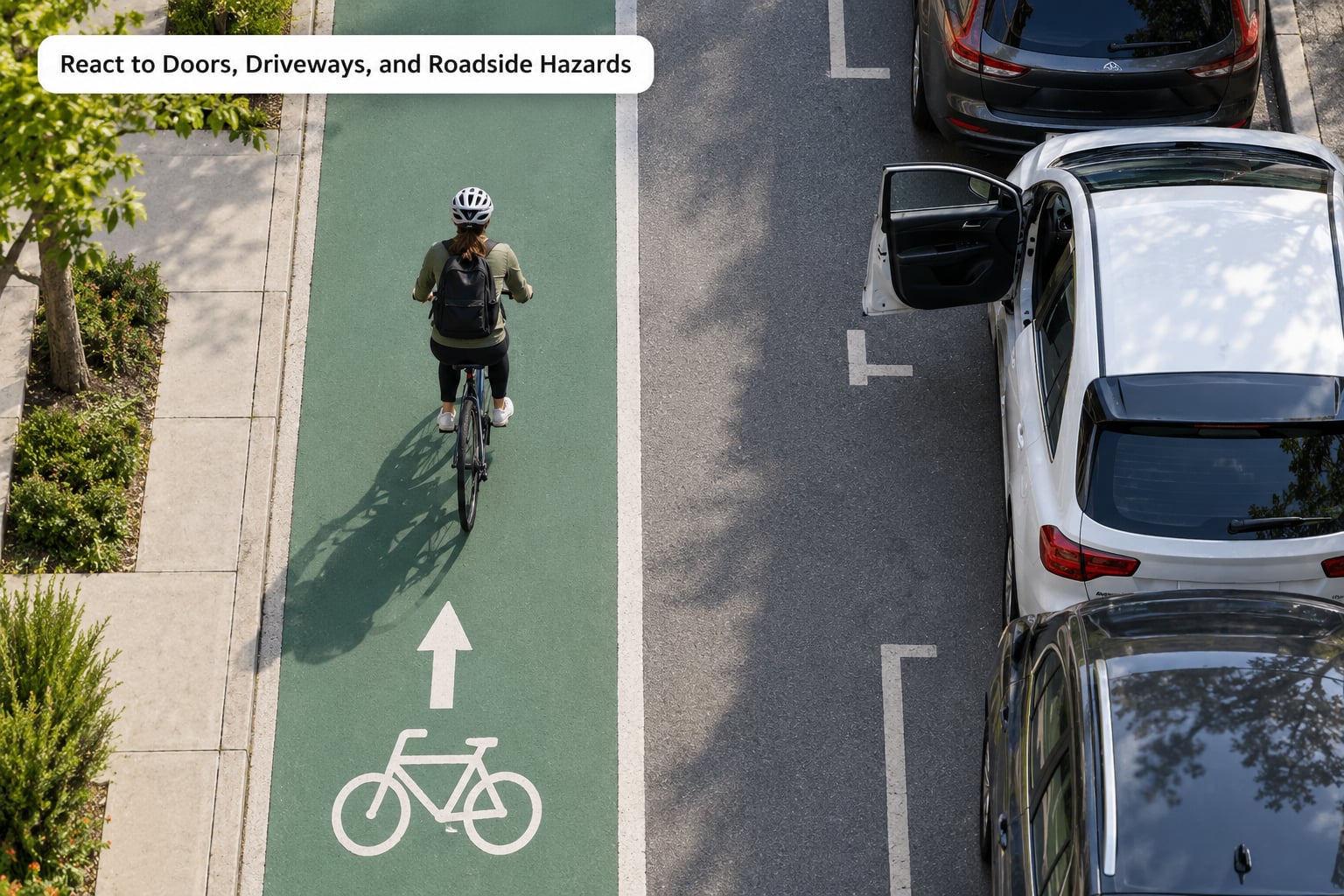
The door zone is the three-to-five foot strip beside a parked car where an opening door reaches the road. Most of the reported collisions that riders name as their worst fear start inside it.
The fix is positional and simple: keep enough lateral distance that a fully open door would miss you. On a road lined with parallel parking, that usually means riding at least three feet out from the parked cars, which puts you near the moving traffic lane edge. Cover the left side of your bike and the right side of your body, and pass a car with an open window open when you can.
Where a car is badly parked or half on the pavement, hold a steady line and pass with the maximum practical clearance. Do not weave out and back for every vehicle; one smooth move is more predictable than six small ones.
Driveways are the same problem in miniature. Expect a car appearing from any driveway, in either direction, at any time. Cover your brakes as you pass each one.
For the rest: pedestrians stepping off a kerb, a dog on a lead, a wheelie bin in the road, a pothole, a puddle, an animal, or a strong crosswind that pushes you across a line. The response is always the same. Pick the clean side early, move over smoothly, and keep both hands on the bars. If something forces a sharp avoidance, brake first and steer second, then say thank you to yourself afterwards.
Common Mistakes
Almost every rider makes at least four of these. The fix is worth more than any new equipment.
- Riding too close to parked cars. Fix: move left of the door zone and stay there until the parking ends.
- Hugging the kerb. Fix: hold a consistent line two feet out, and move out only when a hazard requires it.
- Skipping the shoulder check. Fix: make it a habit before every lateral move, even the ones that feel obvious.
- Signalling too late. Fix: start the hand signal before the manoeuvre, hold it two seconds, then go.
- Weaving unpredictably. Fix: if you are making more than one move in a few seconds, slow down and make it one move.
- Sitting in a blind spot. Fix: if the driver would have to change lanes fully to avoid you, you are too close.
- Braking abruptly in front of traffic. Fix: brake earlier, with both levers, and choose a line that lets you straighten before stopping.
- Assuming eye contact means you were seen. Fix: keep your own positioning and visibility assumptions independent of anyone else’s attention.
- Treating the ride as a race against traffic. Fix: build the habit on quiet roads first, then add busier ones. Riders who feel ready after a few calm commutes are usually the ones who relax into traffic unprepared.
Extra Tips for Safer Club and Group Rides
Group riding adds a variable that surprises new riders: distance to the wheel in front is not distance to the car behind. Riders bunched two feet apart look safe to a driver and are anything but.
Keep your lateral position consistent, hold a steady line through bends rather than letting the group weave, and call hazards out loud. The rider who spots a door or a turning car has the job of saying so; everyone else is looking further ahead and cannot see it.
Split the group on descents and at confusing junctions rather than following a leader through blind corners at speed. Regroup at a defined, safe place, not at a junction or a roundabout. Use a buddy system for anyone who is nervous or new, so nobody ends up alone on an unfamiliar road with a mechanical.
Keep beginners away from the fast group’s line until they have read traffic comfortably. Leaders who push a nervous rider into the middle of a busy road are not helping them learn.
Frequently Asked Questions
Are cyclists required to ride in the bike lane or travel lane?
Usually not. In most US states a cyclist is a vehicle and may ride in the traffic lane, and most codes allow leaving a bike lane when it is unsafe because of debris, parked cars, or a junction. Rules vary by state, city and country, so check your local bicycle code. The practical test is whether a driver would have to change lanes significantly to pass you safely.
How early should a cyclist signal a turn or lane change?
Start the arm signal before you begin moving, and hold it for at least a couple of seconds while the manoeuvre is underway. In the US, an arm held out for at least two seconds counts as a turn signal under most vehicle codes. Signal, check the shoulder, then move in one smooth action. Signalling after you have already drifted sideways tells a driver nothing useful.
Can cyclists ride two abreast in traffic?
In most US states, two abreast is allowed as long as you do not impede normal traffic flow and you keep within a single lane. In practice that means staying side by side only where a car could not reasonably have passed between you, and single file when traffic is close or a lane narrows. Rules differ abroad, where two abreast is sometimes prohibited entirely.
What lights and reflectors are best for riding after dark?
A steady white front light and a steady red rear light are the minimum, and many local codes require both after sunset. Add a rear reflector or reflective tape on your bag and helmet, plus bright or fluorescent clothing, because reflectors only work when a headlight points at them. Carry a spare light or a backup power bank if you ride after dark regularly.
Is it safe to wear earphones while cycling in traffic?
No, and in many places it is illegal. Two-ear headphones block the sound of an approaching vehicle, a horn, and the warning of a reversing car, which is exactly the awareness that keeps you alive in traffic. A single-ear or bone-conduction device at low volume is a compromise some riders accept on quiet roads. If you cannot hear a vehicle, you cannot respond to one.
What should a cyclist do when a vehicle turns across their path?
Do not accelerate to beat it in front. Ease off the pedals, brake if you need to, and stay behind the vehicle until it has committed to the turn and you can see it is clear. If it has already moved into your path, stop rather than trying to squeeze past on the wrong side. Turning vehicles are the most common source of urban cycling collisions, and most drivers simply did not see you.
Conclusion
Pick one habit for your next ride: hold a line a driver can read from fifty metres back. Everything else in this guide hangs off that. Look far ahead, signal before you move, keep a car’s width from parked doors and truck mirrors, brake with both levers, and build confidence on quiet roads before you take on the ones that frighten you.
Progress on a bike is not measured against traffic. A calm rider who took a quieter route is having a better ride than one who white-knuckled the fast road, and both will be safer in 2026 than they were last month.