Learning how to set cycling goals for the season comes down to six moves: decide what you want from the season, be honest about where you are now, pick one primary goal and two supporting ones, turn each into a measurable training target, build weekly actions around them, then review every few weeks and adjust. It takes an hour with a notebook. The hard part is not the writing, it is resisting the urge to set six goals and then abandoning all of them in April.
Most riders fail here in one of two directions. They set a single enormous outcome, like finishing a 200 mile ride next month, and then coast because the goal feels unreachable from day one. Or they write a list of eleven things and lose track of which ones matter. The riders who make steady progress usually write down three goals and know exactly which ride each one is training for.
The rest of this guide walks through the process in order, with the numbers you need at each step and the mistakes that quietly wreck a season. It works whether you have a race, a gran fondo, a century or nothing on the calendar at all beyond “ride more”.
Table of Contents
- What You Need
- Step-by-Step
- 1. Define What You Want From the Season
- 2. Assess Your Starting Point Honestly
- 3. Choose One Primary and Two Supporting Goals
- 4. Turn Each Goal Into a Training Target
- 5. Build Weekly Actions and Milestones
- 6. Review Progress Every Few Weeks
- Common Mistakes
- Frequently Asked Questions
- How do I set cycling goals for the season when I do not know my current fitness level?
- What is a realistic goal for a first century ride?
- Should I train for a double century or focus on shorter events first?
- How often should I review my seasonal cycling goals?
- How do I adjust cycling goals when work, illness, or bad weather disrupts training?
- How many rides per week should I plan during cycling season?
- Conclusion
What You Need
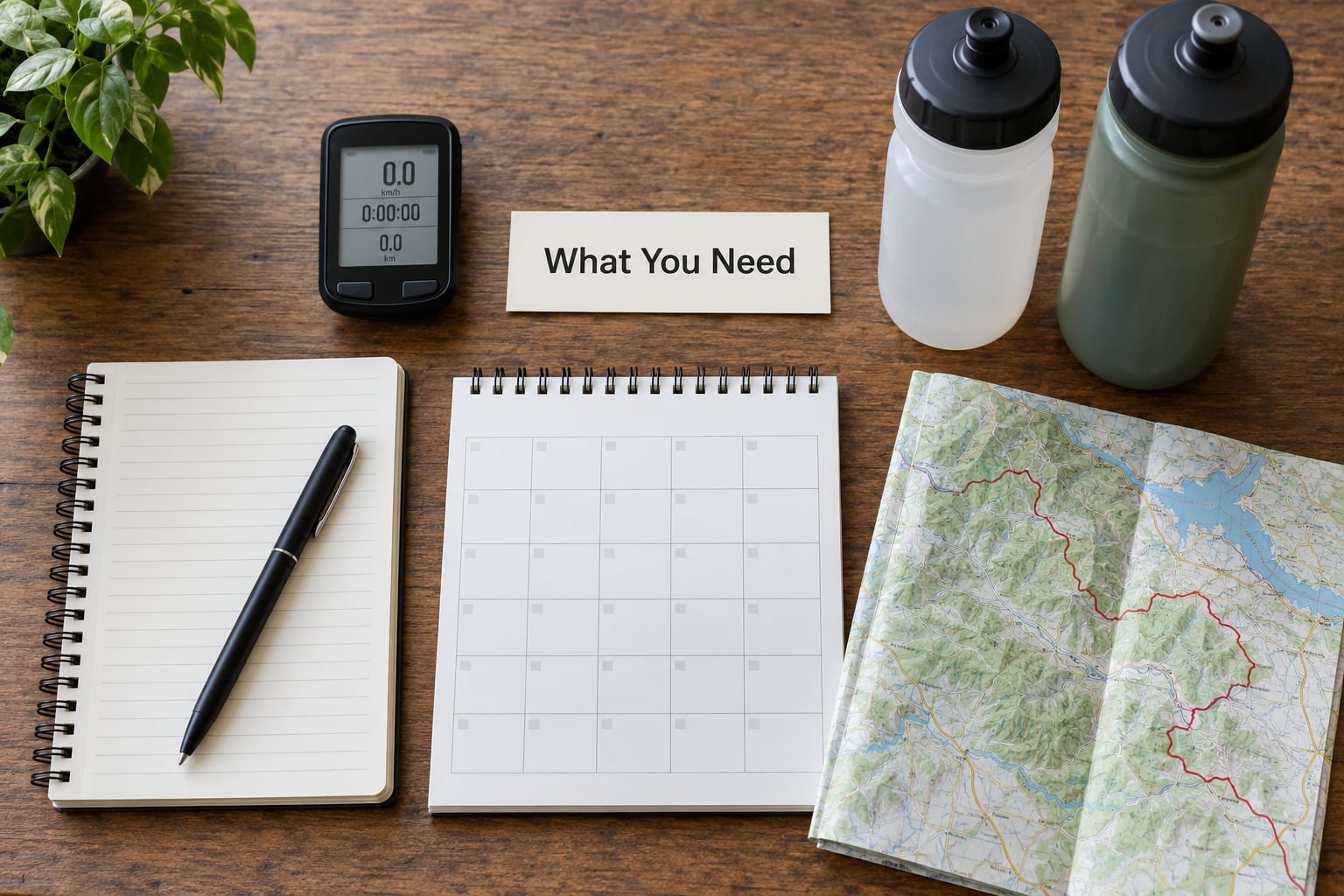
Before choosing goals, gather four things: your current riding baseline, the hours you can genuinely protect each week, your event calendar, and the constraints that limit you. Without those, goals are wishes with a date attached.
Your baseline is the last two or three months of actual riding, not your memory of a good week in June. Pull your weekly hours, your longest recent ride, your weekly distance, and how many weeks in a row you rode at all. If you track power, note your current threshold power. If you do not, a recent 20 minute or 30 minute time trial gives you a usable number, and a heart rate on a steady flat ride does too.
Your available time is the real ceiling, and it is set by work, family, sleep and weather, not by enthusiasm. Be specific: three weekday evenings of 60 to 90 minutes, one long ride of three to four hours on Saturday, and Sundays protected for family. A plan built on five spare hours you do not have is a plan that dies in week three.
Your event calendar should include everything already committed: races, sportive entries, club rides, a cycling trip, a family holiday. Then add the constraints. School holidays, a business trip in week nine, a recurring injury, shift work that rotates monthly. Riders constantly have seasons blown apart by a friend who forwards a gran fondo link on a Tuesday night, so write the fixed dates down before you write any goal.
Finally, decide how you will measure progress. Most people need only three numbers: weekly hours, longest ride distance, and a power or heart rate marker. If you use a training app, add whatever load or fitness trend it shows. Keep the measurement list short enough that you will actually check it.
Step-by-Step
1. Define What You Want From the Season

Decide what the season is for before you decide what to achieve in it. Sorting goals into three types makes this easier: outcome goals are results you partly do not control, like finishing a century or placing in a race. Performance goals are measurable markers of fitness, like a 5 percent rise in threshold power or a 100 mile ride. Process goals are the things you do, like four rides a week.
One outcome goal per season is plenty. Performance and process goals are where most of your actual progress comes from, and they are the ones you can hit. Riders who chase only outcome goals get demoralised by a single bad day; riders who track process goals stay in the sport for another decade.
Write your primary season objective in one sentence, then two supporting objectives that pull in a different direction. A century in August is the primary. “Hold 20 mph on a flat group ride” and “ride a hilly route I have never done, solo, without stopping” are the supporting pair. They train different things, which is exactly why they work together.
2. Assess Your Starting Point Honestly
Set your goals against the last eight to twelve weeks, not against the version of you that existed two summers ago. Riders routinely plan from their best month ever, then spend June wondering why everything hurts.
Look at four things. Weekly volume: take your average over the last two months and multiply by roughly 1.2, not 2, for a season target. Longest ride: your season’s target distance should sit meaningfully above it. Consistency: count the weeks you actually rode three or more times. And recovery: if you have been tired, sore or injured, that number is a cap, not a starting line.
Community consensus supports being generous but not wild. New riders routinely assume a 50 mile ride is unrealistic, then find that once the base builds it is simply a normal weekend. Perceived difficulty, not fitness, is usually the real blocker. Equally, an experienced rider coming back after six months off is not a novice, they are a re-builder, and their season target should reflect that.
3. Choose One Primary and Two Supporting Goals
Tier your calendar so every event has a defined level of commitment, because the alternative is tapering for five races and peaking for none. A useful, widely used scheme divides the season into three event tiers, and here is how to set cycling goals for the season around them:
- A event: the one race, sportive or challenge you want your best performance at. One per season. You build toward it, protect it, and taper for it.
- B events: two or three supporting events, ideally ones that resemble your A event. You race them fresh but never taper for them.
- C events: everything else, ridden for training stimulus and company. No taper, no build, no stress.
Tiering is what makes the plan survive. Your A event gets the preparation, your B events act as dress rehearsals, and your C events give you practice racing without the cost.
If you have no event on the calendar, you still need an A event. Choose a fixed, personal challenge instead: a date and a distance, a climb you want to summit under your own power, or a target for a solo time trial on a route you know. Riders without any anchor event drift, because there is nothing to count the weeks towards.
4. Turn Each Goal Into a Training Target
A vague goal cannot be scheduled, so convert each one into a target with a number and a date. For a distance goal, write the target distance, the date, and the longest ride you must complete four weeks earlier. For a time trial, write the course, the target time and the test date. For a climbing goal, write the gradient, the elevation and the target power to hold.
Apply SMART thinking without letting it go stiff. A useful riding target is specific, measurable, realistic, relevant and time-bound, but the realism part is where most people cheat themselves. Test your targets against your baseline from step two. A 20 percent jump in weekly hours in the first month is not ambitious, it is a fast-forward to February injury.
Set intensity as a target too. Most riders improve by spending about 80 percent of their riding time in easy aerobic zones and 20 percent or less in harder efforts, which is the widely used 80/20 split. That gives you a concrete weekly rule: three easy endurance rides plus one harder session is a complete week for most recreational riders.
5. Build Weekly Actions and Milestones
Divide the season into three phases and give each one a job. Preparation builds the base and fills the gaps. Build sharpens specific qualities and adds load. The event phase holds your level through your A date and tapers into it.
Use a three-weeks-load, one-week-recovery rhythm. Three weeks of progressive training followed by a genuinely easier week is the simplest way to stay fresh across a whole season, and it is far better than three months of grinding followed by a crash. Many riders set the season goal as “no more than three consecutive hard weeks”, and the recovery week is the part that counts.
Now convert phases into calendar weeks. With 16 weeks to your A event, a common split is roughly 8 weeks of base, 5 to 6 weeks of build, 2 weeks of sharpening, and 1 to 2 weeks of taper. With 12 weeks you compress the base to 5 or 6 weeks and shorten the build. With 24 weeks you can add a second build block. Longer is not automatically better for a recreational rider, because a 24 week plan often includes three months of winter riding that breeds boredom.
Give the plan dated milestones so you can tell whether it is working. Good checkpoints: a 20 minute test at the end of base, a longest-ride target halfway through the build, a full dress rehearsal of the A event three to four weeks out. Write the dates in the calendar next to the goal, not in a separate app you will forget.
6. Review Progress Every Few Weeks
Check your numbers weekly and your plan monthly. A weekly check takes two minutes: did you hit the ride count, did the long ride happen, did the hard session happen. A monthly check takes twenty: compare actual hours against target hours, compare longest rides against your milestone list, and look at whether your power or heart rate markers have moved.
Make one adjustment at a time. Riders who rewrite the entire plan every month never learn whether any single change worked. If hours are chronically short, either cut the target or cut a session. If the long rides are going fine but the hard session never happens, move it to a realistic day rather than adding a fourth workout.
Reset when reality forces it. After illness, injury, a work crisis or a stretch of bad weather, do not try to make up missed kilometres. Take one easy week, reassess your actual starting point using step two, and rebuild from there. The season is not over, it just has a different shape. Riders who accept that early keep their season; riders who try to run a missed month in a fortnight usually lose the next three months too.
Common Mistakes
Setting goals only by distance. Distance ignores pace, terrain and how the day felt. Add a second measure: average speed on a known route, or the number of consecutive weeks you complete without a missed session.
Copying another rider’s plan. A training plan built for a rider with a power meter, six spare hours and an indoor trainer does not transfer to a rider with a heart rate monitor and three free evenings. Copy the structure, not the numbers, and scale the volume to your own baseline.
Treating fitness as performance. Getting fitter and performing well on one particular day are different things. Taper, weather, illness and nutrition all affect a single performance. Judge your season on the fitness trend across the whole block.
Changing six targets at once. If everything moves, nothing teaches you anything. One adjustment per monthly review keeps cause and effect readable.
Ignoring recovery. The most common training error is a ramp that rises every week with no easy weeks at all. If your rest heart rate is elevated, your legs feel heavy for days, or motivation has collapsed, you need a recovery week before you need another goal.
Letting other people set your calendar. This is the one forum complaints about more than any other. A friend signs up for an event and forwards the link, and suddenly your A event is a date you never planned around. Write your A event down, share the plan with your riding partners, and say no to the second big event, or accept it will be your B event and plan accordingly.
Frequently Asked Questions
How do I set cycling goals for the season when I do not know my current fitness level?
Start with a baseline test rather than a guess. Time a steady 30 minute effort on a flat route, or ride a familiar loop at a hard but sustainable pace and record your average power or heart rate. Do that two rides, one early in the season and one six weeks later, and the gap between them tells you which direction you are moving. Set your first season goal around showing up consistently and completing rides of a distance you have already managed, then add speed or distance once the data exists.
What is a realistic goal for a first century ride?
A century is realistic for most riders who can already ride 40 to 50 miles comfortably, so the honest test is your longest recent ride, not your fitness on paper. Aim to complete 100 miles in a single day without a time pressure, riding at an easy, conversational pace, and treat four to six months as a sensible build window. A common mistake is picking a route with a big climb early in the day. Choose a flat or rolling route first, practise fueling on the first long ride, and use a 30 minute break every 60 to 90 miles.
Should I train for a double century or focus on shorter events first?
Focus on shorter events first unless you already ride long. A double century is 200 miles and typically takes 12 to 16 hours of riding plus stops, so it depends more on pacing, fueling and mental stamina than on raw fitness. Most riders who attempt one without a long-riding habit lose two to three hours, bonk, and finish on fumes. Ride repeated 100 mile days, a 150 mile ride, and at least one overnight or multi-day effort first, and treat a 200 mile day as the reward for that base.
How often should I review my seasonal cycling goals?
Check your numbers weekly and your plan monthly. A weekly check takes two minutes and answers whether you rode the number of times you planned. The monthly review is the important one: compare actual hours against target hours, check your longest rides against the milestone list, and look at whether your power or heart rate markers have moved. Make one adjustment at that monthly review, not five, so you can still tell which change helped.
How do I adjust cycling goals when work, illness, or bad weather disrupts training?
Take one full easy week, then reassess your actual starting point using your recent volume and longest ride, and rebuild your targets from there. Do not try to make up missed kilometres in a single week, since the compressed version is how riders end up injured or burnt out. Cut sessions rather than frequency first, protect the long ride, and drop your event target to a shorter distance if the block is clearly gone. The season is not lost, it just needs a new plan.
How many rides per week should I plan during cycling season?
Three to four rides a week is the sweet spot for most recreational and club riders, and three good sessions beat zero in a week when work gets busy. A workable week is two or three easy endurance rides of 60 to 90 minutes, one harder session such as intervals or a climb repeat, and one longer ride of two to four hours. Riders aiming at a century or an event can add a fifth short recovery ride, but adding hours is less useful than keeping the easy rides truly easy.
Conclusion
Set cycling goals for the season in three moves you can finish this weekend: write one primary outcome goal with a date, write two supporting goals that train something different, and then fill in the first two weeks of training actions so the plan has somewhere to start. Add one A event, two B events and a set of C events to the calendar, then let the monthly review decide what changes next.
Write it down where you will see it before the first ride of the season. Goals that live in a notes app you never open are just hopes.