How to train for a bike ride with limited time comes down to protecting four things: one long endurance ride every week, two short hard sessions, easy aerobic rides in between, and a final week where you cut volume instead of adding it. Three to six hours a week is genuinely enough to finish a century or a sportive. The rule underneath all of it is simple: cut volume before you cut intensity.
Most riders who arrive at a long event underprepared did not fail because their workouts were too easy. They failed because they rode the first hour too hard, ran out of food at hour three, and had never sat in the saddle for the length of the event. Fitness is the least common reason a time-crunched rider blows up.
That is good news, because endurance adapts to time in the saddle at almost any intensity, while power does not. Cut your weekly hours and you lose some of the boring aerobic volume that every training plan sells you first. You keep the short, purposeful, hard sessions, and those are what make you faster on the climbs and more comfortable at hour four. This is the whole method, and the rest of the article is how to run it.
Table of Contents
- What You Need
- How to Train for a Bike Ride With Limited Time: Step by Step
- Assess Your Starting Fitness and Available Time
- Build a Repeatable Weekly Plan
- Use Short, Targeted Intervals
- Make the Longest Ride Count
- Taper and Practice Event Logistics
- Common Mistakes
- Frequently Asked Questions
- How many rides a week do I need to train for a long bike ride?
- Can I prepare for a century with only three rides per week?
- Is an indoor bike trainer useful when outdoor training time is limited?
- Should I increase my long ride by a large amount each week?
- What should I do if I miss several workouts before the event?
- How do I know if I am ready for a century or double century?
What You Need
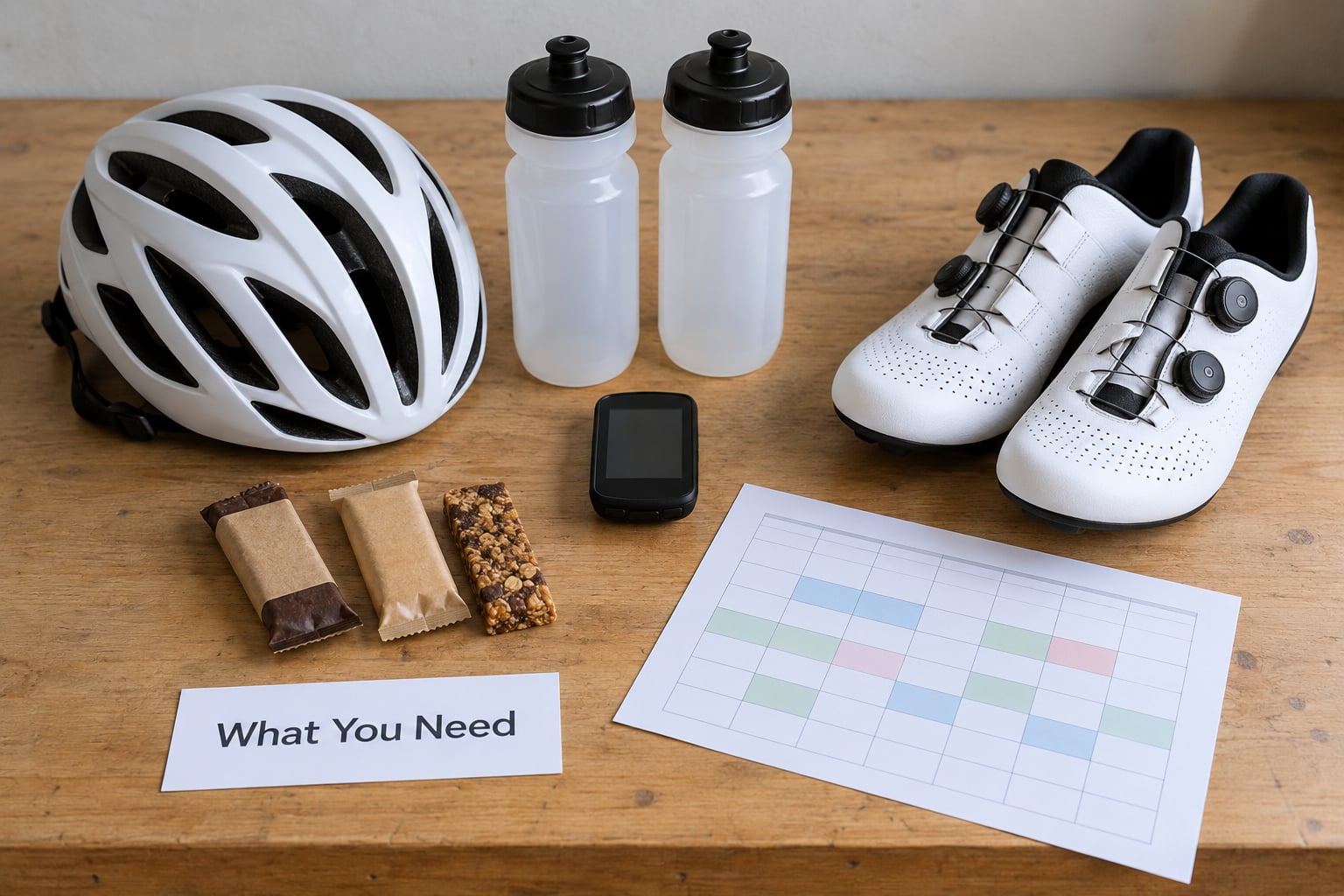
You need far less kit than a training plan implies. What actually matters is knowing four numbers before you build a single week, plus a bike that will not strand you 50 miles from anywhere.
The ride itself. Distance, distance with elevation, and the cutoff time. A flat 100 miles at an average of 15 mph is about seven hours in the saddle. A hilly 100 miles with 6,000 feet of climbing might be the same distance but a completely different kind of day, and it needs a different kind of preparation.
Your real weekly hours. Not the hours you wish you had. Look at the last three weeks and count the minutes you actually spent on the bike. Add your realistic ceiling for the weeks ahead, which is usually lower than your ceiling because life gets busier, not quieter, as a big day approaches.
A bike in good mechanical order. New chain, cables or brake pads, tires you trust, and a spare tube plus a plug kit if you run tubeless. Bike problems cause more DNFs than fitness does. A five-minute check before every long ride is the cheapest insurance in cycling.
Food and fluids you can actually stomach while moving. This is not a shopping list, it is a practice problem. You need one or two options for carb-heavy food that tastes fine at 14 mph after two hours, and you need to have eaten that exact thing at least twice in training before the event.
Optional: a way to track effort. A power meter is the gold standard, a heart rate monitor is a decent second, and neither is required. Most of this article works on feel alone, and there is a full section below on running a session without any electronics beyond a stopwatch.
One honest note on health. Training builds fitness, and the discomfort of hard sessions is normal, but chest pain, fainting, unusual breathlessness at rest, a fever, or pain that sharpens with every ride are not things to train through. Stop and see a doctor or a sports physiotherapist. Same rule after an illness: come back gradually rather than trying to make up the hours you missed.
How to Train for a Bike Ride With Limited Time: Step by Step
Assess Your Starting Fitness and Available Time
Before you plan anything, write down four honest numbers: your average weekly riding hours over the last month, your longest single ride in the last six weeks, the number of days a week you can genuinely train, and how quickly you normally recover from a hard effort.
The longest ride matters more than the weekly total. If your best recent effort was 90 minutes and the event is eight hours, you have a genuine gap, and no amount of thinking will close it. Say that out loud early, because it changes your pacing plans rather than your training.
Consistency beats catch-up. Riders who ride four hours a week, every week, arrive fitter than riders who ride ten hours in a good week and nothing for three. Training effect comes from repeated stimulus over time, so if you miss a week, resume at roughly the volume you were doing before the gap instead of trying to repay the hours.
Recovery capacity is the fourth number and the one everyone skips. If you are exhausted for two days after a hard session, you need fewer hard sessions and more easy ones, not a bigger week. Training hard on Monday, Tuesday and Wednesday is how time-poor riders end up riding the event on a body that never recovered.
Before you commit, check the training itself is boring. A long ride at a conversational pace and one or two sessions with structure will keep a rider with four hours a week comfortably through a century. The temptation with a small window is to make every session count, which sounds sensible and quietly produces overtraining. If the plan makes you dread Tuesday, the plan is wrong, not you.
Build a Repeatable Weekly Plan
Repeatability matters more than cleverness. If you have worked out how to train for a bike ride with limited time once, you have already beaten the riders who rebuild a plan every Sunday night. Pick the pattern that matches your hours and leave it alone for weeks at a time.
| Weekly hours available | Long ride | Short hard sessions | Easy riding |
|---|---|---|---|
| About 3 hours | 90 minutes, steady | One 30-40 minute session | Two 30-45 minute spins |
| About 5 hours | 2 to 2.5 hours, steady | Two 45-60 minute sessions | Two 60-75 minute rides |
| About 8 hours | 3.5 to 4 hours | Two 60-75 minute sessions | Two to three easy rides |
| About 10 hours | 4.5 to 5.5 hours | Two or three short sessions | Three easy rides |
A five-hour week looks like this on the calendar:
- Monday rest, or 15 minutes of mobility work if you are restless.
- Tuesday 60 to 75 minutes, mostly easy with one block of hard effort in the middle.
- Wednesday 60 to 90 minutes, easy, conversational, ideally outdoors with a friend.
- Thursday 45 to 60 minutes indoors, structured and hard.
- Friday rest.
- Saturday your long ride, 2 to 2.5 hours, with fuelling practice.
- Sunday an easy 60 minutes or full rest, depending on how Saturday went.
On three training days, the version that survives a real life is: one long ride, one hard session, one easy ride. Nothing else. Riders who try to add a fourth session usually take three good weeks and then stop entirely.
If weekends are your only reliable window, the shape changes. Put both weekend hours into the same pattern rather than spreading them: a hard session of 60 to 90 minutes on one day, the long ride of three to four hours on the other, and nothing in between except ordinary commuting. Commuting counts, and a round trip of 40 minutes a day is a free two hours of easy aerobic riding across a week. That is the quietest way to buy back the hours that work took.
Write the week down. Not in an app you will check once, on a card by the door or in your phone calendar. A plan that lives only in your head gets cancelled by the first bad evening, and cancelled weeks are what turn a training block into a bad day on the bike.
Stack intensity never on consecutive days, and put your long ride after a rest day if your week allows. The long ride is the session that most needs a fresh body, and it is also the one people schedule first because it fits the calendar. Protect it.
Indoor or outdoor is a decision about what the hour is for. If the hour is in the evening on a work night, indoors wins: no lights, no traffic, no wet kit, and you can follow a structured session. If the hour is a weekend morning and the weather is reasonable, outdoors wins, because handling, pacing in a group and bike-position comfort only train outside. A useful split for most people with a trainer is one or two indoor hard sessions a week and every weekend ride outdoors. And if your indoor machine is a gym bike with no power meter, that is enough, provided you train by feel as described below.
Use Short, Targeted Intervals
Short sessions still have to be hard, or you are just commuting slowly. When time is short you cut the length of the workout, never the intensity of the work. A 60-minute session with three hard efforts inside it beats 90 minutes of steady riding every week.
Here is a copyable 60-minute structure, the session I would put in almost any compressed week:
- 10 minutes easy warm-up. Spin gently until you are warm, then do three 30-second hard efforts with easy spinning between them to open the legs.
- Three 10-minute efforts at roughly 88 to 95 percent of your threshold, with 5 minutes easy between each. Steady, controlled, not the fastest thing you have ever done.
- 5 to 10 minutes easy cool-down until your breathing is back to normal.
Feeling for 88 to 95 percent of threshold without a power meter: you can breathe in short phrases, you can say a short sentence but not a paragraph, and you know you are done at any moment but could hold on for several more minutes if the road kept going. That is the sweet spot, and it is the most useful intensity in compressed training.
For sessions under 45 minutes, shorten the efforts rather than the effort. Three sets of 5 minutes at a hard but repeatable pace, with 4 minutes easy, fits neatly into a 40-minute indoor block including warm-up and cool-down.
For a gym bike with no power meter and no heart rate, the talk test is enough. Ride at an easy conversational pace for 10 minutes, then hold a pace where you can manage only short phrases for 5 minutes at a time, recovering for 3 minutes between efforts. Repeat three times. That is a real workout and it needs no equipment.
Two warnings. Do not let a hard session leave you destroyed, because you will not recover before the long ride and the long ride is the point of the week. And do not stack a hard Tuesday and a hard Thursday around a Saturday long ride without an easy day between them. Riders on four hours a week who feel great in May are usually doing about 80 percent of their riding at an easy effort, and roughly 20 percent very hard.
Use the 15-minute gaps instead of losing them. On a week where a ride gets cancelled, ten to fifteen minutes of strength and mobility work is worth more than another easy spin. Squats or split squats, a step-up or two, calf raises, a plank, and some hamstring and hip mobility covers the main time-crunched cyclist needs: staying stable in the saddle for hours and resisting the niggles that end a training block early. It does not replace riding, and anyone claiming otherwise is selling something. It holds training stress up on the days riding is impossible, and a routine you can do in your living room at 6am is the only one that survives a bad month.
Make the Longest Ride Count
The long ride is the session that actually prepares you for the event, and it is the one that compresses easiest. Two to three hours once a week builds time-in-the-saddle durability, which is exactly what you need at hour five of a century.
Turn it into a rehearsal rather than a sufferfest. Pick a duration that fits your training week, not the event distance. A rider with a five-hour weekly budget rehearses with a two-and-a-half-hour ride and accepts that the last two hours will be new. That is still better than a seven-hour hero ride that wrecks the following week.
Include some climbing, even if it is only a few short pitches. Hills are where pacing and fuelling skills get tested, and they are the part riders are least conditioned for after a winter of flat commuting. Steady, not hard: climb at a pace you could hold for an hour.
Practice fuelling on this ride, because fuelling is a skill, not a purchase. Aim to take in roughly 30 to 60 grams of carbohydrate per hour once you are past about an hour of riding, starting early rather than saving it for when you are already hungry. Drink to thirst with electrolytes if it is hot or you are a heavy sweater. Most riders under-eat on big days by a factor of two, and that is the single most common reason a strong rider finishes a long ride crawling.
Hold back. Sit in the group, ride at the front if you are comfortable, but do not test yourself in the first 30 minutes. Riders in cycling forums describe blown rides over and over, and the cause is almost always the same: an adrenaline-driven start that spends the effort the second half needs. If you can finish the ride feeling like you could have gone another 30 percent, you paced it correctly.
How do you hold back when your legs are fresh and the group is rolling away? Pick a number. Sit at a steady 16 to 18 mph on the flat and count your effort, not your speed, because the group will keep going whatever the terrain does. Take food before you want it, since you cannot eat when you are already gasping, and if the pace keeps rising, let the front group go. Nobody has ever finished a century behind and resented it later.
One rider I know pre-loads the night before and during the first hour, then nothing until hour four, and finishes every long ride shuffling. Same fitness, worse result. The fix is unglamorous: set the timer, eat every 20 minutes whether or not you are hungry.
End the ride with energy in the tank on purpose. The last 20 minutes of an easy cool-down is deliberate, not wasted time. It teaches your body to hold form when it is tired, which is the exact skill that decides whether you enjoy the back half of the event.
If you are coming back after a real break, a winter off, or an injury, treat the first four weeks as rebuild rather than prepare. Ride three easy short rides a week for a fortnight, add the hard session back once the legs stop complaining, and only then start extending the long ride. Coming back to your old hours in week one is the standard way people pick up a second injury.
Taper and Practice Event Logistics
Tapering is not optional in a compressed schedule, because compressed schedules stack load into fewer days and leave less room for fatigue to fade. Cut volume, keep frequency, drop intensity.
| Weeks to the event | What the week looks like |
|---|---|
| 8 weeks out | Build the pattern. Ride your schedule, extend the long ride by about 10 to 20 percent every week or two, no more. |
| 4 weeks out | Longest ride of the block. One hard session, rest days respected, no new workouts introduced. |
| 2 weeks out | Long ride slightly shorter. Keep one hard session so you do not arrive flat and uncoordinated. |
| Event week | Two short easy rides with 4 to 6 minutes of hard effort each, 30 to 45 minutes. Nothing long. Nothing hard. |
The progression rule matters: never increase duration and frequency in the same week. Add ten percent to the long ride, or add a day, never both. Sudden jumps are where compressed plans break.
Use the last rides for logistics, not fitness. Check tire pressure and the spare kit. Read the route profile and know where the big climbs sit, because that determines your fuelling schedule. Work out where you park, when registration opens, and how long the drive or train takes. Set alarms you will actually hear. Almost every disaster story about a missed start starts with a confident rider assuming there was time to spare.
Some riders also like to know the plan for a bad day before the good one arrives. If the weather turns, if you wake up with a sore throat, if you miss the start: reduce the distance, stop early, ride the flat part only. Choosing a sensible version of the ride in advance is far easier than making the choice while sitting in a car park.
Pack your fuelling exactly as you tested it, plus more than you think you need. Familiar is faster than optimal on the day.
Check the event details again close to the date in 2026. Cutoffs, start times and registration rules do change, and the rider who assumed last year’s details are the one standing at the gate on the morning. It takes five minutes and it removes the most embarrassing way to fail this whole plan.
Common Mistakes
1. Suddenly doubling the long ride. It feels productive and it usually costs you a week of training. Fix: add no more than 10 to 20 percent every week or two, and cut the following week if you overshoot.
2. Training every single day. Riders with four hours a week sometimes try to squeeze fitness from seven days of activity. Rest is where the adaptation happens. Fix: two hard days, one long day, the rest genuinely easy or off.
3. Skipping food on the long ride. You cannot eat on the sofa, so you skip eating on the bike too. Fix: set a timer for every 20 to 30 minutes and take a few bites before you feel you need them.
4. Racing the group ride. The fast group ride is the most tempting thing in the calendar and often the most expensive in recovery. Fix: use group rides for motivation, skills and social riding, not as your only hard session. Follow the wheel.
5. Riding the long ride hard because it is your only real session. That is how you end the week with nothing left for Saturday. Fix: keep the long ride at a steady effort, roughly an RPE of 3 or 4 out of 10.
6. Chasing fitness signals and side quests. New shoes, a bike fit, a training app, a new power meter, a different zone scheme, every single week. Fix: settle the setup weeks out and then let it be.
7. Ignoring fatigue and illness. Fever, a resting heart rate that has climbed 10 beats per minute for no reason, poor sleep and no motivation are all signals to back off. Fix: take two easy days, and if it does not settle, see a doctor. Missing a week costs far less than starting a long event sick.
8. Believing you need a power meter. Plenty of riders put off a plan because they do not own the gadget. Fix: run every session by feel using the talk test and the breathing description above. A meter makes the numbers convenient, not the training possible.
9. Doing everything hard at once. All your sessions feel like a race, so nothing recovers. Fix: roughly 80 percent of your hours should be easy enough to chat in, and the hard 20 percent should be genuinely hard. Riders who do it the other way round stall out fast, and burnout is what riders describe most often after a few months of a compressed plan.
Frequently Asked Questions
How many rides a week do I need to train for a long bike ride?
Three or four rides a week is the practical minimum for a century, a sportive or a charity ride. One should be your long endurance ride, one or two should be short and hard, and the rest should be easy. Two rides a week can work for an experienced rider who already has a base, but beginners usually need at least three to build time in the saddle.
Can I prepare for a century with only three rides per week?
Yes. Make one ride long and steady, one short and hard, and one easy and conversational, and repeat that pattern every week. The long ride builds the durability you need for five to seven hours in the saddle, while the hard session keeps your power up on the climbs. Two to three hours on the long ride builds up gradually rather than one brutal weekend per week.
Is an indoor bike trainer useful when outdoor training time is limited?
Very. A trainer gives you a consistent, weather-proof window of 45 to 60 minutes in the evening or early morning, and it makes structured sessions easy to run. The trade-off is that it does not build bike handling skills or time-on-bike durability, so keep your weekend long ride outdoors. Indoor riding also suits a gym bike: use the talk test and short efforts.
Should I increase my long ride by a large amount each week?
No. Add 10 to 20 percent to the long ride every week or two at most, and never increase duration and frequency in the same week. Big jumps bring soreness that eats your next few sessions, which is how riders end a training block fitter in week one with in week six. Most plans work best with steady, boring progression.
What should I do if I miss several workouts before the event?
Do not try to repay the hours. Resume with one easy ride at roughly the volume you were doing before the gap, add the hard session back a few days later, and cut the long ride by about 30 percent on your first weekend ride. You will lose very little fitness in two weeks, and the attempt to catch up usually costs more than the missed sessions did.
How do I know if I am ready for a century or double century?
The honest test is whether you have recently completed a ride roughly two thirds of the event distance at a steady pace while eating and drinking normally and still feeling comfortable at the end. A century usually needs you to hold 15 to 18 mph for seven to eight hours, so a comfortable four-hour ride at that speed is a strong signal. If your longest ride is under three hours, treat the event as a long day out.
Start with one thing this week. Put one long, steady ride on the calendar, protect it, and take carbs on it from the first hour. Everything else, the intervals and the taper, works better once that session exists and stays in the diary.