Riding out of the saddle efficiently comes down to three things: shift down before you rise, carry your weight forward without hanging on the bars, and hold a cadence high enough that the load lands in your legs instead of your knees. Standing lets you drive each pedal stroke with your body weight, so you can make more power for a short burst, but you also pay energy to hold yourself up, which is why it feels harder and burns roughly 6 to 10 beats per minute more than seated pedalling.
So efficiency here is about timing. Stand when the road asks for it, hold the effort for 20 to 60 seconds, then sit and recover before the standing has eaten your whole climb.
Most of the wobbling, knee ache and gear grinding riders complain about is not a talent problem. It is a transition problem and a gear problem, and both are fixable in a couple of rides.
Table of Contents
- The 7 Rules of Efficient Out-of-the-Saddle Riding
- What to check on the bike before you stand
- Saddle height and fore-aft position
- Crank length and cleat setup
- Saddle width and bar position
- How to ride out of the saddle efficiently: step by step
- Step 1: Shift down while you are still seated
- Step 2: Plant both feet level
- Step 3: Clear the saddle
- Step 4: Move the hips back, not up
- Step 5: Get your weight forward without hanging on the bars
- Step 6: Rock the bike toward the downstroke pedal
- Step 7: Let the back foot control the front pedal
- Step 8: Sit down cleanly and reverse shift
- Why standing gives more power and costs more
- Seated or out of the saddle: what actually changes
- When to stand and when to stay seated
- By gradient
- By discipline
- Sit bone relief on a long ride
- What cadence and gear to use when standing
- How to sprint out of the saddle
- Common mistakes and how to fix them
- Group riding safety and etiquette
- Standing drills that make it automatic
- Freewheel practice
- Trainer standing intervals
- Hill repeats
- Frequently Asked Questions
- Should I shift down before I stand up?
- What cadence should I use out of the saddle?
- Is standing more efficient than sitting when climbing?
- How long can I stay out of the saddle on a long ride?
- How do I stop wobbling and knocking when standing?
- Why does my knee hurt when I stand but not when I sit?
- What to practice this week
The 7 Rules of Efficient Out-of-the-Saddle Riding
- Shift down before you rise, while you are still seated. Two or three gears easier than the one you would sit and spin in. Shifting after you are up is what causes the surge-and-swallow that drops the rider behind you.
- Start the transition seated and finish it seated. Shift into the easy gear, stand, ride the bout, sit down, then shift back up. Never change gear and body position at the same time.
- Weight forward, hands light. Hips back over the pedals, chest low over the hoods or drops, elbows soft. The bars steer the bike, they are not something to hang from.
- Rock the bike toward the downstroke pedal. Push the bike underneath you on the power stroke. That side-to-side motion is the extra force, not the arms.
- Keep the cadence up. Roughly 70 to 90 rpm on the flat, a little higher on gentle ramps. Slow standing pedalling is what makes your knees track and your saddle rattle.
- Point your toes down as you clear the saddle. It buys roughly an inch of clearance and stops you dropping back onto the saddle nose halfway up a steep pitch.
- Stand in bursts, not for the whole climb. Long standing bouts cost more than they return, and they load the knees and the perineum. Sit back down while you still have something left.
What to check on the bike before you stand
Most riders blaming their standing technique are actually sitting on a setup that makes standing hard. Fix the bike first and half the wobble disappears on its own.
Saddle height and fore-aft position
Standing puts your hip open, so you get more knee bend at the top of the stroke than you do seated. If your saddle is already high for seated riding, the standing stroke will be cramped and the bike will rock. Riders on the r/bikefit forums who spend a season standing usually drop the saddle a few millimetres, not an inch, and stop the rocking within a few rides.
Do not chase this with the saddle clamp. If dropping the saddle by a few millimetres fixes the wobble and nothing hurts, that is your seated climbing height. If your knee tracks in and out only when you stand, that is a fit conversation, not a technique one.
Crank length and cleat setup
Long cranks make standing worse, because the extra pedal travel at the top of the stroke leaves the hip swinging. Shorter cranks, or a lower saddle, both reduce the rocking that riders mistake for bad balance.
Check your cleats while you are thinking about it. Standing pedalling puts noticeably more load through the cleat bolts and the plastic body, and a cleat that is already chewed up can snap mid-climb. Selle Anatomica flag this as a real and under-reported failure on longer rides.
Saddle width and bar position
A saddle that is too narrow makes standing uncomfortable, because you end up rocking your weight onto the nose to get off it. If you sit on a 143 mm saddle and are still wide through the sit bones, a wider or shorter-nosed saddle will let you rise without twisting.
Drop bars also help: the extra hoods and drops give you somewhere to lower your chest, and that is what lets you carry weight forward without bracing.
How to ride out of the saddle efficiently: step by step
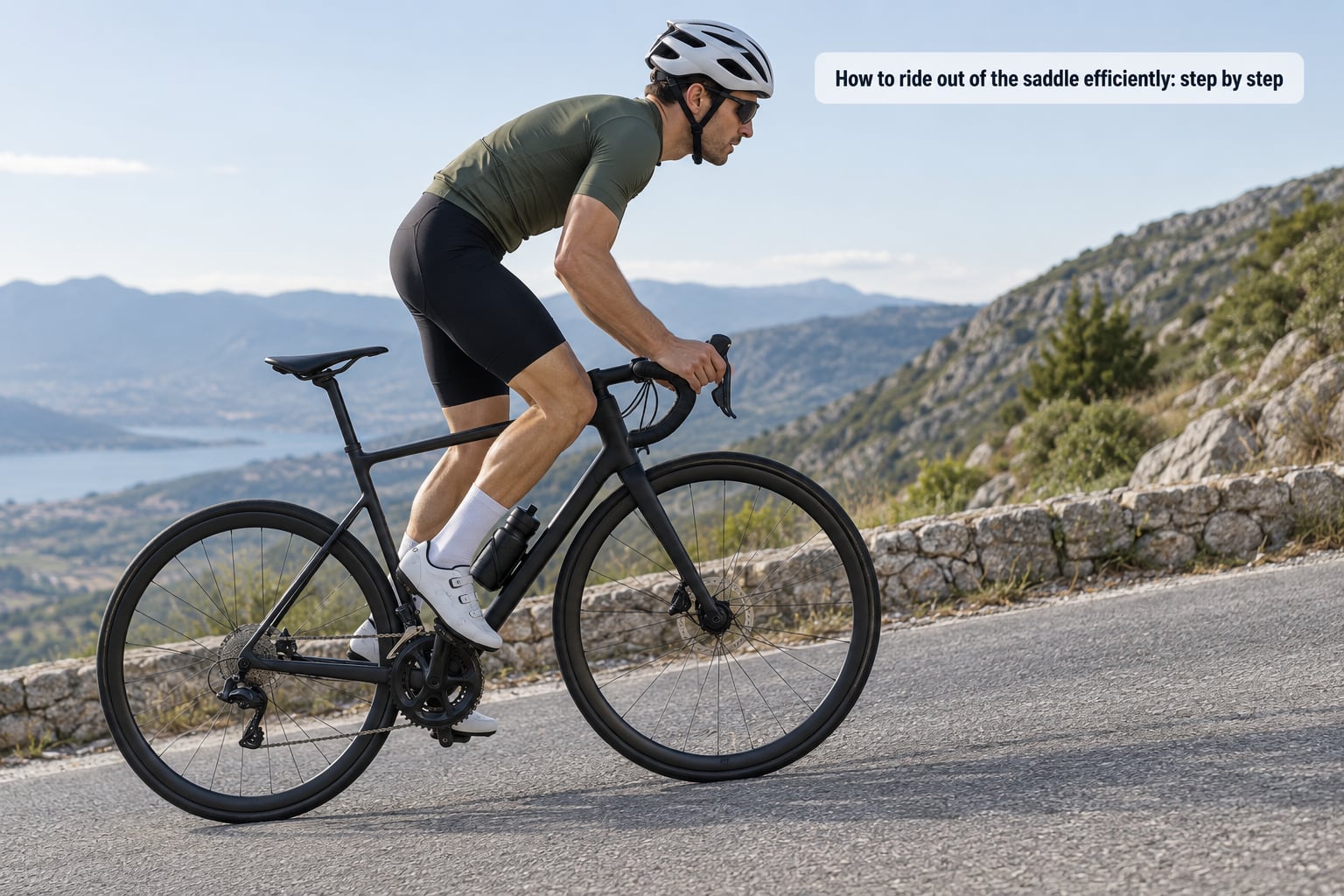
Step 1: Shift down while you are still seated
Look ahead and drop two or three gears before your speed drops below what you can pedal. Sitting for the first stroke or two of the new gear takes the harshness out of the transition and lets your legs find the rhythm before the load arrives.
Step 2: Plant both feet level
Get the foot that is about to go through the top of the stroke level with the other one. Uneven foot timing is the most common cause of a half-hearted rise, because the body weight arrives before the pedal is ready for it.
Step 3: Clear the saddle
Push off with the arms just enough to lift your hips, and point your toes down as you go. On a road bike without a dropper post this is where riders clip the saddle nose; on a mountain bike you get that clearance from the dropper instead.
Step 4: Move the hips back, not up
The hips travel backwards over the pedals as much as they rise. Hips that come straight up leave your weight behind the bottom bracket, and the bike then falls away underneath you on the next downstroke.
Step 5: Get your weight forward without hanging on the bars
Lower your chest toward the hoods or drops until you feel the weight on the front wheel. Keep the elbows soft and the hands light, and let the bar do the steering. Riders who hang from the bars tire their upper body and get the rocking that out-of-the-saddle riding is supposed to avoid.
Step 6: Rock the bike toward the downstroke pedal
As each foot drives down, tip the bike very slightly toward that side. It is a small movement, a few centimetres, and it is where the extra power comes from. The Weight Weenies forum describes the same idea as pushing the bike rather than forcing it, and it costs noticeably less energy for the same speed.
Step 7: Let the back foot control the front pedal
The leg coming up from the bottom of the stroke pulls the bike slightly sideways and the hand holding the bars counters it. Riders who ignore this end up with a bike that wanders, especially in the first few seconds of the bout.
Step 8: Sit down cleanly and reverse shift
When the bout is over, sit first, then shift up two or three gears. If you are in a group, call it. A standing rider changes speed faster than the seated riders around them, and riders behind are the ones who pay for a surprise.
Why standing gives more power and costs more
Seated pedalling puts roughly a third of your body weight through the saddle and two thirds through the pedals. Standing reverses that: your body weight passes through the cranks, so the peak force on each stroke goes up noticeably. That is why you can sprint, attack and clear a short wall from the pedals rather than from the saddle.
The cost is that you now have to hold your own body up with your legs for the entire bout, and your upper body joins in as a stabiliser rather than a passenger. That extra work shows up almost immediately on the monitor: heart rate typically sits 6 to 10 beats per minute higher standing than seated at the same power, and most of the additional demand is anaerobic rather than aerobic.
That is not a bad thing, because sprinting and steep ramps are anaerobic work anyway. It becomes a bad thing when riders use standing as their default climbing mode. You are spending a finite budget of high-intensity capacity on a 45-minute drag up a hill, and then wondering why you blew up at the top.
One more quiet cost: with your hands wider or your chest higher, drag goes up. On a road sprint that is irrelevant. Over 20 minutes of standing on a long climb, the seated position is simply cheaper aerodynamically.
Seated or out of the saddle: what actually changes
| Factor | Seated | Out of the saddle |
|---|---|---|
| Peak power | Lower, limited by leg force alone | Higher, body weight loads each stroke |
| Efficiency | Higher over minutes | Lower, cost of holding the body up |
| Typical cadence | 85-100 rpm | 70-90 rpm, higher on gentle ramps |
| Heart rate at equal power | Baseline | Roughly 6-10 bpm higher |
| Main energy source | Mainly aerobic | Large anaerobic contribution |
| Muscles working | Quadriceps, glutes, calves | Adds core, back, shoulders and arms as stabilisers |
| Knee load | Lower and symmetrical | Higher, and more lateral if the hip swings out |
| Comfort over time | Pressure builds on the sit bones and perineum | Relieves that pressure, loads the hands and lower back |
| Ideal bout length | Minutes to hours | 20-60 seconds, occasionally longer on a steep pitch |
| Best used for | Endurance, time trial, aero position, testing | Sprints, attacks, short walls, rough road, accelerations |
When to stand and when to stay seated
By gradient
On a 3 to 5% ramp, sit. Nothing on that gradient needs standing power, and sitting keeps your cadence up, your heart rate down and your hands on the bars where they belong. Standing on a shallow ramp is pure waste.
At 8% and steeper for more than a few seconds, stand. The speed drops to a range where seated power is limited, and the gradient will not let up for a while, so it is one of the few genuinely efficient standing cases.
On a short wall, stand every time. Twenty or thirty seconds at 10 to 14%, then sit immediately at the top. That is the textbook use of the position.
On rough road, cobbles or a technical mountain bike pitch, stand and stay light. Unweighting the saddle takes the sting out of the hits and lets you pedal through the rough stuff instead of bouncing off the bike.
By discipline
| Discipline | How much standing matters | Notes |
|---|---|---|
| Road climbing | High | Short bursts on steep ramps, plus sit bone relief on long days |
| Criterium | Very high | Corner exits, accelerations and attacks are almost all standing |
| Cyclocross | High | Short, violent efforts, usually after a run-up |
| Mountain bike | High | Technical pitches, plus dropper post clearance |
| Gravel | Medium | Loose surfaces and short pitches, not long drags |
| Commuting | Low to medium | Standing mostly serves to relieve saddle discomfort |
| Time trial and triathlon | Low | Aero position is the priority, and standing breaks the position |
| Indoor trainer | Medium | Useful for high-resistance intervals and sprint practice |
That last row is where a lot of riders get it wrong. Standing on the trainer for a long steady session costs you the same extra energy and gains you nothing, because there is no balance to manage and no acceleration to absorb.
Sit bone relief on a long ride
Standing is genuinely good for pressure: it takes your weight off the sit bones and the perineum, which is why riders with a numb or sore saddle feel a clear difference within a minute of standing.
Swap seated and standing every few minutes rather than committing to 15 minutes up. If saddle pain is sharp, worsening, or accompanied by numbness that does not clear within a few minutes of getting off the bike, stop riding it and get the saddle or fit looked at rather than training through it.
What cadence and gear to use when standing
Here is the number most guides leave out: standing cadence sits somewhere between 70 and 90 rpm on the flat, rising toward 90 to 100 rpm on a gentle ramp, and dropping toward 60 to 70 rpm only on a short, very steep push. The TrainerRoad forum complaint that nobody says what “slow down” means is fair, so here it is.
Below roughly 60 rpm standing, two things go wrong at once. The torque per stroke climbs, which is what makes your knees complain on the outstroke, and the load lands and lifts rather than pressing continuously, which is the knocking that riders describe on the flat.
On the gear question: shift down two or three gears before you stand, and shift back up two or three after you sit. Bigger jumps work in a pinch but they produce the surge that unsettles a group.
On bout length, 20 to 60 seconds is the useful range. A standing bout past about two minutes on a road bike stops buying peak power and starts costing you, because the anaerobic demand is now the only thing keeping you going.
How to sprint out of the saddle
A sprint is the shortest standing bout there is, and it has its own rules. Most riders ride a sprint with their hands on the tops, which is slower and taller than it needs to be.
For a sprint, move to the drops, bring your chest low and keep your weight over the front wheel. That gives you a lower, more stable position and takes the biggest chunk of aerodynamic drag off. Hold the cadence high and push hard enough that your head bobs slightly on each stroke; Selle Anatomica uses that head-bob cue as the test for whether you are actually driving.
Start from a high cadence, not a slow one. Sprinting is a gear that is too easy for about a second and then too heavy for the last few, and beginners lose the race in that first second rather than at the end.
Sit down the moment the sprint ends, before your cadence collapses. Trying to sit down while the legs are still spinning at 120 rpm is how riders get a knee injury at the end of a fast effort.
Common mistakes and how to fix them
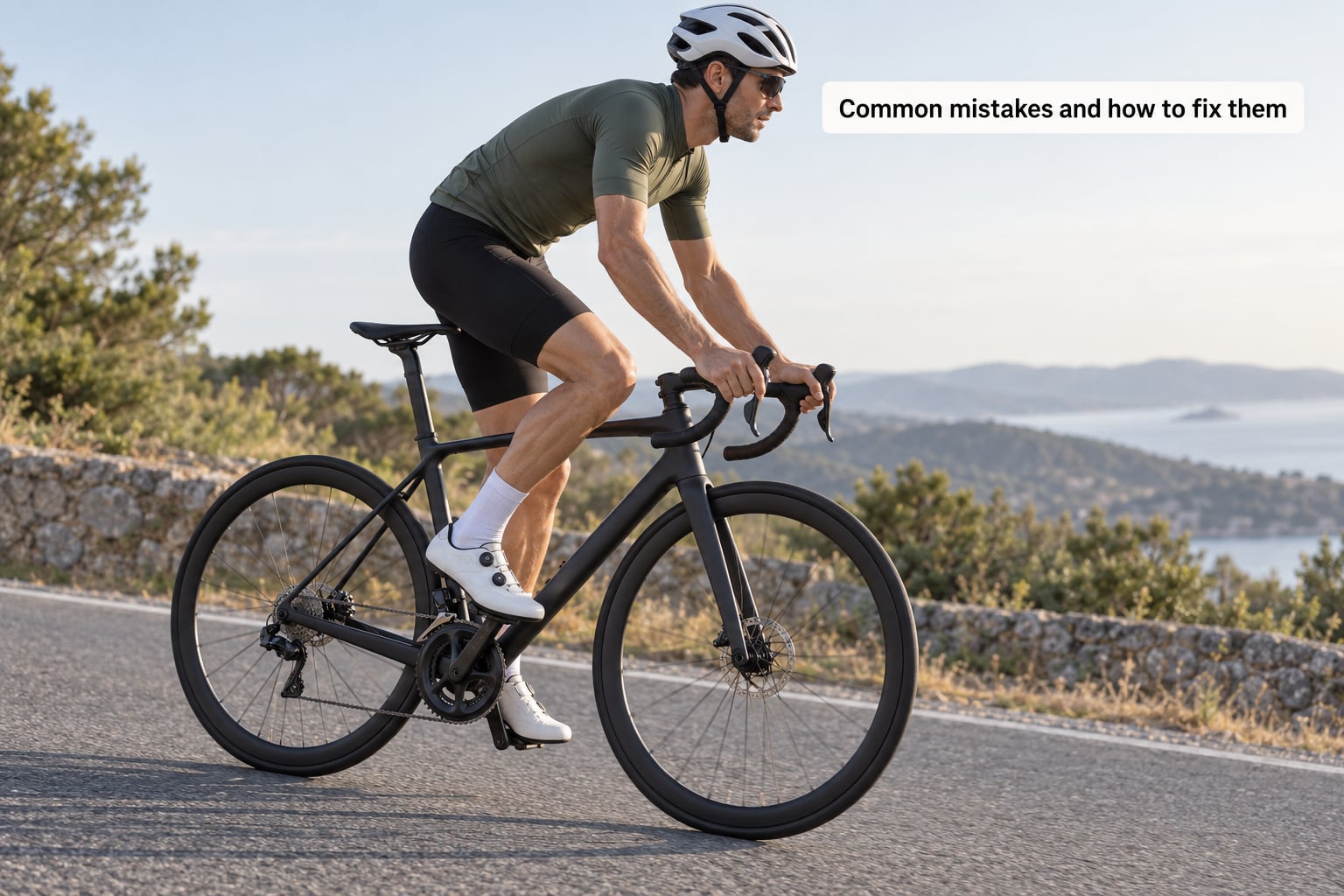
| Symptom | What is causing it | Fix |
|---|---|---|
| Knocking or bottoming out at the top of the stroke | Gear too hard, cadence too low, saddle too high, cranks too long | Shift down, hold 70-90 rpm, check saddle height before blaming technique |
| Side-to-side wobble across the bike | Weight behind the bottom bracket, heavy hands | Hips back over the pedals, lighten the grip, rock toward the downstroke instead |
| Chattering or jerky cadence | Standing before the cadence has settled, or forcing a hard gear | Start seated for a few strokes, pedal harder with the legs rather than the arms |
| Clipping the saddle nose on the rise | Toes level, saddle too high, no dropper post | Point the toes down as you rise, fit check, or fit a dropper post |
| Knee pain standing but not seated | Lateral hip swing and load through the knee, often a fit issue | Bring the hips back and over the pedals, then see a fitter before changing technique |
| Hand pressure or burning in the forearms | Hanging on the bars, chest not low enough | Soft elbows, weight forward through the hips, hands on the drops or hoods |
| Losing the group on the rise | Shifting and standing at the same time | Call it, shift seated, stand, then reverse shift once seated |
Knee pain deserves a note of its own. Standing increases the lateral load on the knee as the hip swings out, which is why plenty of riders feel it more standing than seated even on a perfectly reasonable setup. If the pain shows up in one knee only, follows you off the bike, or gets worse as you ride longer, stop tuning technique and get a bike fit. Patellofemoral pain and iliotibial band irritation are both things a fitter or a physio can assess in one session, and guessing with saddle height changes makes them worse.
For long-term knee trouble in general, a physio who works with cyclists is a better first call than an internet forum, whatever the forum tells you.
Group riding safety and etiquette
Call it out loud before you stand. The standard call is “Standing!”, and the reason is mechanical, not etiquette: your cadence change and your speed change happen faster than a seated rider can read them, and the rider directly behind you is the one who reacts.
Do not stand up under a bunch of riders who are already on a steep pitch. Wait for a gap, or stay seated and let the group stretch out for a few seconds.
On the sit-down, sit first and shift second. Reversing that order is the single most common cause of a rider behind swerving, and it is a one-second habit to unlearn.
Standing drills that make it automatic
Standing is a motor pattern, and like most motor patterns it responds to repetition far better than it responds to reading about it.
Freewheel practice
On a flat, quiet road, coast without pedalling, stand up, and settle onto the pedals in the new position. Ten repetitions, a couple of times a week. It removes the balance fear that stops a lot of riders from ever practising the position, and it costs nothing.
Trainer standing intervals
On an indoor trainer, do standing work only where it belongs: high resistance and short intervals. Four to six efforts of 20 to 30 seconds at a hard gear, with a few minutes easy between them, once or twice a week is plenty. Add a 20-minute block of easy seated pedalling after, because the recovery is part of the session.
Do not run long steady sessions standing. There is no skill to be gained there, and it just makes the position feel harder than it is.
Hill repeats
Find a ramp you can ride in a car. Do 6 to 10 repeats where you stand for the first 30 to 40 seconds, sit for the recovery, and go again. The short standing bout followed by a seated recovery is exactly the pattern you want to make automatic, because it is the pattern that costs you the least.
Frequently Asked Questions
Should I shift down before I stand up?
Yes, always, and do it while you are still seated. Drop two or three gears, sit through the first stroke or two so the cadence settles, then stand. Shifting after you are up creates a surge that unsettles the rider behind you and makes the first few strokes choppy. Reverse the sequence on the way down: sit first, then shift back up.
What cadence should I use out of the saddle?
Aim for roughly 70 to 90 rpm on flat or rolling terrain, and 90 to 100 rpm on a gentle ramp. Only drop toward 60 to 70 rpm on a short, very steep push where you are nearly out of the saddle anyway. Below about 60 rpm the torque per stroke climbs, the load lands and lifts rather than pressing, and your knees take the difference.
Is standing more efficient than sitting when climbing?
No, not over time. Standing produces higher peak power because your body weight loads each stroke, but you also pay energy to hold your body up, and heart rate typically runs 6 to 10 beats per minute higher at the same power. That extra demand is largely anaerobic, so it is worth spending on a sprint or an 8% wall and worth wasting on a 45-minute drag.
How long can I stay out of the saddle on a long ride?
20 to 60 seconds per bout is the useful range on the road, with seated recovery in between. Beyond about two minutes the position stops adding meaningful peak power and keeps costing you, and the pressure moves from your sit bones to your hands and lower back. Swap between seated and standing every few minutes on long rides rather than committing to one.
How do I stop wobbling and knocking when standing?
Knocking at the top of the stroke is a gear, cadence or fit problem: shift down, hold 70-90 rpm, and check whether the saddle is too high or the cranks too long. Wobble across the bike is a position problem: hips back over the pedals, light hands, and rock the bike toward the downstroke pedal instead of hanging on the bars.
Why does my knee hurt when I stand but not when I sit?
Standing opens the hip, so your weight shifts more sideways onto the knee, and if the hip swings out to clear the saddle the load gets worse. Bring the hips back and over the pedals and lighten the hands first. If it still hurts, or the pain follows you off the bike or shows up in only one knee, get a bike fit rather than continuing to change technique on your own.
What to practice this week
Do one thing on your next ride: shift down two gears while seated, stand for 30 seconds with your hands light and your hips back over the pedals, then sit before you feel like you have to. Repeat it a few times on the same climb, and the position will stop being something you think about and start being something your body already knows. Once that feels automatic, add the 70 to 90 rpm cadence target, and only then worry about holding the effort longer.