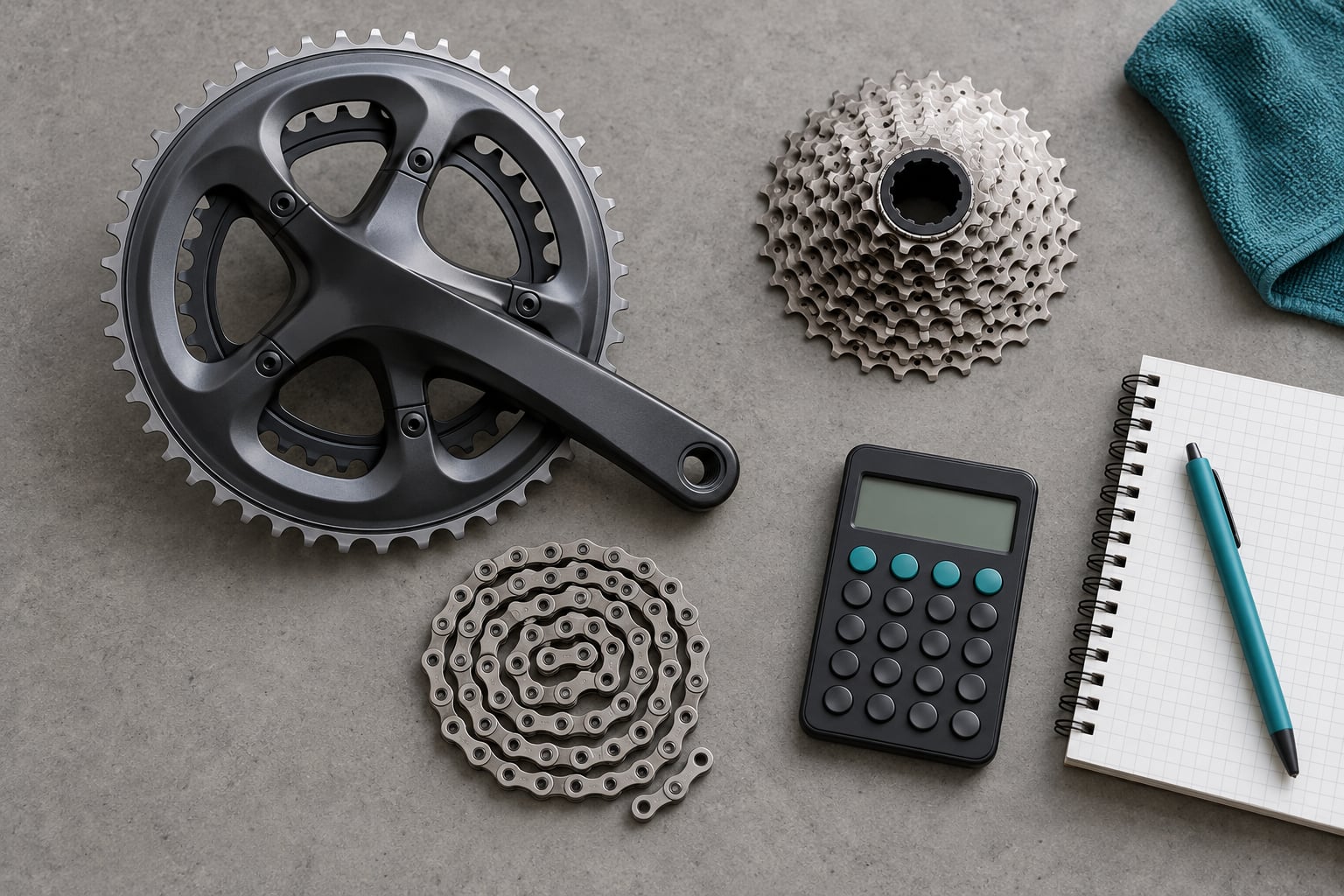
Short answer: most road riders need a compact 50/34 chainring with an 11-34 or 11-36 cassette, which is roughly a 1:1 bottom gear, to make steep climbs holdable. Move to sub-compact or gravel-style ratios such as a 46/30 with an 11-42 when you ride sustained pitches above about 15%, tour with luggage, or sit under roughly 3 W/kg.
Gearing decides how easily you can spend the power you have. It does not create more of it, and that distinction is where most disappointing climbs actually start. So what gearing do you need for steep climbs is a question you answer with your own gradient and your own watts, not with somebody’s forum post.
Table of Contents
- What Gearing Do You Need for Steep Climbs?
- How Much Easier Should Your Climbing Gears Be?
- Do You Need a Compact, Subcompact, or Triple Chainring?
- What a double crankset gives you
- What a triple adds, and what it costs
- How Do You Choose the Right Chainring Sizes?
- Does a Larger Rear Cassette Make Climbing Easier?
- How Do You Calculate Gear Inches and Development?
- What Cadence Should You Use on a Steep Climb?
- How Do You Test Gearing Before a Century or Double?
- Common Gearing Mistakes on Steep Climbs
- Frequently Asked Questions
- What is the best gear ratio for steep hills?
- Is a 50/34 compact gearing low enough for mountain roads?
- Do I need a triple chainring to climb steep grades?
- Should I pedal in a higher gear on steep climbs?
- What cassette size is best for long, steep road rides?
- How do I know if I am in the wrong gear while climbing?
- Start With One Easier Gear
What Gearing Do You Need for Steep Climbs?
The answer depends on four things: the steepest gradient you ride for more than a minute, the power you can hold for twenty minutes, the weight of rider plus bike plus luggage, and whether you would rather spin a light gear or push a heavier one at a lower cadence. Change any one of those and the correct gearing changes with it.
That is why the same chainring that suits a fit club rider in the flatlands leaves their neighbour grinding up the first ramp. Here is the vocabulary first, because these numbers decide everything else.
| Term | What it is | Why it matters on a steep climb |
|---|---|---|
| Chainring size | The teeth on the front crankset, usually two rings on a road bike | A smaller inner ring makes every gear on that ring easier |
| Cassette range | The spread of rear sprockets, from smallest cog to largest | The largest cog sets your easiest gear; the smallest sets your hardest |
| Gear ratio | Front teeth divided by rear teeth, so 34 divided by 34 equals 1.0 | Lower numbers are easier to pedal, higher numbers cover more ground per stroke |
| Gear inches | Ratio multiplied by wheel diameter in inches | Lets you compare gearing across bikes with different wheels |
| Development | Metres travelled per pedal revolution | The same idea in metric, and easier to sanity-check against a route profile |
| Gear step | The percentage jump between neighbouring gears | Big steps at the low end mean constant shifting on a ramp |
One more thing worth settling early: what counts as steep. A gradient of 6% rises 6 m for every 100 m you travel, which most riders feel as a nudge rather than a climb. It is at 8% that a compact chainring starts earning its place.
| Gradient | How it rides | Bottom gear that suits most people |
|---|---|---|
| 3-4% | False flat, sitting on the nose | Anything, 50 x 11 is fine |
| 5-6% | Rolling, you notice the road tilt | Around 45 to 60 gear inches |
| 6-7% | A proper pull, easy on a good day | Around 40 to 45 gear inches |
| 8-10% | Sustained climbing, cadence matters | Around 30 to 35 gear inches |
| 12% | Category climb, power is the limit | Around 27 to 30 gear inches |
| 15% and above | Ramp territory, most rigs run out | 22 to 25 gear inches or lower |
| 18-20% and above | Hairpin ramp or first pitch of a mountain | Under 22 gear inches |
| Any gradient, fully loaded | Luggage adds mass on every metre | Under 25 gear inches as a starting point |
How Much Easier Should Your Climbing Gears Be?
There is a way to work out your number instead of copying someone else’s, and it takes one equation. Power at the pedals equals system weight in kilograms, times gravity, times gradient, times wheel radius, divided by gear ratio, times the usual cadence and angular factors.
For an 83 kg bike-and-rider system on a 700c wheel, pedalling at 80 rpm, that collapses to a clean rule: watts needed equals 2290 multiplied by the gradient, divided by the gear ratio. The gradient is a decimal, so 12% is 0.12.
Use it backwards. Divide 2290 by your sustainable climbing power, and you have the number that converts gradient into the ratio you want. A rider holding 250 watts needs a ratio of 9.2 times the gradient; on a 12% pitch that is 1.1, and on a 20% hairpin it is 1.83.
| Gradient | 200 W (2.7 W/kg) | 250 W (3.3 W/kg) | 300 W (4.0 W/kg) | 350 W (4.7 W/kg) |
|---|---|---|---|---|
| 5% | 0.57 | 0.46 | 0.38 | 0.33 |
| 6% | 0.69 | 0.55 | 0.46 | 0.39 |
| 8% | 0.92 | 0.73 | 0.61 | 0.52 |
| 10% | 1.15 | 0.92 | 0.76 | 0.65 |
| 12% | 1.37 | 1.10 | 0.92 | 0.79 |
| 15% | 1.72 | 1.38 | 1.15 | 0.98 |
| 18% | 2.06 | 1.65 | 1.37 | 1.18 |
| 20% | 2.29 | 1.83 | 1.53 | 1.31 |
W/kg figures in brackets assume a 75 kg rider. Read the table as a ceiling, not a target: any gear easier than the number will hold the gradient, any gear harder drops your cadence below 80 rpm.
Now translate those ratios into teeth, because a ratio is only useful if you can shop with it. The numbers below assume a 700c wheel of roughly 27 inches and a 2.11 m circumference.
| Chainring | Rear cog | Ratio | Gear inches | Development (m per crank revolution) |
|---|---|---|---|---|
| 50 | 11 | 4.55 | 122.7 | 9.59 |
| 50 | 28 | 1.79 | 48.2 | 3.77 |
| 50 | 34 | 1.47 | 39.7 | 3.10 |
| 39 | 11 | 3.55 | 95.7 | 7.48 |
| 39 | 28 | 1.39 | 37.6 | 2.94 |
| 39 | 34 | 1.15 | 31.0 | 2.42 |
| 34 | 11 | 3.09 | 83.5 | 6.52 |
| 34 | 28 | 1.21 | 32.8 | 2.56 |
| 34 | 34 | 1.00 | 27.0 | 2.11 |
Look at the two ends of that table and you can see why 50 x 11 is a terrible climbing gear and a lovely cruising gear. On a 12% ramp an 83 kg system needs about 98 newtons of force at the contact patch, which through a 50 x 11 gear becomes roughly 43 newtons at the pedal. In 34 x 34 the same hill asks for about 195 newtons. One is a fast, hard effort; the other is a slow, sustainable one.
No single gear works for every steep climb, which is the honest answer. The bail-out gear you tuck away for 18% walls is a liability on a 5% drag back from the cafe, and a 34 x 28 you would happily ride all day in the hills is far too slow to hold a group on the flat.
Do You Need a Compact, Subcompact, or Triple Chainring?
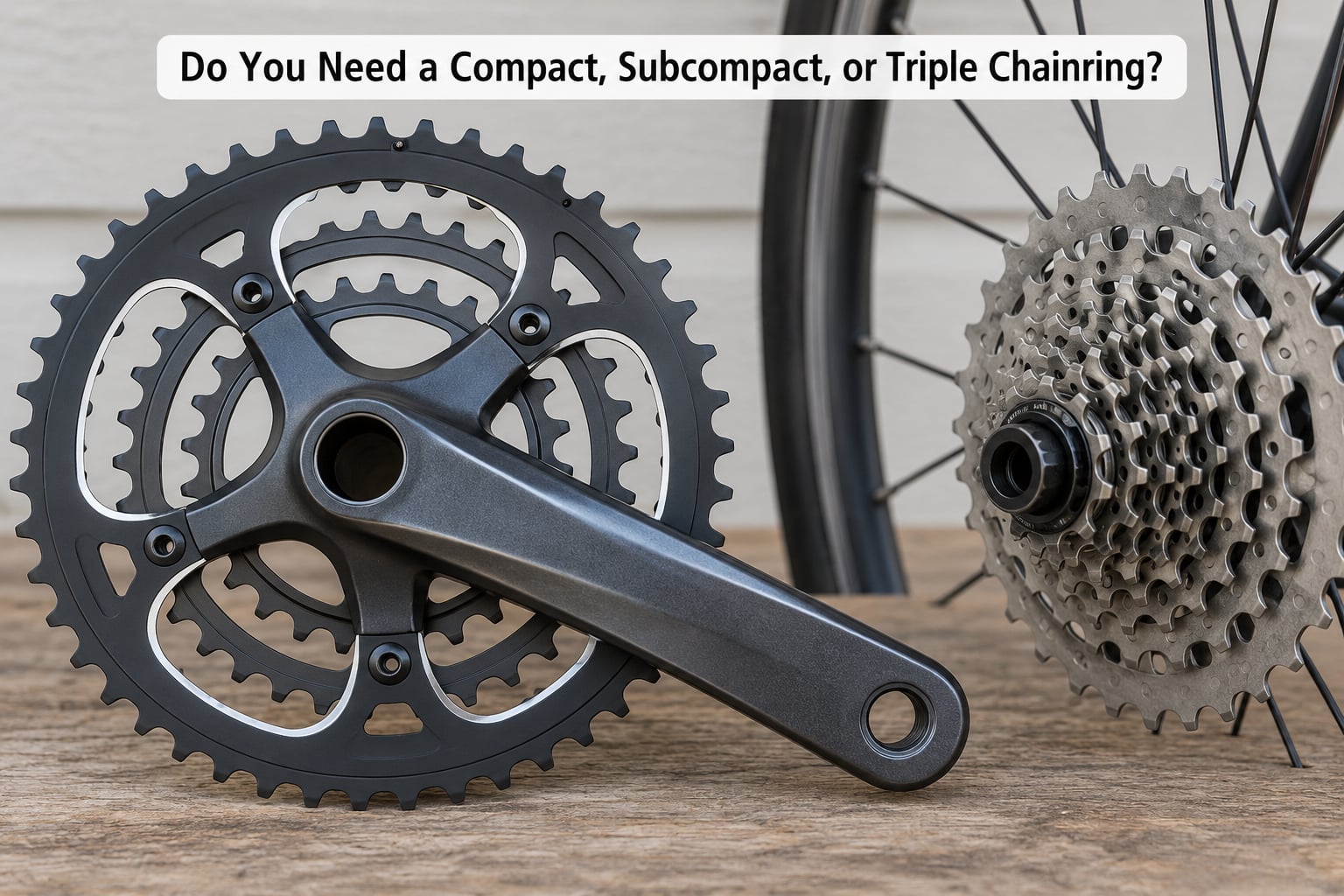
For almost every road rider the answer is a double crankset, and the real choice is 50/34 or something smaller. A triple adds range you may never touch, and it asks for more of your attention than most people expect.
What a double crankset gives you
A compact 50/34 paired with an 11-34 cassette lands on a 1:1 bottom gear, which handles gradients up to roughly 12% at about 275 watts for an 83 kg system. A semi-compact 52/36 is the same idea with a taller outer ring, useful for fast flat riding and pointless as a climbing choice.
Sub-compact rings, typically 46/30 or 48/32, exist for one reason: they get you below 1:1 without dropping to a triple. Riders on the Trainer Road forum run combinations like 46/33 with a 10-36, and r/gravelcycling riders report that a gravel double with an 11-42 transforms their steepest pitches.
What a triple adds, and what it costs
A 48/38/28 crankset adds a bail-out gear below anything a double can offer, which genuinely helps on a loaded century or a road with a 20% first pitch. Against that: more weight, a front derailleur that has to be dialled in properly, and one more chainring to cross-chain away from when you are tired.
Triples make sense for riders who cannot hold a meaningful speed in the lower gears of a double, and for loaded setups. For everyone else, one more tooth of low range rarely pays for the shifting fussy-ness.
| Setup | Bottom gear | Range | Chain handling | Who it suits |
|---|---|---|---|---|
| 2x compact 50/34 with 11-34 | 1.00 | 209% | Two rings, front shifting under load | Most road riders, hilly to alpine |
| 2x compact 50/34 with 11-36 | 0.94 | 227% | As above, one tooth lower | Alpine roads and loaded riding |
| 2x sub-compact 46/30 with 11-42 | 0.71 | 282% | Tighter chainline than a triple | Gravel, heavy riders, very steep routes |
| 1x 40T with 10-44 | 0.91 | 340% | Chain stays put, no front shifting | Gravel riders who ride rough roads |
| 1x 36T with 10-52 | 0.69 | 420% | Simplest system going | Bikepacking and the roughest passes |
| Triple 48/38/28 with 11-32 | 0.88 | 186% | Hardest to set up, most to maintain | Loaded centuries, very low power |
That 1x row is not a compromise in the way people assume. On a 10-52 cassette, gear steps near the bottom are a couple of percent, so 1x riders hold a steady cadence on a ramp where a road double with 11-28 teeth is up and down the block constantly.
How Do You Choose the Right Chainring Sizes?
Choose the inner ring for your steepest pitch and the outer ring for your fastest flat, then split the difference. That is the whole method, and the usual pairings fall out of it.
A 50/34 suits riders who can hold around 4 watts per kilogram and rarely see 15%. A 48/34 is a near-identical crank with a slightly calmer top gear, useful if you ride fast group stuff. A 46/30 or 48/32 is the choice for sub-4 W/kg riders, heavy bikes or genuinely alpine routes.
Two practical checks matter more than the tooth count. The gap between your inner and outer ring should stay in the region of 16 to 20 teeth, because a bigger jump makes the front ring hard to shift under load. And cross-chain as little as you can: an inner ring in the smallest cogs and an outer ring in the biggest cogs is where chain wear and noise come from.
Chainring wear tells you something too. If your inner ring goes oval or develops shark-fin teeth years before the outer ring does, it is probably being ridden too small, or too large a cassette is pairing with it.
Does a Larger Rear Cassette Make Climbing Easier?
Yes at the low end, and no on the flat. This is the single most persistent myth in cycling forums, so let us kill it cleanly: the smallest cog on your cassette is what governs your top gear, and adding range at the bottom does not change it at all.
What a bigger cassette does change is the step size through the range. Percentage range is the largest cog divided by the smallest, minus one.
| Cassette | Range | Bottom gear with a 34 ring | What it serves |
|---|---|---|---|
| 11-28 | 155% | 1.21 | Hilly European day riding |
| 11-30 | 173% | 1.13 | Rolling terrain, commuting |
| 11-32 | 191% | 1.06 | General-purpose road |
| 11-34 | 209% | 1.00 | Alpine road default |
| 11-36 | 227% | 0.94 | Steep alpine, loaded |
| 11-42 | 282% | 0.81 | Gravel and loaded touring |
| 10-44 | 340% | 0.77 | 1x gravel, rough passes |
| 11-50 | 355% | 0.68 | Very steep, low-power riding |
| 10-52 | 420% | 0.65 | Bikepacking and extreme terrain |
Before you buy any of these, run six compatibility checks:
- Cage length. A short-cage road derailleur physically cannot take a 36-tooth cog, let alone a 44. Check the derailleur body markings and the maker’s stated maximum sprocket size.
- Maximum sprocket rating. Longer-cage units from Shimano, SRAM and Campagnolo are rated to 42, 44, 50 and 52 teeth depending on model, and those ratings change between generations. Verify the exact derailleur you own.
- Chain length. A 44-tooth cog needs roughly four extra links over an 11-34. Most chains are cut for the middle of the block, so budget for a linkset.
- B-tension. The B-screw sets the gap between the jockey wheels and the largest cog. On a long cassette you usually need to back it off so the upper pulley clears the teeth.
- Freehub driver. Shimano HG, SRAM XDR and Campagnolo N3W bodies are not interchangeable, which rules out some cross-brand cassette and wheel pairings.
- Chainline and shifting feel. Very large cogs can pull the chain well off the narrowest chainline on a compact, and the front derailleur’s outer plate needs trimming to avoid rub in the big-big combination.
Gearing is a system. A cassette chosen purely for maximum range is how people end up with poor shifting and a bent hanger, and it is why the forum advice repeats the same warning: change the cassette before the chainset, and change the derailleur before the cassette.
How Do You Calculate Gear Inches and Development?
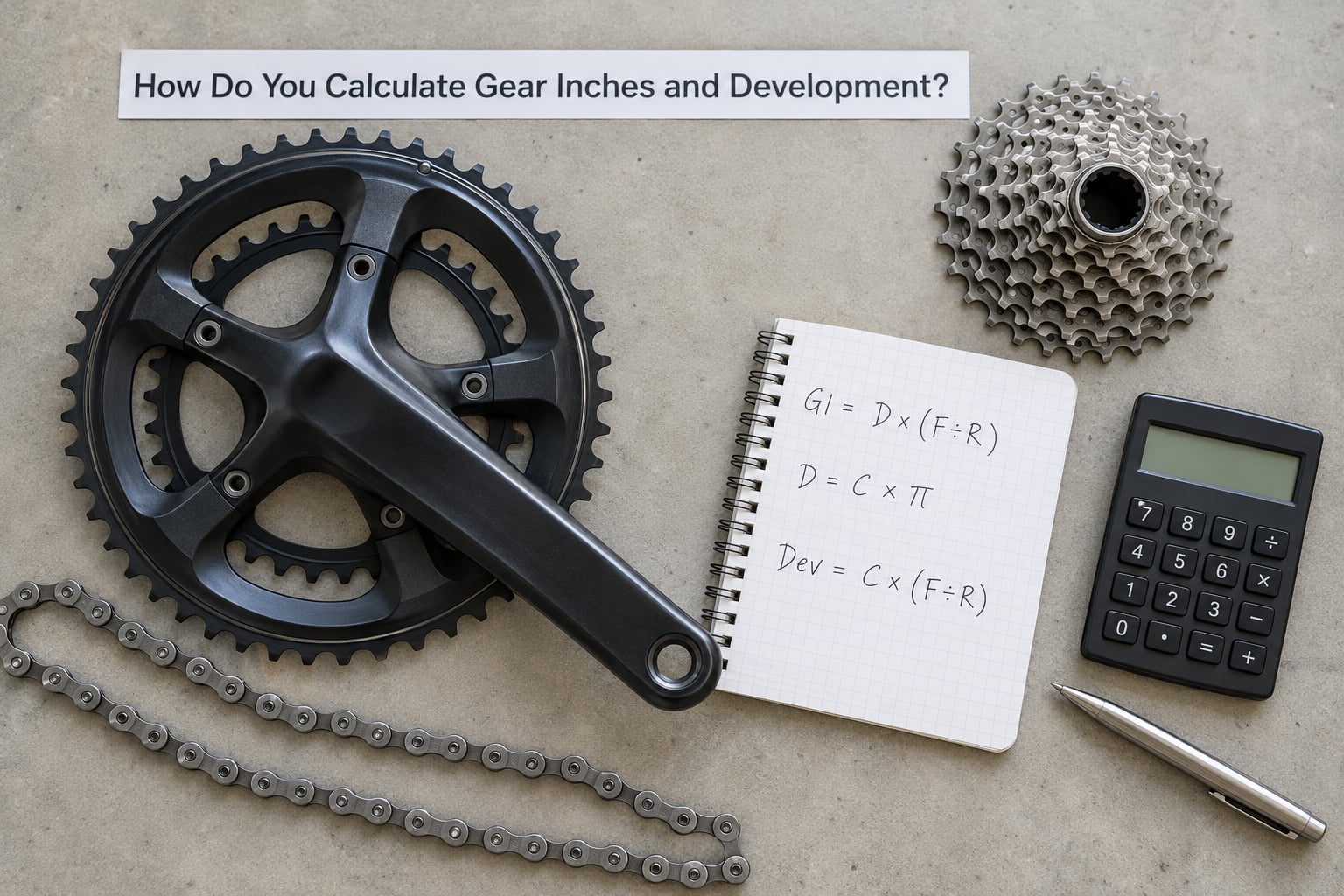
Both numbers exist to answer one question: is this gear easy enough? Gear inches multiply the ratio by wheel diameter, development multiplies the ratio by wheel circumference in metres. Work out either one and you can compare bikes with different wheels without riding both.
A worked example: a 34-tooth inner ring in a 28-tooth cog gives a ratio of 1.21. On a 27-inch wheel that is 32.8 gear inches and 2.56 m of travel per pedal revolution. A 34 x 34 gives 1.00, which is 27.0 gear inches and 2.11 m.
Here is a reference card worth keeping, using a 27-inch 700c wheel. Around 30 to 40 gear inches is moderate road climbing gear. Around 27 to 30 is easy. Around 22 to 27 is very easy and suits steep alpine work. Below 22 is loaded or 1x territory.
The myth to avoid is that bigger wheels make every gear easier, so a mountain bike climber is automatically better geared. A 700c road wheel with 28 mm tyres has about a 2.11 m circumference, while a 29er with fat tyres can be nearer 2.30 m, which raises every gear by about 9 percent. Swapping a 42-tooth chainring for a 52 moves gearing by roughly 24 percent, more than twice the effect of the wheel change. Riders on MTBR forums make exactly this point: treat 1:1 as a minimum on gravel, and go to 0.95:1 or lower on 29-inch wheels because the bigger wheel stiffens every ratio.
What Cadence Should You Use on a Steep Climb?
Most road riders settle between 70 and 90 rpm on a sustained climb, and staying above roughly 65 rpm is the line between spinning and grinding. The number matters less than the feeling: if you can hold a smooth, quiet, controlled pedal stroke for twenty minutes without your legs tightening up, you are in a sensible gear.
Pick the gear before the road tilts rather than reacting to it. Shift while you are still on a shallow gradient, and keep the effort light through the change. Dumping straight into the easiest cog on a ramp feels dramatic and then leaves you going nowhere, because an easy gear creates speed, not power.
Spinners usually come out ahead over distance because a high cadence spreads load across more pedal strokes. Grinding briefly is still useful in a headwind or when you stand to unload the saddle, just not for a whole mountain.
How Do You Test Gearing Before a Century or Double?
Test it on a climb you already know, before the day matters. The steepest familiar hill within an hour of your home gives you a repeatable laboratory, and repeatability is what tells you whether a change helped.
Start by riding your current bottom gear up that hill and recording your cadence at three points: the base, the steepest pitch, and two minutes after you crest. Ride it again a week later in the same conditions. If your cadence at the steepest pitch sits under 65 rpm, or your legs burn out early, your lowest gear is too hard for you.
Then try the candidate setup. A temporary chainring swap for a training ride is the cheapest test there is, and a friend with an 11-36 cassette covers most questions. Time the climb at a consistent power, which your bike computer will log for you, rather than comparing raw times that depend on the day.
Recovery matters as much as the climb. Ride down fast, turn around, and see whether the second effort matches the first. If it does not, the gearing was never the limiting factor on that ride.
Keep the distinction clear in your head: training rides are for testing setups, and race days are for executing the one you have already proved. The worst possible move is a new drivetrain the morning of a double century.
Common Gearing Mistakes on Steep Climbs
- Carrying too many heavy gears. Riders on r/cycling report using their biggest gear almost never. If your top gear is unreachable in normal riding, take two teeth off the outer ring and spend the weight on range instead.
- Staying in the flat-road gear. The gear that felt right on the valley floor is the wrong gear on the ramp. Re-gear as the gradient builds, not after your cadence has already collapsed.
- Shifting too late. On a climb, shift at the base of the pitch, while the load is still light. A change under full power costs speed and can skip.
- Buying the biggest cassette you can find. Maximum range is not the goal. Overly wide cassettes give huge steps at the low end and frequently exceed the derailleur’s rating.
- Copying pro gearing. Riders on r/triathlon routinely check a used time trial bike before buying, and often find 48 with a 10-33 gives a bottom gear of 1.45, which is far too hard for the buyer. Pros ride at 5 watts per kilogram or better; check your own number first.
- Trading a safe cadence for an unfamiliar setup. If a gear feels wrong at 70 rpm, it is wrong. Ride the lowest gear you can control on a training ride before committing to it on a long route.
And the mistake that is not about gearing at all: expecting a smaller chainring to fix a fitness ceiling. Riders on the same forums agree that gearing helps, but no combination makes a heavy bike lighter or a weak rider stronger. Weight, tyre pressure, pacing and leg fitness each cost you more on a steep climb than the bottom gear does.
Frequently Asked Questions
What is the best gear ratio for steep hills?
For most road riders the target is between 0.9 and 1.1, which a 50/34 chainring with an 11-34 or 11-36 cassette gives you almost exactly. Work out your own number by dividing 2290 by your sustainable climbing watts, then multiplying by the gradient as a decimal. A rider holding 250 watts wants about 1.1 on a 12% pitch and about 1.83 on a 20% hairpin.
Is a 50/34 compact gearing low enough for mountain roads?
Usually yes. A 50/34 with an 11-34 or an 11-36 handles gradients up to about 15% for a rider sustaining roughly 300 to 345 watts, which is around 4 watts per kilogram for a 75 kg rider plus bike. Riders under 3 watts per kilogram, anyone touring with luggage, and anyone facing sustained pitches above 18% should look at sub-compact or gravel gearing.
Do I need a triple chainring to climb steep grades?
Only if the lowest gear on your double is still harder than the steepest pitch you ride. A triple earns its place on fully loaded centuries, on roads with 20% first pitches, and for riders who cannot hold a useful speed in a double. Otherwise the extra ring costs weight, adds a front derailleur to maintain, and encourages cross-chaining exactly when your legs are tired.
Should I pedal in a higher gear on steep climbs?
Not for long. A higher gear on a ramp feels fast for a few seconds and then costs you, because your cadence drops and your power output falls with it. Aim for 70 to 90 rpm and change to an easier gear before the gradient hits rather than after. A brief harder gear in a headwind or when standing is fine; grinding for twenty minutes is not.
What cassette size is best for long, steep road rides?
An 11-34 or 11-36 is the sweet spot for alpine road riding, and it needs a medium or long cage derailleur. For gravel, loaded touring or routes above 18%, look at 11-42, 10-44 or 10-52 options, which means a derailleur rated for those cogs, a longer chain and usually a B-screw adjustment. Riders on r/gravelcycling report an 11-42 transforming steep gravel climbs.
How do I know if I am in the wrong gear while climbing?
Three signals: your cadence falls under about 65 rpm, your pedal stroke becomes heavy and noisy, and your speed stops responding when you try to pedal harder. Any one of those means shift to an easier gear immediately rather than pushing on. If you are in an easy gear and still cannot make progress, the limit is your power, not your gearing, and no chainring will change that.
Start With One Easier Gear
Find the steepest pitch on your regular route, divide 2290 by your sustainable climbing watts, and multiply by that gradient as a decimal. That is your ratio ceiling. Buy or swap toward the easiest gear that sits at or below it, which for most road riders means a 50/34 chainring with an 11-34 or 11-36 cassette.
Then prove it on a hill you know, at a consistent power, twice, before you commit. If your cadence holds between 70 and 90 rpm and the second effort matches the first, the gearing is right. If it does not, the drivetrain is not your problem.