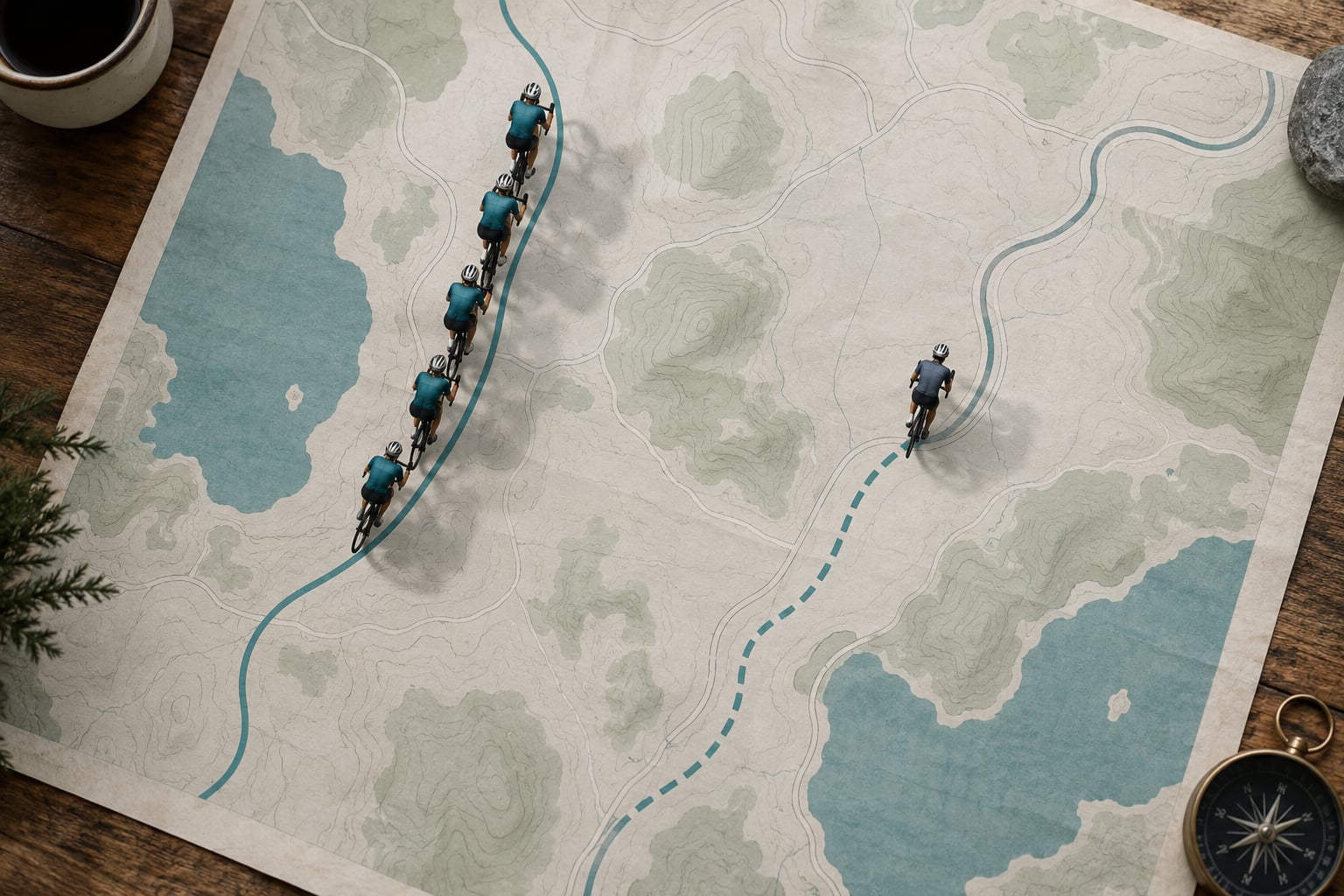
Group rides are faster than solo rides because riding in a line cuts the wind you have to push through, because riders take turns at the front so no one person pays the full cost, and because a group holds a pace that is hard to quit. The first two are physics. The third is just how people behave.
That last part is worth taking seriously, because it is the half of the answer almost nobody writes down. Riders notice that their heart rate sits lower in a group at the same speed. A rider put it plainly on r/cycling: “When I ride with a group my overall effort is far less than it would be for the same speed solo.” Same road, same speed, less work. This article explains where that gap comes from, and where it disappears.
Short version before the detail: on flat and rolling roads at a steady group pace, a well-run group typically holds a faster average than the same rider manages alone. On steep climbs, in bad wind, in a mismatched group, or with lots of regrouping, that advantage mostly evaporates. If you have wondered whether joining a club ride would make you faster, the answer is usually yes, and the size of the win depends almost entirely on how that ride is run.
Table of Contents
- Why Group Rides Are Faster Than Solo Rides at a Glance
- How Drafting Reduces Wind Resistance
- Pacing and Group Dynamics
- Climbing, Corners, Stops, and Terrain
- What Does Not Make Group Rides Faster?
- How to Use a Group’s Speed Advantage Safely
- Why Group Rides Are Faster Than Solo Rides on Rolling Roads
- Which Should You Choose?
- Frequently Asked Questions
- Why group rides are faster than solo rides
- How much faster is a group ride than a solo ride?
- Does drafting work when riding uphill?
- How far behind the wheel should a cyclist draft?
- Do group rides always burn fewer calories?
- Why can a group ride be slower than a solo ride?
- Conclusion
Why Group Rides Are Faster Than Solo Rides at a Glance
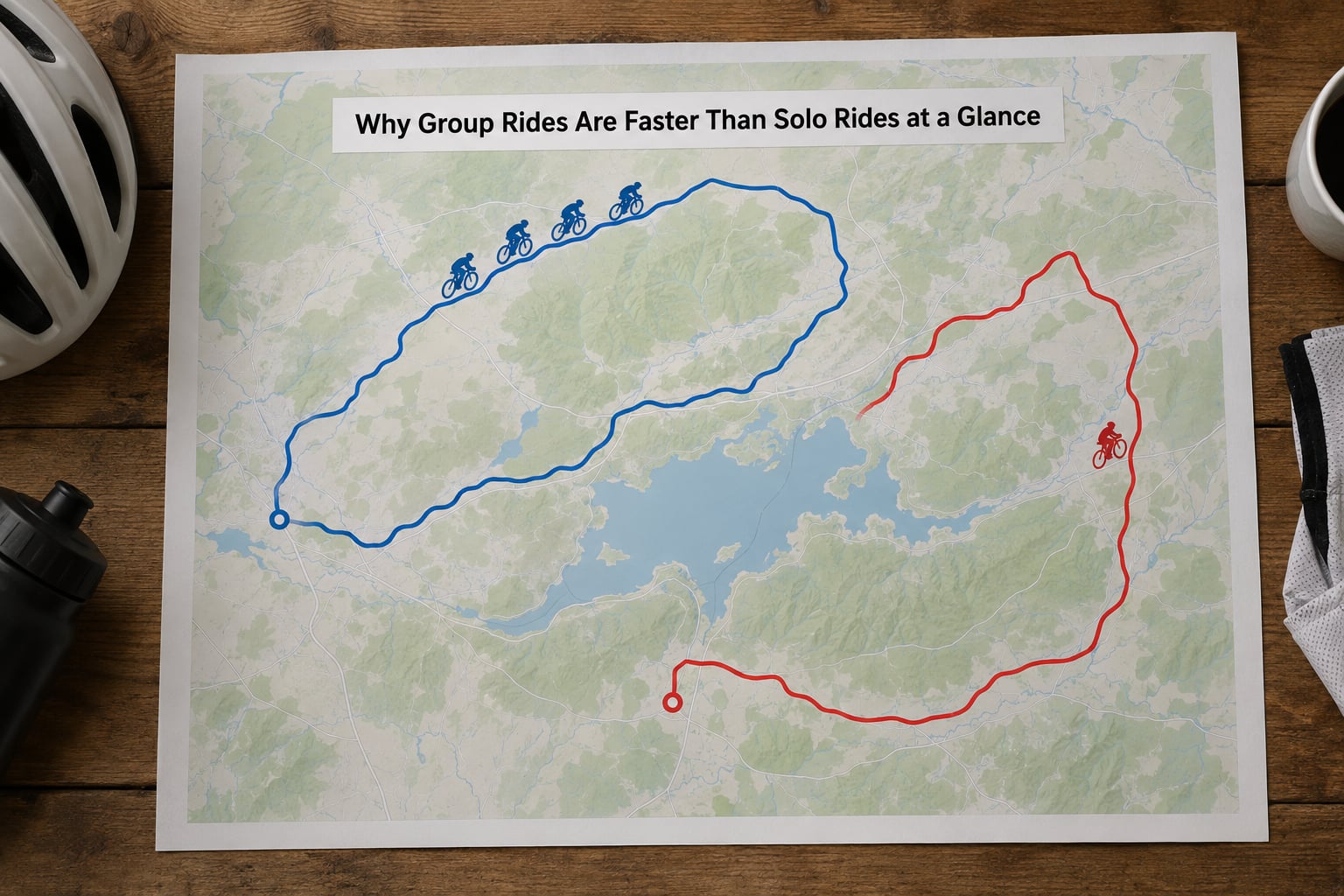
| Factor | Solo ride | Group ride | Which wins |
|---|---|---|---|
| Average speed on flat roads | Limited by the strongest effort you can repeat alone | Set by shared pacing and rotation | Group |
| Power at a given speed | Full frontal area exposed | Reduced inside the slipstream | Group |
| Energy cost over 3 to 5 hours | High, because drag dominates at speed | 20 to 30 percent lower with good drafting | Group |
| Pacing decisions | Made alone, easy to surge or fade | Set by the group and its leader | Depends on the group |
| Steep climbing | Even effort, no drafts | Gaps open and break the paceline | Solo, usually |
| Stops, regrouping, mechanicals | You stop when you want | Whole group stops together | Solo |
| Speed predictability | You set it and you keep it | Depends on the ride type and leader | Solo |
| Motivation and discipline | Entirely self-directed | Peer pressure and accountability | Group |
| Training value | Clean, precise, controllable effort | Varied, sociable, harder to structure | Solo, for structured work |
Read that table as a set of conditions, not a verdict. Every row where the group wins depends on the group actually behaving like a group.
How Drafting Reduces Wind Resistance
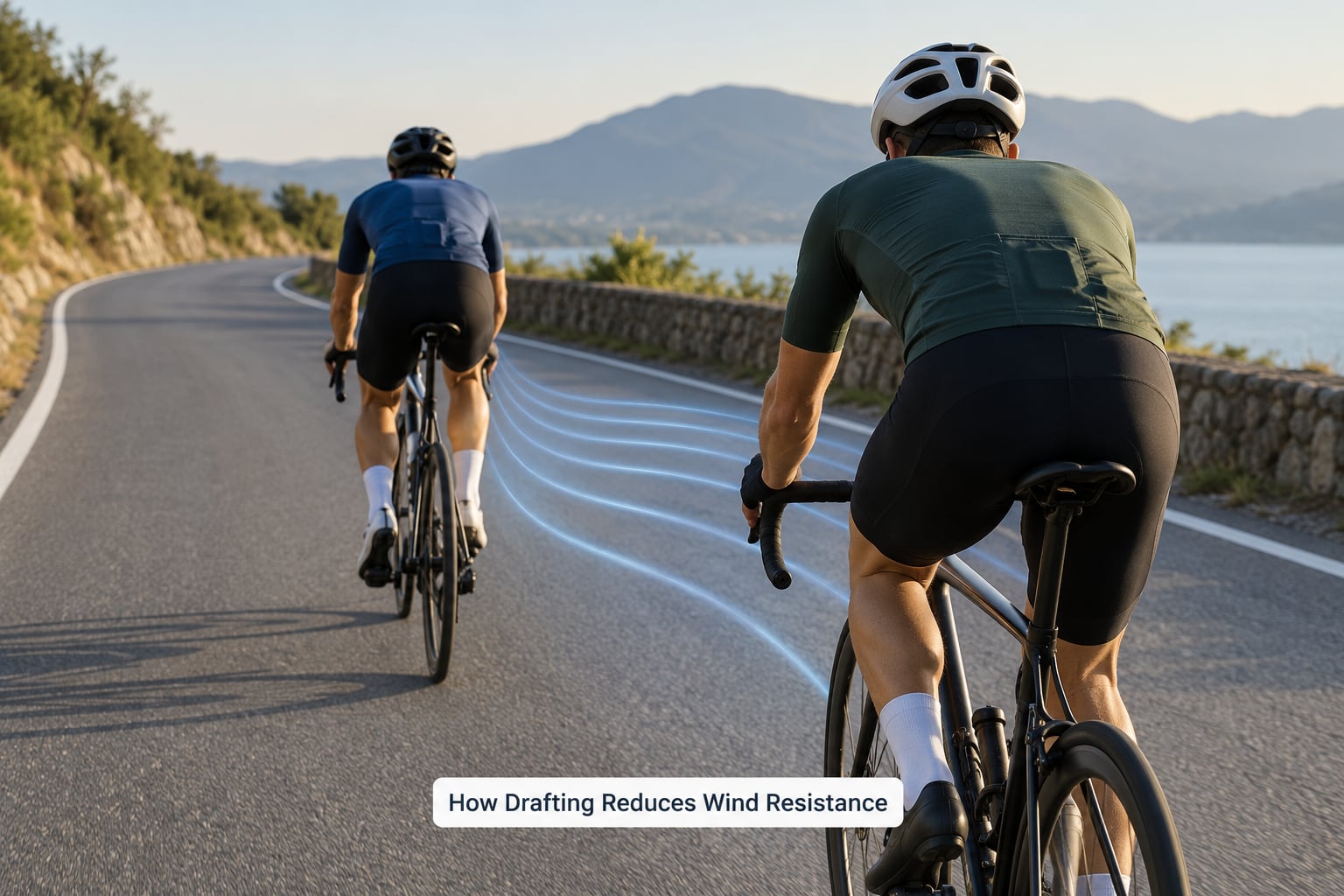
Drafting works because the rider in front breaks up the air for everyone behind. A cyclist moving at speed pushes a column of air forward and creates a low-pressure wake in their wake. Sit in it and the air hitting your chest is far gentler than ambient air.
Why group rides are faster than solo rides comes down to one equation: the power you need to overcome air resistance rises roughly with the cube of your speed. Push the cube and small speed gains cost disproportionately more. That is why a group that sustains a slightly higher speed can do so at a noticeably lower power than the solo rider chasing the same number.
Reported savings by wheel gap, the distance from the front rider’s rear wheel to yours:
| Wheel gap | Typical energy saving | What it feels like |
|---|---|---|
| About 0.5 m | 30 to 33 percent | Almost effortless, and nerve-wracking |
| About 1 m | Around 25 percent | The sweet spot for most club rides |
| About 2 m | Around 15 percent | Comfortable, still clearly sheltered |
| About 5 m | Roughly 5 percent | Minor benefit, mostly psychological |
| Beyond 10 m | Negligible | You are riding in open air |
Those percentages are representative ranges drawn from sports-engineering research on drafting, not fixed constants. Wind direction, rider size, and body position all move the numbers around.
Position matters as much as distance. The rider on the front does full-on wind resistance for the entire group. The two riders on the flanks each take a share in an echelon. The riders near the middle and rear are sheltered by the people around them on both sides and behind, which is why sitting mid-pack saves more than following a single rider alone.
Crosswinds shrink the benefit. When air arrives from the side, riders have to yaw to sit in the wake, and a pure crosswind leaves the tail end of a line with no clean shelter. Groups handle it by rotating the echelon so someone is always tucked behind someone else.
And drafting is not a license to ignore your own aerodynamics. Moving from the hoods to the drops is reported to cut drag by roughly 10 to 15 percent at 40 km/h. That saving is available whether you are alone or in a line.
Pacing and Group Dynamics
The second mechanism is not aerodynamic at all. It is arithmetic about who is tired when. A rider on the front works hardest, so a well-run group rotates the lead and everyone recovers in the sheltered positions behind. Nobody sustains the front position, so the group can hold a pace that outlasts any individual.
A rider on r/cycling described the mechanic without any of the physics: “group rides are faster than solo rides, because you can take turns pulling while the rest of the group rests in lowered wind resistance.” That is the whole system in one sentence. Riders on the front spend short spells at high output, riders behind spend the same minutes at a much lower cost.
The third mechanism is behavioral. A group sets a target and holds it, which is exactly what a solo rider fails to do on a bad day. Nobody wants to be the one who slows the ride, and nobody wants to be the one who gets dropped. That social pressure produces steadier pacing than most riders manage alone.
The Indoor Cycling Institute has published work finding that riders scored enjoyment 1.4 points higher on a 56-point scale in a group setting than cycling alone, with the difference statistically significant. Different discipline, indoor rather than road, but it is independent evidence that riding with other people changes how hard you are willing to push and for how long.
Not all of that is about speed. Experienced riders on Road Bike Review put it plainly when they described fast group rides as having “a bunch of half wheelers pushing each other.” Informal racing inside a group adds a speed source no solo ride can borrow.
Climbing, Corners, Stops, and Terrain
Drafting loses most of its value where speed drops or where the group stretches out. On a steep gradient riders sit up, pedal out of the saddle, and the gaps that a line can bridge at 35 km/h become gaps nobody closes on an 8 percent wall.
Technical descents do the same thing. Nobody drafts through a corner sequence, and a large group is slower through corners and on the road back up than a confident rider who picks a line and goes. Urban riding with lights, crossings, and parked cars adds stops that a group cannot avoid together.
Stops are where group time disappears fastest. Two minutes of waiting for a dropped rider every twenty minutes is a large slice of an afternoon, and no amount of aerodynamic advantage pays that back. Groups also navigate worse than individuals because someone has to check the turn and everyone has to wait for that person.
Mechanical trouble hurts more in a group too, though it usually ends with a spare bike and a set of hands. A flat ten minutes back is ten minutes back. The support is real, but so is the delay.
What Does Not Make Group Rides Faster?
A group is not automatically fast, and this is where most explanations stop short.
- Being in a group is not free speed. A slow group averages exactly what its slowest members can hold, and a cautious group averages well below what most riders could manage alone.
- Rider size changes the math. Bigger riders produce a larger wake. Three to five matched riders in a line often beat a larger group strung out badly.
- Strong wind compresses the advantage. In a headwind or crosswind the sheltered positions are smaller, contested, and constantly changing.
- Frequent stops erase it. A group that repeatedly splits and regroups trades the aero win back to the clock.
- Riding beyond your sustainable threshold cancels it. Holding on until you blow is the fastest way to convert an efficient group ride into a very slow one, because the tail has to wait for whoever is at the back.
- Advertised pace is not actual pace. A ride listed at an 18 to 19 mph average can hold 26 mph pace lines, as riders on r/cycling regularly point out. Groups split more often than their listings suggest.
None of this makes group riding a bad idea. It makes it a decision rather than an upgrade.
How to Use a Group’s Speed Advantage Safely
- Pick a group that matches you, not one that impresses you. Riders on r/bicycling describe the best setup as starting with a larger ride, finding two or three people at your level, and then riding all week as a small matched group. The physics support them. Three to five riders in a tight line shelter each other far better than fifteen riders spread across the road.
- Hold a wheel-length or so. About a metre back is where most of the saving lives without the risk of overlap. Closer is faster and more dangerous, and the trade-off is real rather than rhetorical.
- Sit slightly back from the middle of the pack on big rides. Riders mid-to-rear are shielded on multiple sides. That advantage shrinks to nothing in a group of four.
- Rotate properly. Pull through, ease off, move up, and hold your wheel until you are genuinely recovered. A rotation that has everyone surging is slower than no rotation at all.
- Overlap wheels only when your front wheel is level with their rear tire. The quarter-inch overlap rule is the single most useful safety habit in a group.
- Communicate changes out loud. Rolling off the front, a mechanical, a stop coming up. Silent changes cause the crashes riders complain about most.
- Look up the road, not at the wheel. A group is a shared responsibility for hazards, and that only works if riders are watching ahead.
- Follow local law and predictable positioning. Ride predictably, signal, and obey the two-abreast rule where it applies. Being visibly in a group is part of why traffic gives you room.
- Match the session to your goal. Group rides are excellent for long-distance pacing and for practicing skills under mild pressure. They are poor for precise interval work, because pace surges and regrouping wreck a planned power target.
Why Group Rides Are Faster Than Solo Rides on Rolling Roads
On steady and rolling terrain, the benefits stack instead of fighting each other. A group can hold a smooth line where a solo rider fades, rotate the lead so nobody reaches the wall, and shelter each rider in the headwind sections. The result is a higher average speed at a lower individual power than the equivalent solo effort, which is why a rider can come off a club ride feeling like they worked less than the speed suggests.
Which Should You Choose?
Choose a group ride when you want a faster long ride without a hard interval effort, when you are building skills that need other riders around you, when you want access to experienced pacemakers, or simply when riding alone is the thing you keep putting off. Motivation is a legitimate training input, and a group supplies it more reliably than willpower does.
Choose a solo ride when you need exact pacing, when the ride is a genuine interval session, when you are testing equipment or running a time trial, when navigation and route-finding are part of the point, or when you want a genuine recovery day with no pace changes and nobody to talk to.
If you ride solo and want some of the benefit without a club, a single companion can deliver a meaningful share of it. Ride behind a friend at a metre on a shared line, take turns pulling, and you get most of the drafting saving. It is not a peloton, but it is much better than open air.
Frequently Asked Questions
Why group rides are faster than solo rides
Because three mechanisms stack: drafting cuts the air you push through, lead rotation spreads the hardest work so the pace lasts, and group accountability keeps riders from surging and fading. The physics does most of the work at speed, but on rolling roads the shared pacing is often what decides the average.
How much faster is a group ride than a solo ride?
On flat roads at a steady group pace, roughly 20 to 30 percent less energy is needed for the same speed, and a group can usually hold an average the solo rider cannot. On steep climbs, in strong wind, or with repeated regrouping, the gap shrinks to nearly nothing. Expect the big win on the flat, not on the climbs.
Does drafting work when riding uphill?
Much less so. Riders sit up, pedal out of the saddle, and the gaps open too wide to bridge, which breaks the paceline. At low speeds aerodynamic drag is a minor share of total resistance anyway. The group still helps on a climb through pacing and motivation, but not through wind shelter.
How far behind the wheel should a cyclist draft?
About half a metre to a metre, roughly one wheel length. Reported energy savings run from 30 to 33 percent at half a metre down to around 15 percent at two metres. Closer is faster but leaves no room for reaction, so most riders settle near a metre once they are comfortable.
Do group rides always burn fewer calories?
No. Per hour at the same speed, drafting reduces energy cost, so a matched ride should burn less. Over a whole ride the result depends on time spent at pace, regrouping stops, and surges. A hard group ride with ego-driven accelerations can easily out-burn a steady solo one.
Why can a group ride be slower than a solo ride?
A mismatched or cautious group averages only what its slowest riders can hold, large groups lose time in corners and regrouping, and a rider naturally faster than everyone else will spend the ride frustrated and waiting. Strong crosswinds and frequent stops also cut the aerodynamic benefit to nearly nothing.
Conclusion
A group’s advantage is efficiency, not a magic speed bonus. Drafting cuts your power requirement, rotation keeps that power sustainable, and the group holds a pace you might otherwise abandon. On flat and rolling roads that adds up to a real, measurable difference. Everywhere else, it mostly does not.
Start with one steady club ride at a pace that matches your current fitness, not the fastest group your area offers. Ride a metre back, stay in line, rotate when you are asked, and check your own power data afterwards. That single ride will tell you more about why group rides are faster than solo rides than any amount of reading will.