Knowing how to take a pull in a paceline comes down to one job: move to the front of the line and ride there, in the wind, for an agreed distance or time so everyone behind you can recover. When your turn ends you signal, peel off to the left, drift back down the line and rejoin on the last wheel. It takes about five minutes to learn and a few rides to make automatic.
Most groups run a single file of six to ten riders with the leader rotating to the back on a regular cycle. Riders in a single paceline save roughly 20-30% of their energy depending on wind and speed, which is why sharing the front evenly matters more than pulling hard. A rider who treats a pull as a sprint helps nobody and gets dropped on the next climb.
What taking a pull actually means: you move to the front of the paceline and hold a steady speed at the head of the line for a set distance or time, usually 1 to 3 minutes or about 0.3 to 1 mile. Then you signal, move off the front to the left, ride back through the group on the recovery line and rejoin at the tail in the draft. The pull is not finished until you are back in the draft.
A good pull comes down to five habits:
- Look 3 to 5 riders ahead rather than at the wheel in front of you
- Hold a cadence around 90 to 100 rpm instead of dropping a gear and grinding
- Keep the speed identical whether you are fresh or nearly finished
- Signal early enough that the next rider can settle on your wheel without a surge
- Never overlap wheels, and never brake harder than you pedal
Table of Contents
- What You Need
- How to Take a Pull in a Paceline: Step by Step
- Move to the Front in a Stable Position
- How to Take a Pull in a Paceline at a Pace You Can Hold
- Ride a Clean, Predictable Line
- Rotate to the Back Without Cutting Across
- Recover and Re-enter the Rotation
- Common Mistakes
- Group-Riding Tips
- Frequently Asked Questions
- How long should I stay at the front of a paceline?
- Should beginners take pulls on a fast group ride?
- Is it safe to overlap wheels with the rider in front?
- What hand signals should paceline riders use?
- Where should I return after finishing my pull?
- How do I recover after taking a pull?
- Conclusion
What You Need
You need a road bike you can ride one-handed at low speed and a helmet, and that is honestly the equipment list. No special kit, no aero bars, no gadgets. The skills matter far more: holding a straight line while coasting, feathering the brake lever without stopping the pedals, and looking far enough ahead to see a change in pace before it happens.
Communication matters as much as bike control. A group that agrees on hand signals before the ride moves as one unit. Agree on how you will signal the pull is over, how hazards get called, and what happens if a rider drops. Forum threads on paceline etiquette come back to the same point from every angle: agree the pull length and the signals before the ride, not mid-pull.
Three practical prerequisites before you ever take a pull:
- Road awareness. You need peripheral vision for car doors and a habit of scanning three seconds ahead. Riding the front means being the rider most exposed, not least.
- Hydration and fueling. Pulling adds heat and effort. Carry fluids and eat before you are hungry, not after.
- Matching the ride speed. Do not take a pull in a group that is riding faster than you can hold. Join a line that matches your pace on the day, not the pace you managed once.
Confidence is the last item, and it comes only from doing it once badly in a forgiving setting. Nothing about the first pull is physically hard. The fear is entirely about making a mistake in front of other people.
How to Take a Pull in a Paceline: Step by Step
Move to the Front in a Stable Position
Leave the wheel with a smooth, gradual move rather than a lunge. Signal first with a hand or a call so the riders ahead know a change is coming, then ease out to the side, hold your line parallel to the bike in front and take its rear wheel.
Begin accelerating before you reach the front, not after. The gap between a rotating leader and the next rider opens the instant a puller arrives too slowly, and the whole line pays for it. Settle onto the wheel at the speed the leader is already doing, then match it.
Success check: you are breathing steadily, the wheel in front fills your view, and you can look up and scan the road without swerving. If you are still closing the gap when you get to the front, you are too far back. If your hands are white on the bars, you are too tense.
Watch your distance to the wheel ahead. Beginners tend to hover six inches back and brake constantly. A bike length is about right on an open road; close it to half a length only when the pace is steady and the rider in front is doing the same thing.
How to Take a Pull in a Paceline at a Pace You Can Hold
Pick a speed you can hold to the end of the pull without your cadence collapsing, and keep it identical throughout. A puller who fades creates a bottleneck that travels down the line for several seconds, and a puller who surges creates an accordion effect where everyone accelerates then brakes.
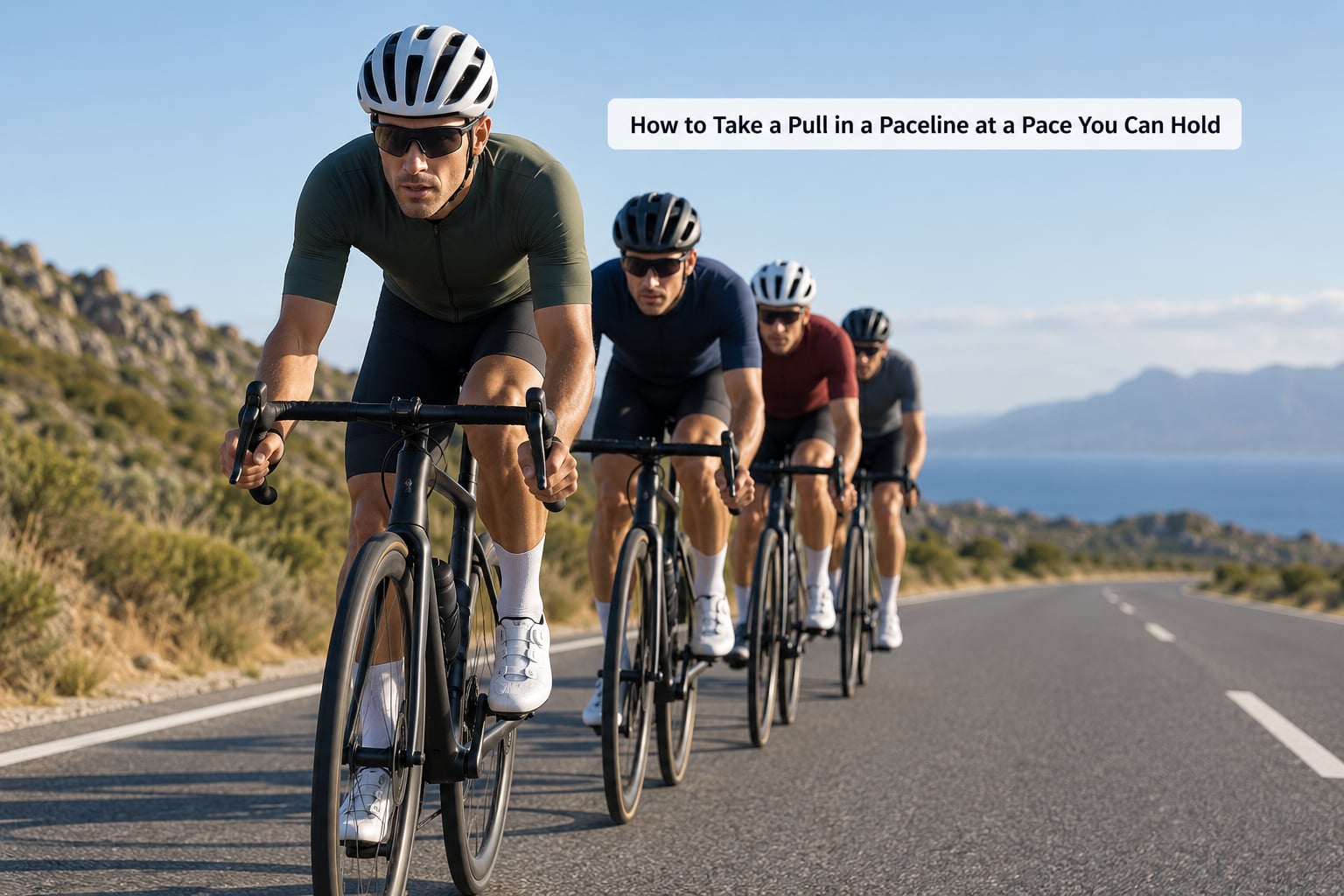
The group decides the number, not you. Most clubs settle on something between 1 and 3 minutes per rider, or roughly 0.3 to 1 mile, and state it out loud before rolling. Once speeds reach the low twenties in mph, riders often stretch to 2 to 6 minutes because each changeover costs more energy than the longer pull saves.
| Riders in line | Suggested pull | Why |
|---|---|---|
| 2 to 3 | 30 to 60 seconds | Few riders means long gaps, so changes need to come fast |
| 4 to 6 | 1 to 2 minutes | The most common club line; keeps everyone rotating evenly |
| 7 to 10 | 2 to 3 minutes | Longer pulls mean more rest without more changeovers |
| 11 and up | Split into two lines | A single line this long is hard for cars to pass and easy to lose riders in |
Scale by speed and terrain as well. On the flat under 15 mph, hold short pulls because you spend more time in the wind per mile. On a tailwind you can carry a longer pull; on a headwind or a crosswind, shorten it. On a climb, most groups pull to the top of the hill rather than on the steepest section, then let the line rotate during the descent. On a descent, rotate through faster because everyone is fresh again at the bottom.
Power matters too, but think effort rather than numbers. A pull should feel hard, roughly an effort you could hold for two to five minutes, not an all-out effort. r/Velo threads on power levels for pulls describe the failure mode well: riders surge to hard numbers on the pull-through because they feel strong after sitting in the draft, then have nothing left for the recovery.
Success check: nobody behind you is braking, nobody is sprinting to catch you, and your cadence has not dropped by more than about 10 rpm from where it started.
Ride a Clean, Predictable Line
Ride straight. Hold a constant radius through corners, leave room for a car to pass on your left when the group is single file, and keep the line centred and predictable so nobody behind has to guess your path. Riders behind you read your tyre track as the road.
Look 3 to 5 riders ahead, not at the back of the bike in front. That single habit is what separates a smooth puller from a choppy one, because you can ease off the pedals before the group slows instead of reacting to a braking wheel you never saw. Keep your head up and your eyes scanning on corners, through car parks and anywhere the road surface changes.
Brake by feathering the lever while still pedalling. In a line, hard braking means the rider behind has to brake, and nine riders later the group has lost all its speed. Slowing with the group is fine. Stopping in the line is not.
Success check: the group holds one speed through a whole stretch of road with barely a visible brake light or a hard pedal stroke. If riders behind are surging and braking, the pull in front is not working, and it is usually because the leader’s effort is changing.
Rotate to the Back Without Cutting Across
Decide before you get tired, not after. Know roughly how far the pull is, then leave at the planned point even if you feel like you could hold it longer, because the rider behind you has already spent the time sitting in the wind waiting for your decision.
Signal clearly with a flick of the right elbow or a raised hand, made twice, while staying seated and keeping the same speed. On a road bike review thread about pull-off signals, the agreement was almost universal: a double elbow flick, made from the saddle, without changing pace. Add a verbal call where you are in earshot of the rider behind.
Then move left off the front while still pedalling. Do not drift right across the line, because that is where the riders behind you are. Ride the recovery line, the fast lane of clear road along the inside of the group, at the group’s speed. This is where you catch up with the tail of the line without a single hard acceleration.
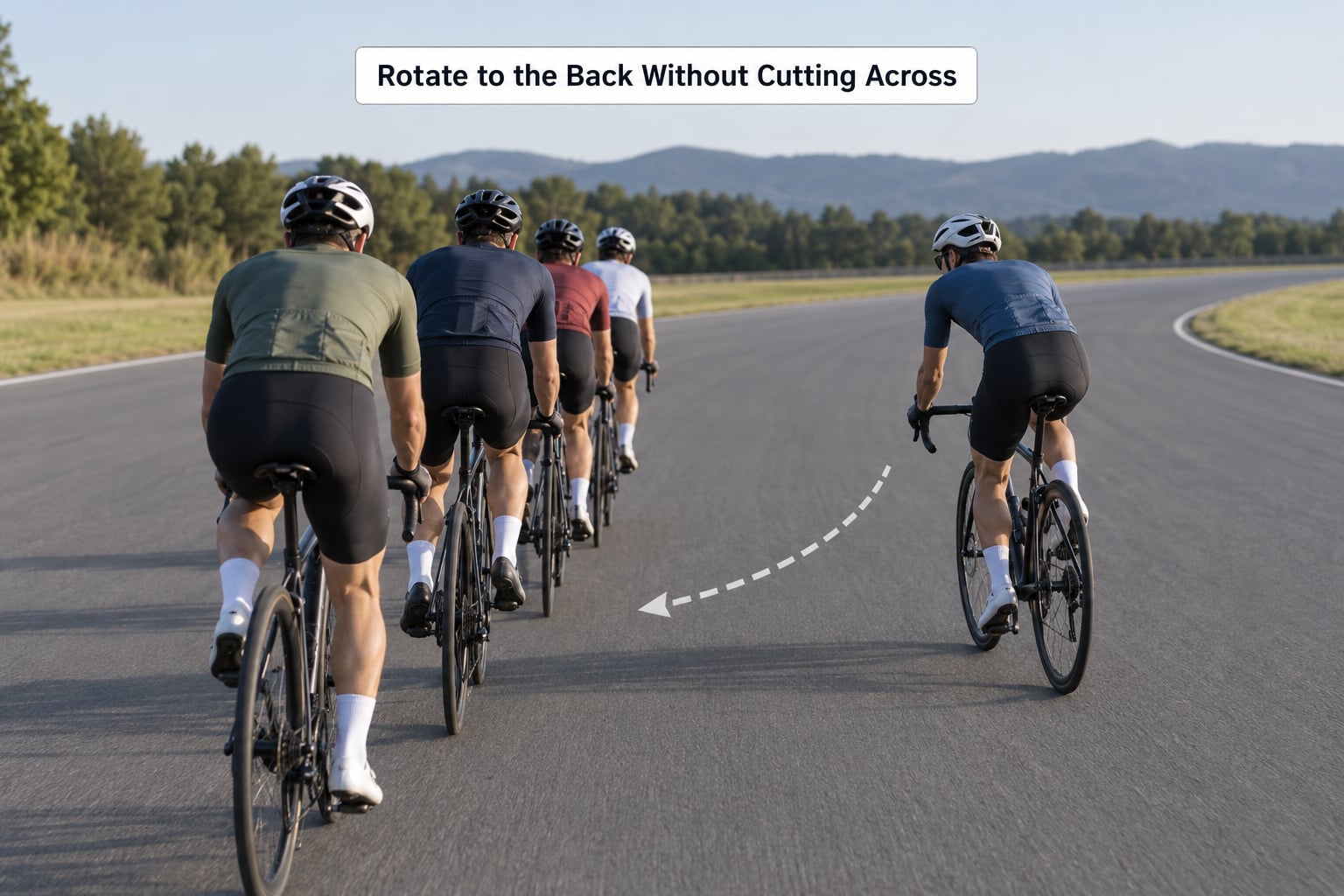
Join behind the last rider on his rear wheel with about a bike length of space. Do not slot in between two riders, and do not pass the last man to take position on the outside; if someone is moving up, sit behind them until the space opens.
Success check: you are back in the draft without anyone in the line having to speed up or slow down, and the last rider has not had to check over their shoulder for you.
Recover and Re-enter the Rotation
Your pull is over but your turn is not. Coach Davis Phinney, quoted by a coaching site on paceline skills, would essentially stop pedalling as he came off the front and then accelerate hard onto the last wheel with three strong strokes. That works for a sprinter. Everyone else keeps some speed on and settles into the draft more gradually, which is the safer default.
Sit up slightly, relax your shoulders, and let the rider in front do the work. Drink if you have a bottle within reach, and if you need food, take it at the back where a dropped wrapper breaks nobody’s rhythm. Most groups rotate on a fixed cycle, so know when your next turn is coming and how much recovery you actually have.
If you are too tired to pull when you reach the front, say so early and clearly: tell the rider behind you, call out, and let someone else take the wheel. Plenty of riders skip a pull by telling the rider in the recovery line to jump in before they reach the front. Nobody minds. What breaks a group is a rider who nods, takes the wheel and then falls off it three minutes later.
Success check: by the time you are back on the front of the line, your breathing has settled and you can hold the same speed as the first time.
Common Mistakes
- Surging onto the wheel. You feel strong after resting and accelerate hard to catch the leader. The group has to accelerate with you and will have to brake again. Fix: match the leader’s speed before you arrive.
- Fading at the end of the pull. You go out too hard and come back at half speed. Fix: pick an effort you can hold, and shorten your pull before you shorten your cadence.
- Overlapping wheels. Your front wheel is alongside the leader’s rear. This is how a line goes down. Fix: keep a full wheel in front of you, use peripheral vision to find the tyre, and check the bike’s shadow if you need to.
- Rotating with no signal. The rider behind has to guess and either follows you left or crashes into you. Fix: elbow flick twice, then move.
- Dropping to the tail in too much of a hurry. You sprint to the back and arrive with nothing. Fix: ride the recovery line at group pace and slot on smoothly.
- Staring at the wheel in front. You brake for every small wobble. Fix: look 3 to 5 riders ahead and let the wheel come to you.
- Riding too close and braking constantly. Fix: open to about a bike length and close it only when the pace is steady.
- Using aero bars in a line. On a drop handlebar you cannot see, and with it tucked you cannot signal. Fix: stay on the hoods and tops with your head up.
If wheels do touch, do not panic and do not stop dead. Say it out loud, stay seated, let the bike in front move away, and let the group slow to a safe speed. Everyone looks down, everyone slows, nobody reaches for a wheel.
Group-Riding Tips
Things that make pulls more useful for everyone:
- Brief before the ride. Agree the pull length, the rotation side and the signals while people are still standing still.
- Rotate by ability. Stronger riders pull longer, weaker riders pull shorter. Fixing a rigid 60 seconds for everybody is what burns the tail riders out.
- Keep the line under six to eight riders. Longer than that and split into two, as a double paceline, so traffic can pass and nobody is buried.
- Call hazards. Glass, gravel, a car door, a wheel that has lost pressure. A single clear call is worth more than any pace adjustment.
- Never pressure someone into a pull. Coax, don’t shame. A rider who is embarrassed will either sprint or quit.
- Practise small. A four-rider line on a flat quiet road is the best place to learn this, not the front of a fast Saturday ride.
- Use echelons in crosswinds. When the wind pushes sideways, stagger the line diagonally instead of staying single file.
Frequently Asked Questions
How long should I stay at the front of a paceline?
Most groups use 1 to 3 minutes, or roughly 0.3 to 1 mile, per rider. Short lines of two or three should rotate every 30 to 60 seconds, while lines of seven to ten can handle two to three minutes. On a climb, pull to the top of the hill rather than up the steepest part, and shorten your pull in a headwind. Agree the number out loud before the ride starts.
Should beginners take pulls on a fast group ride?
Ask the group leader to start you at the back and rotate you in only on flat, straight sections at moderate speed. Do not take your first pull in a crosswind, on a descent or at the front of a group riding faster than you are comfortable with. A short, flat, predictable stretch is all you need to learn the mechanics. Most riders say the first pull feels far harder to start than it does to ride.
Is it safe to overlap wheels with the rider in front?
No. Overlapping wheels is the main reason pacelines crash, because a small wobble or a bar strike then contacts the tyre in front. Keep roughly one bike length of space on an open road and never let your front wheel sit alongside the leader’s rear wheel. Use peripheral vision to track that tyre, and if you do touch, stay seated, say so out loud and let the line slow down safely.
What hand signals should paceline riders use?
Two standard signals cover almost everything. Flick the right elbow twice, or lift the right hand, to show the rider behind that your pull is over, then move off the front to the left. Point and wave at hazards ahead. Agree these on before the ride, because the biggest source of confusion is not disagreement about signals, it is nobody saying what they are.
Where should I return after finishing my pull?
At the tail of the line, behind the last rider and roughly a bike length back. Signal, move left off the front while still pedalling, ride the recovery line along the inside of the group at the group’s speed, then join behind the last wheel smoothly. Do not cut across the line to the right, do not sprint to the back, and do not slot between two riders. Your pull is only complete once you are back in the draft.
How do I recover after taking a pull?
Ride behind the last rider, sit up a little and relax your shoulders so the wind comes over your back instead of your chest. Keep a gentle pedal so you stay in the wheel rather than coasting to a stop. Drink and eat at the back of the group if you need to. The main error is coming off the front too fast and then having nothing left to close the gap home.
Conclusion
The fastest way to learn how to take a pull in a paceline is to watch a complete rotation before you join one. Sit at the back of a line, follow the leader’s wheel, watch how the puller signals and peels away and how calmly everyone rejoins. Then agree the hand signals and the pull length with the riders around you, and take your first turn on a quiet flat road with a group of four.
Keep it boring: steady cadence, steady speed, one bike length, clear signal, smooth return. A rider who does exactly that every rotation is worth more to the group than a strong rider who sprints every time they reach the front.