If you search for how many miles a week to train for a century, you will find a hundred plans and almost no numbers. Here is the short version: most riders need roughly 40 to 60 miles a week in the weeks before a 100-miler, beginners often get there on 20 to 40, and trained riders who already ride 100-plus are just maintaining fitness. The bigger lever is your longest single ride, not the weekly total.
A century is a long day, not a long week. What decides whether you finish is saddle time, fueling practice and how politely you spend your effort in the first 50 miles. Mileage is a useful proxy for all three, and it is the number people actually want, so let us put real figures on it.
Table of Contents
- How Many Miles a Week Do You Need for a Century?
- Century Training Mileage Ranges at a Glance
- How to Build Your Century Training Plan
- Set a baseline before you count a single mile
- How many miles a week should you add as you build?
- The 12-week mileage progression
- What Should a Weekly Century Training Week Look Like?
- Three days a week, limited time
- A typical club-rider week
- A week for an already-trained rider
- How Far Should Your Longest Ride Be Before the Century?
- How Do You Know You Are Ready for 100 Miles?
- Should You Increase Mileage Every Week?
- Frequently Asked Questions
- How many miles a week to train for a 100 mile race?
- How many weeks to train for a century ride?
- Is it okay to bike 50 miles a week?
- Is it realistic to bike 100 miles per week?
- Do I need to ride 100 miles before a century?
- Conclusion: Start With Consistency
How Many Miles a Week Do You Need for a Century?
About 40 to 60 miles a week for most recreational and club riders, with a long ride that builds to 70 to 80 miles two or three weeks out. New riders can finish on 20 to 40 miles a week if the long ride is spread out over months, and riders already above 100 miles a week do not need much more than they have.
That range moves with four things. Training age matters most: six months of steady riding and six years of it produce very different riders at the same weekly number. Available time decides how the miles split across the week. Terrain matters more than most people expect, because a hilly century costs three to five times the energy of a flat one at the same distance. And the event itself sets the ceiling, since a 100-miler with 9,000 feet of climbing is a different ask than a pancake loop.
One framing has stuck with me from the training guidelines for the Honolulu Century Ride, written by CTS Coach Pete Taylor: your body does not care how many miles have gone under your wheels, it cares how many hours it has been pedaling. Keep that in the back of your mind when you are a slower rider, riding a mountain bike, or looking at a century route with serious elevation.
Century Training Mileage Ranges at a Glance
| Rider level | Weekly miles | Hours a week | Long ride target | Weeks needed | Main priority |
|---|---|---|---|---|---|
| New to cycling | 20 to 40 | 3 to 5 | 40 to 60 miles | 16 to 24 | Time on the bike, no jumping in |
| Casual weekend rider | 30 to 50 | 4 to 7 | 50 to 65 miles | 12 to 16 | Consistency and a long-ride habit |
| Regular club rider | 50 to 80 | 7 to 10 | 70 to 80 miles | 10 to 12 | Fueling practice and pacing |
| Trained cyclist | 80 to 120 | 10 to 14 | 80 to 90 miles | 8 to 10 | Recovery, sharpening, not more volume |
These are practical starting ranges, not guarantees or thresholds. A rider on the low end of a row who adds miles steadily and rehearses their race-day routine will beat a rider on the high end who is tired in week three. Riders on r/bicycling have reported finishing centuries on 20 to 40 miles a week over four months, taking about seven hours, which proves the low end is real for patient riders and punishing for everyone else.
The hours column is the one I would actually plan with. Ten hours a week is where the good outcomes cluster. On the minimum-viable question, riders on r/cycling have described completing a first century on six to ten hours a week with a longest training ride of 65 hilly miles, and another put it plainly: if you can comfortably ride 40 miles in two and a half hours, you can complete 100 miles.
How to Build Your Century Training Plan

Set a baseline before you count a single mile
The honest starting question is not how far you rode last Tuesday. It is how far you can ride today and still feel normal the next morning without booking three recovery days. If 30 miles is currently a two-day event for you, that is your baseline and your plan starts there, not where a training plan says it should.
Write down the last four weeks of actual riding, average it, and use that as week one. If it comes out at 35 miles, your build target might be 65 or 70 miles a week at peak. If it comes out at 15, the honest answer is a 20-week plan or a late-season event.
How many miles a week should you add as you build?
Add 5 to 10 miles a week, or no more than 10 to 15 percent, whichever is smaller. A rider jumping from 40 to 60 to 85 miles in consecutive weeks is not building fitness, they are borrowing against it, and the bill arrives as a sore knee or a dead weekend in week four.
Then take a week off the ramp. Every fourth week, drop to 50 to 60 percent of the previous week. Riders often describe that week as the one that makes everything else work, because it is where the adaptation actually lands.
The 12-week mileage progression
Copy this shape and shift the miles to fit your baseline. The long ride is the important number; the rest of the week is there to support it.
| Week | Long ride | Weekly total | Focus |
|---|---|---|---|
| 1 | 30 to 35 miles | 40 to 50 | Base, get the habit back |
| 2 | 35 to 40 | 50 to 60 | Easy endurance only |
| 3 | 40 to 45 | 55 to 65 | Add one quality session |
| 4 | 30 to 35 | 35 to 40 | Recovery week |
| 5 | 50 | 60 to 70 | First real long ride |
| 6 | 55 to 60 | 65 to 75 | Practice fueling |
| 7 | 60 to 65 | 70 to 80 | Rolling terrain, race kit |
| 8 | 45 to 50 | 50 to 55 | Recovery week |
| 9 | 70 | 75 to 85 | Peak long ride |
| 10 | 60 to 65 | 60 to 70 | Sharpen, hold back |
| 11 | 30 to 40 | 40 to 45 | Taper, cut 30 to 40 percent |
| 12 | 15 to 20 | 25 to 30 | Event week, cut again |
Notice what happens in the last two weeks. You are doing less riding and arriving fresher, which feels wrong to almost everyone the first time. Cut total volume 30 to 40 percent the week before the event and a further 40 to 50 percent in event week, keep one short ride with a few hard efforts so your legs remember what effort feels like, and stop adding anything.
What Should a Weekly Century Training Week Look Like?
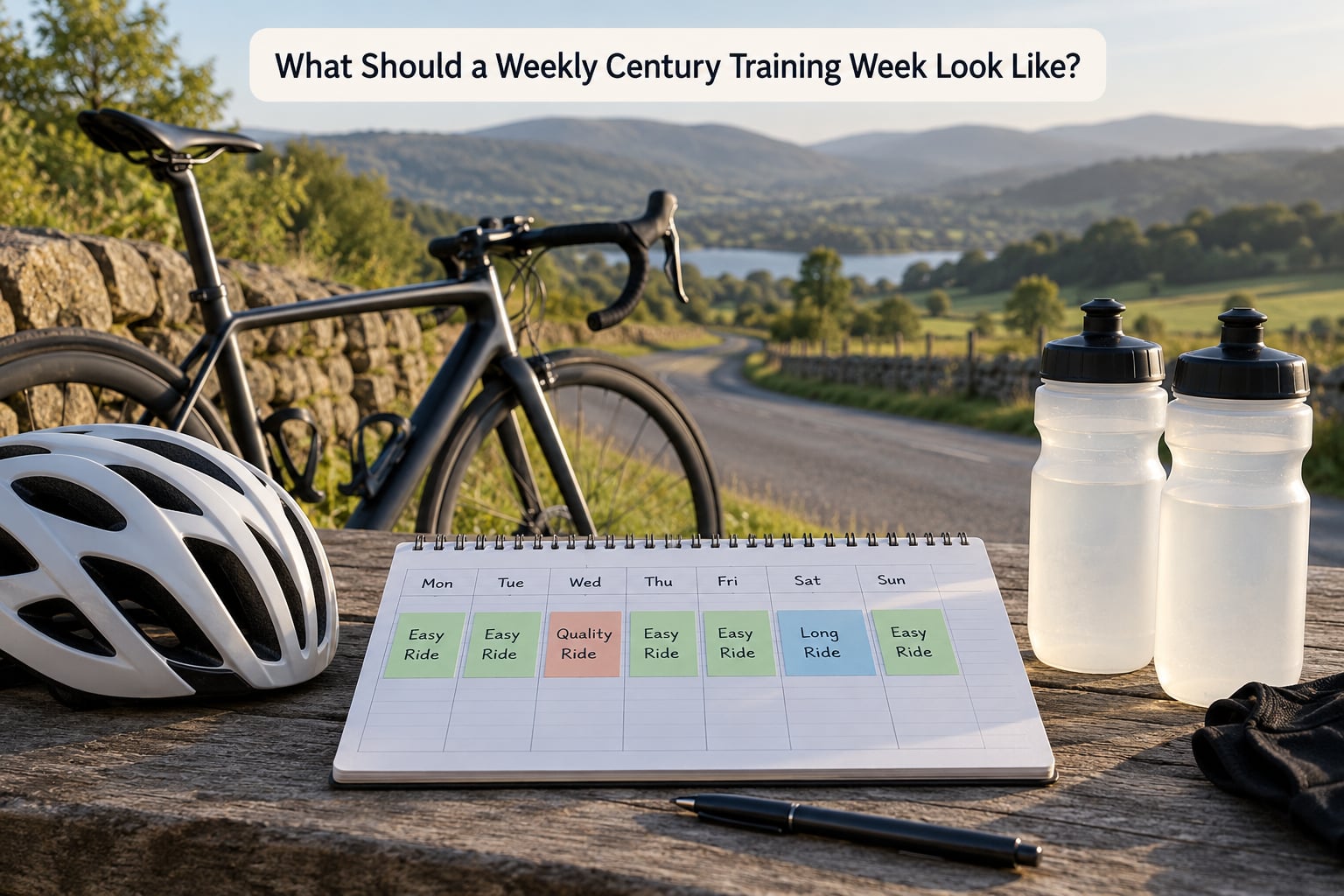
Mileage is the goal, not the shape of the week. Most of those miles belong at an easy effort where you can hold a conversation, and almost all of the mistakes I have seen come from riders trying to squeeze their quality work into the same days as their long ride.
Three days a week, limited time
Two short weekday rides of 30 to 45 minutes at easy effort, plus one long ride that carries most of the mileage. That is a complete century week. Riders with a demanding week at work often ask whether three rides is enough, and the honest answer is that three well-spread rides beats five crammed into a weekend.
A typical club-rider week
Monday and Tuesday off or 30 to 45 minutes easy spin. Wednesday a tempo or sweet-spot block of 60 to 75 minutes, which is where you improve your ability to hold pace without going red. Thursday easy, 45 to 60 minutes. Friday off. Saturday the long ride. Sunday an easy recovery spin if you have the legs for it. That lands you in the 50 to 80 mile a week band, which covers most organized centuries.
A week for an already-trained rider
Same structure, higher intensity, longer rides, and more of the volume on the bike rather than in intervals. The trained rider’s risk is the opposite of the beginner’s: they add miles because they can, arrive at the start line overtrained and slightly stale, and then race a slow, cautious century anyway. Hold your effort, not your mileage.
Whatever the week looks like, eat on every ride over about 75 minutes. Aim for 60 to 80 grams of carbohydrate an hour, starting within the first 20 to 30 minutes, and drink 500 to 750 ml of fluid an hour with electrolytes once you are out in the heat. Nobody finishes a century fast because of how they fueled, but plenty of people fail at mile 80 for want of a bottle they forgot to drink.
How Far Should Your Longest Ride Be Before the Century?
Build to 70 to 80 miles, two or three weeks before the event, and stop there. That is the number the consensus on r/trainerroad keeps landing on: get to about 70 miles in training and a century is within reach. Riders who push to a full 100 in training tend to arrive more tired than the ride demanded, and there is no training benefit past the point where the long ride stops being the hardest thing in the week.
There is one exception worth naming. If your event is a gravel or mountain-bike century at 12 to 14 mph, 100 miles is closer to nine hours in the saddle and your longest training ride needs to reflect that, not a road pace. Those riders should convert the target into hours: four to five hours of steady riding a couple of weeks out is the equivalent, and the climbing matters more than the distance.
Timing also matters. Do the peak ride two to three weeks out, not the week before. The week before is for arriving recovered, and a 75-mile ride seven days out leaves you riding the event with tired legs and a very sore set of shorts.
How Do You Know You Are Ready for 100 Miles?
Mileage gets you to the start. These are the checks that tell you whether you will finish, and none of them involve a number on a calendar.
- You have ridden the distance before. A completed 70-miler on similar terrain is the single best predictor. Riders who jump from a 20-mile longest ride to a century are gambling, and some get away with it, as the r/bicycling reports of 100 to 120 mile weeks after a 15-mile longest ride show. Most do not get away with it.
- Your pace holds up on rolling terrain. If you ride the first 50 miles and notice you are crawling, the day is already over. Ride long efforts that include hills and check that your heart rate or effort stays where you intended.
- You have practiced fueling on a real long ride. Not carried gels, actually eaten them at 60 grams an hour for four hours, and found out whether your stomach tolerates that at mile 60.
- You recover in a reasonable time. Your longest training ride should be over by Sunday night, not setting up Wednesday. Fitness you cannot recover from is not fitness.
- You can hold a conversation for two hours. The talk test is old-fashioned and still the most reliable gauge of the easy effort that makes up most of a century.
Should You Increase Mileage Every Week?
No, and the constant climb is where most century plans go wrong. Increase on a schedule with dips built in, and treat any week you missed two or more rides as a reason to repeat rather than catch up. Riders coming back from a winter off, illness or a two-week work block should resume at roughly 80 percent of where they left and rebuild from there, because the fitness drops faster than the plan expects.
This idea gets called the 75 rule among club riders: never ride more than 75 percent of the miles from your best week of the previous month. It is a rough ceiling, not a law, and it exists because volume is a supporting player while consistency is the one doing the work.
That is also why a smaller plan beats a bigger one. A rider who holds 45 to 55 miles a week for twelve weeks, with a long ride that reaches 70, will usually have a better century than a rider who tries to hit 100 miles a week and either gets injured, gets stale, or gets sick in the last fortnight. Riders on r/trainerroad describe adding about 5 to 10 miles a week to their long ride and nothing dramatic happening, which is exactly how it is supposed to go.
Frequently Asked Questions
How many miles a week to train for a 100 mile race?
About 40 to 60 miles a week for most recreational and club riders, with one long ride that builds to 70 to 80 miles two or three weeks before the event. Beginners can finish on 20 to 40 miles a week if they spread the build over four months or more. Riders already above 100 miles a week mostly need to maintain, add no more than 5 to 10 miles or 10 percent a week, and take a lighter week every fourth week.
How many weeks to train for a century ride?
Eight to twelve weeks works if you can already ride 50 miles comfortably. Starting from a longest ride under 30 miles, plan on 16 to 24 weeks instead, because the long ride has to climb steadily rather than jump. A rider already comfortable at 60 to 80 miles can get sufficient in six to eight weeks with a short taper. Give yourself more time than the event date suggests, because people get sick and the weather moves.
Is it okay to bike 50 miles a week?
Yes, and for a lot of riders 50 miles a week is the sweet spot. It is enough volume to build aerobic fitness and a long-ride habit without wrecking your weekends, and it sits in the middle of the range where most first centuries get finished comfortably. What matters more than the total is that one of those miles comes in a single long ride of two to four hours, with fueling practiced on it.
Is it realistic to bike 100 miles per week?
It is realistic for experienced riders and unnecessary for everyone else. A century is 100 miles on one day, not a requirement to pile up 100 miles every week, and chasing that number is how riders end up injured or stale by the start line. If you already ride there, keep some of it. If you do not, the same event is better served by 50 to 70 solid miles a week with a long ride that reaches 70 to 80.
Do I need to ride 100 miles before a century?
No, and most good plans stop at 70 to 80 miles for the longest training ride. Doing the full distance in training costs you two days of recovery and teaches you very little extra. What you need instead is a long ride that feels hard, plus practice at eating 60 to 80 grams of carbohydrate an hour and staying steady on rolling terrain. Riders on r/trainerroad consistently point to about 70 miles in training as the marker for being ready.
Conclusion: Start With Consistency
So, how many miles a week to train for a century? About 40 to 60 for most riders, less if you are starting out and more if you are already fit, with the real work sitting in one long ride that climbs to 70 to 80 miles over ten to twelve weeks.
Start by writing down what you actually rode over the last month. Pick a weekly number you could hit on a bad week, add 5 to 10 miles a week, drop a lighter week every fourth, and cut volume for the final fortnight. Practice your fueling on every ride past 75 minutes, keep the easy miles easy, and the mileage will take care of the rest.