Electrolytes for cyclists are simply minerals that carry an electrical charge in your body: sodium, potassium, chloride, magnesium and calcium. You lose mostly sodium when you sweat, so on rides over about 90 minutes, in hot weather, or when you are climbing hard, replacing that sodium along with fluid is what keeps you steady to the finish. Short easy spins in mild weather rarely need anything more than water and a normal meal.
That is the whole idea, and most of the confusion around the topic comes from marketing that treats a simple mineral as a magic ingredient. Here is what the minerals actually do, how much riders typically use, and how to work out your own numbers rather than copying someone else’s bottle.
Table of Contents
- What Are Electrolytes and Why Do Cyclists Need Them?
- Which Electrolytes Matter Most for Cycling?
- When Does a Cyclist Need More Electrolytes?
- How Much Sodium and Fluid Do Cyclists Usually Need?
- How to find your own sweat rate in three steps
- Electrolyte Drinks, Tablets, Chews, and Salty Foods Compared
- How to Use Electrolytes During a Long Road Ride
- Before the ride
- During the ride
- After the ride
- Can You Take Too Many Electrolytes?
- Frequently Asked Questions
- Do I need electrolytes on every ride?
- Are electrolyte products necessary, or is that just marketing?
- How do I choose an electrolyte drink mix?
- What should I do after a long ride?
- When do hydration symptoms mean I should see a doctor?
What Are Electrolytes and Why Do Cyclists Need Them?
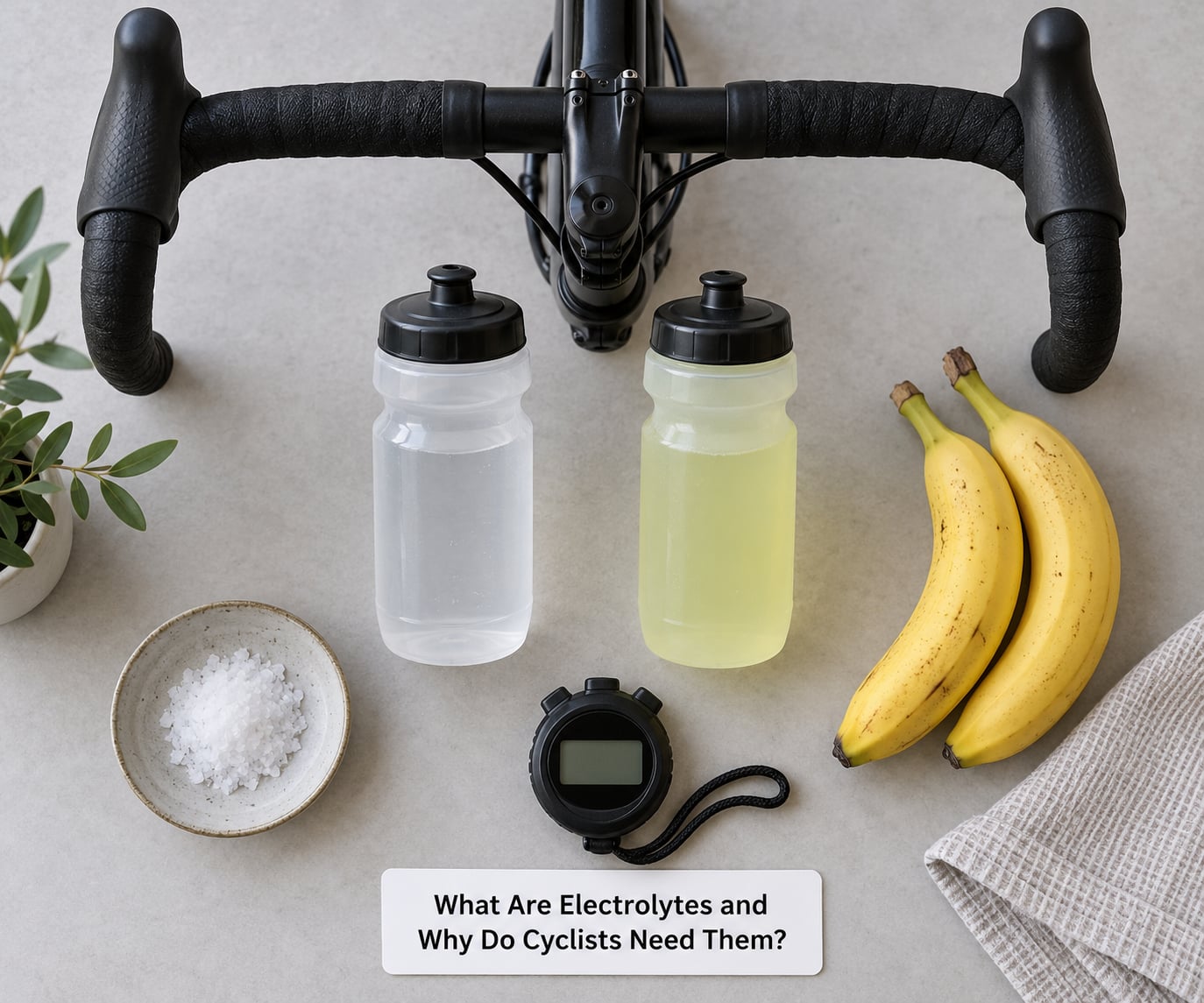
Electrolytes are minerals that dissolve into your body fluids and carry an electrical charge: mainly sodium, chloride, potassium, magnesium and calcium. On the bike, sodium is the one you lose in meaningful amounts, because sweat is a salty fluid and the salt has to go somewhere.
You sweat to cool yourself down. That works brilliantly until the scale tips: sweat carries sodium out, and if you drink back the water without the sodium, your kidneys cannot hold the fluid and you finish the ride more depleted than you started. Sodium is also what lets your gut absorb fluid efficiently, which is why an empty stomach full of plain water often sits badly.
Two more jobs matter day to day. Sodium and chloride drive nerve signalling, the electrical version of a spark that tells a muscle to contract. Potassium and sodium work together inside every cell to keep fluid evenly distributed, and magnesium plays a role in the release of energy.
None of that makes electrolytes a performance drug. The honest scientific picture, as noted in a Trainerroad forum thread, is that electrolytes did not clearly improve performance in some studies of two-hour endurance work. What they reliably do is help you stay hydrated, and hydration is the part that quietly ruins a lot of long rides.
Which Electrolytes Matter Most for Cycling?
Sodium, by a wide margin. If you only supplement one thing while riding, make it sodium, and get it from food, drinks or tablets as suits you.
Here is how the main ones stack up in practical terms rather than textbook terms.
Sodium. The dominant loss in sweat, usually measured in grams per hour. It holds fluid in your bloodstream, keeps your blood volume up, and helps your intestines absorb what you drink. This is the one worth counting.
Chloride. It travels with sodium in sweat, so it comes along for the ride in almost every product that supplies sodium. You will never need to chase it separately.
Potassium. Lost in sweat, but in much smaller quantities than sodium, and your food supply is normally generous. Bananas, potatoes and beans cover it without thinking about it. Riders on an indoor trainer eating nothing at all for 90 minutes are the rare exception.
Magnesium. Relevant over weeks and months rather than hours, and more interesting as a night-time supplement than a mid-ride one. Sweating for a single ride will not leave you short.
Calcium. Not an on-bike electrolyte. It matters for bone health and is plentiful in a normal diet.
So the popular question about the big three resolves cleanly: the two electrolytes athletes most commonly replace from sweat are sodium and chloride, and the third, potassium, is essentially covered by ordinary food. That is also why a product claiming to be a full “electrolyte matrix” is not wrong, just usually more than a two-hour ride needs.
One useful side note: a white salt crust on your jersey or a gritty feeling in your eyes is a rough sign that your sweat is on the salty side. Riders like that usually need more sodium per hour, not less. It is a crude marker, but it costs nothing to notice.
When Does a Cyclist Need More Electrolytes?
Riders need more when sweat losses are high and long. That is the simple test: does your ride run long enough, or hot enough, that you will be replacing more than about a litre of sweat?
- Rides over 90 minutes. Past that, most riders cannot eat and drink enough to replace everything from solid food alone.
- Hot and humid weather. Humidity matters more than temperature because sweat stops evaporating, so you sweat more without cooling down.
- Climbing-heavy routes. Long climbs mean sustained high sweat rates, often in exposed terrain with no shade.
- Back-to-back training days. You start slightly down and stay slightly down if you never fully rehydrate.
- Heavy sweaters. A rider who finishes a summer century visibly drenched and salty is losing more than one who looks dry and comfortable.
- Winter commuting and long cold rides. Cold suppresses thirst, so riders drink less without feeling thirsty, even though losses continue.
Cycling asks less of you than running does, and the reason is mechanical. Running adds a bounce, and every footfall jars the body, which raises sweat rates and the sodium concentration of that sweat. Cycling is smooth and seated, so sweat rates sit lower. A runner may be losing well over a litre an hour with a salty sweat; a cyclist in the same weather is more often in the 500 ml to 1 litre range. The same drink mix will therefore taste much stronger to a cyclist, and that is not a marketing quirk.
Individual needs vary enormously. Some riders genuinely need twice what their training partner does in identical conditions. Sweat rate testing, covered below, is the only reliable way to know which one you are.
How Much Sodium and Fluid Do Cyclists Usually Need?
Most sports nutrition bodies put a typical rider somewhere between 300 and 600 mg of sodium per hour during long exercise, and a widely used practical range for concentration is 0.5 to 1 g of sodium per litre of fluid. Those are broad bands, not prescriptions. Heat, sweat rate, body size and how long you are out all move the number.
| Ride length | Typical fluid | Typical sodium | Notes |
|---|---|---|---|
| Under 1 hour | Drink to thirst | Usually none needed | Water and a normal meal cover it. |
| 1 to 2 hours, cool weather | 500 to 700 ml per hour | 300 to 500 mg per hour | A small amount in one bottle is usually enough. |
| 2 to 4 hours, mild | 600 to 900 ml per hour | 400 to 700 mg per hour | Concentration matters more than total volume. |
| 3 to 5 hours, hot | 700 ml to 1 litre per hour | 600 to 1000 mg per hour | Ultra-riders report running around 900 mg per litre. |
| Ultra or multi-day | Match sweat rate, up to 1.2 litres per hour | 600 to 1200 mg per hour | Salty food and tablets both become useful. |
Two cautions on the table. Those fluid figures are the ceiling of what most riders can absorb, not a target to hit; forcing more than your gut will take is how people end up with sloshing and cramps. And nobody should drink by schedule alone. If a plan tells you to take in a litre an hour and you are not thirsty at 40 minutes, that is information.
How to find your own sweat rate in three steps
This is the most useful twenty minutes you will spend on hydration, and it needs no equipment beyond a bathroom scale and a towel.
- Weigh yourself nude before you ride, and write the number down. Do the same kit on each test so the comparison is fair.
- Ride for a set time in conditions that feel representative of the rides you care about. Note how much fluid you drank and how often.
- Weigh again immediately after, before drinking or changing. The drop in kilograms is roughly the fluid you lost. Add back what you drank, and you have your sweat rate in litres per hour.
Do it twice, once in cool conditions and once in summer heat, because the second number is the one that matters in August. Riders who lose roughly 1.4 kg on a long summer ride are in the heavy-loss group and should think about sodium concentrations at the higher end of the ranges above, while drinking within their comfort.
Estimating sweat sodium without a lab is much harder. The white-crystal jersey tell and how aggressively you crave salt afterwards are the practical shortcuts people use. If you want a real number, a laboratory sweat test is the only route, and it is not cheap.
Electrolyte Drinks, Tablets, Chews, and Salty Foods Compared
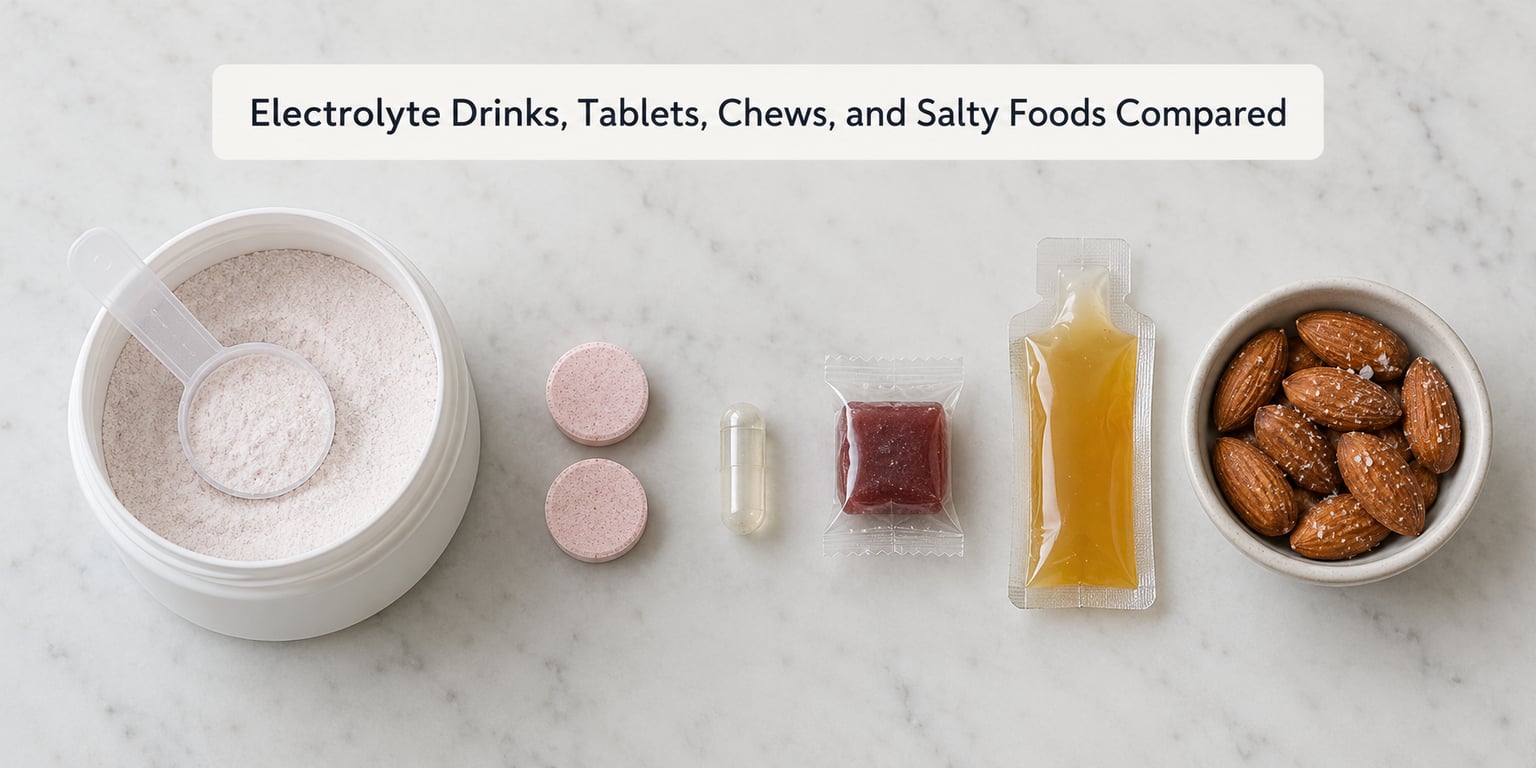
Every format can get sodium into you. The differences are sugar load, how much control you have over the dose, and how it behaves in a jersey pocket at kilometre 90.
| Format | Sodium per serving, typical | Sugar | Best use | Watch out for |
|---|---|---|---|---|
| Drink powder | 200 to 600 mg per litre mixed | Often 15 to 30 g per litre | Rides where drinking is easy and carbs help | Over-concentrated mixes cause gut trouble |
| Effervescent tablet | 200 to 300 mg per tablet | Usually none | Riders who want sodium without fuel | Clogs bottle nozzles; hard to dose half a tablet |
| Salt capsule | 200 to 500 mg per capsule | None | Ultra events where pocket space is tiny | No fluid of its own; can feel abrasive if dehydrated |
| Electrolyte chew | 50 to 200 mg per chew | Small amount | Easy to take, easy to remember | Several needed to reach a useful hourly number |
| Gel with sodium | 50 to 200 mg per serving | 20 to 25 g | Already taking carbs, want both | Sodium here is a bonus, not a plan |
| Salty food | Varies widely | Varies | Long days where eating is realistic | Hard to weigh out on the bike |
Whole-food sodium has quietly become a favourite on long rides. Riders combine tablets with potato chips, pretzels and salted almonds, and plenty of people use sea salt rather than table salt because the mineral mix sits closer to blood. It works, and the tradeoff is that you have no idea whether you got 200 mg or 800 mg.
My practical view is that a measured mix beats a guessed food for anything under five hours, and food becomes more attractive past that, when you are eating proper meals anyway. Riders on a long gravel day who mix half a tablet into every other bottle report it is enough to stop the mid-ride cramp that used to end their day.
How to Use Electrolytes During a Long Road Ride
Think of sodium, carbohydrate and fluid as three things that work better together than apart. That is not a slogan, it is how the intestine moves: sodium and glucose are absorbed by the same transporter, so a carbohydrate hit improves the uptake of both, and carbohydrate itself is fuel you need past 90 minutes.
Before the ride
Eat a normal meal with some salt in it in the three hours before you leave, and start slightly topped up rather than empty. Riders racing a long event sometimes take a higher-sodium drink the evening before, which is well established in endurance sport. There is no need to do anything dramatic for a Sunday century.
During the ride
- Set up bottles in advance and put them in the fridge. A cold bottle goes down better and you are less likely to overdrink it.
- Mark the dose on the bottle with a piece of tape, so half a tablet in one bottle and a full one in the next does not become guesswork at hour three.
- Drink to thirst, with a floor. The debate on the forums pits drink-to-thirst against drinking ahead of it, and both sides are partly right. Thirst is a good late signal, so use it, but pair it with a minimum you know you can comfortably clear.
- Pair sodium with carbohydrate rather than bolusing a tablet every 90 minutes and hoping.
- Stop concentrating late in the ride. Gut blood flow drops when you are working hard, so the last two hours are when a strong mix sits worst.
One rider we know of targets 60 to 80 g of carbohydrate an hour on hard rides, adding sodium alongside, and notes that professionals go to 120 g an hour. That is elite territory. A beginner starting at 30 g an hour and building to 45 to 60 g over a few weeks ends up with a far better ride than someone who starts at the pro number and quits at kilometre 60.
After the ride
Drink roughly 150% of the fluid you lost, and get sodium with it so your body holds onto it rather than excreting it. That is why recovery drinks exist and why they are not a bad thing on a back-to-back training day. Then eat a proper meal within a couple of hours. After a normal ride you do not need a recovery ritual at all.
Timing around the clock matters far less than people think. Electrolytes in the morning versus at night is a non-question, because the goal is simply to replace what you lost across the day.
Can You Take Too Many Electrolytes?
Yes, and more is not better. The most common problems are unglamorous rather than dangerous, but one of them genuinely is.
Gastrointestinal distress is the number one complaint on the bike forums. Too much fluid, too concentrated a mix, or drinking hard from the start all cause sloshing, cramping and diarrhoea. This is the failure mode that actually ends rides.
Hyponatremia is the one to understand. If you drink a lot of plain water and lose sodium in sweat, blood sodium can fall rather than rise. Symptoms include headache, nausea, confusion and swelling of the hands and feet. A sports drink will not rescue someone with hyponatremia; the problem is excess fluid, and the fix is medical, not a stronger mix. There have been documented cases among ultra-endurance riders and hikers who drank far more than they lost.
Excess sugar is quieter but real. Many mixes carry 20 to 30 g of carbohydrate per litre, and riders who are not eating gels and bars on top of that can end up short on fuel while thinking they are over-fuelled, or simply gain weight over a long day.
Sodium for 500 mg at a time. Half a gram is a normal mid-ride serving, not a dangerous dose. It becomes a concern as a daily habit rather than a ride-time one, particularly for people with high blood pressure, kidney disease or heart conditions, and for anyone on medication that interacts with sodium. If any of that applies, talk to your doctor or a registered dietitian before adding electrolytes to your routine.
Separately, the idea that cramps mean you were short of electrolytes is mostly wrong. Sudden cramping late in a ride is far more often pacing, fatigue and dehydration combined. Chasing it with a salt tablet mid-cramp rarely does much.
Frequently Asked Questions
Do I need electrolytes on every ride?
No. For anything under about 90 minutes in mild weather, water and a normal meal before you leave are enough, and adding electrolytes simply adds sugar you did not need. They earn their place on long rides, in heat, on heavy climbing days, and whenever you are riding tired and slightly behind on fluids.
Are electrolyte products necessary, or is that just marketing?
Mostly marketing at the margins, genuinely useful at the extremes. For a two-hour spin, water and salty food do the same job for nothing. For a six-hour ride in July or a multi-day ultra, a measured source of sodium is one of the few things that reliably gets enough into you, and doing that with real food is harder than it looks.
How do I choose an electrolyte drink mix?
Read the label for milligrams of sodium per litre once mixed, not per scoop, and aim for roughly 0.5 to 1 g per litre as a starting band. Then check the sugar: if you are also eating gels and bars, pick a low or sugar-free mix. Flavour matters more than most labels admit, because you will be drinking it for hours.
What should I do after a long ride?
Replace roughly 150% of the fluid you lost, with sodium alongside it so your body retains it rather than excretes it, and eat a normal meal within a couple of hours. If the ride was easy or short, simply eating and drinking like a person is enough. The recovery window matters most on back-to-back training days.
When do hydration symptoms mean I should see a doctor?
Persistent headache, nausea, confusion, or swelling of the hands and feet during or after a ride can point to hyponatremia rather than simple dehydration, and that needs medical attention rather than a stronger drink mix. The same applies if you are repeatedly unable to keep fluids down, or if you have heart, kidney or blood pressure conditions and want to change your sodium intake.
If you do one thing after reading this, weigh yourself before and after your next long ride. That single number turns every argument about electrolytes for cyclists into arithmetic, and it takes twenty minutes to get.