To pace yourself on a century ride, hold back for the first 30 miles, ride a steady conversational effort through the middle, and spend whatever you have left over the final 20. A century is an endurance day, not a race, and most of them take somewhere between 5 and 8 hours.
That sounds obvious once you read it. Most of the time it is the one thing riders get wrong, because the first 20 miles feel so good that everyone surges, and then mile 60 arrives and there is nothing left. The century really starts at mile 70, and whether you enjoy miles 80 to 100 is decided back at mile 5.
Below is a staged plan you can follow without a power meter, and it works just as well if you have one. Adjust it to your own training, and if you have any medical or dietary conditions, talk to a doctor or registered dietitian before changing what you eat or drink on a long ride.
Table of Contents
- What You Need to Pace Yourself on a Century Ride
- Step-by-Step: Build a Pacing Plan That Gets You to 100 Miles
- Step 1: Set a Sustainable Starting Effort for the First 30 Miles
- Step 2: Use the Route to Set Effort Zones
- Step 3: Fuel Before You Are Hungry
- Step 4: Hydrate to Prevent an Energy Drop
- Step 5: Manage Climbs Without Blowing Your Legs
- Step 6: Finish Strong in the Last 20 Miles
- Common Mistakes That Ruin Century Pacing
- A Simple Century Pacing Checklist
- Frequently Asked Questions
- How hard should the first 30 miles of a century feel?
- Should I eat before a century ride or wait until I feel hungry?
- How often should I drink on a 100-mile ride?
- What pace should I use on long climbs during a century?
- How do I recover if I start feeling tired after 50 miles?
- Is it better to ride with a faster group during a century?
- Conclusion: Start Slower So You Can Finish Strong
What You Need to Pace Yourself on a Century Ride
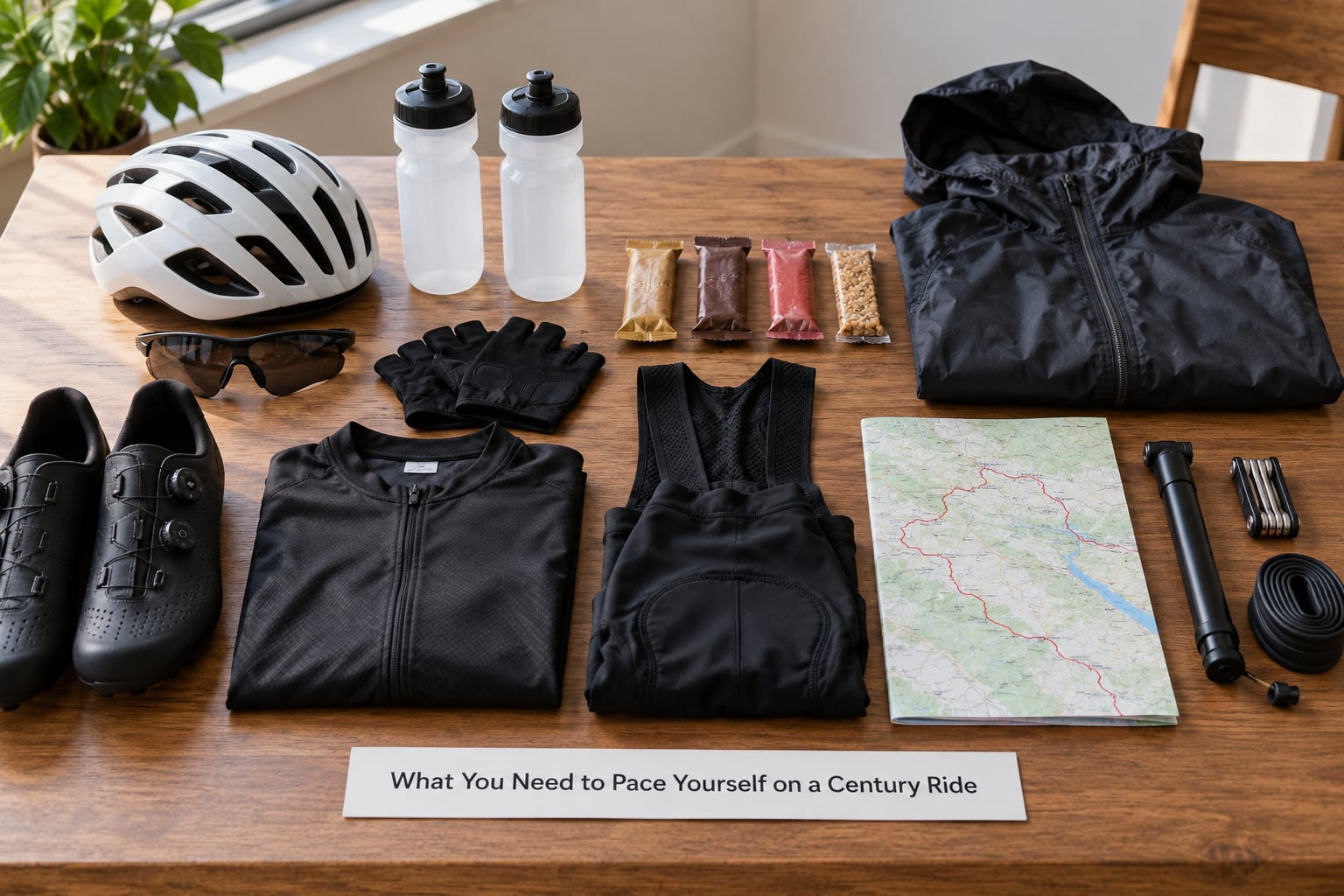
Pacing is a head game, and the head needs something to work with. A rider who arrives with two bottles, food for seven hours, and a route they have already looked at can hold an effort all day. A rider who brought one bottle and a single bar will not, no matter how motivated they are.
- A mechanically sound bike. Tires at the right pressure, chain checked, brakes tested, gears shifting cleanly under load. A roadside failure at mile 70 ends the pacing plan permanently.
- Two bottles, minimum. One full on the start line, one in your jersey. Top up at every rest stop rather than carrying spare weight from the start.
- Fuel for the whole day. Aiming at 60 to 80 grams of carbohydrate an hour means real food, so pack more than a single energy bar.
- A route you have seen. Download the track to your bike computer, run it once through on a map, and note the two or three climbs that will decide your day.
- Weather-appropriate kit. A packable jacket is non-negotiable, because a headwind on a descent is colder than you expect.
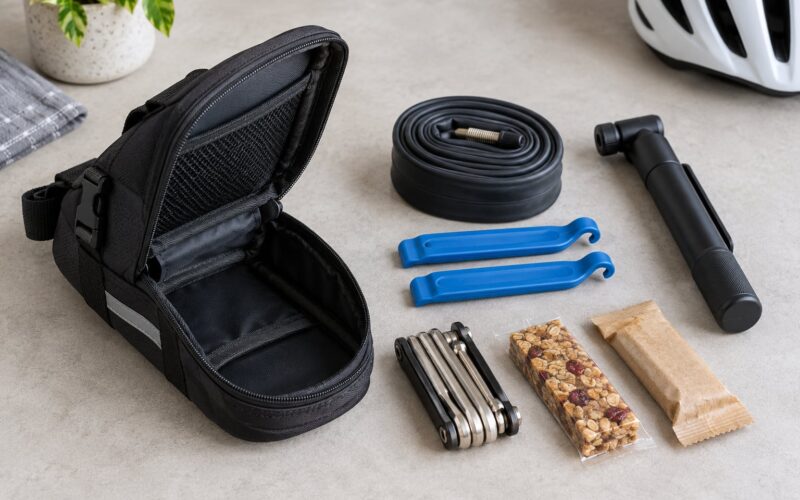
- Repairs and identity. Spare tubes, a mini pump or CO2, a multitool, phone, and a little cash for a rest stop that does not take cards.
- Training fitness. A long ride of 70 to 80 miles in the two to three weeks before the event tells you more than any amount of theory.
Check the support rules before you roll out. Some organized centuries have neutral feed zones and no personal bottles allowed, some have bag drops, and some have cut-off times. A rule you learn at the start line is a rule that costs you the ride.
One more check: ride the route, or at least the biggest third of it, beforehand if you have never seen it. Every century has a climb that looks like nothing on paper and eats an hour of your day.
Step-by-Step: Build a Pacing Plan That Gets You to 100 Miles
Step 1: Set a Sustainable Starting Effort for the First 30 Miles
Start at an effort you could hold all morning while still being able to answer a question about your weekend. In heart-rate terms that usually sits around 60 to 70 percent of your maximum; by feel it is roughly 3 or 4 out of 10, where breathing is deep but controlled.
Use whichever tool you have, and pick one and stay with it. With a heart rate monitor, watch the trend line over ten minutes rather than the second-by-second number, because a spike on a short rise is normal. With a power meter, aim for roughly 65 to 70 percent of your FTP. With neither, use perceived exertion and run a simple self-check: could you say a full sentence right now? If not, you are too far above the line.
Why hold back when you feel capable of more? Because the first 30 miles are where you buy the last 20. A rider who goes out at target pace arrives at mile 60 with depleted glycogen, cooked legs, and a mental bill to pay. A rider who went out ten percent slower arrives at mile 60 fresh enough to decide the outcome.
You will know the opening effort is right if you finish the first 30 miles thinking the ride was too easy. That feeling is the whole point, and it is worth trusting even when the group pulls away from you.
Step 2: Use the Route to Set Effort Zones
Read the route as a series of jobs rather than as one flat number. Flat and rolling sections are for holding a steady rhythm, climbs are for spinning and settling in, and descents are for recovering, not for spending.
On flats, hold your Step 1 effort and count it in breaths instead of speed. A headwind is not a reason to push; a tailwind is not a reason to sprint. On rollers, stay seated and keep the effort smooth so you do not burn your fast legs on terrain that does not deserve them.
Mark the climbs in advance and decide in advance what each one costs you. Then work to that plan instead of reacting to whatever the rider in front of you is doing, because that rider is on a different day, with different training and a different set of remaining legs.
If the route has one long climb near the end, budget for it in advance. A negative split is nice, but a century is not a race and an even or slightly positive split with a strong finish is perfectly good.
Step 3: Fuel Before You Are Hungry
Hunger is a lagging signal, and by the time you feel it you are already behind. Set a timer for 20 to 30 minutes from the start and start eating on schedule, whether or not you feel like it.
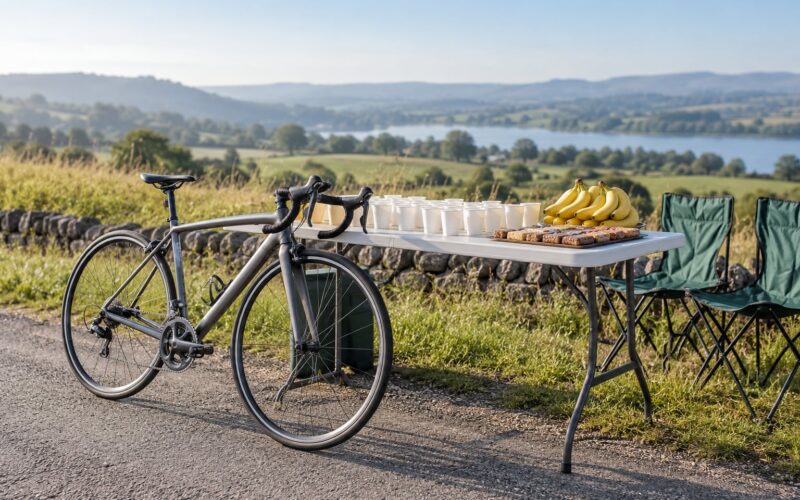
General sports nutrition guidance for endurance efforts is 60 to 80 grams of carbohydrate per hour, which works out to roughly a banana and a half, or a bar plus a gel, or a couple of handfuls of trail mix. Gels are efficient but do not always sit well for hours, so most riders are better off with a mix of real food and drink mix.
Work out your own number in the weeks before the ride by weighing yourself before and after a long training ride, then adjusting the food in your pockets until the numbers work. Test every new thing on a long ride, never on the event itself, and eat and drink more during training than you think you need.
By mile 60 you want to be eating because it is the scheduled time, not because you have run out of options. Riders who under-eat early usually do not recover that mistake later.
Step 4: Hydrate to Prevent an Energy Drop
Drink to thirst, starting early rather than when you are already behind. On a mild day most riders land somewhere around 500 to 750 millilitres an hour, and in heat or at a low bodyweight it can be more, but thirst is a better guide than any fixed number.
A useful check is to look at your bottle. Pale yellow means you are roughly keeping up; dark means you are behind and need to drink in the next few minutes. Very clear means you may be drinking too much, and forcing extra fluid on a long hot ride is a real mistake with real consequences.
Sodium matters more than most riders expect. After about 90 minutes, plain water alone is leaving something out, so use an electrolyte drink or a salty snack in a hot ride, and cut back on drinking if you feel bloated rather than thirsty.
Watch for overheating: a headache, a racing heart at the same effort, goosebumps, and hands that feel strange are all signs to slow down, get fluids in, and cool off before pushing on.
Step 5: Manage Climbs Without Blowing Your Legs
Have a repeatable approach so that climbing is a process rather than a negotiation. Gear down early and spin, because a low gear at a moderate cadence costs far less than grinding in a big ring at half the revs.
Then settle into a pace that feels too easy for the first two minutes of the ramp. Almost every climb feels brutal at the base and fine at the top once you stop accelerating, so give it five minutes before you judge it.
Stay seated when you can, stand when the gradient gets steep enough that sitting down means grinding, and use short out-of-the-saddle efforts rather than one long attack. Standing uses more energy and it is not a place to spend your reserve.
Change your hand position on the hoods or the drops as you go, take a sip of water on the flatter part at the top, and stay aero on the descent to recover before the next effort. Your last climb of the day should be boring, not heroic.
Step 6: Finish Strong in the Last 20 Miles
Around mile 80, take stock rather than pushing the throttle. Check whether your effort feels controlled, whether your breathing is still even, and whether you still have food and water. If any of those say no, you have been going too hard and the fix is to settle down for 10 miles and accept a slower finish.
Keep eating and drinking on the same schedule. The last 20 miles are exactly where riders who skipped the plan run out, and the finish is not worth an empty tank.
Keep your cadence high and your gearing comfortable even if the speed drops. A rider who stays smooth at 15 mph in the last 10 miles usually rolls past riders who are grinding at 13 mph, because grinding costs more than it looks like it should.
Do not turn the final miles into a race, no matter how good you feel. A century is a day, and a sprint finish in a group of 200 people does not earn much. If you have anything left, spend it on holding your line, sitting in comfortably and getting to the car upright.
Common Mistakes That Ruin Century Pacing
Starting too hard. The fix is boring: pick an effort, check it at 10 minutes, and hold it. If you are at 6 out of 10 in the first 20 miles, you are already making a mistake.
Relying on caffeine and energy drinks. Riders routinely use more caffeine than is useful and then get a crash, jittery legs, and an unsettled stomach at mile 60. Keep whatever you normally tolerate, and skip the double shot you have never ridden with.
Skipping food early because you feel fine. The fix is the timer. Eating on schedule is what lets you eat freely later, and going in under-fuelled is the single most common reason a century falls apart in the second half.
Sitting in the drops for hours. A tucked position feels fast and costs you a lot in neck, shoulder, and hand fatigue. Change position every 15 to 20 minutes, come up to the hoods, and take your hands off the bars entirely for a minute.
Chasing a faster group. Drafting raises your speed and your power at the same time, so a group pace can feel manageable and still be above what you can hold for five hours. Sit in for the early miles only if the group’s pace is at or below yours.
Ignoring a mechanical niggle. A sound that is slightly different is not a reason to grind on. Check it at the first rest stop, when a small adjustment is free.
Resting for 25 minutes because the stop is comfortable. Keep stops to 5 to 10 minutes. Long stops make your legs stiff, your blood pool oddly, and restarting genuinely hard.
Treating the last climb as a finish line sprint. If there is a climb near the end, ride it at the same effort as the others. Arriving at the top is what matters.
A Simple Century Pacing Checklist
Before you roll out, run through this list once. It takes two minutes and it catches almost every problem that gets discovered at mile 50 instead.
- Route downloaded, climbs noted, cut-off times checked
- Weather checked, and a packable jacket in your pocket
- Two bottles full, plus food you have already eaten on training rides
- Tires, brakes, gears, and a spare tube
- Phone charged, cash for the rest stop, someone knows your route
- Headlights if the start time means finishing after dark
During the ride, ask yourself the same four questions at every rest stop. Am I within my planned effort band? Did I eat on schedule? Am I drinking because I am thirsty, or because I am behind? Is there anything on the bike that sounds wrong?
If the answer to the first one is no, adjust immediately rather than at the next problem. Nothing you do on a century ride is harder to fix late than effort, because effort spent is gone and nothing buys it back.
Frequently Asked Questions
How hard should the first 30 miles of a century feel?
They should feel almost too easy, around 3 or 4 out of 10, or roughly 60 to 70 percent of maximum heart rate. If you can talk in full sentences comfortably while riding, your effort is about right. Riders who feel flat in the first 30 miles are usually pacing correctly, and the payoff shows up after mile 60 when they still have something left.
Should I eat before a century ride or wait until I feel hungry?
Start early rather than waiting for hunger, because hunger arrives late and a century takes 5 to 8 hours. Aim for 60 to 80 grams of carbohydrate an hour, starting in the first 20 to 30 minutes and continuing on a timer even when you do not feel like it. Test your food choices on long training rides so nothing new upsets your stomach on the day.
How often should I drink on a 100-mile ride?
Drink to thirst, starting early instead of waiting, and take regular sips at every rest stop rather than big gulps. Most riders land around 500 to 750 millilitres an hour in mild weather and more in heat. After about 90 minutes, add electrolytes rather than drinking plain water only, and avoid forcing extra fluid when you are not thirsty.
What pace should I use on long climbs during a century?
Use a slower cadence in an easier gear than you would choose for a short hill repeat, roughly 70 to 90 rpm, and hold an effort you could sustain for an hour. Settle in during the first two minutes of the ramp instead of attacking it, and stay seated unless the gradient forces you to stand. Climbing takes far less energy than most riders spend on it.
How do I recover if I start feeling tired after 50 miles?
Ease your effort down for the next 10 miles rather than trying to push through, and check your food and fluid intake, since early under-fuelling is the usual cause. Eat and drink on schedule even if your appetite has gone, and stop for a proper 5 to 10 minute break if you need to. If you are still struggling at mile 70, the goal becomes finishing comfortably, not chasing a time.
Is it better to ride with a faster group during a century?
Only if that group’s pace is at or below the effort you can hold for five hours, because drafting raises your speed and your power at once. Groups also pace unevenly, and surges that feel easy early are what blow riders up at mile 60. A steady group near your own pace is genuinely useful, so pick the group that matches your plan rather than the fastest one at the start.
Conclusion: Start Slower So You Can Finish Strong
The first thing to do is set an opening effort you could hold for hours, then treat it as the plan rather than a suggestion. Eat on a timer from mile zero, drink to thirst with electrolytes after 90 minutes, and decide in advance what each climb on the route will cost you.
How to pace yourself on a century ride comes down to one habit: hold back early on purpose, then spend what is left at the end. The first 20 miles decide how the last 20 feel.