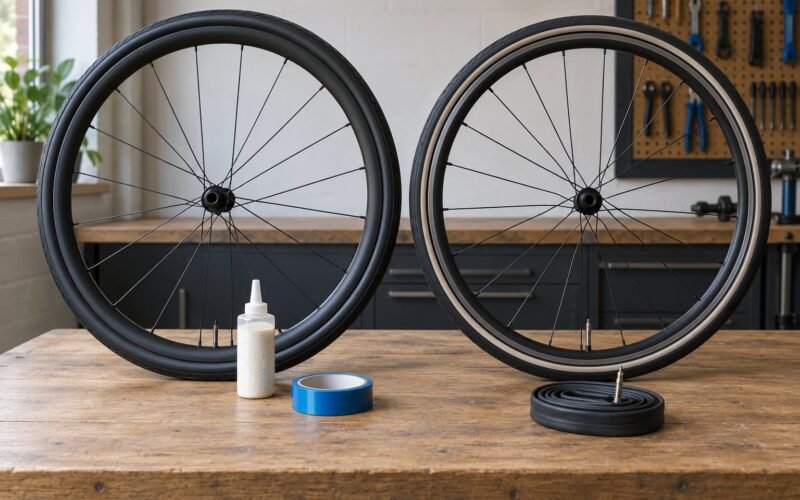
Disc brakes are the better road bike brakes if you ride in rain, ride steep alpine descents, or want braking power that stays the same on the tenth descent as on the first. Rim brakes still make sense when weight matters, the budget is tight, you already own a frame built for them, or your riding stays in dry weather on flat roads. Neither system is faster in a straight line on dry pavement with a skilled rider on the levers.
I ride a disc brake road bike most days and keep a rim brake bike for the summer evening loop where the roads are dry and flat. That split is what most riders end up with, and it is a sensible one. Updated for October 2026, here is how the two systems actually differ, where the marketing overstates the difference, and which one fits the riding you actually do.
Table of Contents
- Disc Brakes vs Rim Brakes for Road Cycling at a Glance
- How Do Disc Brakes and Rim Brakes Stop a Bike?
- Which Type of Road Brake Has Better Control?
- Disc Brakes vs Rim Brakes for Wet and Descending Roads
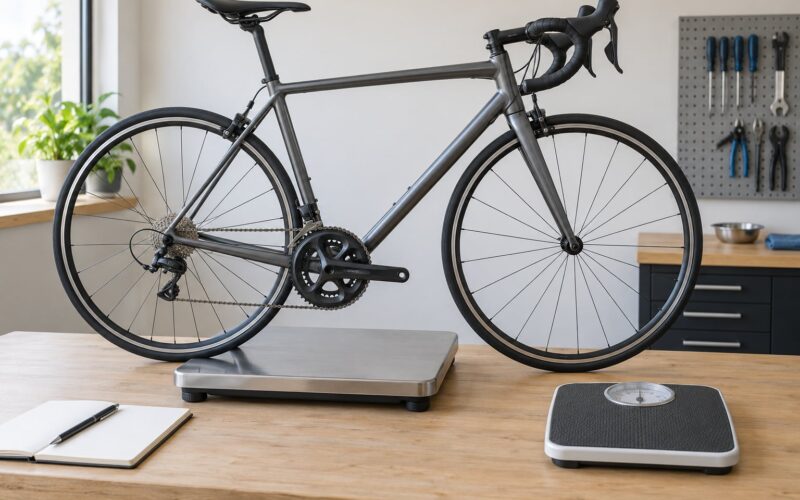
- Are Disc Brakes Heavier Than Rim Brakes?
- How Do Rim Brakes and Disc Brakes Compare in Maintenance?
- Which Road Brake Is More Durable and Reliable?
- How Much Do Disc Brakes vs Rim Brakes Cost?
- Which Should You Choose?
- Frequently Asked Questions
- Are disc brakes always faster than rim brakes?
- Can I install disc brakes on an older road bike?
- Do disc brakes make a road bike unsuitable for racing?
- Are hydraulic disc brakes harder to maintain than rim brakes?
- Do disc brakes perform poorly when they get hot?
- Can I convert my rim brakes to disc brakes?
- Conclusion
Disc Brakes vs Rim Brakes for Road Cycling at a Glance
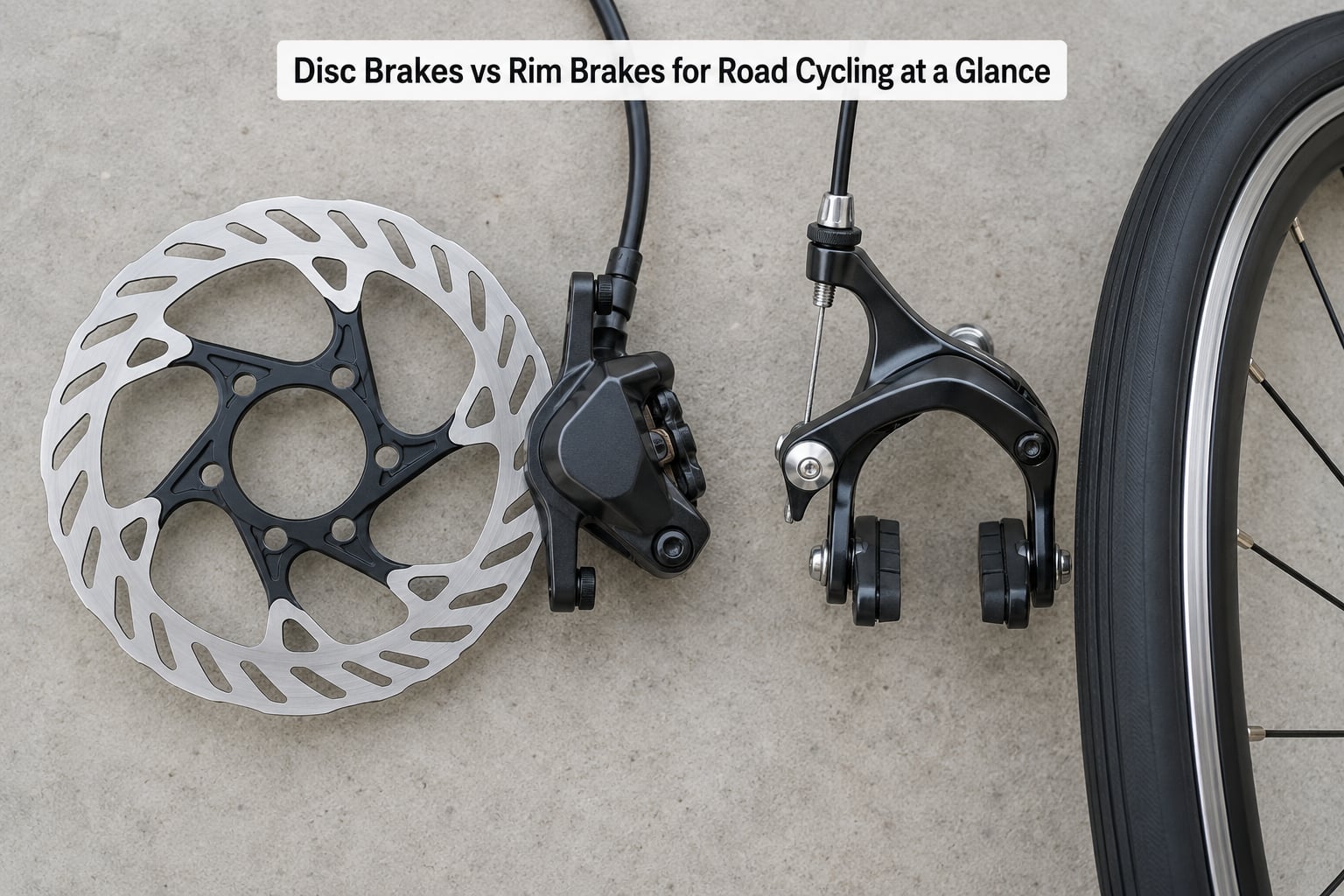
Here is the short version of disc brakes vs rim brakes for road cycling, criterion by criterion.
| Criterion | Disc brakes | Rim brakes |
|---|---|---|
| Braking power, dry | Higher and consistent | Good, ample for flat road riding |
| Braking power, wet | Nearly unchanged | Drops noticeably |
| Control and modulation | Excellent at the lever | Very good, more dependent on setup |
| Weight penalty | 200 to 500 g across the bike | Baseline lighter |
| Heat management on descents | Rotor sheds heat well | Rim and pads can fade or warp |
| Routine maintenance | Pad and rotor checks, occasional bleed | Cable, housing and pad service |
| Damage from contamination | Permanent, pads and sometimes rotor | Temporary, cleanable with a wipe |
| Effect on the wheel | None on rim or tyre | Wears the brake track |
| Noise | Can squeal or knock under load | Quieter, some rim buzz |
| Cost to buy | Higher | Lower |
| Second-hand availability | Plenty | Plenty, and cheaper |
| Best for | All-weather, gravel, winter, descent riders | Climbing, budget, dry-weather and retro builds |
The one line that matters most: on dry, flat, low-speed roads the gap between the two is small. Everything that separates them opens up in rain, in heat, and on steep descents.
How Do Disc Brakes and Rim Brakes Stop a Bike?
Both systems end in the same place: friction on a rotating surface. What differs is where that friction happens and how the force reaches it.
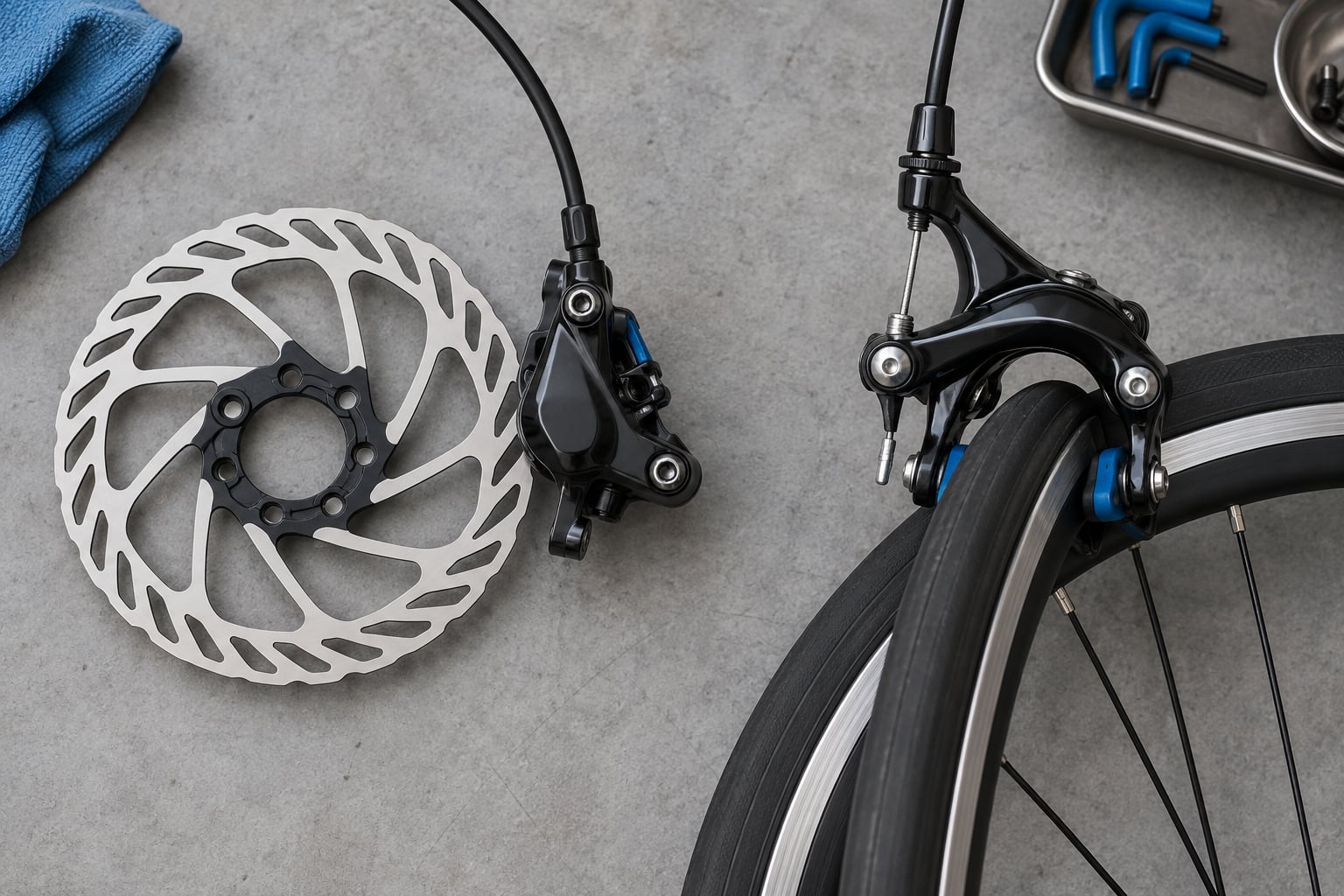
A rim brake squeezes two rubber brake pads against the rim itself, on the machined brake track. A cable runs from the lever to a pivoting caliper, and the cable tension pulls the arms together. Most road rim brakes are single-pivot dual-pivot designs that pull both pads in, with a small amount of pad clearance built in so the pads retract as you release. The classic exception is the Magura RT hydraulic rim brake, which pushes fluid to a cylinder at the caliper and gets near disc brake power on the rim. Riders on forums still praise the RT as fantastically strong, and they remain findable second-hand, but they are a small market now.
A disc brake squeezes pads onto a metal rotor bolted to the hub. The rotor never touches the frame or the tyre, which is why grit, mud and chain lube stay out of the braking surface. Hydraulic discs, which is what nearly every road groupset from Shimano, SRAM and Campagnolo now uses, push brake fluid through a hose from the master cylinder in the lever to pistons in the caliper. Mechanical discs run a cable instead, which saves weight and needs no fluid but adds cable friction and needs more frequent adjustment.
One practical consequence follows from that layout: pad wear is obvious on a rim brake, because you can see the pad and the brake track from the side of the bike. On a disc brake you have to look at the caliper from behind the wheel or drop the wheel out to check the pads properly.
Which Type of Road Brake Has Better Control?
Disc brakes give better control on modern road bikes, and the reason is leverage rather than raw power.
Rim brakes compress the rim wall to generate friction, and the rim wall is a structural part of the wheel. To get usable braking force, a rim caliper has to be heavy and clamped precisely, and its pads sit a long way from the axle, which limits leverage. Discs apply force at the hub, right where the rotor is bolted, so a compact two-piston caliper produces a lot of braking force from a light body.
That extra leverage shows up as modulation, which is simply how well you can vary braking force by varying lever pressure. On a good hydraulic disc brake, one finger can feather the lever through a range from gentle slowing to near maximum grip. Mechanical discs get close but need more hand effort and a tighter cable adjustment. Rim brakes, when the pads are aligned and the cables are fresh, are more progressive than most riders expect, which is exactly why skill changes the outcome more here than with discs.
More power does not automatically mean better control. A rider who can modulate a rim brake to the threshold has, in practice, the same usable stopping performance as a rider who drags a lever on a rotor. The braking difference shows up when a rider is out of their depth: descending a wet mountain pass, riding a loaded bike downhill with a tailwind, or braking late in a bunch.
Hand comfort is the other half of control. Rim brake levers sit closer to the bar and often need more force to pull, which tires the hands on a long descent. Hydraulic disc levers have a longer, softer stroke with a one-finger braking point. On a long alpine descent that difference is worth real attention.
Disc Brakes vs Rim Brakes for Wet and Descending Roads
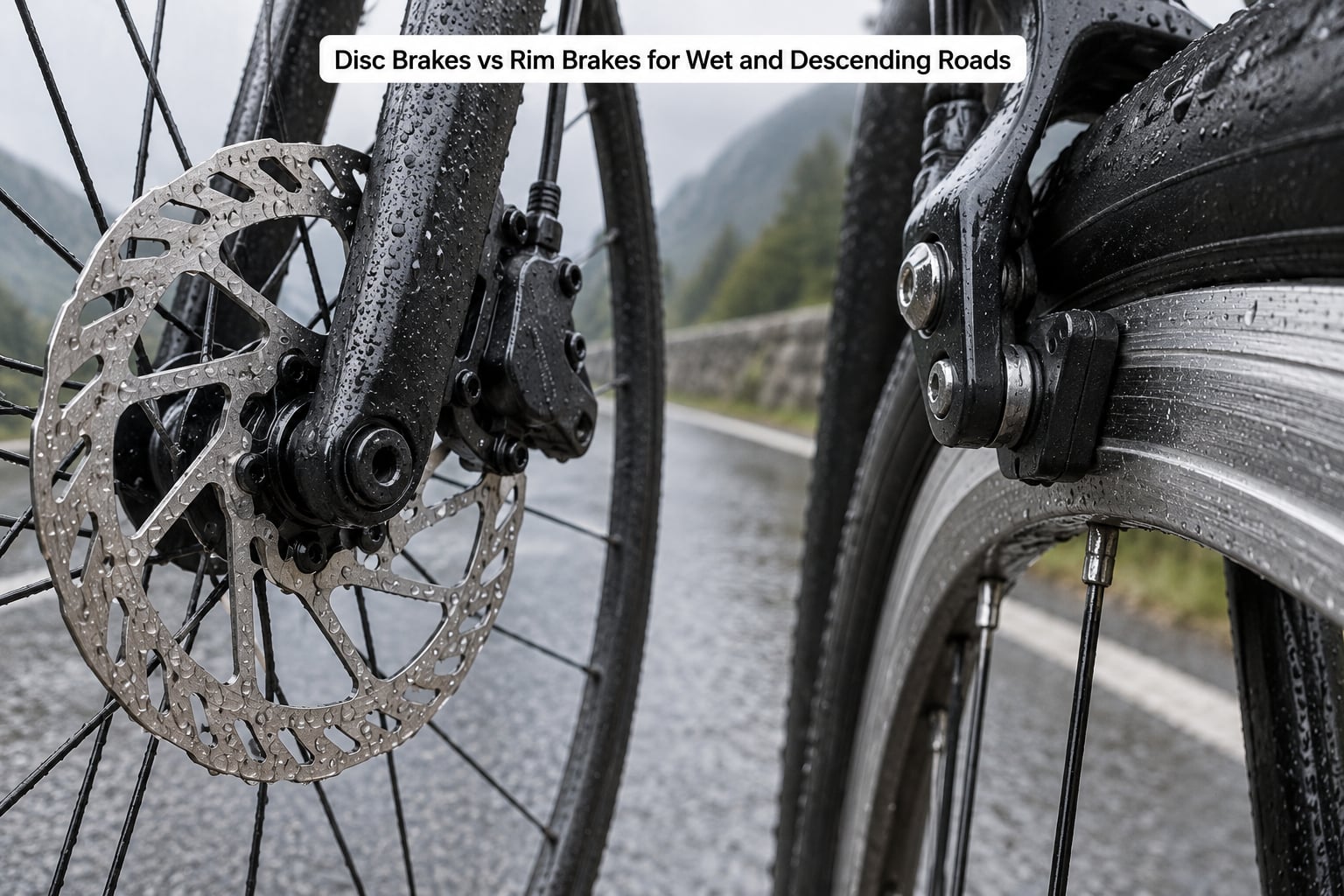
Wet weather is where disc brakes vs rim brakes stops being a preference and becomes a safety margin.
Water on a rim brake track cuts friction sharply, because water sits on the surface the pads have to grip. Riders on r/cycling describe carbon brake tracks working fine in the wet, though they add the honest caveat that an alloy brake track would still be better. The gap widens when the road has grit, oil from a bike lane, or the dust and pollen that collect over a dry summer. Disc brake pads and rotors get wet and keep essentially the same stopping power.
Heat is the second factor, and it shows up on long descents where you brake repeatedly without ever coming to a stop. A rotor is a flat steel disc with air moving across it, so it sheds heat and resists fade. A rim brake dumps its energy into a wheel that is already carrying your weight, and on a carbon rim that heat can distort the brake track and go concave. One rider on r/triathlon described a pulsing sensation under braking that turned out to be an uneven, grooved rim surface.
Some rim brake setups cope well. Alloy brake tracks tolerate heat better than carbon, and good pads on a well-set-up caliper will still get you down a mountain. The failures cluster where heat, weight and poor alignment combine, which is why long alpine descents are the classic rim brake fade scenario.
Disc brakes are not immune to heat. Sustained hard braking on a long descent heats the fluid, and hot fluid gives a lever that feels vague and weak. That is why quality fluid matters and why rotors should be kept clean and unpainted. But fading from heat is far rarer on discs than from contamination or a warped rotor.
Are Disc Brakes Heavier Than Rim Brakes?
Yes. A disc brake setup adds roughly 200 to 400 g on a typical build, and up to around 500 g once you account for the rotors, calipers, hoses and the slightly heavier wheels that come with them. Citing figures published by Canyon and Superteam, that is the range most of the industry quotes.
The number moves with your choices. Smaller rotors weigh less, entry-level groupsets use heavier calipers than top-tier ones, and thru-axle front ends add their own mass. Hydraulic lines cost a little more than mechanical ones. If you are comparing like for like at the same price tier, assume the mid part of that range.
Whether it matters is a fair question. A 300 g saving is worth real time on a long climb for a racer, where the rider is already near minimum weight and marginal mass costs power. For a club rider on a 9 kg bike with panniers, that same 300 g is close to noise. Nobody in the cafe sprint is noticing it.
The counterweight is the long-descent argument. Lighter in the hand and softer on the levers means less fatigue when you are braking for twenty minutes straight, and fatigue is what causes mistakes on a mountain road.
How Do Rim Brakes and Disc Brakes Compare in Maintenance?
Rim brakes are simpler to service at home. Disc brakes ask for more, but most of what they ask for is avoidable rather than frequent.
On a rim brake, the routine job is cables and housing. Fresh inner cable, new housing, set the barrel adjuster, then align the pads so they touch the brake track evenly and pull the arms back far enough to clear the tyre. Swap the pads when the grooves run out, check the quick release or thru axle, and look at the brake track for wear. It is all jobs a home mechanic can do with basic tools, and it is the reason rim brake bikes stay on the road for decades.
On a disc brake you inspect pad thickness through the caliper window, check the rotor for wear and warp, keep the rotor surface free of oil, and replace the fluid on an interval or when the lever starts feeling spongy. Bleeding is the task that scares people, and it is the one most often handed to a shop. The honest framing is that bleeding is a skill, not a frequent requirement, and plenty of riders learn to do it once and then rarely need it.
Alignment is worth calling out. A bent rotor or a caliper mounted out of square produces rubbing that no amount of bleeding will fix, and rubbing turns into heat and noise. A rotor true check and a re-centre are quick once you know the sequence.
None of this is a reason to avoid discs. It is a reason to know the difference between a maintenance task and a fault, because forum users get that wrong constantly.
Which Road Brake Is More Durable and Reliable?
Disc brakes are more durable in the sense that they do not wear out your wheels, and less durable in the sense that a single mishap can ruin a part.
Rim brakes consume the wheel. On an alloy rim the brake track grooves over time and on a carbon rim it thins, at which point the safe answer is a whole new wheelset. That is the biggest single cost of running rim brakes on nice wheels. Pad and shoe replacement, by contrast, is cheap and easy.
Disc brakes consume rotors and pads, and rotors can be bent. Hit a pothole, kerb or rock hard enough and a disc rotor develops runout, which shows up as pulsing under braking, rubbing, or a lever that pulls to the bar. A true rotor can often be trued; a cracked one has to be replaced. Contamination is the other permanent failure. One drop of chain lube, degreaser or dirty water can destroy pads outright, and if it reaches the rotor, the rotor needs replacing too. A rim brake contaminated with the same stuff just needs a wipe.
Before a long or mountainous ride on either system, a two-minute check pays for itself: squeeze each lever hard and confirm the caliper does not pull to the bar, look at pad or shoe wear, spin each wheel for rubbing, and confirm the quick releases or thru axles are correctly torqued. On a disc bike, take the front wheel out and give the rotor a close look for cracking.
How Much Do Disc Brakes vs Rim Brakes Cost?
Discs cost more to buy and more to service. Rim brakes cost less at both ends, and the gap widens once the frame and wheels are included.
The purchase comparison is straightforward. Mechanical rim brake levers and calipers remain the cheapest option on a new bike by a wide margin, hydraulic discs sit in the middle, and top-tier hydraulic disc groupsets from Shimano, SRAM and Campagnolo sit at the top. When two brake types are available on the same bike at two price points, the gap usually reflects the groupset tier rather than the brakes alone.
Running costs follow the same pattern. Rim brakes need cables, housing and pads, all of which are cheap and widely stocked. Disc brakes add rotor and pad replacement plus fluid and occasional bleed services. Consumable prices vary by brand and region, so treat any single figure as indicative rather than fixed.
The expensive mistake is interface mismatch. A rim brake frame and fork physically cannot take disc calipers, so converting means a new fork, new frame or new wheelset, new hubs, new levers and new calipers. That is most of a bike. On the other hand, adding rim brakes to a disc frame is a cheap, bolt-on job if the mounts are there, and it is a genuine fallback for anyone who wants the disc bike to double as a race bike under UCI rules.
Which Should You Choose?
Start with the frame you own, then the conditions you ride in, then everything else.
- Check what the frame takes. If you already own the bike, this decides it. Disc mount or rim brake mount, and that is that. Converting means replacing most of the bike.
- Be honest about weather and terrain. Regular wet commuting, winter base miles, gravel, or alpine descents point to discs. Dry summer riding on rolling roads is where rim brakes are perfectly comfortable.
- Decide if weight is your hobby. Racing and climbing hard makes those extra few hundred grams worth worrying about. Everything else, the number barely registers.
- Count the true cost. Rim brakes wear your rims and cost nothing to service. Discs cost more up front and never touch the wheel, which matters if you like carbon wheels or plan to keep the bike a long time.
By rider type: pick discs for all-weather commuting, year-round club riding, gravel and cyclocross, and anyone who regularly descends steep, sustained mountains. Pick rim brakes for competitive climbing, budget first bikes, retro steel and vintage builds, and riders who want the lightest possible bike they can service at home without a workshop.
And there are cases where rim brakes are a poor fit. If you race or commute through winter rain, if you ride a route with sustained 8% descents and a loaded bike, or if you already have carbon rims and cannot stomach replacing a wheelset when the brake track wears out, discs are the sensible answer even though they are heavier.
Are rim brakes still good in 2026? Yes, for fair-weather road riding they are more than adequate, and the used market is full of quality rim brake groupsets and wheelsets at a fraction of what the equivalent disc parts cost. The honest caveat is spare part availability: the market has moved on, so plan your pad and cable purchases rather than assuming endless supply.
Skill matters more than any spec sheet here. As one BikeRide forum poster put it, most problems come from inexperienced riders. A confident rider who feathers a rim brake can descend just as safely as they would on discs, which is the strongest argument in favour of keeping the simpler system you already have.
Frequently Asked Questions
Are disc brakes always faster than rim brakes?
No. On dry, flat roads with a confident rider, the stopping distance difference is small and depends more on technique than hardware. The gap opens up in rain, on steep sustained descents, when braking one-handed, and on a loaded bike. If those situations are part of your riding, discs earn their extra weight; if they are not, rim brakes stop you perfectly well.
Can I install disc brakes on an older road bike?
Only if the frame and fork were built with disc brake mounts in the first place. Many road frames from the last fifteen years are, and the fork usually is too, but a rim brake only frame has no mounts, no chainstay clearance and no compatible hub spacing. Check for flatmount or postmount tabs near the dropout before you buy any parts. If the mounts are absent, converting means a new frame and fork.
Do disc brakes make a road bike unsuitable for racing?
Not at all. UCI rules allow disc brakes on the road, and modern race-oriented disc frames are built with aero profiles that assume them. What matters is rider choice: many racers bolt rim calipers onto a disc frame for a race or crit, which is cheap on most frames since the mounts are already there. Confirm the rules for any specific event, because equipment lists vary, and check that your rotors and calipers fall inside the permitted weight and format.
Are hydraulic disc brakes harder to maintain than rim brakes?
They ask for more, mostly because bleeding looks intimidating. In practice you inspect pad thickness through the caliper, keep the rotor clean, replace fluid on an interval, and true a bent rotor occasionally. Rim brake servicing is cables, housing and pads, which is simpler and cheaper. Neither system needs shop visits if you learn one extra procedure, and many riders bleed their own discs happily after doing it once.
Do disc brakes perform poorly when they get hot?
Heat does soften hydraulic disc brakes, because hot fluid expands and the lever feels vague. On a long descent you can keep the rotor cooler by braking in short pulses, using both brakes alternately, and avoiding dragging the lever, and larger rotors shed heat better than small ones. Rims and pads on a rim brake suffer more from the same heat, often fading outright or distorting a carbon rim, so discs still handle hot descents better overall.
Can I convert my rim brakes to disc brakes?
Not on the same frame and fork. Rim brake frames have no caliper mounts, no chainstay or fork clearance, and hubs with the wrong dimensions, so a full conversion means a new frame, fork, wheelset, levers and calipers. The reverse is cheap: many disc frames still have rim brake mounts, so you can add calipers and pads for race days. Check the frame before buying either, since this decides the question for you.
Conclusion
Disc brakes win on braking consistency, wet grip, heat resistance and the fact that they never wear out your rims. Rim brakes win on weight, cost, home servicing and simplicity. On dry roads ridden confidently, the performance gap is much smaller than the marketing suggests.
Before you buy anything, do two things. Look at the brake mounts on your frame and fork and decide what you actually have to work with, because that rules out half the options before you spend anything. Then write down where and when you ride: if rain, gravel or long steep descents are part of it, get discs, and if you are chasing weight or starting on a budget, a well-set-up rim brake bike is a genuinely good machine.