Rolling resistance is the force that slows a rolling bike down. Every time a tire rotates, its rubber and casing are squashed at the front and released at the back, and the energy used to do that mostly comes back as heat rather than as forward motion. That lost energy is rolling resistance, and it is the one part of your speed equation you can change cheaply.
It sounds simple, and the physics is genuinely straightforward. What makes it confusing is how often the advice floating around online contradicts itself: pump the tires hard, or run them soft; go narrow for speed, or go wide. Both camps quote real tests. The difference is what those tests measured.
This guide pulls the explanation together in one place, with the numbers, the trade-offs and a method you can run yourself on your own bike this weekend.
Table of Contents
- Key Takeaways
- Rolling Resistance Explained: What Happens at the Tire?
- Rolling Resistance Explained for Cyclists: The Force Equation
- How Much Power Does Rolling Resistance Cost?
- Why Tire Pressure and Tire Width Matter
- Which Tires Have Lower Rolling Resistance?
- How Tire Construction Changes the Result
- How Road Surface and Wheel Width Affect Rolling Resistance
- How to Test Rolling Resistance at Home
- How to Reduce Rolling Resistance Without Sacrificing Safety
- What About Rim Tape, Tubes, and Tubeless Seals?
- Rolling Resistance and Your Overall Cycling Efficiency
- Frequently Asked Questions
- Does a wider bicycle tire roll faster than a narrow tire?
- What tire pressure gives the lowest rolling resistance?
- Is tubeless lower rolling resistance than a tube?
- Does rolling resistance matter more on long rides or short sprints?
- Why does my new tire feel slower than my old one?
- Can bad rim tape increase rolling resistance?
- Conclusion: Start With Tire Pressure and Tire Choice
Key Takeaways
- Rolling resistance comes from elastic hysteresis: the tire deforms each rotation and does not return all of that energy.
- At road speeds it typically costs somewhere between 5 and 15 watts on a normal bike, and more with wide gravel or knobby tires.
- A smaller, rounder contact patch lowers resistance. Wide tires achieve this by sitting at lower pressure, not by touching less road.
- Diameter matters more than width. A 28mm tire at a sensible pressure usually beats a 23mm at a rock-hard one.
- Rough surfaces reward lower pressure, because less casing flex means less energy wasted fighting vibration.
- Tires lose performance as they age, and a square, hard or damaged casing can cost more watts than any width change.
Rolling Resistance Explained: What Happens at the Tire?
Rolling resistance is energy lost to deformation inside the tire every time it rotates. As the wheel turns, the leading edge of the casing is forced upward against the road while the trailing edge springs back down. Rubber and fabric are elastic, so most of that energy does return — but not all of it. The shortfall is called elastic hysteresis, and it is absorbed as heat inside the casing and as vibration in your hands.
The contact patch is the small area where tire and road meet. Change its size and shape and you change the resistance. A hard, narrow tire makes a long, thin patch. A wide tire at lower pressure makes a shorter, rounder patch under the same load. Rounder patches deform the casing less deeply and less sharply, which is why patch shape matters more than raw patch size.
Rolling resistance is only one of four things standing between you and more speed. The other three are aerodynamic drag, gravity, and vibration loss. Aerodynamic drag rises steeply with speed and is usually the largest single cost at racing speeds. Gravity only matters when the road tilts. Vibration loss, where energy disappears into a handlebar and saddle you cannot see, grows sharply with roughness and with tire pressure. Every speed change trades one of these against the others, which is why the fastest setup on one surface is not the fastest on the next.
That trade-off explains the folklore. Riders who test on a quiet road with a power meter find lower pressure helps, because smooth tarmac lets a softer tire deform gently. Riders who test on rough tarmac find the opposite, because a hard tire skips over cracks instead of absorbing them. Both results are real.
Rolling Resistance Explained for Cyclists: The Force Equation
The resisting force equals a coefficient of rolling resistance (Crr) multiplied by the load pressing on that tire. Every cyclist can use that relationship without touching advanced mathematics, because it says two plain things: resistance scales with how much weight the tire carries, and resistance scales with the tire’s own tendency to resist deformation.
Typical Crr values sit near 0.004 to 0.006 for a good road tire at a sensible pressure on smooth tarmac. A worn or hard casing pushes toward 0.008 or higher. A wide gravel tire on rough ground can sit around 0.010 to 0.014, and a knobby mountain bike tire higher still. Multiply Crr by the load on one tire to get the force in newtons opposing that wheel.
There is one more term hiding in there: hoop strain. A tire is a hoop under tension, and squeezing it flattens that hoop into an oval. The more you flatten it, the more the sidewalls and casing have to stretch out of shape and back again, and stretching costs more than it gives back. That is the whole reason pressure matters, and why the relationship is not linear.
How Much Power Does Rolling Resistance Cost?
On smooth tarmac at road speeds, rolling resistance usually takes somewhere between 5 and 15 watts on a typical road bike. Wider gravel or mountain bike setups can add 10 to 15 watts compared with a road tire, which matches what riders on the r/gravelcycling forum report about their typical setups. Treat everything below as a worked estimate, not a measurement of your bike.
| Rider plus bike weight | Wheel load per tire | Crr 0.004 (good road tire) | Crr 0.007 (worn or hard casing) | Crr 0.011 (wide gravel tire) |
|---|---|---|---|---|
| 65 kg | about 32 kg | about 1.3 W | about 2.2 W | about 3.5 W |
| 80 kg | about 39 kg | about 1.5 W | about 2.7 W | about 4.3 W |
| 95 kg | about 47 kg | about 1.8 W | about 3.3 W | about 5.2 W |
| 110 kg | about 54 kg | about 2.2 W | about 3.8 W | about 6.0 W |
Values are two-wheel totals at constant speed, rounded for estimation. A loaded touring bike or one carrying pannier weight pushes the wheel load higher than rider weight alone suggests, which adds to every figure in the row.
Speed changes the picture because aerodynamic work rises with the cube of speed while rolling resistance stays nearly flat with speed. Over distance, the picture shifts again, because gravity and rolling resistance both accumulate per kilometer while drag only builds once you are moving.
| Speed | Road tire, Crr 0.005 | Gravel tire, Crr 0.010 | Knobby MTB tire, Crr 0.015 | Approx. difference, gravel versus road |
|---|---|---|---|---|
| 15 km/h | about 2 W | about 4 W | about 6 W | about 2 W |
| 20 km/h | about 3 W | about 6 W | about 9 W | about 3 W |
| 25 km/h | about 4 W | about 8 W | about 11 W | about 4 W |
| 30 km/h | about 5 W | about 10 W | about 15 W | about 5 W |
| 40 km/h | about 7 W | about 13 W | about 19 W | about 6 W |
These are estimates at roughly 80 kg of rider and bike weight. They explain why an eight-watt difference barely registers on a twenty-minute sprint and decides a whole long day.
Why Tire Pressure and Tire Width Matter
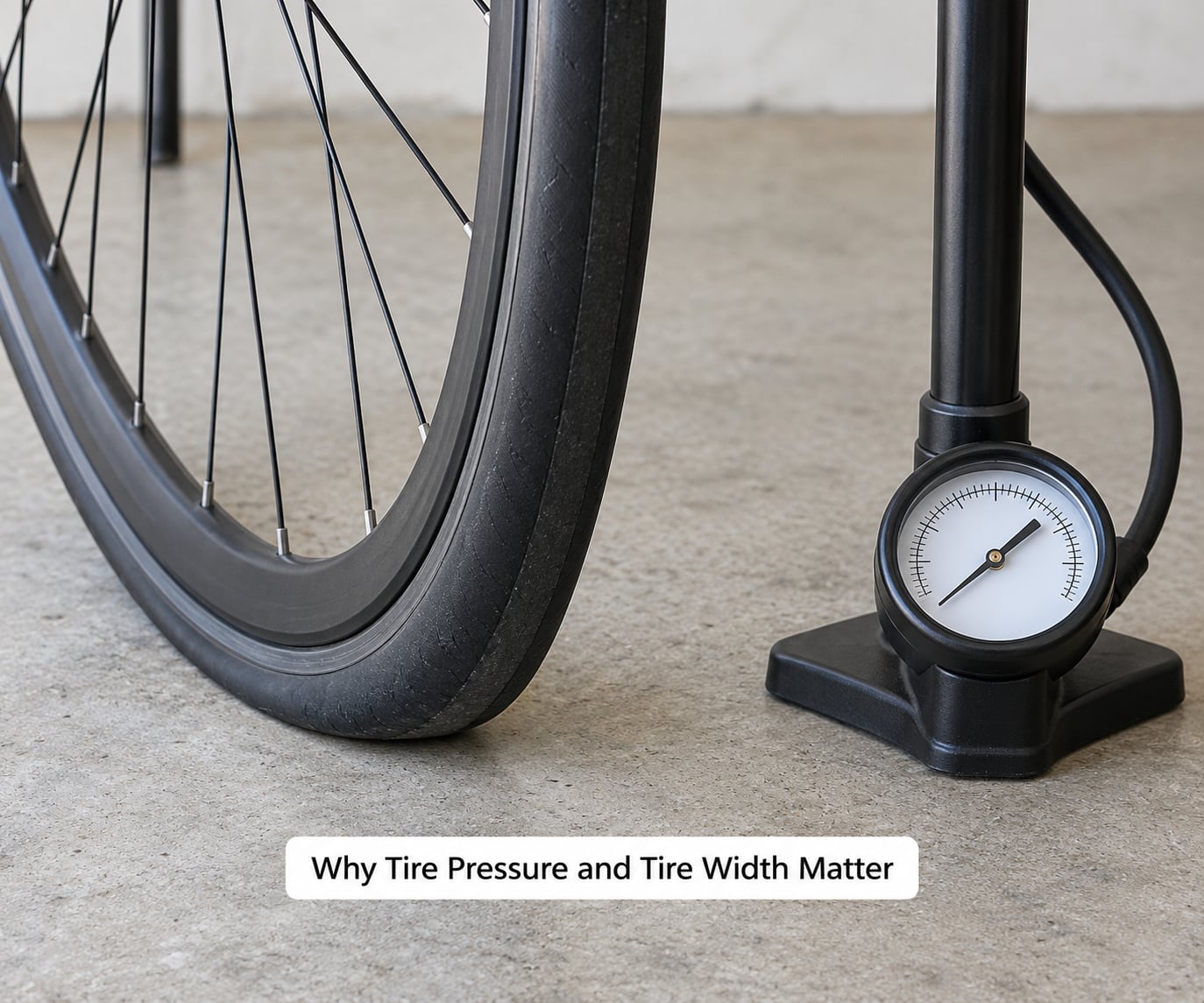
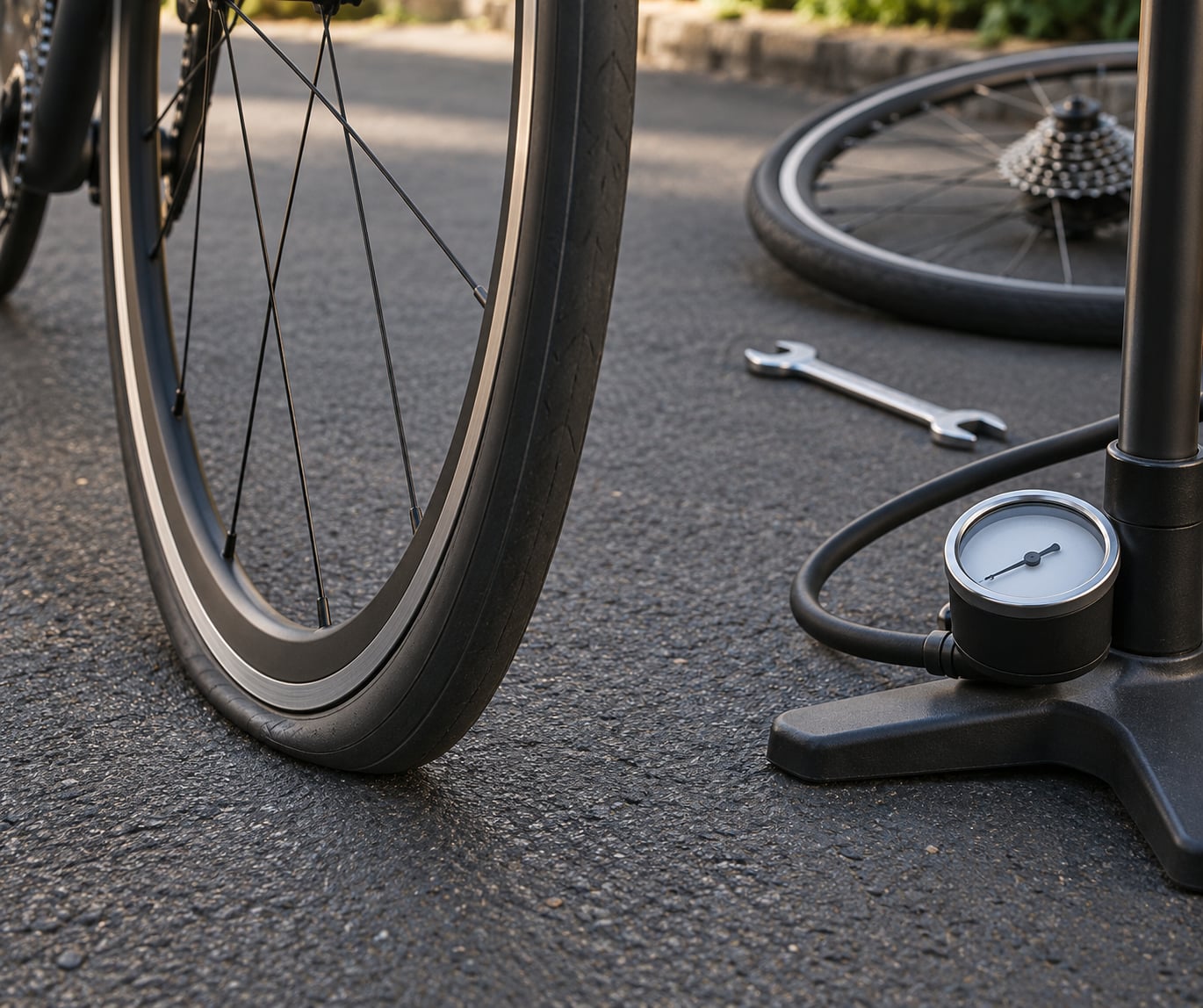
Tire pressure sets how deeply the casing deflects, and deflection sets how much the casing has to bend back into shape each rotation. Pressures that stop you bottoming out against the rim also reduce the resistance penalty of a soft tire. That is the trade: enough pressure to protect the rim, no more.
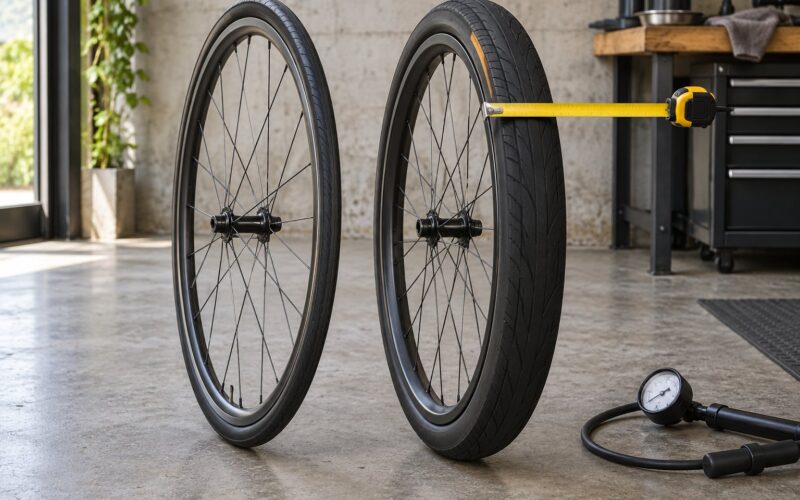
Modern industry guidance, which follows the ETRTO standard, puts a sensible tire width at roughly 1.25 times the internal rim width at minimum and up to 2.5 times at maximum. On a rim with a 21mm internal measurement that gives a workable range of about 26mm to 52mm. Hookless rims sit at the tighter end of that range by design, which is why a wider tire on a hookless rim often produces a rounder patch than a narrow tire on an older hooked rim.
| Rider plus bike weight | 28mm tire on 21mm internal rim | 32mm tire on 22mm internal rim | 40mm tire on 24mm internal rim |
|---|---|---|---|
| Under 60 kg | about 65 psi | about 55 psi | about 40 psi |
| 70 kg | about 75 psi | about 65 psi | about 48 psi |
| 80 kg | about 85 psi | about 72 psi | about 55 psi |
| 90 kg | about 95 psi | about 80 psi | about 60 psi |
| Over 100 kg | about 100 psi or a wider tire | about 88 psi | about 68 psi |
Starting points only, in psi, for smooth tarmac on a hookless rim. Subtract a few psi for rough tarmac and add a few for a heavily loaded bike. Manufacturers publish maximum pressure per tire, and that number always wins over any table.
The old claim that higher pressure is always faster came from drum testing, where a tire spins against a steel roller under controlled load. Users on the TrainerRoad forum point out the disconnect plainly: pure drum tests reward higher pressure, yet the bike feels worse. A drum cannot absorb the hits, so it never charges the tire for the vibration it avoids in real use. Slick, smooth-surface tests also reward pressure in a way a cracked, textured road never does.
Which Tires Have Lower Rolling Resistance?
Lowest loss on smooth tarmac comes from a supple casing, a fine or slick tread, and a pressure that keeps the patch round. That combination suits road racing and fast time trials. It wears quickly, feels harsh, and loses advantage the moment the surface gets rough.
Supple training tires with light tread patterns sit close behind on smooth roads and close the gap on rough ones, because a compliant casing absorbs more of the surface before the shock reaches you. Riders who move from a hard race tire to a supple trainer often describe the bike as slower for the first few rides, then faster on every ride that has gravel, cracks or patched surfaces in it.
File-tread and touring tires add a fine pattern that costs a small amount of drag but gives predictable grip in the wet and extends casing life. Touring and all-season casings often add puncture belts, which stiffen the sidewall slightly and add a watt or two.
Gravel tires are the deliberate opposite trade. They run at much lower pressure, carry more casing, and give up several watts on smooth tarmac in exchange for grip, comfort and durability where those things matter. Knobby mountain bike tires cost more again and belong on soil and rock, not on road.
Puncture-protected versions sit across all of these. The protection layer does add stiffness, so an unprotected version of the same tire usually rolls a little better and wears a little faster.
How Tire Construction Changes the Result
Casing stiffness is the biggest lever inside a tire. A supple casing absorbs deformation gently; a stiff one resists it, then pushes back harder. Sidewalls that fold smoothly beat sidewalls with a square, hard edge, and a tire that has gone hard and square with age behaves like a stiff casing even if the tread still looks new.
Tube versus tubeless changes pressure stability more than it changes inherent loss. A well-fitted butyl tube is fine. A latex tube holds pressure better at low pressures, which protects a soft setup, and adds a small amount of friction against the tire bed. Tubeless setups with a good seal tend to hold steady pressure over a day; several VeloNews readers report around 1.5 bar per day loss on some latex setups, so long events need a check-in routine.
Tread depth matters less than most people assume on smooth road, because a shallow file pattern sits mostly in the contact patch. On loose surfaces, knob height and spacing dominate, which is why a knobby tire’s disadvantage on tarmac is so large.
Bead and rim profile shape the patch edges. A straight-wall hookless rim supports the casing higher up, keeping the tire profile rounder under load and helping the shoulders lift cleanly. A deep hooked rim and a narrow tire let the casing pinch into an oval shape, which increases both deflection and the risk of the casing rubbing the rim.
No single feature guarantees a lower loss. Manufacturers publish rolling resistance ratings, but test methods and surface assumptions differ between brands, so a number from one maker rarely compares cleanly against a number from another. Treat those ratings as a shortlist filter, not a verdict.
How Road Surface and Wheel Width Affect Rolling Resistance
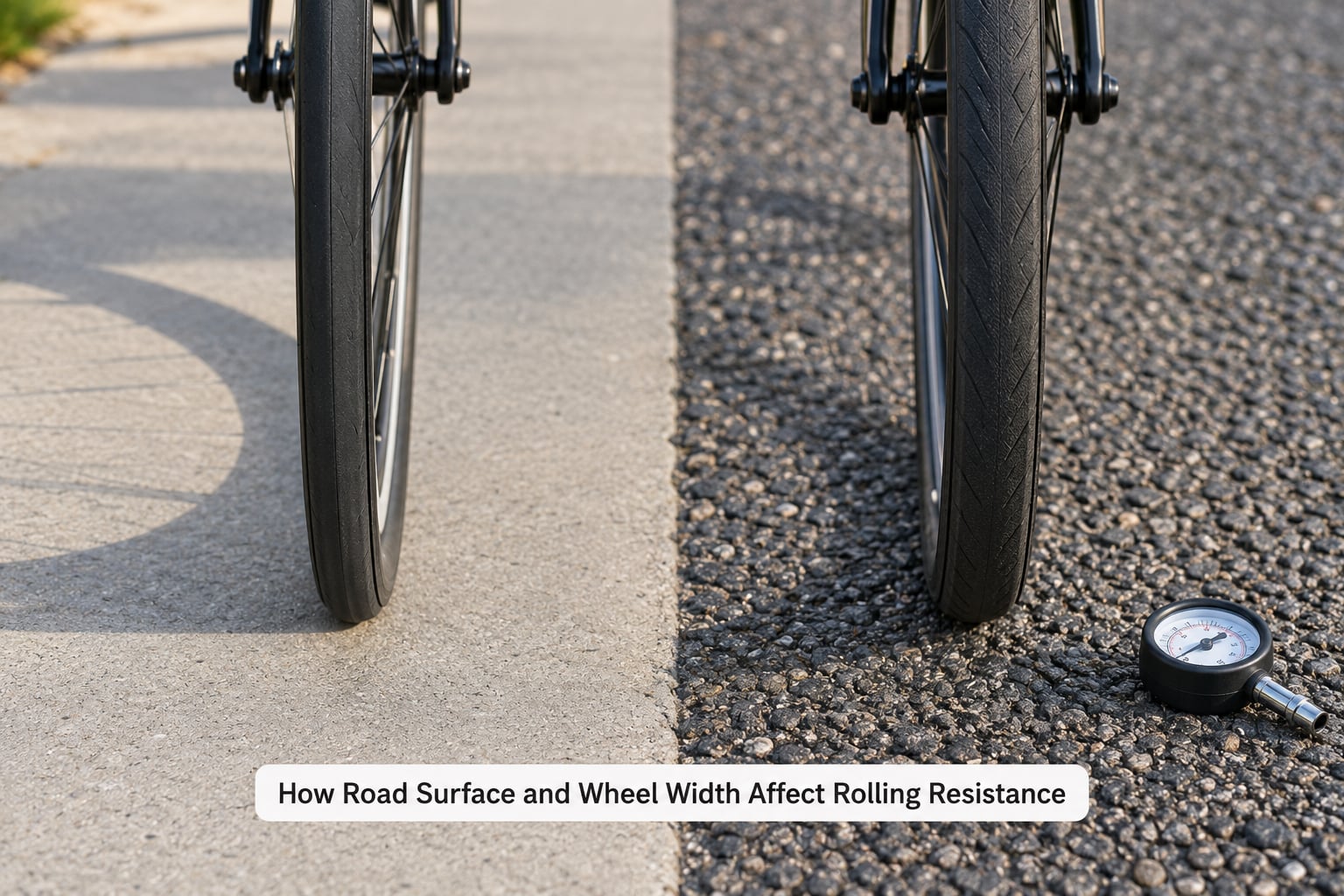
Smooth, new asphalt is the best case. The tire finds a continuous surface and the casing flexes gently and predictably. Old asphalt with patches, coarse chip and hairline cracks forces repeated small deflections, and a hard tire converts much of that into wasted energy and buzz.
Concrete slabs are worse still for a hard tire, because the expansion joints arrive at a fixed interval. A supple tire rides them; a rock-hard one skips. Rough chip seal punishes underinflation and overinflation equally: too soft and the tire squashes into the texture, too hard and every high point becomes an impact.
Wet and contaminated pavement add a drag component from water displacement and, on roads carrying fine grit, from particles trapped under the tread. Grit embedded in the rubber keeps deforming the casing all day. Road racing tires with no tread pick up far more of it, which is one reason racers clean wheels during long events.
Wide road tires and gravel tires both behave better than narrow hard tires on these surfaces, because a lower pressure lets the casing conform instead of bridging. Wide tires on smooth tarmac, though, behave worse than narrow tires only if you also run them at a narrow-tire pressure.
How to Test Rolling Resistance at Home
You do not need a laboratory. Three methods work with ordinary kit, and the power meter version is the one worth owning.
1. Out-and-back A/B. Pick a straight, flat road with no traffic, and ride it twice in each direction at a steady speed. Swap the pressure or tire between one pair and repeat. Average out wind by using opposite directions, then compare times. Repeat four or five pairs before believing any difference smaller than about two seconds.
2. Coast-down. Ride up to a comfortable speed, stop pedalling, and time how long the bike takes to coast to a stop on a level road. A bike that coasts noticeably further is losing less energy. Expect wind and gradient noise, so run it a few times in both directions and compare the average.
3. Power meter A/B. Ride a fixed route twice at the same speed and heart rate, once on each setup, and record average power. This is the version most riders trust, and it isolates the tire variable cleanly because speed, position and effort are all held constant. Allow a couple of kilometers of warm-up on each run before you trust the numbers.
None of these methods resolves differences below about a watt, and none of them survives a bad day of gusty crosswind. They will, however, tell you whether a change is worth keeping.
How to Reduce Rolling Resistance Without Sacrificing Safety
Start with the cheapest and largest wins, and work down the list.
1. Set pressure for your actual weight. Use the table above as a starting point, then adjust for surface. This is usually the biggest gain available and it costs nothing but a gauge.
2. Check tire age and casing condition. Rubber hardens with time and sunlight regardless of tread depth. A five-year-old tire that looks fine often loses more watts than any width change will recover, and a tire with a bulge, a visible cut or a flat spot on the sidewall has no business being on the bike.
3. Match tire width to rim internal width. A tire fitted well outside the manufacturer’s range pinches into an oval shape and can rub, which adds drag and ruins the ride. Check the rim and tire markings before anything else.
4. Choose the right tread for the route. A slick race tire on a chipped surface is slower and noisier than a file tread, and it wears out in a season.
5. Keep wheels true and bearings smooth. A rubbing brake or a less-than-smooth bearing steals watts in a way no tire change recovers.
6. Distribute load sensibly. Panniers and a heavy bar bag raise wheel load. That is fine, but it means a pressure setting that was right for an unloaded bike is now too soft.
7. Clean wheels and tires on multi-day events. Grit and sealant residue in the tread add small continuous losses that nobody notices on day one and everybody feels on day four.
One hard rule: never run a pressure low enough to risk a pinch flat or a rim strike. A pinch flat costs a day, and a dented rim costs far more than any watt you were trying to save.
What About Rim Tape, Tubes, and Tubeless Seals?
Rim tape has a bad reputation it mostly earned years ago. Torn tape, a strip of tape riding over the spoke hole, or a badly sized inner tube can pinch the casing at the rim bed, and a pinched casing drags continuously. That shows up as a subtle rubbing sound and a bike that feels heavier than it should.
Latex tubes hold pressure better than butyl and tolerate lower pressures more gracefully, which makes them a good match for a supple tire run soft. Butyl is cheaper, easier to fit, and slower to lose air. Neither creates meaningful drag by itself; how well the tube sits under the tire bed does.
Tubeless sealant is the least obvious drag source. Sealed casings can squeak when sealant dries out, and a dried-out sealant layer adds a little friction inside the tire until the casing is flexed enough to break it loose. Drying is normal, but heavy dried sealant accumulation adds rolling loss. On long events, topping up and spinning the wheels restores the moving film.
Sealant that has leaked out and dried around the bead or the rim edge creates a small extra seal, and that extra seal can raise pressure loss behavior in ways that leave the tire running at a pressure you did not set.
Rolling Resistance and Your Overall Cycling Efficiency
Put the four barriers side by side and the tire looks modest on smooth tarmac at 30 km/h. Aerodynamic drag at that speed on a road position typically costs far more than the 5 watts a good road tire loses. On a descent, gravity dwarfs everything. At 40 km/h in a tuck, drag climbs again until it dominates. Rolling resistance just sits there, quietly, the whole time.
That steadiness is exactly why it matters over distance. A hundred-kilometer ride spends hours at speeds where drag is enormous, so saving five watts there is worth perhaps a fraction of the total time gained by a better position. But a road that rolls downhill and across a flat plain for four hours puts those same five watts into every minute of it, with no reward for technique.
On century and multi-day riding, tire and pressure work becomes the highest-value low-cost change available, because it costs a gauge and an afternoon. It matters even more on rough surfaces, where a supple tire cuts both resistance and fatigue. And for e-bike riders, the same watts come straight out of range: with a heavier bike and a mixed surface, tire losses can account for a meaningful share of a charge.
Where a lighter wheel upgrade helps is different. Reducing rotational mass helps most where you accelerate and climb repeatedly. Once you are at a steady speed on the flat, a heavier and quieter wheel will still hold that speed on the same power, so upgrade rotating mass when you climb or sprint, and fix the tire when you cruise.
Frequently Asked Questions
Does a wider bicycle tire roll faster than a narrow tire?
On smooth tarmac, a wider tire at its correct lower pressure usually has lower rolling resistance than a narrow tire pumped hard, because it holds a rounder contact patch. On rough surfaces the gap widens, since a supple wide casing absorbs impacts instead of wasting energy on them. A wide tire pumped to narrow-tire pressure will roll worse, not better.
What tire pressure gives the lowest rolling resistance?
The lowest rolling resistance appears at the point where the casing keeps a round contact patch without risking the rim, which is usually about 15 percent tire drop or the upper half of the tire and rim manufacturer’s pressure range, whichever is lower. Below that, rim strikes and pinch flats appear. On rough surfaces, drop further. Above that, vibration losses climb.
Is tubeless lower rolling resistance than a tube?
The two are close. A tubeless tire avoids a slightly pinched tube and typically loses pressure more slowly, so it holds a lower, steadier pressure on long rides. A latex inner tube also holds pressure well and can match a tubeless setup. Most of the difference you feel on a bike comes from pressure and casing condition rather than from the tube itself.
Does rolling resistance matter more on long rides or short sprints?
On a sprint lasting a few seconds, resistance barely registers at all. Over a long steady ride it accumulates, and a few watts saved become minutes over a full day. This is why racers tune pressures by testing on long flat stretches, and why the same setup behaves completely differently on a twenty-minute climb.
Why does my new tire feel slower than my old one?
A new tire is often stiffer than the one it replaced. It sits on a smaller, squarer contact patch until it beds in, and it usually holds more pressure than you may have run before. Give it a few rides, set pressure for your weight rather than for the sidewall maximum, and it usually settles down within a week or two.
Can bad rim tape increase rolling resistance?
Yes, and more than most riders expect. Tape that has lifted, torn or bulged over a spoke hole pinches the casing at the rim bed, and a pinched tire drags continuously. You will hear a faint rubbing noise at speed and the bike will feel heavy on the flat. Refitting the tape takes minutes and removes the drag entirely.
Conclusion: Start With Tire Pressure and Tire Choice
Rolling resistance comes from the energy your tire spends deforming and not getting back, and the two things that control it are how deeply the casing deflects and how supple that casing is. Get both right and a few watts disappear from every kilometer you ride.
Begin with the free checks. Look at tire age and casing condition, then set pressure for your real weight on the surface you actually ride, and confirm the tire width suits your rim’s internal measurement. Only after those are right does it make sense to think about changing tires or rims, and by then most riders have already found the improvement they were looking for.