To corner on a road bike well, you do three things in order: pick a speed the tyres can hold, look through the corner to the exit, and lean the bike under you while your upper body stays quiet. Get those three right and descents stop being the part of the ride you dread.
Most riders who struggle with corners are not weak or clumsy. They are carrying too much speed, staring at the pavement in front of the wheel, and squeezing both brakes halfway through the turn. Each of those is fixable, and all three show up in the steps below.
This guide is written for club riders and anyone learning how to corner on a road bike with less white-knuckling. You need a roadworthy bike, a helmet, and an hour of quiet tarmac somewhere. That is genuinely all the equipment involved.
Table of Contents
- What You Need
- How to Corner on a Road Bike Step by Step
- 1. Look Through the Corner Before Turning In
- 2. Set a Speed You Can Control
- 3. Brake Mostly Before the Turn
- 4. Choose a Simple, Predictable Line
- 5. Lean the Bike and Keep the Upper Body Calm
- 6. Pedal or Coast Smoothly Through the Exit
- Common Mistakes
- Frequently Asked Questions
- How can beginners practice cornering before trying a fast descent?
- Is it safe to corner on a road bike in wet conditions?
- Should I take the inside or outside line through a road turn?
- What should I do if the front wheel starts to wobble in a corner?
- Does cornering technique change on a touring or carbon road bike?
- Where to Start Tomorrow
What You Need
Before you practise anything technical, make sure the bike is in a fit-and-function state. A tyre at low pressure rocks under load in a lean, a worn brake pad lengthens your stopping distance, and a loose wheel makes every correction feel worse than it is.
- Tyres: check pressure with a gauge before every ride. Firm casing and correct pressure give a predictable contact patch when the bike is on its side.
- Brakes: confirm both levers bite evenly and that the pads are not worn flat or contaminated.
- Headset and bars: hold the front brake and rock the bike fore and aft. Any knock or play means a service before cornering practice.
- Helmet: properly fitted, level on the head, straps tight enough that it does not shift when you shake it.
- Shoes and clothing: closed-toe shoes with a stiff-ish sole give better pedalling control than soft slippers, and nothing baggy that can catch a pedal.
Conditions matter more than kit. Dry, clean tarmac with a clear view of the exit is where you learn. Skip the first lesson in the rain, in gravel wash, or in leaf litter — all three cut the grip you have available in ways you cannot see.
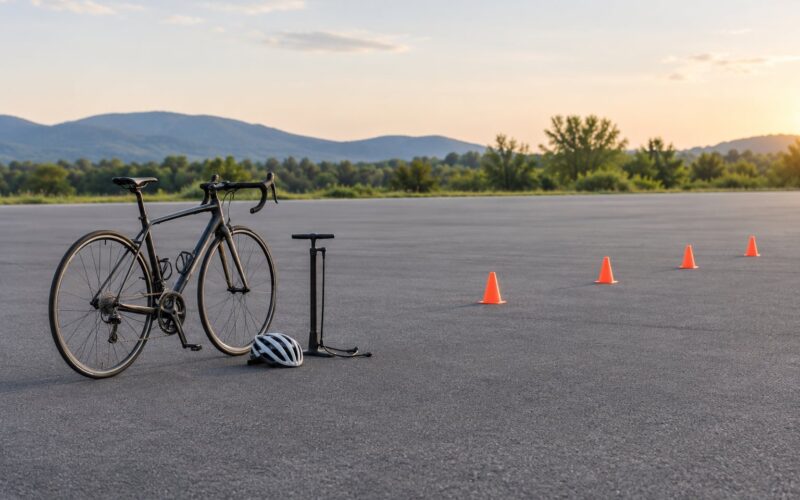
Start with low-speed turns. An empty car park, a quiet cul-de-sac loop, or a park path with no traffic gives you room to make mistakes at 15 km/h instead of 60. A descent can wait a week. The habit of steering a leaning bike cannot.
How to Corner on a Road Bike Step by Step
1. Look Through the Corner Before Turning In
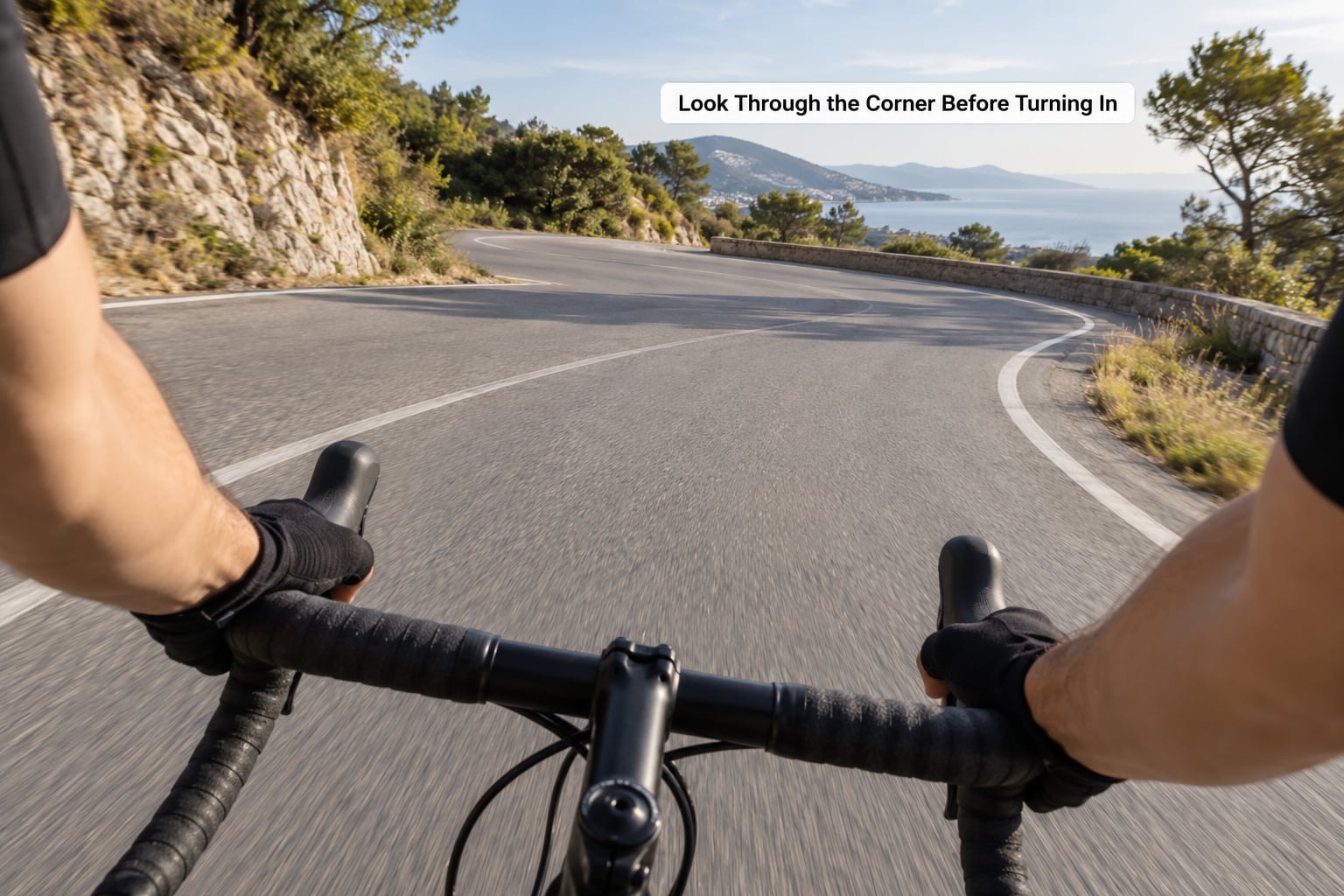
Your eyes steer. A bicycle goes where the rider is looking, so the first move in how to corner on a road bike is deciding exactly where you want the bike to be when the corner is over, and putting your eyes there early.
Look at the exit — a tree line, a wall, a gap in the hedge you intend to pass through. Keep your head level and your gaze about 20 to 30 metres ahead. The bike will settle into the arc without you thinking about the bars.
Glance down at the front wheel and the effect is immediate: the bike straightens or drops into the turn faster than you intended, because your body has quietly asked for it. A quick downward glance to check a wet patch is fine. Holding your gaze there is what causes the crash.
You will know this step worked when the corner passes without you remembering where the bars were pointed.
2. Set a Speed You Can Control
Judging corner-entry speed is a skill, and it is mostly about knowing what the surface is doing. Radius, gradient, camber, crosswind, traffic and paint all eat grip. A 60 km/h sweeper with a gentle radius and clean dry tarmac is a different proposition from a 60 km/h hairpin.
For a beginner, use a simple conservative rule: enter fast enough to keep both pedals turning comfortably, and slow enough that you could stop on the straight section if something appeared in the corner. If you cannot answer “what would I do if a car pulled out” without panic, you are too fast.
A controlled turn is not a slow turn. Riders who corner well carry speed through the arc and lose it early; riders who are scared arrive slow, brake hard, and then coast out apologising. The difference is where the speed change happens, not how much speed you carry.
Downshift before the corner so you are not stuck on a hard gear. Being slightly too slow in a low gear is far less costly than being slightly too fast.
3. Brake Mostly Before the Turn
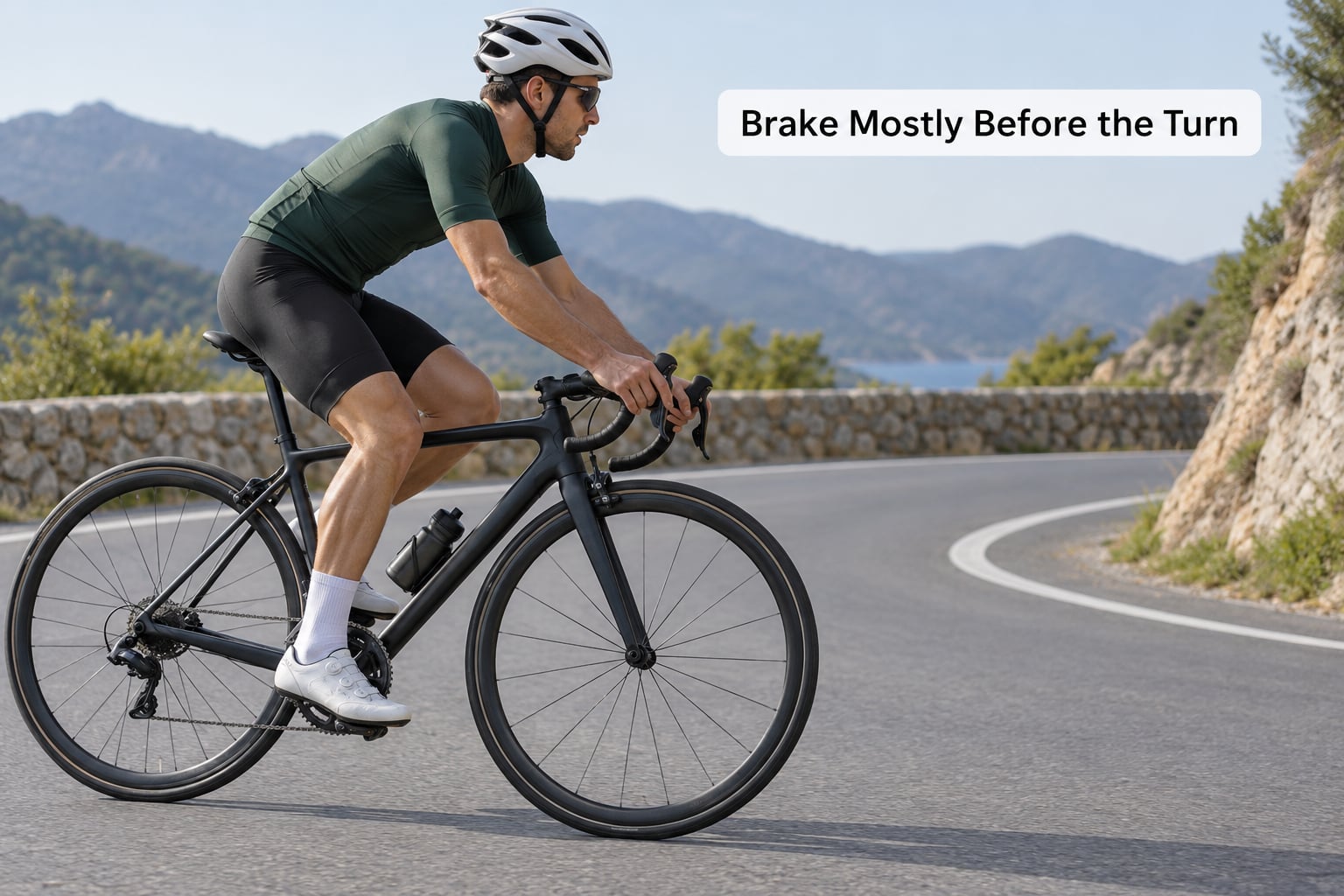
Straight-line braking uses the full grip of both tyres. Braking while leaned over uses only what is left after the corner is already asking for it, which is why a mid-corner stop usually ends with the tyre sliding and the bike dropping out from under you.
So: stop pedalling, squeeze both levers smoothly and evenly, and finish almost all the braking while the bike is still upright. Pressure on the levers should ramp up rather than spike, and the bar should stay level as the speed falls away.
Trail braking — easing off the brakes as the lean develops — is a legitimate advanced technique, and the difference between gripping and sliding is measured in millimetres of lever travel. Leave it alone until the basic version is automatic.
Urgency is the exception. If you arrive hot, sit up a little, brake firmly but smoothly, and accept a wider line. Standing the bike up mid-corner to find traction is a valid save, not a failure.
4. Choose a Simple, Predictable Line
For a normal paved corner, the outside-inside-outside line is the default: start wide, cut toward the apex on entry, then drift out to the edge of the road again so your exit is straight and your view is long. It shortens the path slightly, and more importantly it leaves you pointing where you are going.
Where the line changes depends on what is under the wheels. A painted centre line, a white edge stripe, a drain cover, a gravel patch at the apex, wet leaves, sand, tram rails, cobbles, and manhole covers all reduce grip. Cross them at a shallow angle, or plan a line that avoids them entirely.
Sometimes the simple direct line is the right one. In traffic, on a narrow road, at a blind bend, or where the inside edge is covered in gravel, going straight and slow beats a clever line that puts your front tyre on loose material.
Blind corners get a committed line, not a cautious one. Pick one, ride it, and do not weave across the road trying to see further. Straight-line commitment is safer than indecision.
5. Lean the Bike and Keep the Upper Body Calm
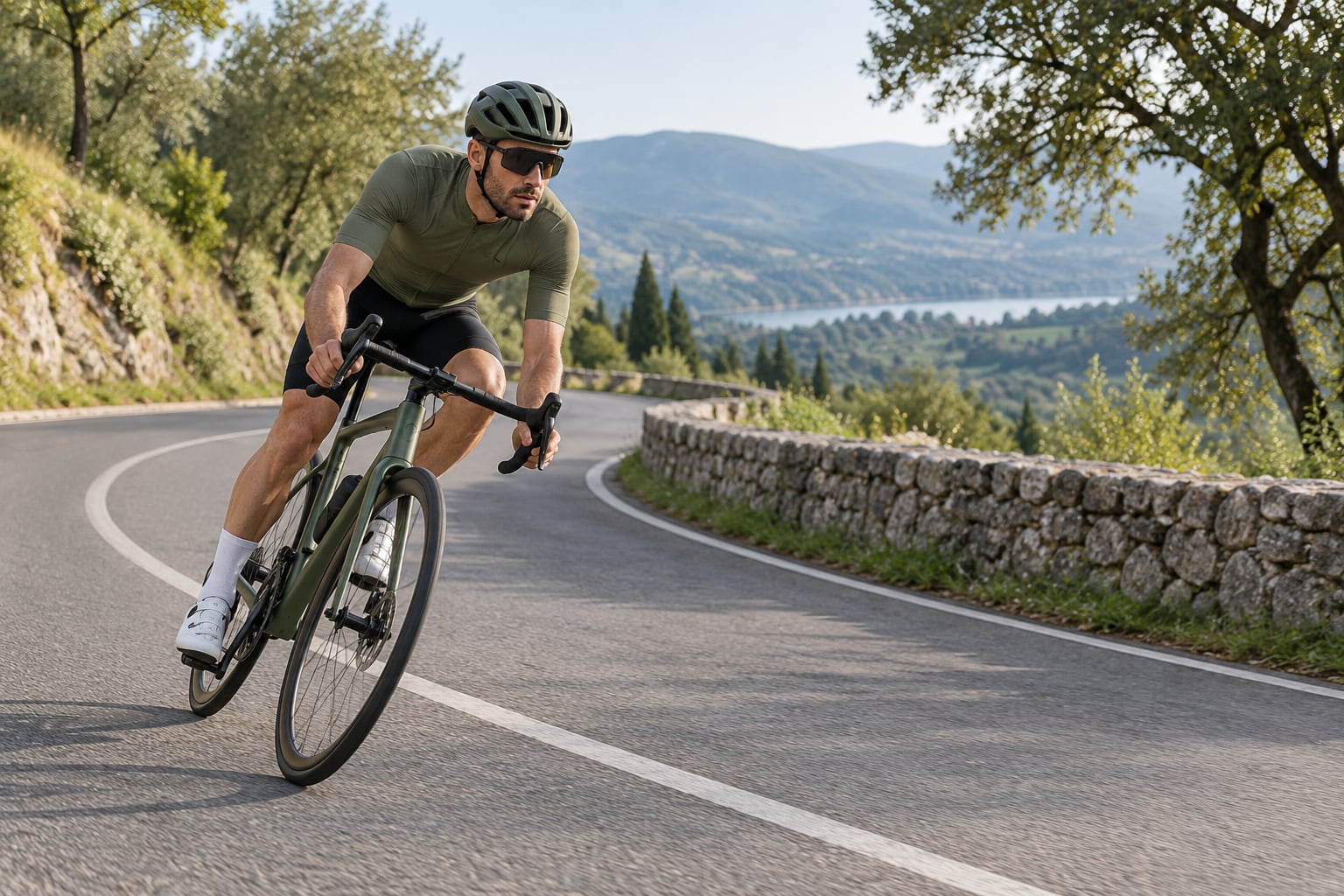
Here is the part most tutorials get wrong. The bike leans; the rider stays comparatively upright and still. Press on the outside pedal — the pedal pointing down toward the road at roughly the six o’clock position — and let the bike fall under you while your torso stays quiet.
In practice you steer into the corner, the bike rolls underneath, and your body follows just enough to keep the combined centre of mass over the tyres. Elbows soft, hands light on the brake hoods, shoulders relaxed. A tense rider shakes the bike and bleeds speed.
Hands on the drops gives you a lower, calmer position and better leverage for very tight or low-speed corners. Hands on the hoods keeps brake access instant. Use the drops when the corner is tight, slow or rough, and the hoods when you want quick braking in traffic.
Two misconceptions to drop. Leaning your torso into the corner while the bike stays upright makes you less stable, not more. And yanking the bars after the lean has started just adds noise — the lean is already there, so steer with your eyes instead.
6. Pedal or Coast Smoothly Through the Exit
Grip climbs back as the bike comes upright, so the exit is where you can pick up speed. Stay centred over the bike while you unweight, and resist stamping on the pedals while the bike is still heavily leaned — a sudden hard stroke can break the rear tyre loose.
As the bike comes up, drive smoothly and look further down the road. A clean exit feels like nothing happened: the steering is stable, no small corrections are needed, and the view ahead opens up before you need it.
Forum riders mention crashes accelerating out of a corner far more often than crashes inside it. That is why the exit deserves the same attention as the entry — ease on, stand up, then go.
Common Mistakes
Most cornering problems come from a short list of repeated habits. Each one has a matching correction, and they are all things you can practise deliberately in a car park.
- Entering too fast. The fix is a slower entry, not a harder brake. Arrive slower, carry more speed through the arc.
- Looking at the front wheel. The fix is a focal point at the exit, chosen before you turn in.
- Yanking the handlebars. The fix is a smooth pressure on the lever and softer elbows. Steering happens at the eyes.
- Leaning only the body. The fix is pressing the outside pedal down at six o’clock and letting the bike fall under you.
- Braking abruptly mid-turn. The fix is finishing nearly all braking upright, before the lean starts.
- Crossing slippery markings. The fix is a line that treats paint, gravel, leaves and metal covers as obstacles, not decoration.
- Drifting wide on the exit. The fix is starting the outside drift earlier so the road straightens with you.
- Holding the inside line all the way. The fix is the full outside-inside-outside arc, which gives you a longer view of what is coming.
A short practice progression helps. Start with cones set ten metres apart and ride slaloms at walking pace, alternating which hand is on the hood. Next, do the same with the outside pedal weighted and eyes on a point beyond the cones. Then figure-eights, then real corners on a quiet road at moderate speed.
Once you can do that without thinking, add speed. Set a phone on the cockpit or mount a camera, ride the corner, and watch the footage back. Seeing that you looked down for two full seconds is more instructive than any article, including this one.
Frequently Asked Questions
How can beginners practice cornering before trying a fast descent?
Use a flat, empty car park and cones or bottles. Ride slaloms, then figure-eights, then wide circles, first at walking pace and then at 20 to 25 km/h. Add the outside pedal press and a look-through-the-exit focus before you add any speed. The skill you are building is balance in a lean, and that only needs space, not gradient.
Is it safe to corner on a road bike in wet conditions?
It is manageable but not the day to learn. Wet paint, metal drain covers and manhole covers are the most slippery things you will meet, and they are often exactly where the racing line points. Brake earlier, in a straighter section, leave more space from the kerb, and ride in the tyre tracks where the water has been pushed aside. If the road has been wet for hours, stay home.
Should I take the inside or outside line through a road turn?
Normally outside, then inside near the apex, then back outside on the exit. That arc keeps the corner radius wide, shortens the distance slightly, and leaves you pointing down the road with a long view. Take a more direct line when the inside is covered in gravel or debris, when the road is narrow, or when traffic means you cannot afford to use more road than you have.
What should I do if the front wheel starts to wobble in a corner?
Do not clamp the brake or jerk the bars. Release a little brake pressure, soften your elbows, and stop trying to force the lean further than the tyre is holding. Look at the exit again, which keeps the steering active and stable. If the front is washing out, the corner is beyond your current speed for those conditions, so straighten up and lose some speed.
Does cornering technique change on a touring or carbon road bike?
The technique is identical, because balance and grip work the same on any bike. What changes is the margin. A touring bike carrying panniers has more total mass and sometimes a higher centre of gravity, so it wants a slightly slower entry. Deeper carbon rims and wider tyres add stability, but comfort does not add grip.
Where to Start Tomorrow
Pick one corner on a route you already know, ride it three times, and change exactly one thing each time: the entry speed, the line, the braking point. Record the last lap on a phone and watch the footage afterwards.
If you only take one idea from this guide, take the eyes. Look through the corner to the exit, before you turn in, and let the bike follow. Everything else in how to corner on a road bike gets easier once the bike is going where your eyes already sent it.