To ride safely at night you have to do three things well: be seen, be predictable, and be prepared. A white front light and a red rear light make you visible, a straight line and early signals make you readable, and a route you already know plus a shared ride plan makes the unexpected survivable.
That is the whole argument, and the rest of this guide is the detail behind it. Most night-riding problems are not exotic. They are a dim light pointed at the sky, a group that stretched out until nobody could call a hazard, or a rider who turned onto a road nobody had scouted in daylight.
It is also worth naming why the same trip feels harder after dark. In daylight a driver collects information from your whole outline at once: where you are, how fast you are closing, and whether you are moving with traffic or across it. Darkness removes most of that at a stroke, and a driver is left reading your lights and your speed rather than your intentions. Every technique below is aimed at putting that information back, in a form that reaches a stranger quickly.
This guide is written for US road riders, winter commuters, club groups and anyone getting back on a bike after dark. It was last reviewed in 2026, and light and reflect laws change, so check yours before you rely on it.
Table of Contents
- What You Need
- Lights and backup power
- Reflective and high-visibility clothing
- Route tools and a charged phone
- A minimal repair kit and identification
- A two-minute pre-ride check
- Step-by-Step: How to Ride Safely at Night
- 1. Plan a Familiar, Low-Risk Route
- 2. Inspect Lights and Backup Power
- 3. Wear Highly Visible Clothing
- 4. Make the Bike Easy to See
- 5. Ride Predictably and Manage Speed
- 6. Handle Intersections and Unexpected Hazards
- If you are hit: the first ten minutes
- 7. Ride Safely in a Group
- 8. Finish and Account for the Ride
- Common Mistakes
- Lights aimed too high
- Relying on reflectors alone
- Riding at daylight speed
- Hugging the kerb
- Forgetting spare batteries or a backup light
- Letting the group stretch out
- Choosing unfamiliar roads after dark
- Ignoring changing weather
- Frequently Asked Questions
- How bright should a bicycle light be for riding at night?
- Should road cyclists use white or red lights, and can lights be mounted anywhere?
- Is riding at night after sunset safe for recreational cyclists?
- How long should a bicycle light’s battery last on a long ride?
- Can reflective clothing replace a working bicycle light at night?
- What should a cycling group do if a rider’s light fails?
- Conclusion
What You Need
Riding safely at night starts before you clip in. Gather this list, check each item works, and only then roll out.
Lights and backup power
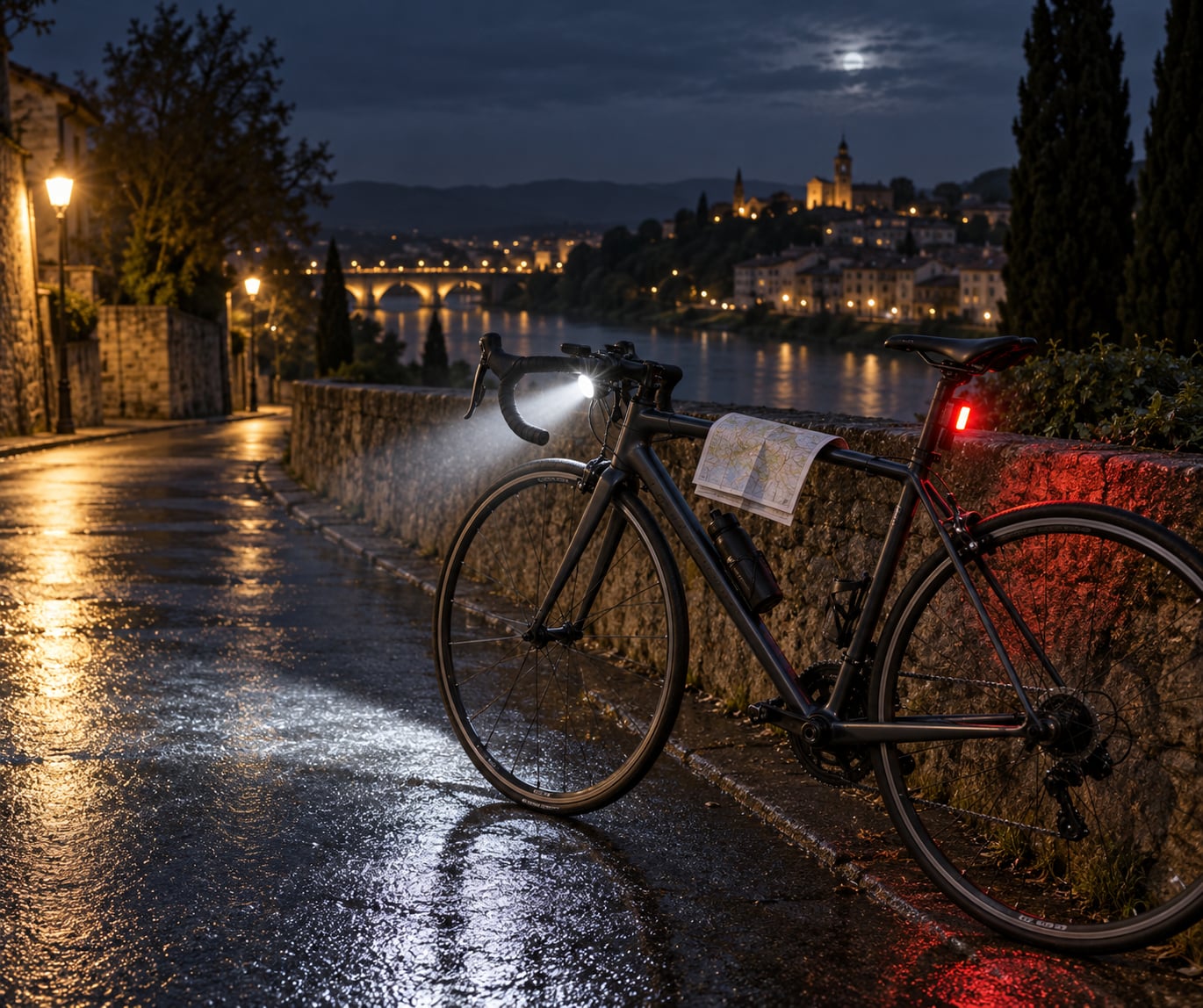
A front white light aimed slightly down so its beam cutoff sits at road level, and a red rear light mounted high enough that it is not hidden by a saddlebag. Both need to run in a mode you can actually see from the side of the road.
Then carry a second set. A small bar light or helmet unit in a pocket costs you almost nothing and saves a ride when the primary dies. Riders on forums like Electric Bike Forums treat a spare light as standard kit, not luxury.
Brightness is a poor proxy for safety, and the settings that feel excessive on a dark road are often wrong for a lit one. What changes by road type is reach, mode and whether you need a second beam pointed somewhere else entirely.
- Lit urban street: a modest front light with the beam aimed well down to avoid dazzle, a steady red rear light mounted high and clear of bags, plus ankle bands and clean pedal reflectors.
- Shared path or multi-use track: a wide, short beam so you can pick out unlit walkers and children, a steady rear light plus a second blinking light, and reflective ankle bands. Keep your phone in a secure mount rather than in your hand.
- Unlit back road: longer reach from the front light plus a helmet light for hazards you steer into, a rear light backed up by a reflective backpack or panel, two full light sets and a complete repair kit.
- Gravel or trail: a helmet light as the primary beam, wide flood rather than a spot, a rear light on the helmet or high on a backpack, and reflective ankle and wrist bands.
Two terms do most of the work in a spec sheet, so it is worth knowing them. Beam cutoff is the line where the light stops hitting the road and starts hitting everything at eye level, which is the difference between a driver seeing you and seeing glare. A steady mode gives a continuous read on your speed; a flashing mode makes you easier to spot at distance but harder to track once you are close, which is why the convention is steady in traffic and flash when you need attention.
Reflective and high-visibility clothing
Reflective tape on your ankles, wrists and shoulders, plus a bright outer layer. Reflective material returns light to its source, so it only works when a beam lands on it. A rider in black with no reflectors is invisible in a headlight until the driver is on top of them, which is the exact complaint that keeps surfacing on r/ukbike.
Route tools and a charged phone
A phone with your route loaded before you leave, spare battery, and identification carrying an emergency contact. Load the map while you still have signal and while you still have daylight.
A minimal repair kit and identification
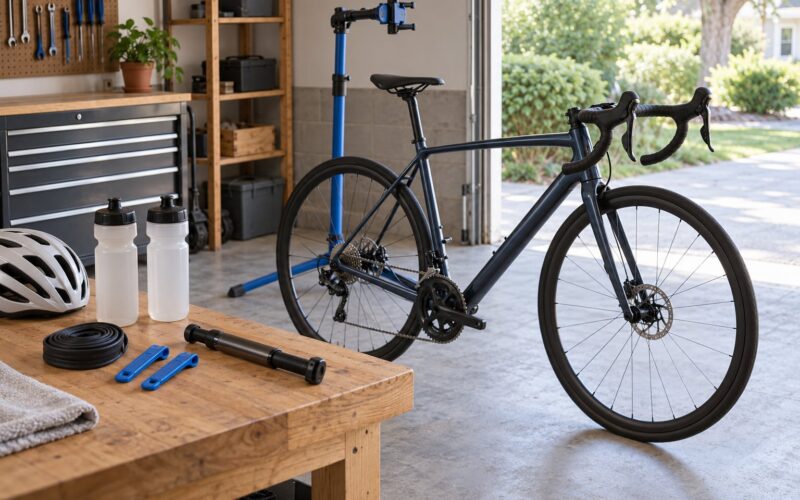
Two spare tubes, tyre levers, a mini pump or CO2 inflator, a multitool and a reflective triangle or strap. Fixing a puncture at the roadside at night is unpleasant; fixing it with a full kit is merely slow.
A two-minute pre-ride check
Run the lights before you leave the driveway, in the dark if you have to. Spin the wheels to confirm the pedal and spoke reflectors are present and undamaged, squeeze both brakes, and confirm your phone is charged and your ride plan is shared. If any light fails this check, you have time to fix it at home instead of on an unlit road.
Two details catch riders out more often than the rest. First, an internal gear hub or a battery that died during a week of commuting tells you nothing about the light you have not charged since Tuesday. Second, a light that flickers at a particular mode is a dying light, and it will fail at the worst point of the ride.
E-bike riders get one extra item: know how much range you have left with the display lights and your main battery combined. Running out of power halfway home on an unlit road with a dead display is a genuinely bad evening, so treat the light budget as part of the range budget rather than an afterthought.
Step-by-Step: How to Ride Safely at Night
1. Plan a Familiar, Low-Risk Route
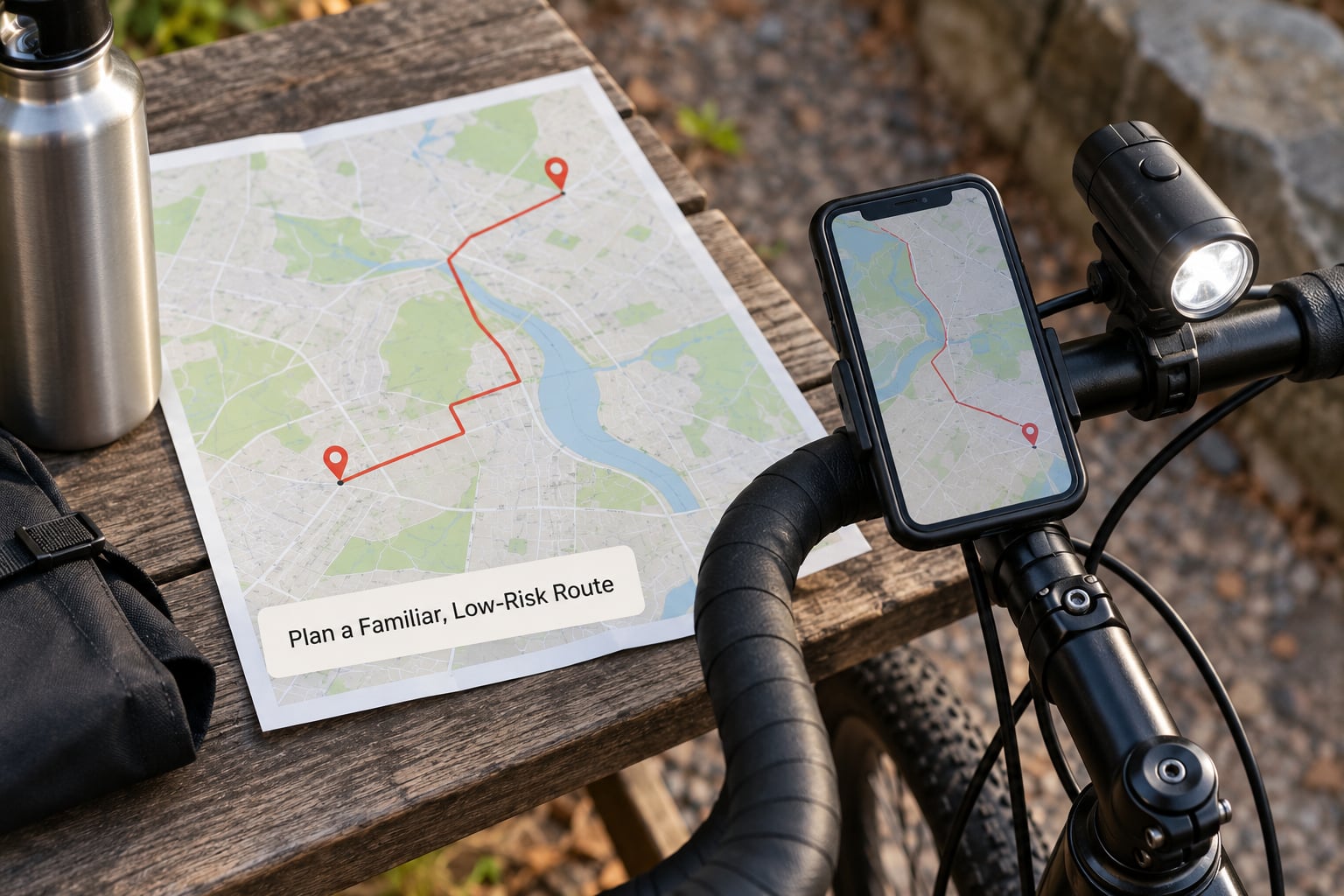
Pick a route you could ride with your eyes shut, then mark the unlit stretches on it. Unlit does not mean empty, and it often means fast, since drivers on a dark rural road are going well above the speed they would use in a lit suburb.
Check the weather before you commit. Fog, rain and a headwind all cut your sight distance, and a route that is fine on a dry evening can be a bad idea in drizzle.
For any road you have not ridden at night, scout it in daylight first. Riders on City Cycling Edinburgh describe doing exactly this before committing to a canal towpath or rural link, and it removes most of the anxiety that makes a first night ride unpleasant.
Share the route and your expected return time with one person, then set a hard turnaround point. Turning back early is a decision, not a failure.
2. Inspect Lights and Backup Power
Test the front and rear lights in a genuinely dark setting, not in a lit garage. Stand ten metres away, turn around, and check that you can see the red glow from behind and the white beam from the front.
Check that the mount is tight and that the light cannot be knocked sideways by a pothole. Aim the front light slightly downward so the cutoff line keeps the beam on the road rather than in the eyes of oncoming drivers. Riders raise this concern constantly in forums, and the fix is free.
Confirm battery or runtime. A USB-rechargeable light that ran half-empty on the last ride is a light that will fail mid-route, so top it up before you leave and carry a backup.
Know the law where you ride. Requirements for a white front light and a red rear light, and the distances at which they must be visible, vary by state and city. Where the legal minimum and your local club guidance disagree, follow the stricter one.
3. Wear Highly Visible Clothing
Bright outerwear matters most in the first few minutes of darkness, when ambient light still washes out reflectors. Colour is doing the early work, reflection does the later work.
Put reflective elements on every part of you that moves in an independent rhythm: ankles, shoulders, wrists and pedalling legs. Ankle bands are the highest-impact cheap item in this whole guide. They sit low, they are outside the cyclist’s shadow when the bike is upright, and drivers report noticing the movement of a pedalling leg well before they register a torso.
Gloves and cuffs with reflective piping make your hand signals visible from the side, which matters because a hand signal nobody sees is the same as no signal.
Then check nothing is blocking a light. A loose strap, a hanging bag or a jersey hem draped over the rear light can turn a perfectly good lamp into a decoration.
4. Make the Bike Easy to See
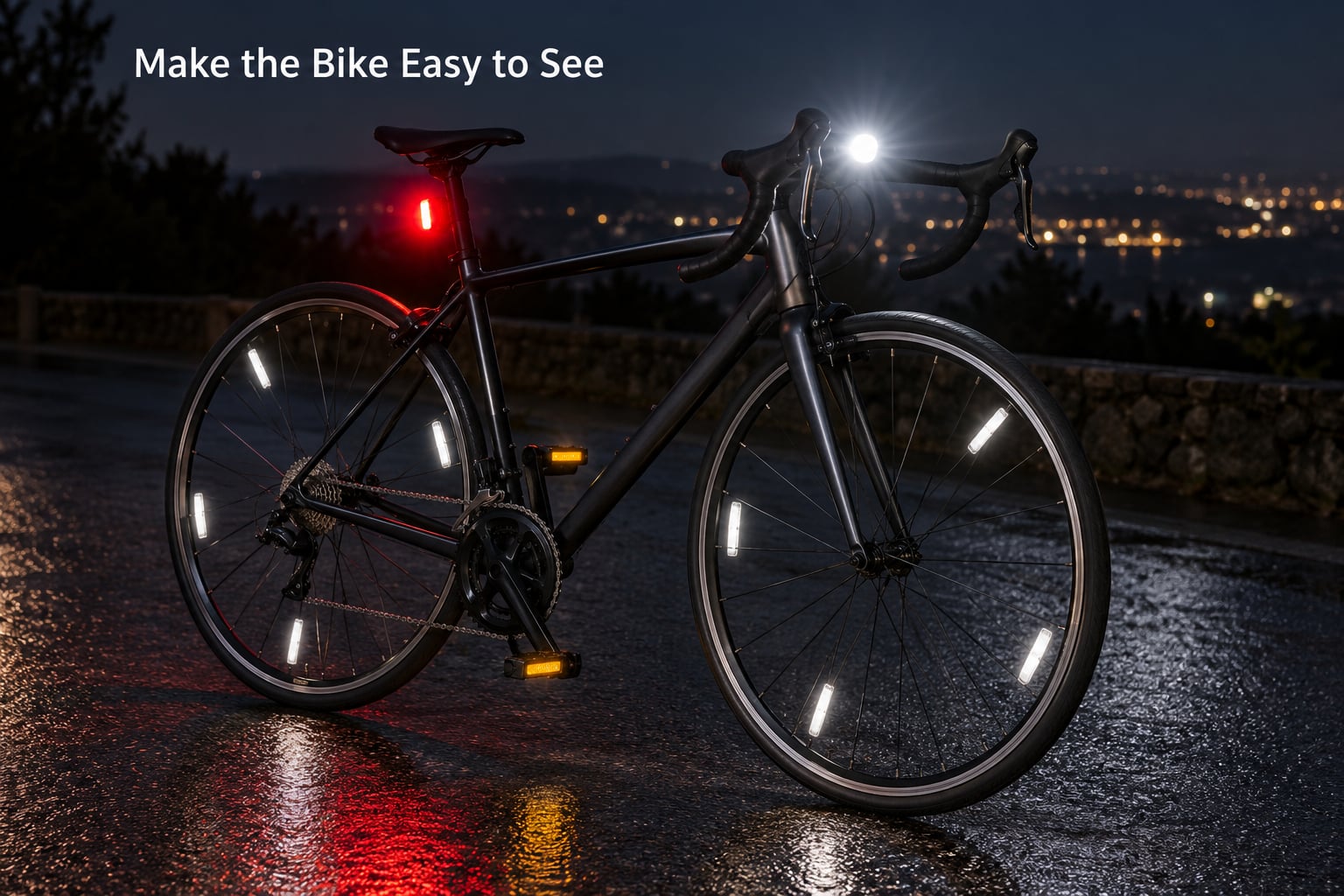
Clean the reflectors. Mud and road film cut reflective output dramatically, and a filthy pedal reflector is functionally the same as a missing one.
Check that pedal and spoke reflectors are present and that both wheels turn freely so the spoke reflectors fire. On a road bike the spoke reflectors do most of the side-visibility work when you are moving.
Run the rear light in a steady mode rather than a flash if you ride in traffic. A steady light gives a driver a continuous read on your speed and distance; a flash makes you easier to spot but harder to track as you approach an intersection.
For an unlit back road or trail, add a helmet-mounted light. It points where your head points, which means it illuminates the hazard you are about to steer into. Off-road riders on r/MTB run bar and helmet lights together for exactly that reason.
5. Ride Predictably and Manage Speed
How to ride safely at night is mostly about removing surprise. Hold a straight line, signal early, and do not weave between parked cars and moving traffic because the gap looks tempting.
Ride three feet off the kerb, roughly 70 to 100 centimetres into the lane. Riding hard against the gutter puts you in the darkest part of the road and directly in front of drivers, who then have to swerve around you. Sitting a little further out gives them a stable target and gives you room to react.
Avoid drain covers and metal plates. In daylight you ride over them. In the dark they are holes you can drop a wheel into.
Drop your speed below your daylight pace. Not dramatically, just enough that you can stop inside the distance your headlight actually reaches. Scan further ahead than feels natural, because the useful information is often a shape before it is a detail.
Watch for hazards that only exist after dark: wet leaves that read as painted road markings, tram or rail tracks that catch a headlight and throw you off line, gravel washed off driveways, unlit bollards, and animals stepping out of the verge.
Signal earlier than you would in daylight, because the reaction time of the driver behind you is already compressed by their own headlights and darkness.
6. Handle Intersections and Unexpected Hazards
Intersections are where the lighting usually fails and where a driver pulling out may not see you at all. Slow down well before the junction, not in it.
Look in more than one direction. Turning into a side road means checking for traffic coming from behind you, and a driver turning across your path may be masked by their own headlights until the last second.
Aim for eye contact where it is possible, and treat no eye contact as a warning rather than a green light. On a road where you cannot make eye contact, position yourself where a driver must physically move around you, which is the visible target position rather than the gutter.
Do not assume you are invisible because you cannot see a car. On a dark road, a driver can often be picked out by your headlight long before you can see them, so keep the beam off the mirror area of any car you are approaching.
If something genuinely appears in your path and stopping risks a rear-end collision, brake hard and straight. Skidding sideways usually puts you under the vehicle that hit you.
If you are hit: the first ten minutes
Protecting yourself comes before documentation. Move out of the traffic lane if you can move safely, switch on your lights, and call emergency services if anyone is hurt or cannot move. Assume you have a concussion rather than deciding otherwise quickly, because adrenaline makes a bad head feel fine.
Once you are safe, gather what you will need later. Photograph the scene, the vehicles, your bike, the road surface and the lighting conditions. Note the time, the location, what each vehicle did and whether a light was working. If a driver leaves, write down whatever you can recall immediately, because it will not improve with time.
Get the other party’s details, and ask police to attend rather than arranging a private exchange if anyone is injured or the road position is disputed. A night crash with no daylight evidence is harder to prove than one with a full set of photographs taken at the scene, which is why the first ten minutes carry most of the weight.
Then write it down the same evening while it is fresh, and keep the receipts for repairs and medical care. Riders often skip this step and then struggle to reconstruct it months later.
7. Ride Safely in a Group
A group at night is safer than a solo rider only while the group stays together. Once it stretches out, the trailing riders are effectively riding alone in the dark with no one ahead to warn them.
Keep a gap of two to three seconds behind the wheel in front, staggered rather than nose to tail, so a single light failure does not black out the whole group. The rider ahead holds a steady line; the one behind them watches the road surface for them.
Agree on call-outs before you start. Two words for debris or a pothole, one word for mechanical trouble, and a firm signal for the group to stop. On a dark road, the person who spots the hazard is often the only person who can see it.
Assign a leader and a sweep. The sweep is not riding at the back for fun; they are counting riders and calling anyone who drops off. Regroup at predictable points such as junctions and turns, not wherever the group happens to stop.
Cancel the ride. If equipment fails, if the weather turns, or if the group keeps losing riders, turning back is the correct decision. Nobody has ever regretted a cancelled night ride; the stories people remember are the ones that went badly.
8. Finish and Account for the Ride
When you get home, check the light runtime before you plug it in. A light that died at mile 40 because you forgot to switch it off is a different problem from one that ran flat at full output.
Charge everything, and note any gear that failed. Loose mounts, cables that need replacing and reflectors that have come off all belong on a maintenance list, not in memory.
Tell the person who had your route that you are back. This is the part riders skip, and it is the part that turns a delayed arrival into an actual emergency response.
If you want to talk through a near-miss, talk about the system rather than the rider. Debriefing without blame produces better decisions inside the group, and the useful question is usually about positioning or speed, not about who was careless.
Common Mistakes
Lights aimed too high
A beam pointed at oncoming drivers makes you harder to judge and creates exactly the blindness you bought the light to avoid. Drop the beam so the cutoff line lands on the road ahead of your front wheel.
Relying on reflectors alone
Reflective material does nothing until light hits it. Pedals, ankle bands and jacket trim are supplements to active lighting, never a replacement for it. That point comes up in r/melbourne and r/bayarea safety posts constantly.
Riding at daylight speed
Darkness shrinks your usable sight distance to whatever your headlight throws. Slow down to the point where you can stop inside that distance and you remove most of the surprise factor from night riding.
Hugging the kerb
The gutter is the darkest part of the carriageway and the place drivers look last. Ride a little further out and you become a visible, predictable target instead of an obstacle.
Forgetting spare batteries or a backup light
A dead light ten miles into a dark ride ends the ride. Carry a second light or spare cells, and treat a light that flickered on the last outing as a light that has failed.
Letting the group stretch out
A long line of single lights in the dark is worse than a tight cluster, because the trailing riders lose the group’s collective visibility. Keep spacing short and count riders at the back.
Choosing unfamiliar roads after dark
Sight lines you have never tested, junctions you have never approached from that direction, and surfaces you have never seen at night are the three things that cause most of the bad stories. Scout first or ride a different way.
Ignoring changing weather
Fog and rain cut visibility far more than darkness alone. If the light beam stops bouncing back off the air, or you start seeing riders ahead only as silhouettes, the sensible move is to turn back.
One last rule covers most of the rest: if you cannot see far enough to stop in time, slow down until you can. Every other mistake on this list becomes much smaller when you are moving at a speed your own light supports.
Frequently Asked Questions
How bright should a bicycle light be for riding at night?
Brightness alone is a poor guide, because a narrow high-lumen beam lights the road without lighting the rider. For lit streets a modest front light with a clean beam cutoff is enough. For unlit back roads you want genuine reach, and a helmet light adds coverage your bar light cannot. The practical test is simple: can you see the road surface far enough ahead to stop in the distance you actually ride at? If not, you need more output or a better aimed beam.
Should road cyclists use white or red lights, and can lights be mounted anywhere?
White in front and red at the back is the near-universal convention, and it tells drivers which way you are facing before you are close enough for shape recognition. Mount the front light on the bars or helmet and the rear light on the seatpost or a helmet, keeping it visible rather than hidden under a bag. Legal details vary by state and city, so check your local rule and follow the stricter one where guidance disagrees.
Is riding at night after sunset safe for recreational cyclists?
It is reasonable, provided you treat it as a different activity rather than the same ride in darker conditions. Well-lit streets and shared paths feel unremarkable to most riders, and the caution belongs on unlit roads with fast traffic. That is the view repeated across r/cycling threads. Choose lit familiar routes, run good front and rear lights, ride predictably, and your risk changes character rather than becoming extreme.
How long should a bicycle light’s battery last on a long ride?
Count on enough runtime to finish your route with a large reserve, not exactly enough. Check the stated runtime at the mode you will actually use, since high settings can cut a figure dramatically, and test the light before the ride rather than trusting the label. On a ride that will take you past sunset, carry a backup light. A light that dies halfway through a dark route is the most common reason night rides get cut short.
Can reflective clothing replace a working bicycle light at night?
No. Reflective material returns light to whatever is shining on it, so it does nothing in an unlit gap between headlights and cannot light the road for you. Wear reflectives as a supplement: a light makes you visible, reflectors make that visibility stronger and more obvious from the side. Riders who appear to get away with all-black kit are usually on lit routes where the driver has other cues available.
What should a cycling group do if a rider’s light fails?
Stop the group somewhere safe and out of the traffic lane, then regroup around the working lights so nobody is isolated. Pair the rider with a companion, lend a spare light or headlamp if you have one, and decide whether the route can continue safely for everyone. If equipment failures keep accumulating, or the group has already stretched out badly, turn back. An early turnaround is always cheaper than splitting the group in the dark.
Conclusion
Here is your first move. Test your lights in the dark tonight and fix anything that fails. Pick a route you have ridden before and mark the unlit parts. Inspect the bike, reflectors and brakes while you are still in daylight. Then decide honestly whether the weather and the hour suit a ride.
None of this is complicated, and none of it is optional. Active lights make you visible, predictable riding keeps drivers able to read your intentions, and conservative group decisions keep a bad night from turning into a dangerous one. Get those three habits right and you have a repeatable answer to how to ride safely at night, on the roads you actually ride, rather than a one-off plan you hope holds up.